Monday, 28 October 2013

Representing Belgium and The French Language: Female Vampire (1973)

From http://upload.wikimedia.org/wikipedia/en/d/d5/Female_Vampire.jpg

Dir. Jesús Franco

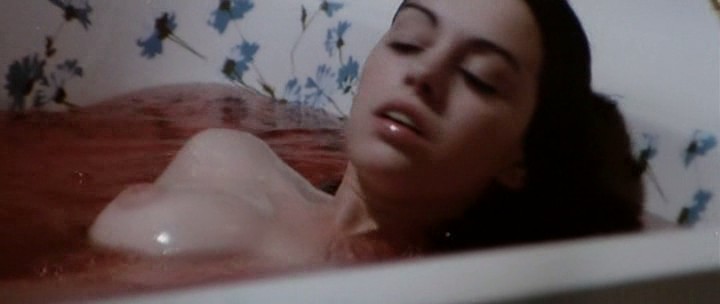
First of all, hopefully I'll be able to pick up from the few days I missed. The least expected thing - technical malfunction out of my hands and nothing to do with my computer - delayed the final stage of the season. It will have to run into November to make up for thirty one films I wanted to write reviews of. A conclusion for the series will have to be written in November or part of the next Month In Review too. To compensate today, I present a review of another Jess (Jesús) Franco film and the first in a group of reviews I wrote for Videotape Swapshop  to tie both places I write for together into this blogathon. 

It made sense, since I was diving into the director at the beginning of the year, going through his filmography slowly, to cover a film or two for this season. Considering how many co-productions he made, including for countries with no other horror films expect his to truly represent them, its befitting and also says a lot about how diverse his career was. And I have barely scrapped a body of work that's over a hundred films not including the re-edited versions. There could have been three of his films covered already, but Bloody Moon (1981), his West German slasher film, is one of the few legitimately awful films of his I've encountered. I rather champion Female Vampire. Merely poking the air next to the catalog of the late man, deciding to view his work when he sadly passed away this year, I can be thankful that its quite a solid series of films I've seen baring those couple of bad ones. Even something like Oasis of the Zombies (1982), which I reviewed on this blog, is no way near as bad as some of the films I've seen. I'm late to the party with reviewing Franco's films, with other blogs devoting themselves to his, but as a person who only saw a handful of his films before and barely had any primary knowledge of what his films were like, there's a potential for a really interesting chronology in these reviews, as the director gets the most tags to his name so far in the labels section for filmmakers, where I slowly get to know more and more about his style as I watch more films. I could be digging at his work for years, which means I may have to use other director seasons as mini-diversions, their thirty or so films a puddle next to the ocean of Franco's, and there's stuff by Franco, like his porn films, that are going to be difficult to find. Here at least I got to one of the first of his films I heard of, and I'm glad for what I saw. I only wish an available DVD wasn't very out-of-print in Region 1 or 2 as of yet. 

Also of importance, looking back on this film, is that Lina Romay deserves her own label in the Actors section of my site. Even if a lot of Female Vampire is near-explicit titillation, she was clearly more than mere window dressing in this film, turning the movie into something more sensual and interesting with her clear interest in how she presented herself. Its worth making this review link a moment of my own applause for both her and her husband Franco together. 


From http://images.dead-donkey.com/images/bscap1924wl3.jpg

Thursday, 24 October 2013

Gremlins In The System

Due to some unforeseen cricumstances, this blog will be effected for a few days. This means that the Halloween 31 For 31 series will be briefly delayed depending on how long the problem will take to be fixed. I will make up for the delay by posting the remaining reviews in the beginning of November.
 
Please wait patiently.

Tuesday, 22 October 2013

Represent New Zealand: Braindead (1992)

From http://25.media.tumblr.com/tumblr_lis2bj7oI61qfen0ho1_500.jpg

Dir. Peter Jackson

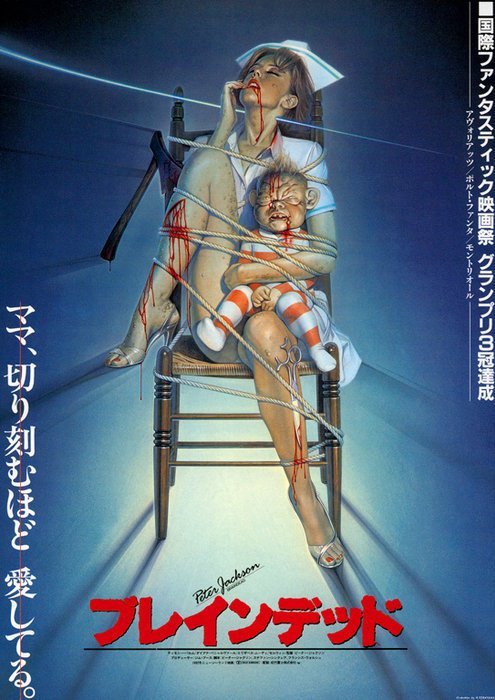
The tone of the film is perfectly set up before the film actually starts. There's an image of the New Zealand flag. An image of a young Queen Elizabeth II on a horse in regal clothes. It suits the ridiculous tone of the film and explains so much about why Braindead became as it is. It's not just because it's still one of the goriest films ever made and so over-the-top in its content. It's because it still does this while being so jovial. So quaint. British idiosyncrasies twisted around and rebuilt through a new viewpoint of a former British colony. That throughout it, for all the bizarre dismemberment, it feels so middle class in tone, which makes it funnier. Set in fifties New Zealand, Lionel (Timothy Balme) is a likable young man who has the potential for eternal happiness when the young Spanish woman who works at the nearby grocer's, Paquita (Diana Peñalver), takes immense interest in him romantically and pulls him out of his shell, the predictions of her grandmother through tarot cards about literal eternal happiness making her adamant about sparking the relationship. Unfortunately Lionel's sole surviving relative in his close family, his mother (Elizabeth Moody), is domineering and controlling of him, wishing him to be there for her beck and call, and certainly she's not happy when his attention is directed to Paquita. This situation is made worse when Mum is accidentally bitten by the newest exhibit at the zoo, the horrifying (but, brilliantly, stop motion) Sumatran rat-monkey. Shown in the pre-credits to be acquired by the zoo through gruesome cost, the rat-monkey's bite causes a victim to decay will still alive, die and become a member of the living dead with the ability to survive even being hacked to pieces. The zombification of Mum forces Lionel to become a social outcast, breaking Paquita's heart in the process and pushing her away, as he is stuck with his sleazy uncle (Ian Watkin) swooping it to try and acquire all the wealth his late sister had, and a basement of ever increasing numbers of zombies. As zombie cinema has taught us, infections can spread quite quickly and Lionel already has a few undead occupants, without rent needing to be paid, in his house without potential ones being created through the party his uncle wants to start.

From http://stagevu.com/img/thumbnail/knlhzclvpchbbig.jpg

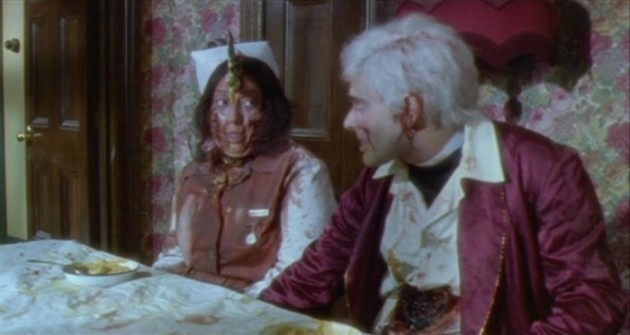
The fifties setting is immediately ingenious. The absurdity of such events taking place in a socially well-to-do, humble pie era of New Zealand, moral and refined, makes this splatter comedy and the gruel that takes place funnier. The film takes advantage of the idiosyncratic absurdities of this, and like Bad Taste (1987), plays up its country of origin's culture for humour as well. And it's a splatter comedy with a capital S. What you get in Braindead is the closest thing to carnivalesque in terms of this kind of splatter cinema outside of something of Re Animator (1985). Instead of hierarchy behind turned upside down as in a carnival, the human body is turned upside down in its function and form here. Gunge from an open orifice should not be eaten in custard but is. Legs should not be able to walk by themselves without the torso but a pair do. Intestines can preen at themselves in the bathroom mirror despite having no mind to function for themselves let alone eyes to actually look at themselves. If a severed limb can be used in a comedic way, it will. What is seen in Braindead is foul and twisted, but it's played with in such a comedic deadpan tone that it elicits giggles as well as shock. That it plays with such a serious tone that is yet so easy to find amusing - the use of a radio play within the film for audio related humour shows more of what Jackson clearly wanted the film to be like - makes it better.

From http://www.meangoblin.com/wp-content/uploads/2013/05/peter-jackson-braindead-a.jpg
It also helps that this was when, frankly, Peter Jackson's films has the most of his personality. Some of the jokes in this final film in his splattick trilogy are just as childish and tasteless as in Bad Taste and Meet The Feebles (1989), such as what is clearly a former Nazi turned drug pushing veterinarian, but he was never pretentious, never sophomoric, and has such an imagination that, alongside friends and other individuals who made these films with him, brought such surprising things to be seen you never though you would see. Say I was spoilt, but Braindead was one of the first of cult horror films I saw when I was eighteen or slightly younger and started searching for them, but most other horror films haven't topped what this film did still. It's not just that the final quarter is the goriest, ridiculous and jaw dropping things I've seen still, including the infamous lawnmower massacre, but that it never lagged before then, as ridiculous in the first three halves, and that it was able to keeping topping what happened earlier on for something even better. You cannot say, even if you say the film's simplistic, that the end peters out or it was a drag to get to the famous end scenes. It makes the romance between Lionel and Paquita legitimately dramatic, and uses the oedipal plot with Lionel's Mum to top everything before the actual climax. I thought, even on another viewing, that it would be impossible to top sequences that left so much fake blood soaked into the set floors that it was still there when everything was cleaned up and other productions were being filmed on it. Somehow Braindead manages to top this with the end of the Oedipal plotline that will leave your jaw on the floor further. The carnivalesque body horror and complete sacrilege displayed with how the body should work and be treated continually goes further and further, managing to not run out of steam halfway through because, like a Looney Tunes cartoon, it is playful and willing to be as surreal even for cheap jokes. Even the repeating kicking in the testicles of the Uncle character, for a cheap overused joke, is still funny on the third time because the set-up for how they happen is as much of the joke too.

From http://images2.fanpop.com/images/photos/6900000/Dead-Alive-aka-Braindead-1992-Stills-horror-movies-6933691-630-335.jpg

There is very much the sense that Jackson couldn't really go further than this. Braindead succeeds majestically, but he made two tasteless and creative films before this and, on the third swing, learnt enough to create a homerun in terms of the final creation. I'll admit this could go against my complete frozen attitude to the more acclaimed Jackson of now, but I am willing to explore the films I've yet to see that have no involvement with J. R. R. Tolkien whatsoever. The thing is, Jackson didn't necessarily need to drop the adolescent but imaginative tone of those early splatter works regardless if he did need to move on. A different tone of horror film could have been enough, but keep his willingness to improvise. Why I may have nearly fallen asleep in rewatching The Fellowship of the Ring (2001) is that Jackson was choosing material, to his detriment, that forced him to have to be as faithful to the original source as possible and not allowed to be the prankster he clearly was with his first films. And frankly, while I will give them a try, hasn't he been making films for the last decade that was adapted from other peoples' work instead of his own ideas? It makes one disappointed that his id has been straight jacketed into being respectable. His first film Bad Taste felt far more like a creation of passion in its ramshackle lunacy and its creativity. Braindead is that film made with more craft and more skill, and I continue to feel resistant about viewing his newer films, even if interest is still there, because it feels like he may have lost the point. 

From http://www.nerdlikeyou.com/wp-content/uploads/2013/10/brain-dead-entertainment-nerd-like-you-1024x576.jpg

Monday, 21 October 2013

Representing Switzerland: Jack The Ripper (1976)

From http://upload.wikimedia.org/wikipedia/en/3/31/Jack_the_Ripper_FilmPoster.jpeg

Dir. Jesús Franco


The Ripper (Klaus Kinski), a doctor, is prowling the streets of fog covered London, a Euro-specific version where everyone is speaking German and the world shown is built from German-Swiss construct, killing prostitutes because of an internal psychosis. However the police are slowly closing in on him, with the love of one detective (Josephine Chaplin) willing to gamble with her life to drag out the killer. Even if it could be the influence of the producers and crew on this film, a higher budget film from the director, this is not the only film from Jess Franco this atmospheric and very well made. With a career that has travelled numerous countries co-producing the work, the late director was very talented at his best, and Jack The Ripper is reminiscent of the British co-productions in their lavish looks. Unlike the British co-productions, this German co-production feels far more lenient to allowing Franco to express his more lurid, trangressive side along with mood. Far from the most lurid of Franco's work, far from the most violent or sexually explicit film ever released on British DVD, and definitely not the most violent or sexually explicit take on Jack the Ripper with the original graphic novel of Alan Moore's From Hell (1999 collected) in existence. But there is still things in this that, even with obvious prophetic effects, still cause one to wince with what is shown or implied, while still not overdoing for the sake of shock. Mixed with the mood the film has, expansive sets and darkly lit streets, it works together very well.

From http://farm5.static.flickr.com/4037/4317835170_08ba0ec4d3.jpg

Some may have issue with how most of the film is slow paced and has quite a few dialogue scenes, but maybe it's my personal taste here, but even with the plot reaching its obvious conclusion with or without the scenes, the dramatic and police investigation sequences were immensely engaging. Probably because, unlike an awful Franco film Bloody Moon (1981), these sequences are actually of interest for characterisation, plot or just detail. It was great that there's a side character, a blind man, whose amplified sense of smell and sound would ultimately doom the killer, in the beginning, to at least escaping the police by the skin of his teeth. That from the beginning he's going to be found out quickly, Kinski's character more desperate than calculated. That he's shown to actually be a person as well as a killer as a doctor. That there's comedy with bickering amongst the police and witnesses, and the witnesses themselves. That the cliché reason behind the killer's psychosis gets distorted through two very distinct scenes, the first through visual manipulation, the second a two person dialogue sequence played out through extreme close-ups of Kinski's face, showing that even if off-screen he was a reprehensibly being, he was still compelling onscreen in genre films like this. That, even if she becomes the per usual potential victim, Chaplin's character has a more calmed relationship with her detective boyfriend and gets involved with tracking the killer down entirely on her own initiative. The film, while possible to dismiss as perverse gloss, has far more subtlety than most films in this genre. Altogether its one of the better of Jess Franco's films. Not one of his best, but at least rearing the silver tier. It proves the work of Franco has quality to it, its graphic content mixed with a tense sense of tone. 

From http://farm3.static.flickr.com/2436/4317100987_12a8d5bab3.jpg

Sunday, 20 October 2013

Representing Russia: Faust (2011)

From https://blogger.googleusercontent.com/img/b/R29vZ2xl/AVvXsEiN-0OtsMQEBcNHRzyHGNA3SWcCQxNEaesRc2xYLXWnYhCV8u4eOcltA2VUcGdCFDIUw2qnpmsmQKauwSbb94CyhzV64K9pfHja4mCkqTqH3-CVh7h0qZaypYlFUNJ49Z_cnnhQ6Dp0R7Y/s1600/faust-2011.jpg

Dir. Aleksandr Sokurov

Even for those who only know of the Faust story though the idea of it, a man who signs away his soul to the Devil, Sokurov's take on it, the final piece of the legendary director's tetralogy of films that concentrated on three real world figures (Hitler, Lenin and Hirohito) beforehand, is a bizarre, legitimately bonkers film which is yet an intellect crafted work about the placement of wisdom and trying to find meaning in existence that may have no God. The connection to those first three works immediately brings about issues - having seen two of the three, it's clear that the issue of power compounded against the ordinary, contradictory behaviour of human being is shared, with this story being the proto-diagram of the real life individuals. It still has to be digested how the Faust story, where the titular character (Johannes Zeiler) needs money and finds himself pulled into a series of strange events with a demonic moneylender (Anton Adasinsky), is turned into this mass of ideas from existential musings to full-on body horror played as a joke at points as well as being gross. It is almost, if not, a perverse buddy film where Faust is less of a friend of the moneylender than dragged behind him in a series of squabbles, pulled into his hands finally when a youthful beauty Margarete (Isolda Dychauk) becomes an obsession for Faust. But the moneylender, as the Devil exists less as an evil being here than a bulbous imp, a literal mass of fat flesh when you see him completely naked at one stage, acts in all his dealings with Faust as if it's a normal transaction or deal, or as a comedic buffoon who wrecks havoc with anything he touches.

From https://blogger.googleusercontent.com/img/b/R29vZ2xl/AVvXsEh5kLSl25j-QYFv8er0SBVyipeaVBZlL48Tlg8QEGDuHdvo77N_9bJXgEGLRHZOo3k8hqh9se6v8vehvm3o1Z4np5PQO7wCrbIzGHnj52aGViHsd-7iSrG3sqCBOsDR6taAhulXwydLKOBc/s1600/shot0013.png

Sokurov's film is dense. Long at two hours twenty minutes. A vast, distinct world of German origin,  interpreted through Russian production, depicted onscreen with a heavy, symbolic tone. But its dense not because it's a grand scale morality drama - F.W. Murnau did this with his silent adaptation in the twenties - but because for such a critically lauded auteur, as I slowly get into his work tiny piece by piece, Sokurov has such a peculiar film here in the final results. Grotesque definitely, the first interior image of the film a giant close-up of the penis of a male being cut open by Faust for research and long passed his mortal coil. That doesn't even begin to explain what the moneyleader actually looks like naked, or when Faust's assistant Wagner (Georg Friedrich) brings out a project he claims to be his to impress Margarete, suddenly evoking Frank Henenlotter in the middle of a serious, austere film. An austere Russian film which yet clearly plays for laughs the moneylender entering a church to empty his bowls blasphemously after drinking the hemlock solution Faust wanted to end his own life with. What Faust as a film means, there's a very obvious idea that, stripping the pretence, the titular protagonist here is no longer the Faust of Murnau who wanted to help people, but wants money, later wants a young, baby faced woman just for a night at least, having to deal with her mother's clear hatred of his presence, but despite coming off as a detestable man, eventually shows the human being who was a professor of great acclaim who finally gets his desire for knowledge back even if it's too late to save himself. The Sun (2005) and Moloch (1999), the two films of the tetralogy I've seen, made frank comments that the characters, Hirohito and Hitler respectively, were human beings, especially with the later despite his disgusting crimes against humanity. The later film needs a re-watching for me, but it at times was comedic, Hitler apathetic and only kept awake in life by his love Eva Braun, his minions like Joseph Goebbels bitchy and whiny, making Quentin Tarantino's Inglourious Basterds (2009) not that different to Sokurov's film in the mindset of depicting the real life individuals. The Sun, which had actual comedic scenes too, while not showing the atrocities Japan and America did in World War II, showed a man believed to be the human incarnation of God for the nation of Japan as a human being, wanting to know and learn of the world too in his interests, forced to show his nation he was only of mortal flesh. Faust had the potential to be a great person, but has yet signed his soul away by the end of this film for the mere ability to have sex which he later regrets, the most obvious of metaphors but perfect for being the central pieces of the other three films before it in this series. As the moneylender points out, a Devil who yet has moments where he is wiser than anyone else, if Faust cannot help heal people, considering he has medical knowledge, or console them, he is useless.

From http://lincolncen.3cdn.net/9e2f1d0fe667d09fc5_ccm6b3jid.png

The film is presented as something very different from most fantasy and art films. Alongside the many mentioned moments in the review, and ones unmentioned, the film presents itself in a very unconventional form. Murky while also visually splendorous, moments in the film are shown through a distorted, tilted camera lens, fitting something that is both sincere in its prestige seriousness but also close to wading through literal faecal matter with its fart jokes, pulsating flesh and extreme distortions of human body parts like genitals. Like Moloch and The Sun, the serious subject is nonetheless counterbalanced with a far more expansive view of humanity which can be bizarre and downright vulgar. Faust is extremer in tone and content than those films, but even with something like Russian Ark (2002), Sokurov combined very difficult content to digest with seemingly out-of-absurdities and humour that yet fits the material and deepens it. Faust is definitely a difficult film, at its length an immense amount to soak in, but it succeeds immensely. As much a very potent take on finding meaning in life through the "comedic" hijinks of Faust and the moneylender as they visit place to place bickering about each other's beliefs. Its swerve to the danger of desiring power, through Faust's gamble for love, shows that even in the simplest wishes, as Sokurov's depictions of Hitler etc. showed too, people can damn their souls through their moral failures. It's a weird film, a gruesome film, abstract when it ends, using Icelandic shooting locations, nearing Max Ernst's landscapes, but as a whole Faust manages to make all of itself work.

From https://blogger.googleusercontent.com/img/b/R29vZ2xl/AVvXsEiJLmxfK-QAg7m5RYewfdHvdBRoGtlx1XVxa__2k9dBKUhpxyaDj1yEI1Scw0GWpB_4kxVYUOlAFa9Y3IGbLXhs4whpn5vro7nPVNo6mYP3B1PFVSbonO80z-2FrIZ_ohgL1zt01uJ9cCE/s1600/Screen+Shot+2013-05-10+at+5.16.03+PM.png

Saturday, 19 October 2013

Representing Thailand: Shutter (2004)

From http://www.loyvideo.com/wp-content/uploads/2012/02/Shutter2004.jpg

Dirs. Banjong Pisanthanakun and Parkpoom Wongpoom

To think ten years ago in the noughties, Asian ghost stories in cinema were an obsession for the genre, both in the films made in Japan, Korea, Singapore, Hong Kong and, with this film, Thailand, and all those English remakes. Ghost stories are still being made, but the trend has passed. I want to claim it was when The Eye remake (2008) with Jessica Alba vanishes from our consciousnesses after its cinema release, but even as the remake fad of those films finally died out there were still remnants being wringed out. If I'm permitted to reference old podcasts I listen to again, paying lip service to Mondo Movies for another time, I'm reminded of how one of the presenters said these films eventually descended down into random objects being possessed by evil than actual tension - "eck, it's in the walls!", "No, it's in the water!", "Oh, it's in my eyes!". Unfortunately Shutter, with its camera motif, doesn't provide evidence against this point in its existence.

From http://www.fantastique-arts.com/photos/2062.jpg
One night a couple, a man and woman, believe they've ran over a woman on a night-time drive home from a celebration. When its revealed that no one has been found afterwards, it becomes clear that the boyfriend is being haunted by a ghost of a young woman who keeps appearing in photographs. As it continues, this haunting reveals more of him than his girlfriend ever knew. For Western viewers, this type of horror cinema began with Hideo Nakata's Ringu (1998), a great start for the boom that begun. It was very much of its home country and of Asia. Unlike the West where religion has dipped in social influence and ghosts are an abstract idea, or in programmes where people sit in dark rooms about to scream when they feel the wind on their shoulders, spirituality is still significant and spirits of the dead still linger with those mortally alive. But it could be understood easily in the West regardless - ghosts are still scary even if we only view them through cable TV programming - and could be remade as PG-13 material for the ticket money of young adolescents. But Ringu is not a succession of jump scares tied around somewhat of a plot. It was mood, oppressive dank atmosphere, sombre drama which, when it went to the horror scenes, chilled the spine, the idea of the dead being on your mind for your ordinary lives disturbing when you encounter a malevolent ones. Shutter is from another country, Thailand, with its own cultural marks on it, but that doesn't excuse that its only sense of horror is a succession of uninteresting jump scares, a flaw that is understandable in any language.

From http://1.bp.blogspot.com/-trK67CNVeV4/UQ5IX4A9cOI/AAAAAAAAFm0/5RubotnbDps
/s1600/SHUTTER%2B2004%2BTHAILAND%2BPHOTO.JPG

It suggests something interesting, like many films, that when you investigate past the surface, behind the bookshelf or in certain images, you will see secrets of another person you never considered being tangible with them. This film even juggles having a segment with a paranormal magazine that doctors fake ghost photographs with a conceit suggesting certain types of photos will be always legitimate. But Shutter is such a dull film. The story, full of dark secrets, is not interesting, and being scary is not possible when you do jump scares continually and use obvious ones repeated from other movies. Neither does it help that, if you are not engaged with a film, the mechanism of a jump scare, pulling you in them making you jump, doesn't work then on that viewer. Neither does it look visually interesting for a ghost story like this to work. Shutter ultimately contributes nothing of real interesting beyond the basics and maybe a joke that suddenly happens in a men's bathroom. No oppressive mood, no cultural details aside from a scrap of things, nothing that distresses or creeps you out. It's an average rollercoaster wrapped around an uninspired mortality drama, even squandering the photography idea it carries in its potential. Shutter was only made in 2004, but suggests this subgenre was already in danger of falling back into obscurity that early on. 

From http://horrorsnotdead.com/wpress/wp-content/uploads/2011/10/shutter-32.jpg

Friday, 18 October 2013

Representing Japan: The H-Man aka. Beauty and the Liquidman (1958)

From http://skreeonk.files.wordpress.com/2011/10/the_h-man_poster.jpg

Dir. Ishirô Honda

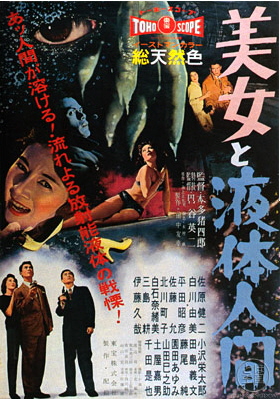
It would have been amiss not to include fifties, nuclear paranoia era sci-fi, having covered one last year, and it's one of the many choices I could have chosen from the boutique of genre films made throughout the decades in Japan. So many are there to choose; even if horror cinema only really came to be around the time of Jigoku (1960) and the influence of its director Nobuo Nakagawa, there are ghost stories and sci-fi monster films from before than I could have used. The same fears of nuclear fallout he tackled through Godzilla (1954) is yet taken to a different tone with The H-Man by director Honda. Godzilla was the ruminations of Hiroshima and Nagasaki through the wholesale destruction of Tokyo, potentially  symbolic of all the earthquakes that have beset the nation too, but with this film, it feels more concerned with the effect of nuclear aftermath, nuclear waste and radiation, the fear that a substance could get into the water. The film at first evokes acid rain in the first scene, but it gets more complicated than that.

From https://blogger.googleusercontent.com/img/b/R29vZ2xl/AVvXsEgav9iwKDDTF1fh4GPr0RNExpL-0xcwNQRdCNbvmZOTX6cy1Ujw2u9RVOd1emBOfGOHTLY5gOL4Ej48_ZVRWdddrCwwecKZdBVhoLr2UQxbCvVYDVCH62TFjzpXM188ACHu9nrHxHvjb9wI/s400/H-Man+%25286%2529.jpg

A drug runner suddenly vanishes one night when trying to transport a large package of narcotics. In the middle of a street, in heavy torrential rain, all that is left of him is a pile of clothes dumped on the road. It's presumed, logically, by the police that it's just a bizarre coincidence surrounding the per usual yakuza infighting, where the gangs are going after each other and the drug runner has ran for his safety, leaving his girlfriend, a club singer, to fend for herself. But said to be hopelessly in love with her, to being the kind of person to still try and see her even at his own risk, his complete absence is a mystery, and while there is still an issue with the drug related crime, another person vanishes leaving only their clothes. Only a scientist who studies nuclear radiation, who to the bafflement of the top police detective takes interest in the case, could have the answer, and it may show a horrifying threat for the entire Tokyo population. Very much sci-fi at its most fantastical. Horror as well, especially with an extended flashback including a "ghost" ship. Pretty gruesome when it shows what actually happens to the victims in sloppy, wet detail. Even if they're replaced with fake ones, toads get the worst of it in the name of figuring out what the protagonists are dealing with.

From https://blogger.googleusercontent.com/img/b/R29vZ2xl/AVvXsEi6tT0e7uDIJpdj2HZRGs6BaXUxCUOW9TUJpYN04ogYuFPRZN-zqYnclHNxc-bD1TbFD16N71kJv-bx0heh4GYEfPXzNeA1zhOIDby0EXn2hxz15tOwJrqqS3BafvA9nNtzR79joH16ocT9/s1600/AIP-2012-05-14-14h25m32s51.jpg

The Japanese sci-fi/kaiju/monster genre is barely tapped into in my viewing of Japanese films as a whole, but it's such a distinct genre in what I've seen while also having pieces of it that bleeds into other areas like anime. The bright colours to the images, glossy and rich, its foot between reality with the films between the fifties and seventies, but also close to both illustration and manga. A big thing about these sci-fi films, alongside yakuza films, is the amount of Western influences and how they almost drown out the Japanese origins of something like in The H-Man. Jazz instead of traditional instruments. (Great jazz pieces at that). The female heroine sings longue songs in English. Proto Pop Art deco for swanky, alcohol soaked nightclubs, one a prominent location in this film with local girls doing showgirl performance numbers in spangled bikinis. The gangsters here are in suits, slicked back hair and only carry guns, inching the film closer to the area of mukokuseki, cross-cultural works on film, that Seijun Suzuki went to with a film like Branded To Kill (1967). Post Second World War, when Western culture entered Japan in vast amounts, this is not a film that questions and or scrutinises this, like a Shohei Imamura film would, and even Godzilla had the first quarter of it set in rural Japan with its traditions clearly visible. No one raises a question about it, and baring certain things like the housing with interior paper walls, nothing pronounces it as "Japanese", more concerned with the story of people randomly disappearing. But it still manages to feel very Japanese paradoxically. The methodical pace. The willingness to depict such a premise completely seriously. The take on the fears of nuclear destruction spoken from experience. Even in being completely nationless in look, it's still very much a creation of Japan only.

From http://skreeonk.files.wordpress.com/2011/10/hman5.jpg

The H-Man is a b-movie. Pulp. The first viewing I found it dull and disappointing. This time I liked it. Opinions change in hindsight sometimes. It still drags by the end, probably because the cause of the incidents is not something like a kaiju that is visually frightening unless the icky practical effects are used, having to rely on the crime subplot for enough menace. But for a b-movie it was made with consideration. It has a grace to it, and at moments it becomes both freakish, and at least once or so far more sexual and edgy than anything that could have been dared done in an American film at this time. There's another example of the bravery in Japanese pop culture here which is willing to show with more vividness fears and anxieties, desires and fantasies even in something like this with its premise. Even in the simplest terms with The H-Man, just making something entertaining its creators went further and made this bright, gangster sci-fi hybrid film which mixes sultry, elaborate jazz orchestration with ominous fears of every drain pipe housing a dangerous entity based on real national scars. With an ending, without spoiling most of it for you the readers to watch it fresh, where you see the bay of Tokyo on fire, the water itself an inferno of flame, with a warning of the events possibly happening again, it neither comforts the viewer into believing it could never happen again, or that such an event couldn't happen in reality in terms of what is scientifically possible, not wrapping itself up in a quickie, happy package. It's still a happy ending, but unlike an American film of this genre, its Japanese counterpart, after seeing the brunt of war and the nuke, still desires to tell its viewers of the era, even if they're entertained in their cinema seats, not to be complacent about the dangers that a nuclear weapon or radiation, or a natural disaster or chemical fallout, could have when it's not a H-Man or a giant, god-like lizard destroying Tokyo. In the American sci-fi film I watched last year, while superior and still creepy, it was about the norm triumphing over an alien outsider. With The H-Man, it's not an issue of the norm being even in the centre of the threat, but that the folly of mankind, regardless of norm, can doom itself, and that even if the threat was an alien, mankind is responsible to keep on their guard rather than take their lives after for granted in a gee-whizz, apple pie mentality. 

From https://blogger.googleusercontent.com/img/b/R29vZ2xl/AVvXsEjCHFDge1ZJ6HTwI3tb9-70QxNVtuktY1CGjv0rPF4IlSfNKTilGOMr6vGB9w68Cc1Lh-3IZT6iOn8q363DOUg1QFapWMwg3wNpD6WX98bw6rTZVGROfCVnY49t7qbZW44j93bAN3UfVBVH/s320/hman22.JPG