Showing posts with label Country: Switzerland. Show all posts

Sunday, 15 December 2013

Mini-Review: Voodoo Passion aka. Der Ruf der blonden Göttin (1977)

From http://imageshack.us/a/img802/1332/l9x3.jpg

Dir. Jesus Franco

Voodoo Passion is straight-up softcore. There is a story of such, but the main and consistent part of the film is the nudity of its female actresses and sex. It feels like a Franco film, a slow and deliberate pace, dream-like, but its streamlined back to the obsession with the female form more so than Female Vampire (1973). Your ability to like this film depends on your liking of mood in Franco's work. A newly wedded wife of a government official moves to Haiti, only to feel that her sense of reality is dissipating as she believes she's murdered people. As this happens, the sensuality of the local music, and the draw of both her husband's platinum blonde haired, and horny, sister and their maid servant, is becoming too much to handle.

What could come off as a "voodoo is bad" film, under the belief that she's being manipulated and with voodoo dolls laying around the house, actually turns out to be immensely different. Baring in mind it feels less like French softcore than the older film, but more Euro softcore, with said sister whose continually nude and lusting over her brother's wife, it's very much a reimagining of Franco's own Nightmares Come at Night (1970). There's shades of Female Vampire too in at least one moment. Far from feeling like Franco tritely repeating himself, it's actually cool that he was riffing on his own work repeatedly in different tones and styles. It helped that he never made the same type repeatedly each time - which may have made this sort of thing too much when he had the expansive filmography he had - and the interconnectivity of it all, that characters are doomed to be repeating the follies of previous Franco characters, is engaging as an idea in taking his whole filmography as one giant film. It comes off as befitting a musician whose main obsession, jazz, could be as much about repeating sequences from previous work and taking it into new improvisions. The thin plot for Voodoo Passion is enough for Franco to push his female protagonist through a series of scenarios where erotic and bloody incidents take place out of her hands. It also becomes apparent, even if depicting its setting as exotic, that Franco is on the side of the Haitians just because he leaps on the opportunity to use the environment's musical rhythms in his film's score instantly, mixing it with jazz as the film progresses. A lot of the film is people being taken away by the beats of the music, equal opportunity nudity by the bucket load, the entire film more of a musical piece than a narrative. Long stretches, when it's not the softcore sex, is lengthy moments of dance, of characters wandering rooms and outside, the entire eighty minutes or so a vast lengthy atmospheric piece.

Its definitely a weaker Franco piece. It does feel long trying to exist only on its nudity and music, not even a basic plot. Nightmares Come at Night (1970), which it takes its inspiration from, was drawing on an abstract air and slightly more complicated narrative. Admittedly the films which repeat tropes from his previous work, that I've seen so far, have felt weaker, though I don't dismiss those films at all, just that in this case, Voodoo Passion is definitely the weakest of the two. It mainly rests on its erotic material and it has to be viewed through that mainly. Is it sexy? Titillating? I confess to being attracted to every woman onscreen, and to Franco's credit the women (and men) are of many shapes and sizes, and that his actresses, even if lusted over, at least had a distinctness and charisma to them that made them more human than vacant. For a man who could get very scuzzy, the film is actually a lot more held back too despite the wall-to-wall nudity. Its solid visual appearance probably  explains this - this is not The Devil Hunter (1980) which does feel scuzzy - and for simple titillation this film is far and above most softcore of now, which is legitimately worse than something like this in quality in so many ways. Whether you can appreciate this film for that or not is entirely of a subjective opinion in this case rather than with other Jess Franco films.

From http://eutorrents.ph/imagehost/images/derrufjvj.jpg

Monday, 21 October 2013

Representing Switzerland: Jack The Ripper (1976)

From http://upload.wikimedia.org/wikipedia/en/3/31/Jack_the_Ripper_FilmPoster.jpeg

Dir. Jesús Franco


The Ripper (Klaus Kinski), a doctor, is prowling the streets of fog covered London, a Euro-specific version where everyone is speaking German and the world shown is built from German-Swiss construct, killing prostitutes because of an internal psychosis. However the police are slowly closing in on him, with the love of one detective (Josephine Chaplin) willing to gamble with her life to drag out the killer. Even if it could be the influence of the producers and crew on this film, a higher budget film from the director, this is not the only film from Jess Franco this atmospheric and very well made. With a career that has travelled numerous countries co-producing the work, the late director was very talented at his best, and Jack The Ripper is reminiscent of the British co-productions in their lavish looks. Unlike the British co-productions, this German co-production feels far more lenient to allowing Franco to express his more lurid, trangressive side along with mood. Far from the most lurid of Franco's work, far from the most violent or sexually explicit film ever released on British DVD, and definitely not the most violent or sexually explicit take on Jack the Ripper with the original graphic novel of Alan Moore's From Hell (1999 collected) in existence. But there is still things in this that, even with obvious prophetic effects, still cause one to wince with what is shown or implied, while still not overdoing for the sake of shock. Mixed with the mood the film has, expansive sets and darkly lit streets, it works together very well.

From http://farm5.static.flickr.com/4037/4317835170_08ba0ec4d3.jpg

Some may have issue with how most of the film is slow paced and has quite a few dialogue scenes, but maybe it's my personal taste here, but even with the plot reaching its obvious conclusion with or without the scenes, the dramatic and police investigation sequences were immensely engaging. Probably because, unlike an awful Franco film Bloody Moon (1981), these sequences are actually of interest for characterisation, plot or just detail. It was great that there's a side character, a blind man, whose amplified sense of smell and sound would ultimately doom the killer, in the beginning, to at least escaping the police by the skin of his teeth. That from the beginning he's going to be found out quickly, Kinski's character more desperate than calculated. That he's shown to actually be a person as well as a killer as a doctor. That there's comedy with bickering amongst the police and witnesses, and the witnesses themselves. That the cliché reason behind the killer's psychosis gets distorted through two very distinct scenes, the first through visual manipulation, the second a two person dialogue sequence played out through extreme close-ups of Kinski's face, showing that even if off-screen he was a reprehensibly being, he was still compelling onscreen in genre films like this. That, even if she becomes the per usual potential victim, Chaplin's character has a more calmed relationship with her detective boyfriend and gets involved with tracking the killer down entirely on her own initiative. The film, while possible to dismiss as perverse gloss, has far more subtlety than most films in this genre. Altogether its one of the better of Jess Franco's films. Not one of his best, but at least rearing the silver tier. It proves the work of Franco has quality to it, its graphic content mixed with a tense sense of tone. 

From http://farm3.static.flickr.com/2436/4317100987_12a8d5bab3.jpg

Saturday, 31 August 2013

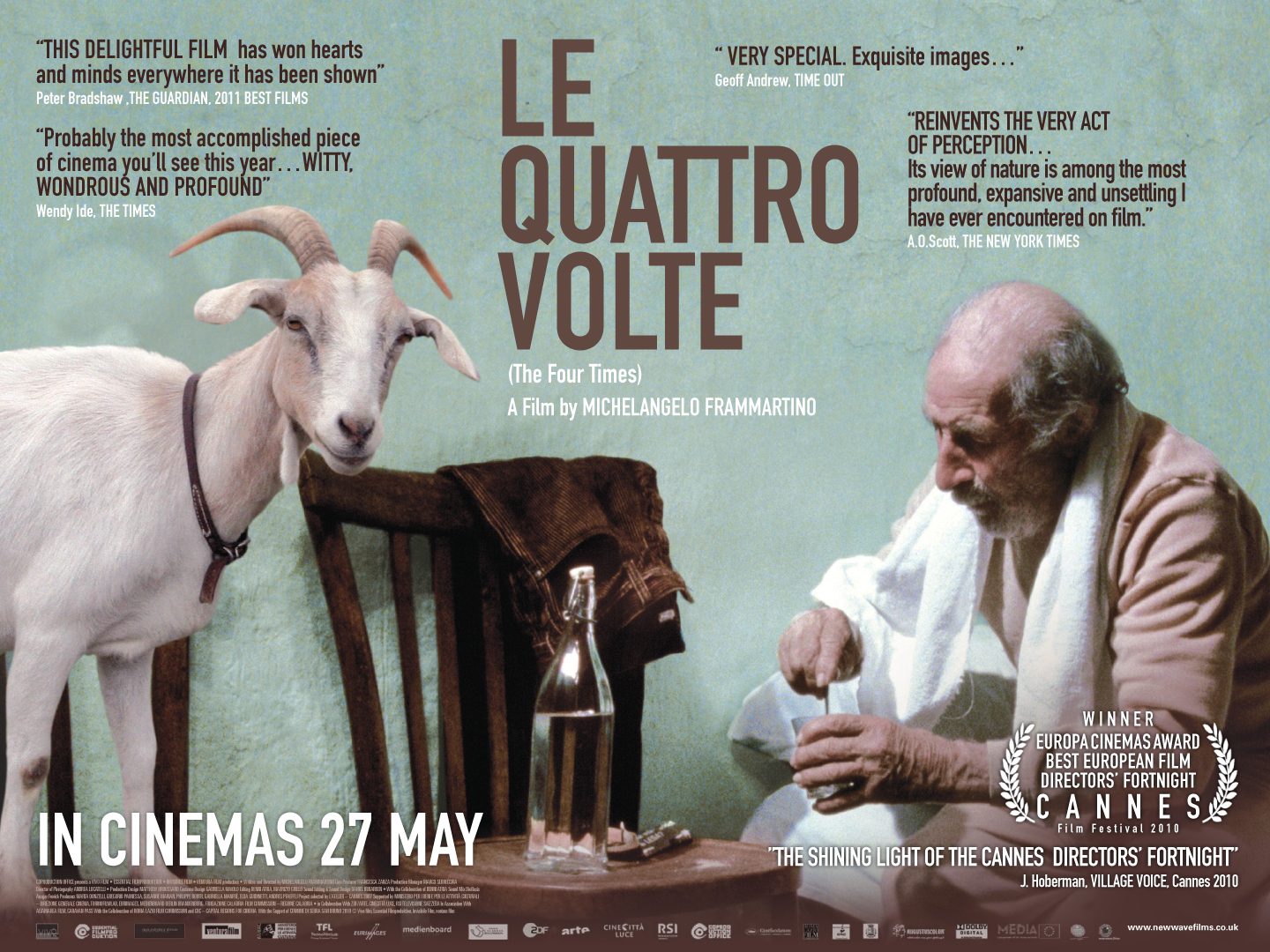
Q Is For… Quattro Volte, Le (2010)

From http://www.newwavefilms.co.uk/assets/directory/49/Le_quattro_volte_quad_vs5.jpg

Dir: Michelangelo Frammartino

I have fond memories of viewing this the first time. I was lucky enough to see this at the cinema at the Showroom in Sheffield. Unfortunately my geographical location means that I have to watch most of my non-mainstream cinema at home on DVD. The availability of this sort of non-studio cinema outside of metropolitan areas or large, middle class cultural centers is disappointing. It has probably forced a lot of film viewers living out of these areas to have to find these areas through DVD, streaming, import or even illegally, thus denting the potential cinema box office for these films. And it could seem snobbish to say this, but in most cases the best films are even not the blockbusters, or even the indie American films released by the studios but the films like Le Quattro Volte, which means that unfortunately people couldn't say that their best films for that year where seen on a big screen. 

Thankfully, despite the prices and time that have to be dealt with for me to go to the Showroom for one day, I've managed to see some great films there. In fact nearly every film has been great, the rarity of going there meaning I go when I desperately want to see something, or has been a memorable moment. I saw Harmony Korine's Trash Humpers (2009) there. This has even more importance to it since, viewing it with an older brother who doesn't watch art cinema let alone knew what he was expecting, we had a lengthy debate all the way back to his apartment that, even if he was offended by the film, was constructive and led to us bonding over the idea of someone, somewhere, humping a bin in the city at the same time. I saw Uncle Boonmie Who Can Recall His Past Lives (2010), the film this post is about, Holy Motors (2012), and at the beginning of this year, Bullhead (2011). Its also where I've had my only experience of a film festival, seeing two films at last year's Sheffield Documentary Festival, one of which was where I saw Planet of Snail (2011). Not only a great documentary from South Korea, but the experience taught me an important lesson, when shaking the director Yi Seung-jun's hand but baffling him with my thoughts on what I saw, that the viewer can over interpret a film or a creation when the creator's view on it was so much more upfront in it already. This causes one to ask whether film critics have the same problem, and the realization, alongside given me a hilarious anecdote I can look back on fondly, really helps with viewing cinema even as a hobby without having to write an amateur review about it. Even if all the other films I saw were terrible, this moment would make those rare trips to the Showroom completely worth it.

And with that, it adds a great deal of fondness to viewing this film over and over again. But Le Quattro Volte certainly holds up incredibly well even if these memories were separated from it.

Review Link - http://www.videotapeswapshop.co.uk/15966/q-is-for-quattro-volte-le-2010-director-michelangelo-frammartino/

From http://2.bp.blogspot.com/-6dkR9rBSSdw/TaOEyB943bI/
AAAAAAAAIFI/RS4dXYmN1Sg/s400/lequattrovolte2.jpg

Monday, 12 September 2011

Alice (1988)


Dir. Jan Svankmajer
Czechoslovakia-Switzerland-West Germany-UK


Note: At least with the UK DVD release, the original language version of the film is available, so don’t be put off if the English dub shown in this clip is off-putting.

What Is It?
A pretty faithful adaptation of the Lewis Carroll story Alice in Wonderland viewed through the eyes of surrealist animator Jan Svankmajer, who made his feature film debut after a few decades of acclaimed shorts.


And?
Alice is almost a continuation from Jabberwocky (1971), which combined another Lewis Carroll work of the same name with Svankmajer’s perception of childhood, existing in the same universe as each other. Immediately from the start of the film, it is less a children’s film and more of a surrealist fantasy art film, where Wonderland is interpreted through corridors of a home and its habitants are stop motion creations made from bone, fur, thread etc. It also separates itself from many children’s films in that its child protagonist is not an idolised version of a child, innocent and yet aware of their surroundings, doing what they can to be kind to others. The Alice in this is a more accurate portrait of a young child, very naive and learning about the fantasy environment very slowly, more slowly than the viewer. Also in one scene, at least for myself, where she is trapped in the White Rabbit’s house made of toy bricks, she shows a selfish spitefulness without any malice where she does not follow the requests of others for the sake of it, a rarity in child characters in mainstream cinema.

For those who have not encountered Svankmajer’s work – and you really should, as they are not just for animation fans, but for any film viewer - his work is distinctive in that the man-made aspect of his animation (and even the positioning of real people as actors) and their textures are upfront and as much part of the films as everything else in them. His stop-motion, and surrealistic flourishes, are usually created using everyday objects both man-made (paper, tools and utensils etc.) and natural objects that are manipulated by human beings (stones, taxidermy animals and bones); he has worked with paper animation and puppetry as well amongst other things, but the emphasis on the materials, and their textures and appearances, is still apparent. (Both these styles appear in Alice as well, and are completely inseparable from everything else). Every scene feels like it has by crafted by someone’s own hands, with the flaws of manipulating and moulding everything into place as much part of generating the atmosphere of his work, be it a short or feature film work.

In the context of other adaptations of Carroll’s story, Svankmajer’s style looks far more ‘creepy’ and ‘unsettling’ compared to something like Disney's, an aspect which is purposely emphasised by having such images as loaves of bread suddenly spurting nails from inside them or the White Rabbit continually losing sawdust from the gaping tear in his chest. However the style is able to go from this to charming and humorous as well, the later a definite part of many of the director’s other work even if its black humour. For its source material it is perfect, adding to the adult sense of whimsy which appears in the original story (which, as well as being a surreal fantasy, satirised attitudes of the British culture of that period, as seen when Alice is put on trial by the King and Queen of Hearts). As an interpretation of childhood, it is just as good, enforced by the use of old style toys that look Victorian at times in appearances. A universal nature in Jan Svankmajer’s work can be seen in the fact that these everyday items are ones that viewers probably possessed or know of greatly – owned by themselves or relatives, found in their attics, or even found on car boot sales and in antique stores – regardless of their country of origin. Svankmajer is also an imaginative filmmaker who, as a practicing Surrealist who works in other mediums as well as cinema, has a keen eye for inspired contrasts and juxtapositions. How fitting is it that the portals to Wonderland and between each part are desk’s drawers, part of a piece of furniture stories like this would be planned and written upon?

Sadly Svankmajer’s other feature work after Alice have been hard to find in the United Kingdom, but having seen Conspirators of Pleasure (1996) and Little Otik (2000) he has affectively taken all of his obsessions from his short work and combined them into longer form narratives that show the craft of a talented veteran filmmaker. Also worthy of praise, especially with Alice, is Welsh film producer Keith Griffiths who helped this film, and other Svankmajer works, to be made. I ask of you the reader to look at his IMDB page, which I will provide in this post, and look at his producer credits. Even though I have disliked or hated some of the films he has produced, Griffiths has contributed to cinema in general immensely, helping such filmmakers aside from Svankmajer like Chris Petit, Apichatpong Weerasethakul and the Quay Brothers (who are huge admirers of Svankmajer and made a short work in tribute to him) to make interesting and unique works. Having Alice and Conspirators of Pleasure in one’s producer credits is worth applauding, but Griffiths’ is even more incredible than this.

Alice is not my favourite Svankmajer feature (that would be Conspirators of Pleasure) let alone out of all of his filmography, but it is a great achievement, a fantastical and surreal work which matches its subject material like a hand to a glove. The film was finally released on UK DVD this year thanks to the British Film Institution, part of a sudden surge of interest in Alice in Wonderland in cinema that started in 2010. Hopefully his other feature films will be made available, but this by itself was worth the wait for me.

Keith Griffiths’ IMDB Page - http://www.imdb.com/name/nm0341702/