Showing posts with label Genre: Melodrama. Show all posts

Saturday, 1 March 2014

Videotape Swapshop Review: Tears of the Black Tiger (2000)

From http://d.ratingmovies.com/servlet/Main/CoverDisplay/Tears_Of_The_Black_Tiger_(2000).jpg?film_rn=9587

Dir. Wisit Sasanatieng

Whether the review is positive or not, to watch a film like this that attempts to be something different and unique is of some interest. Particularly when its using a genre with as wide a scale like the western. Existing from as far back as the beginning of cinema, the western, despite being an inherently American concept, has transferred globally, the films made outside the USA distinct in what is done different in them, what is done to same and what the tone is for them. I intend to watch as many westerns as possible, and review as many of them as possible, because the difference are just as interesting for me as the great films within the genre are breathtaking to see.

Review Link - http://www.videotapeswapshop.co.uk/18732/tears-of-the-black-tiger-2000-dir-wisit-sasanatieng/

http://fc06.deviantart.net/fs70/f/2012/195/1/2/tears_of_black_tiger_by_kriegdersterne77-d5771ss.jpg

Saturday, 4 January 2014

Celluloid Wunderkammer: A Broad Bellflower (1987)

From http://redkorea.files.wordpress.com/2012/01/e311.jpg

Dir. Kyun Soon Jo

I cannot wonder, thinking back on this review, what the original reactions to this film were in North Korea itself. What is the context of its existence? Frankly, considering the controversies surrounding the country, what did the normal public actually think of this film? In their own homes away from public officials? Without a lot of information on the country's cinema, its difficult to gauge these questions fully. The film itself in the context of the new Celluloid Wunderkammer series I started on Videotape Swapshop? The point of the series is that even if a film is forgettable, the context of its existence at least should leave a lasting impression, an opening one even, for a new area of cinema or at least more detail on it. Something interesting to look at if anything. It's almost cliche to say viewing this has made me want to see more of the cinema of the Great Leader's nation, but it wouldn't hurt to take advantage of the films you can find to see and learn from what the nation gives to its own people and to us. And I'm not even talking about Pulgasari (1985) yet.


From http://redkorea.files.wordpress.com/2012/01/df5607broad-bellflower.jpg

Tuesday, 20 August 2013

J Is For Johnny Guitar (1954)

From http://softmorningcity.files.wordpress.com/2011/04/johnny_guitar.jpg
Dir. Nicholas Ray

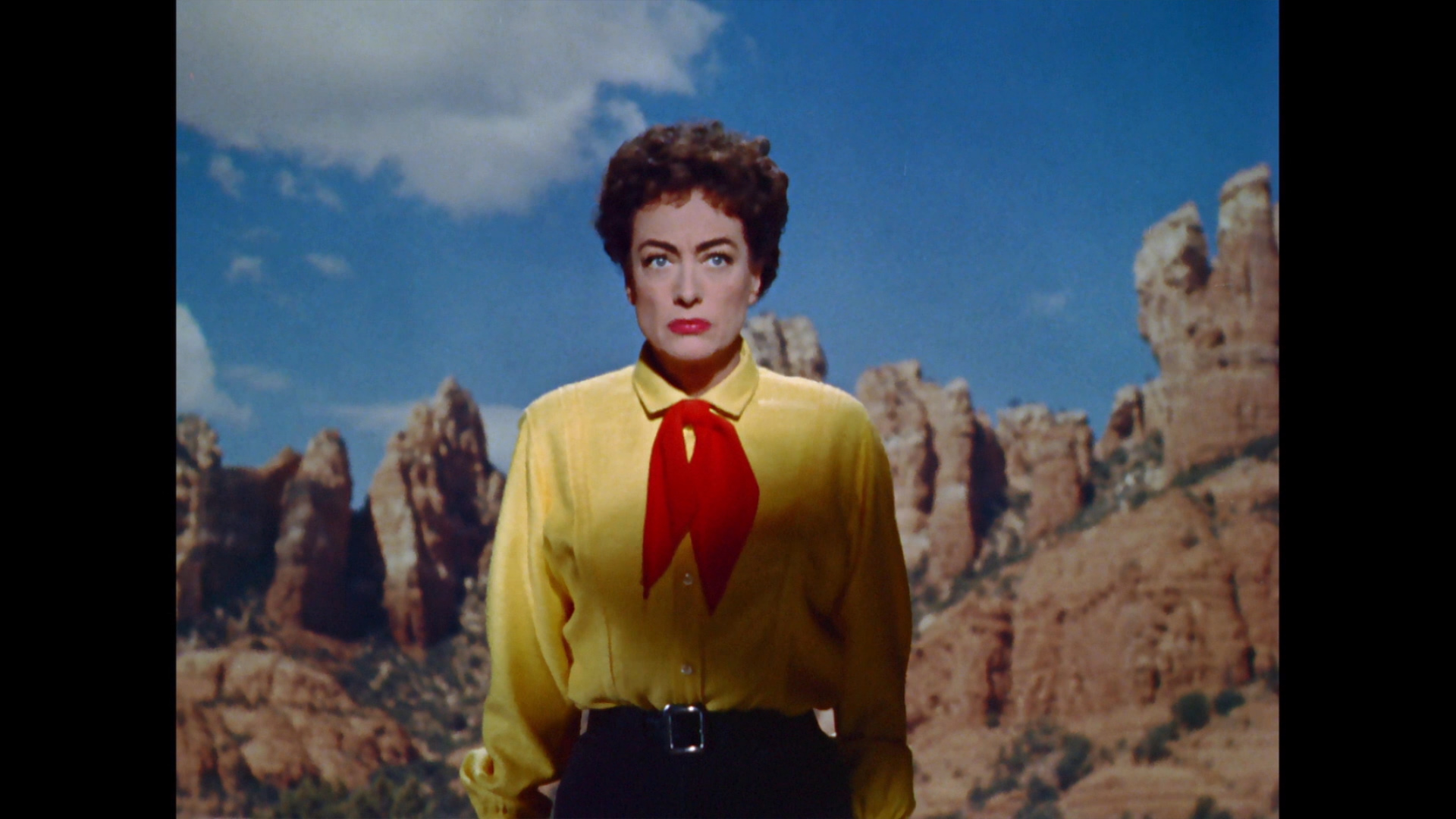
There is a lot of classic American westerns I want to watch, more so now that I have an appreciation for them. I admit I've been more positive about the later revisionist and lurid films, from The Wild Bunch (1969) and spaghetti westerns, but that was because they all had a distinct personality, even as part of a collective sub-genre, that made them all unique and have something to make them stand out. Johnny Guitar, revisiting it, is the sort of film that exemplified this. My first viewing of it years ago I thought there was nothing special about it, but with a lot of time to see more films, including westerns, that opinion is baffling now considering how unconventional it truly is. Its drastically different from the classical American Western of the fifties and before admittedly, but it showed me there are probably a lot of distinct and interesting films in its golden period I once dismissed as potentially dull.


From http://www.dvdbeaver.com/film4/blu-ray_reviews57/johnny_guitar_blu-ray_/large/large_johnny_guitar_blu-ray_x08.jpg

Monday, 19 August 2013

A New [Linguistic] Adventure: Chompa Toung (1974)

From http://3.bp.blogspot.com/-53BOqh7KR2I/UCmscw1NGbI/
AAAAAAAAHFc/Ytov09xjLc8/s1600/CHT01.jpg
Dir. Lim Buh Lun [Or] Dy Saveth

Maybe I should have actually read the blog review that first introduced me to this film and the closest to a full version to view it. The blog, Die Danger Die Die Kill, is a recent discovery of mine, and now thanks to it my scale for world cinema has drastically increased more than before. So many films you'd probably be only able to find online in terrible rips. Ones that may perish forever one day because no one cares about anything without prestige even if they  could say a lot about a country as much as the art house films do. I want to see as many of them as I can before they do perish or if the interweb gets crabby about people uploading said films. But I should have read that he had to view a un-subtitled version to actually see it, and that it is ninety percent dialogue. The result of this is what would happen if someone who is monolinguist, me only able speak English in my cretinous mindset, trying to watch a dialogue heavy drama, with some fantastical elements, without any real idea what was going on except facial expressions and intonation. And this is the first film I've seen from Cambodia, introducing me to their culture and their language for the first time cinematically. I can register Japanese from all the films and animation I've seen. I'm able to distinguish German thanks to the East German dialects of the band Rammstein. But hearing Cambodian and how it sounds meant I had to adapt to it for the first time. Without subtitles it actually made the sense of listening to the language, rather than reading text at the bottom of the screen, and still watching the images above, more significant. I confess I blanked through many parts of the film, but it was quite an enlightening experience I should do more often. The results of having no subtitles is twofold. The first is that facial expressions became something I had to pay dividends to more so than usual, realising how far too dependable I am as a Western viewer to subtitles at times with my film viewing to explain everything. Even if I didn't get a lot of what the film was about, I no longer neglected the importance of facial expression in communication, even when it got very hammy even without the subtitles. Secondly, the language becomes a series of aural rhythms by itself, able to appreciate the sounds of the language and speech for once, backed up by a score that ping-ponged from traditional instruments to funk, psychedelic wah-wah guitar.

What I can gather, in terms of information on the plot, is that it's based on a Cambodian folk tale. A princess, Chompa Toung, played by Dy Saveth who may have been the director too explaining the confusion in the credit at the beginning of the review, is introduced. When she laughs, flower petals literally flow from out of her mouth. She is given a crocodile's egg as a gift, but when it's an adult the beast becomes a man-eater who ends up being let loose and attacks people in the village her family presides over. Taking the blame, she sacrifices herself to the crocodile, but a heavenly being literally stood on top of the clouds intervenes and saves her, his magic depicted as lines actually scratched into the celluloid itself. This is where the whole folk tale, having read it after viewing the film, ends, but the adaptation goes further.  It becomes much more difficult to follow but things can be established. With a pet kitten turning into a woman to be her aide, Toung ventures out into the world after being saved, finding a new place to be her home when the two are caught by a stream by a giant. Possibly a supernatural king, or just a regular one connected with the giant, rules the new home, and she now possesses a new place of luxury to live life in. A prince takes interest in her, siring a superhumanly strong son, but in I how I interpret what happens, a group of young women, four exactly, take immense displeasure in this relationship, and with some outsider help, cloud his mind and push Chompa Toung out of the way. With a bumbling potential lover from her old home, and a lot of scenes of people kowtowing in royal halls, and moments where the kings have contemplative or scrunched up faces like the famous statue of the Thinker, this mess is somehow resolved.

From https://blogger.googleusercontent.com/img/b/R29vZ2xl/AVvXsEj4WjQPGTg1VQd93GAdYzdD6H2GtkvNuZ0uxq7frraWftUwTE8642KUKfsJbnE_s2XzPD-U4eBF2l0UPR83hejXKlxv8uE10QmRAqbJbdW50MiIbEUackWC9SlBrzM2rlOJKBhrMujO4Qw/s320/CHT05.jpg

There is a strong possibility that the lack of subtitles actually makes this of any reward rather than the actual story. It could still be entertaining if I understood it all, but with the closest thing comparable to it being a melodrama crossed with fantasy, it has a lot of dialogue but not necessary any melodramatics or drama just from the visual content. It's not visually splendid either even considering the rough looking version I saw. Almost all the film for that ninety percent of time is actually people sat in lavish rooms talking. Sitting in front of important people, kowtowing, talking more, maybe offering a gift or an accusation, more kowtowing, rinse wash and repeat. Its great education for how to behave in front of Cambodian mythological royalty, but my lack of knowledge of the language scuppers me from trying to grasp the narrative after the first part based on the folk tale. There is as much a possibility that it's a terrible film for a native Cambodian film fan, believing dialogue is of importance but forgetting it needs to be cinematic and compelling. Without the language barrier, what could be a dull mess, although not a lot of people could watch any film in another language then theirs without subtitles, actually becomes engaging by being completely lost in it and having to notice how the actors speak. At points it's a fantasy film too, supernatural in the way I thought the whole film would be going into it. Honestly, a fantasy film which was continually set pieces after set pieces, with what practical effects were available to the production, can travel onto YouTube to many other countries without subtitles. It's not a case of it being a bad or a good film, or an insulting trivialisation of a country through its low budget genre filmmaking, but in preferable the best case examples, a sincere enjoyment in seeing a country rarely talked about in terms of cinema trying its hand at these existing genres and melding their own traditions and ideas to them. Viewing your cousins from the other side of the world and how they'd tackle anything from a fantasy melodrama like this or reinterpreting Star Wars. The deity in the clouds is a male actor superimposed on top of clouds. The giant is another male actor who, thanks to superimposition, is made gigantic compared to everyone else. A jump cut turns a cat into a human woman. The crocodile is a very fake one on the water, or is part of the many pieces of footage clearly borrowed from nature documentaries, dark blue on the battered and buggered VHS rip I viewed, spliced into the film. There was even an accidental effect in the version I viewed which actually added to it, an accident in the transfer of the film on tape where it blurs and, breaking the fourth wall, you see the literal celluloid film at a distance you are watching, adding to the off kilter tone.   

Whether one could find a lot truly entertaining or not is up to debate. But I must confess that, in an age where there are still so many films unavailable, and many without people to subtitle them yet, I've become more braver in trying to watch films which I have no understanding of the language at all. Chompa Toung was an extreme because most of it was just dialogue, but that made it an unique experience in its own right. I would be grateful as well to see a subtitled version too even if its the same jiggered looking version I've already seen. Its best for you the reader to try viewing it yourself. I will post the review from the blog Die Danger Die Die Kill here - http://diedangerdiediekill.blogspot.co.uk/2012/08/chompa-toung-cambodia-1974.html .

There is a link within it to the version of the film I viewed. After that it's up to your own opinion.

From https://blogger.googleusercontent.com/img/b/R29vZ2xl/AVvXsEi3qePwFcZzHDBZpOUyANqfPJfTilF3ddX7XC4Bm5ybsIQHEYEzLWOyrDm3fkQ_Wec50EvgilDPW7szcU-BTWLdMl9-uYPqjKfCceys9EeRoXVDSN0NcUI4szvytS6RJsFRF53DiNLjsZg/s320/CHT02.jpg

Wednesday, 14 August 2013

F Is For... Flaming Creatures (1963)

From http://upload.wikimedia.org/wikipedia/en/thumb/d/db/Flaming_Creatures.jpg/220px-Flaming_Creatures.jpg

Dir. Jack Smith

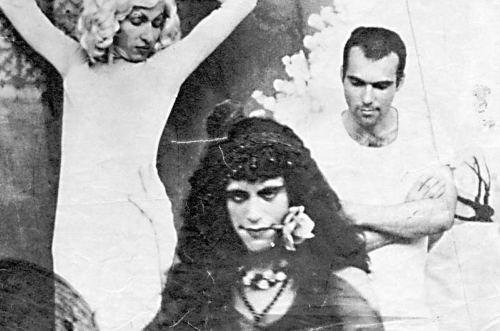
The only issue, posting this link up, is that the films of the late Jack Smith are not in availability outside of rare screenings. I'm only lucky to see his most famous film thanks to it being legally streamed on UBU.com, but even if the original film was intentionally murky, its probably a VHS rip. From my small bit of knowledge, Smith was known for re-editing and modifying his cinematic creations, which would make collecting the official versions together on DVD difficult, but it would be great to see a full length version, in a good print, of Normal Love (1963) which is only a fragment on UBU.com as well. One wishes the right person was reading this and could click their fingers to make it magically happen.


From http://blog.calarts.edu/wp-content/uploads/2009/11/flaming-creatures-2.jpg

Monday, 8 April 2013

Mini-Review: Violent Summer (1959)

From http://www.movieposterstudio.com/pimg/ViolentSummer_US1.jpg


Dir. Valerio Zurlini
France-Italy

From http://wondersinthedark.files.wordpress.com/2011/03/violent-summer-2.jpg

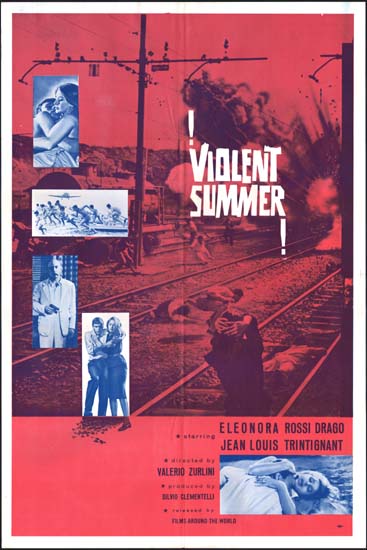
Melodrama deserves to be reviewed on here as much as horror and action cinema is. To ignore the genres I’ve missed so far would be hypocritical as a film fan who claims to watch “everything”. It is a genre that amplifies real life situations in ways that seem over elaborate, in a reality when these problems are frequent for many people, but they have enough a semblance of real life that draws us to them. Set at the dawn of the end of World War II in Italy, Violent Summer pushes the melodrama into a more contemplative area. A young man (Jean-Louis Trintignant) and an older widow (Eleonora Rossi Drago), who’s lost her husband to the war, develop of a romantic relationship, divided by the hostility it creates from her family and his friends, and the falling apart of Fascist Italy, close to home as the man’s father is a high ranking member of the Fascist party as it is being decimated. It is fascinating to think, at least for two films including The Conformist (1970), that Trintignant has played two characters placed near the end, or aftermath, of Benito Mussolini’s rule of Italy and the end of the Fascist state, both of them – one a noble, charming man stuck in his fate, the other a void, both admitting to wanting to be part of the crowd despite being opposites – liable to encounter each other within the cinematic depiction of this era face-to-face. The use of the historical background clearly shows how the lives of the populous (the characters and their fellow ordinary people) were punctured by the chaos of the war, a fighter plane flying so low at a beach, lost, that it frightens the people on it, showing the lack of boundary between the war front and home.

From http://img1.bdbphotos.com/images/orig/i/3/i316ruepjwwgwwe.jpg

It is an elegantly made film, beautiful in cinematography with one sequence, of fireworks and a night of celebration set to an American song, which stands out as well as pushes a key emotional thrust forward. As a drama, it stands well, Trintignant and Drago making compelling leads, Trintignant’s distinct, handsome face, from another era of masculinity, and Drago’s natural and graceful beauty shining through. The divisive element of the film, which prevents it from being a great work, is whether it is actually satisfactory as a dramatic work by its end or not. As a melodrama with lush orchestra music and scenes of heightened emotion, you have to be able to suspend your disbelief to be emotionally connected to the characters, which applies here still despite the obvious political undertones. The divided and antagonised relationships between the lovers and everyone around them has a sense of the completely believable, the horrible awkwardness when a friend becomes hostile to someone they know having passions for someone they believe they shouldn’t. There is however an issue though to whether certain turns in the characters actions and story shifts, especially in the last scene, feel perfectly considered or too abrupt. That will be up to you to decide if you go and look for Violent Summer for yourself to see. 

From http://www.berkeleyside.com/wp-content/uploads/2013/03/VIOLENT-SUMMER-INTEXT702.jpg

Thursday, 7 February 2013

The ‘Unfairly Abandoned Film’ of Cinema [Showgirls (1995)]

From http://d.ratingmovies.com/servlet/Main/CoverDisplay/Showgirls_(1995).jpg?film_rn=996


Dir. Paul Verhoeven
France-USA
Film #27 of The ‘Worst’ of Cinema

From http://4.bp.blogspot.com/_Gdt6SgFdNNw/TFni7shemRI/
AAAAAAAASrE/DMyVFLuqjZw/s1600/showgirls_huge.png

It is amazing that Paul Verhoeven exists. There have been European directors, known for art films, which get put at the helm of Hollywood blockbusters. Verhoeven is something else. That he went from this box office bomb to the large scale 1997 adaptation of Starship Troopers – which has its cake and eats it majestically by both revealing in the nudity and gore, but with enough morality to make itself a satirical masterpiece that decimates the fascist tendencies of science fiction – is incredible. A director as intelligent as Verhoeven, and as subversive as he is still, would not walk into a film like Showgirls blindly. Following a down-and-out girl Nomi (Elizabeth Berkley) as she travels to Las Vegas with star struck aspirations in her eyes, the film is a fairytale. It is comparable to classic Hollywood melodrama, with its sweeping camera curves and brightly coloured and decorated environments, following a wide eyed young girl – Dorothy from The Wizard of Oz, Alice and her Wonderland – but one inside an NC-17 film with graphic nudity, continuous swearing, back stabbings and obscene neon lights. It’s Oz on a terrible cocaine daze, and where the monkeys don’t have wings but run amok around the dressing room and leave faeces over the stage.

From http://i68.photobucket.com/albums/i33/shannymaldonado/STILLS/AWP10SH.jpg

And wide eyed young girl is appropriate for Nomi. Berkley has been lambasted for her role, but it slowly dawned on me, once I got use to her abrasive personality and the twisted quirks of Joe Eszterhas’ script, that she is a little girl in the body of a beautiful but far-from-innocent woman. She is tough, but at times cradling or holding a symbolic teddy bear missing an eye, she’s also childish, pointlessly obstinate even to people trying to help her and consumes junk food like a five year old. She will have to learn a lot, or even less, committing questionable behaviour before she becomes Cristal Connors (Gina Gershon), giant mouth and teeth, sequined and moulded eyes and face, and Texas drawl hiding someone who has fought mercilessly, sadistically, for her top spot in Vegas. And that turns out to be Showgirls’ ignored virtue in that it’s a slap in the face, contained in a glamorous mirror, of this sort of place and of this kind of film narrative, full of betrayals that are petty rather than dramatic, slime horn males whoring out their female clients, while a strip club is at least honest and thoughtful about allowing their male client to see the women’s naked bodies, and insidious behaviour. Only Nomi’s friend Molly (Gina Ravera), a seamstress for the major Vegas theatre production Nomi becomes part of, is completely virtuous and free of sin, only to get thrown in the garbage in a horrifying way. Eszterhas’ script by itself is too lurid and ridiculous to be completely serious, but I have to wonder if Eszterhas himself or Verhoeven when he got the script realised that it worked in depicting a Las Vegas that is so wrong and bizarre as it is seen in the film and added to it. Three years later the adaption of Fear and Loathing In Las Vegas (1998) was released, but despite having only read Hunter S. Thompson’s original book way back in college years ago, the film feels too arch and kooky to work now when I rewatched it. Showgirls shows this place far more potently, more decadent and depraved, with only my memories of Thompson’s original prose as a more damning piece of this city of gold shown in the film.

From http://static.cinemagia.ro/img/db/movie/00/08/08/showgirls-853426l.jpg

The film is a sordid overload. There is so much female nudity, especially from Berkley who I did grown up seeing in Saved By The Bell (1989-1993), that it batters you senseless and yet, to its advantage, makes every moment of it stand out. The dialogue is legitimately abstract at times, perfectly conveying the melodramatic tone, of a young woman climbing up in fame in all its clichés, while being jaw dropping in where it goes, such as Nomi and Crystal, in the only time they have a friendly banter with each other, discussing eating the same kind of dog food in the past. Having worked with writers who have had absurdist ideas in their scripts, intentional or not, like the news breaks in RoboCop (1987), I can see Verhoeven in his second collaboration with Eszterhas taking advantage of how ridiculous the film gets. And if the film is camp, the Las Vegas shown is horrifying in its gaudiness in the first place, the reptile zoo Hunter S. Thompson envisioned while on mass quantities of drugs even more insane and over congested as a g-string and shrimp cocktail hellhole. Made in the nineties, the many clear layers of the film, even if moments of Showgirls do not work on this first viewing, are clear even if they are within an exploitative tone. It’s a far more fascinating take on the struggles a female performer has to go through – the pain, the leering from men – than Black Swan (2010) by embracing its scuzziness, rather than being above it, and by questioning the whole desire at reaching the goal if it makes you less of a human being. What could be Nomi’s potential love interest (Glenn Plummer) skirts between the one who got away and another victim/predator of the Vegas strip because of his human flaws, while Kyle MacLachlan’s character, perfectly played by him, shows a two faced nature that is fitting for the whole narrative. Yes, the sex scene with him where Berkley flops around like a fish in a pool is silly, but its clear Verhoeven is between a balancing act between intentional silliness for humour and kicking this type of story in the ribs in a damning way.

From https://blogger.googleusercontent.com/img/b/R29vZ2xl/AVvXsEjiddSsljyA_HCfvJsU6uQScjQZYFGo0xe0TlHa9X5s64ceAuIrV8XN4nTO74UYf8t3YZIpP6oM2dCzWGd2EIe394hBJF0d1kzVrHR40FAwxW0d6qgqBiy_-LFlOSLa8Xnc5x-Mi0l-sHw/s1600/Showgirls+1995+Elizabeth+Berkley.JPG

It’s not the sort of film, sadly, that large audiences, and more sadly, film critics like, which dares to not be a safe art cinema drama which repeats everything we know of already, or a merely okay genre film which doesn’t push itself into taking risks, but something which is confrontational, is attempting its hardest in a sincere way to be something brave even if it has unintentionally funny scenes, and more of a taboo for critics, dares to skirt and question the line between being serious and satirical, not in a cynical wink-wink sort of way accepted now, but in a way that relishes the sleaze but cautions people of how terrible it would be to see in real life. It would be viewed as hypocritical, but Verhoeven actually managed to balance out the fine line between this in his American films by making sure the critiques of his own material within the films was poignant and black humoured rather than tedious moralising. Very few Hollywood directors dare this sort of thing now sadly, with maybe a few exceptions like Neveldine/Taylor being the only ones in existence, and sadly not getting the chances to make as many films like Verhoeven let alone high budgeted ones. Probably the shift to more teenage friendly content, probably not helped by Showgirls, waving the flag for the NC-17 rating, bombing as badly as it did, has affected this, but  I would also argue we’ve let the politically correct mentality, mixed with the hipster sense of irony, undermine American cinema, where films with sexual content are not actually sensuous  but passionless, where violence is festishistic or numbingly forced like Michael Haneke fostered on the world with Funny Games (1997), when once before very violent films like RoboCop actually made you cringe with real pain and horror even if you laughed or cheered it on. Feminism in cinema has been changed from being a real drive for women’s voices to be more heard of in films to being an excuse to accuse any film which plays with titillation or real sexuality as sexist, and the desire for peaceful liberalism hides a lot more morally objectionable and sick attitudes to violence in films than what Arnold Schwarzenegger did to villains in Total Recall (1990). Most films now are ‘edgy’ but have no actual courage to offend, divide, scrutinise, dissect  or willingly blur the lines between mere titillation and real intellectual meat, and finally seeing Showgirls after all this time, its disappointing something like this no longer, unless pigs fly, will get released in multiplex theatres if it did back in 1995. I want the people who like this as a legitimately great, or flawed but fascinating, film to crush the individuals that merely view it as empty, crap trash and take control of its cult following from them, the side where champions of vulgar auteurism on sites like MUBI.com and the legendary French director Jacques Rivette can bond over it, despite being on different spectrums of cinema at times, and give something like this the due it deserves or admit that it was a brave attempt that, fittingly, has survived many of the critics of the time who lambasted it.

From http://img11.nnm.ru/c/c/b/5/9/6955bdab97576f866108dbb82c9.jpg