Showing posts with label Genre: Political Drama. Show all posts

Saturday, 28 December 2013

Prata Palomares (1972)

http://titlovi.com/images/posters/Prata-Palomares_dfb6e998.jpg

Dir. Andre Faria

Honestly, as physically availability becomes less of a concern in how I treat what I look to watch for in cinema, the question of how cinema itself is treated is subjected to questioning. The notion of what cinema is meant to do and represent; as I watch this sort of cinema more, concepts such as tone, politics and structure are broken down. The lack of availability of a film like Prata Palomares, and the fact that its use of Gimme Shelter by The Rolling Stone at the end will make it difficult to release the film uncut, makes the influence of films like this one more powerful for me, the suppression of films like it for distribution reasons adding to the potency of things it breaks. Films like this become difficult to gage with because of this, but have a more pronounced effect on your thoughts when you can gage with them. It's a perverse irony that this Brazilian film, made during a military government that prevented the film from being shown at two Cannes Film Festivals, is now only available for me to see, in a period of freedom of speech in most places, from a copy ripped from a VHS tape from an unknown dimension. Consumerism turns out to be more powerful than a dictatorship.

The film itself is about the dangers of compromise. Two wounded revolutionaries wait in a church in a local village for a mission to be started. One pretends to be the priest that was supposed to take over the church, at first using it to bring the people together against the corrupt upper-class family that runs the town, but through an existential crisis becomes a lapdog for their words. All of this is presented in an abstract and unconventional film which shifts from the polemic to the gruesomely surreal. There's material reminiscent of Alejandro Jodorowsky and Glauber Rocha. The violence reminds me of José Mojica Marins too, whose horror films made him an unexpected political rebel when the same Brazilian government that suppressed this film banned his too. Prata Palomares is its own unique, charged film though, which like many films from South America I've seen, have a rawness where local culture, of countries and regions, meet the complications of politics, morality and urbanisation with a vivid metaphorical and phantastical bent. There's a brutalness in the violence and despair felt by the lowest in social ladders even in an abstract presentation. It's incredibly passionate filmmaking that is desiring to create real rebellion.

I confess the first part of the film, where the rebels are by themselves in the church, shouting at each other, was a struggle. In fact, for its moments of goodness, it's the worst of experimental polemic cinema, that which would actually compromise any revolutionary message in how it feels like it's a herd mentality wrapped in broad, unintentionally ridiculous pretence. But when a woman, a possible Virgin Mary figure for the revolutionary cause, enters their bubble and one of them becomes the "priest", the film truly starts to become a great work. Full of transgressive imagery - cannibalism, a church as a literal execution dudgeon, police death troops assaulting people - the issue in the middle of its message of how the left wing revolutionary can become compromised, distorted and a tool for the state is still relevant today and gives this messy film power. How anyone can confuse what they should do, regardless of political bench they're sat on, and end up being a lapdog or a deluded liberator. It does have some compromised thoughts. At first this sole female character of note is there only to give birth to the children of revolution, although this thankfully changes, in a film of archetypes and stereotypes, when even destroyed she's still the strongest force of the rebellion. It's also a revolution where one of the evil, decadent family - American, older woman pasted up in make-up, corrupt little girl who adores the violence - is clearly signposted as such by being effeminate and gay. This is a minor detail but it's another irony to write about with this film, where the issue of what one character's revolutionary ideals are questioned, that the message of the film is questionable in small details, the danger of this coming off as a brutish, heterosexual masculinity being projected from the film rather than an idealism for a new political utopia apparent in aspects like this. Details that could retrograde these ideals to the same mentality of the decadence its rebelling against. With someone like Alejandro Jodorowsky, he had the right idea of presenting decedent sexuality not in terms of specific sexuality, but when all sexuality becomes merely to consume another through corrupt and visually grotesque tackiness.

Despite these few details though Prata Palomares still has a great deal to stand out. The "priest" at first has the right idea - that the Christian God and Jesus were subversives for the downtrodden, or at least question God but use the cross as a symbol of unity - but he compromises himself into the puppet for others who wish to crush humanity through brainwashed spirituality. His desire for peace and non violence becomes as a means to shut up the anger of the downtrodden in a very clever flourish at one point. What makes the film spectacular when it fully immerses itself into its plot is how complex and unconventional it is. Even when corrupted, or just insane, the "priest" can be right. He destroys his comrade's revolutionary streak, in the best scene of the film, by pointing out that for all his polemic words, he's lost the one word needed to make his desire for upheaval of worth. Christians just need two sticks together in the shape of a cross he says, and his friend doesn't have this but empty phrases. But the "priest" is also a coward and easily manipulated, suffering from the same flaw. When revolution is seemed to have been won in the ending, what he does is no less ugly than what the former leaders did - in fact its more pathetic and off-putting in its farcical delusion of utopia. The one sole exception who is consistent is the woman, a politicised Mary Magdalene, who beret the men throughout the film for their compromises, but even she is literally silenced.


The film is difficult, shifting in place and full of dialogue that needs to be digested. The acting is stylised, with large portions screamed at high levels and a character at one point ramming his head into walls out of self mutilation. Sometimes the rebels just scream for large passages over what they're witnessing. It's an aggressive and abrasive work which matches its rich, ideological questions with the form of a blunderbuss shot, surreal images and a unconventional time structure even when following its small plotline. Unfortunately this reckless, difficult filmmaking is rarely seen now because even alternative cinema seems to have a tendency to copy mainstream filmmaking. By the seventies film could be trangresssive and legitimately dangerous, with many films that are still difficult to assess or handle even today for the modern cinematic canon. Prata Palomares is chaos onscreen and it's not surprising it was suppressed by the Brazilian government of the time, not just because of its message, but its tone and erratic nature which obliterates any sense of good taste. The difficulty of the film, even that sluggish first quarter, is now a nectar for me as a viewer. I am bored by what is to be expected and safe; it means nothing because I will forget it and, even by the virtues of mere entertainment, not have enough to actually entertain me. A film like this challenges my perceptions and my politics, and for glaring flaws, the challenge is rewarding as a film viewer but also in expanding the thoughts in my mind. Sadly films like this can only be seen, literally, on a muddy VHS rip from origins I don't know of. Thus it feels like a need to find films like this is a minor rebellion to clean out what I've been stuck with as cinematic art. Less elitism, more bored frustration, and befitting a film made to promote subversive ideology for utopian ideas, its complexity asks as well that even the concept of cinema should not be left to follow one style but question it continually. 

From http://i39.tinypic.com/10zwdmt.png

Saturday, 13 April 2013

Death May Be Your Seleção (Eden of the East (2009-2010))

From http://4.bp.blogspot.com/-3KV3RU9C238/Teg3dRd0_ZI
/AAAAAAAAAI8/IQ_KytbpCVo/s1600/eden_of_the_east_466_1024.jpg


Dir. Kenji Kamiyama
Japan

[Note: This is a review of all the parts that make up this property – the original eleven episode television series (2009), and the two feature films King of Eden (2009) and Paradise Lost (2010) – as one single entity. I will not include spoilers, but the bigger issue of reviewing this in these terms is how the opinion one has for the work contrasts from just reviewing the television series by its own and the whole together. It may also mean you will have to acquire more than a single DVD set to get all the parts of the entire narrative, so take note.]


From http://images.wikia.com/edenoftheeast/images/3/37/18515_eden_of_the_east.jpg
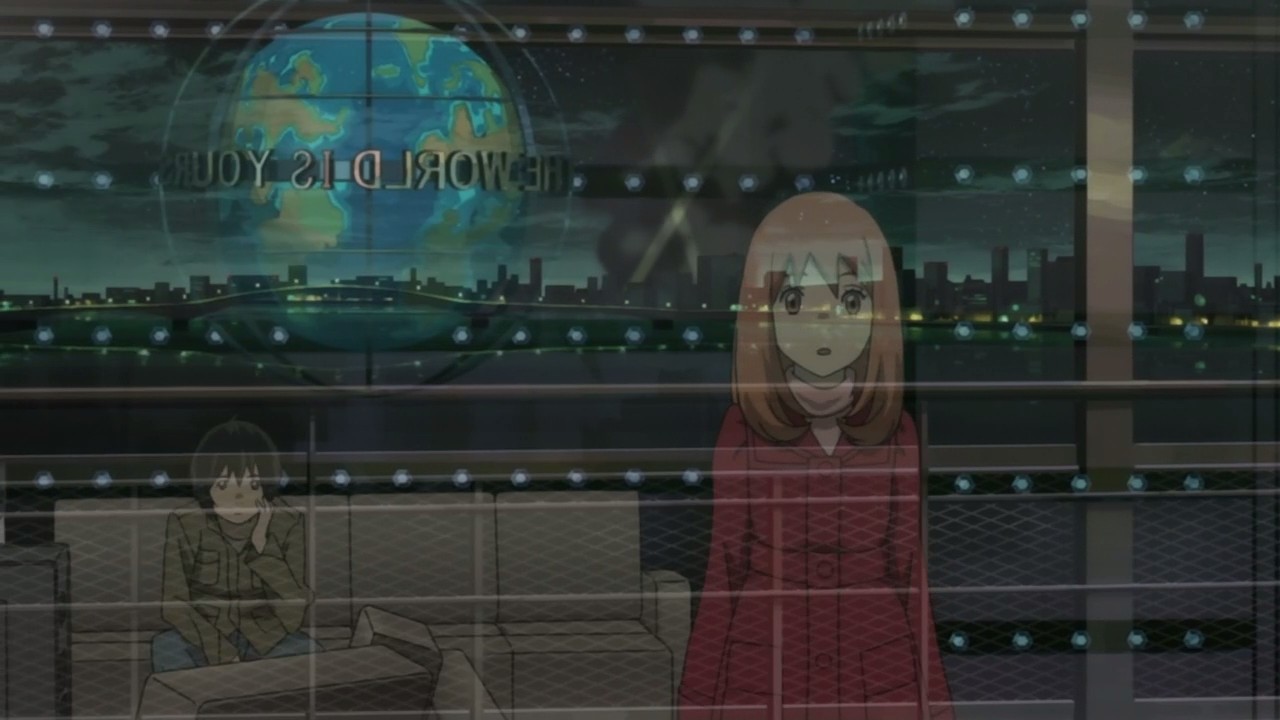
If there is one virtue to Eden of the East that stands above all else, it’s how different in manner and tone this is from most anime that is released in the West. Its prime focus, whittling it all down, is its director-writer scrutinising his country’s sociological and economic situation and, through a science fiction, political thriller premise, offering up his own hope for the future of Japan through entertainment. Missiles are a motif of the work, but it is just as likely, if more so, for a major plot turn to take place just from a piece of internet technology or a mobile phone, military hardware having less effect than ordinary consumer technology in a country where such things of mobile communication has its own urban legends and pop cultural connections. Envisioning its world through the eyes of restless youths, shut-ins and NEETs, the latter young adults not in employment, education or training, it’s a story where a single specialist phone can make the Prime Minister of Japan say “uncle” on public television. It’s very much a creation of the late 2000s and of this decade, even at five years old now, still relevant now for Japanese and non-Japanese viewers, and fascinating storytelling of the period only a few years ago you can view from a distance.

From http://eggfux.files.wordpress.com/2010/12/eggfux-eden-of-the-east-shot.png

On an improvised trip to Washington D.C. by herself, the young Japanese woman Saki Morimi (Saori Hayami in Japanese, Leah Clark in English) has an odd encounter with a Japanese man her age, completely naked and welding a pistol in one hand and a phone in the other, outside the White House, finding herself becoming enamoured to this mysterious person calling himself Akira Takizawa (Ryōhei Kimura in Japanese, Jason Liebrecht in English). With no memories of who he is, Takizawa discovers that the phone is a specialist one where, with up to ten billion yen only accessible on it available for his use, he has the ability to do almost anything through a mysterious female contact called Juiz (Sakiko Tamagawa in Japanese, Stephanie Young in English), who proclaims him as a savour of Japan. With such power in a single phone comes great responsibility, realising he is in a game where he has been fostered into trying to save Japan with this phone at his disposal, slowly recovering his memories with the help of Saki and her friends while dealing with the consequences of this predicament, both what he may have done before he lost his memories and the other users who have these phones as well, all called Seleção and trying to win the game or do what they desire with the resources they have. Wanting to literally punch the person who set the game up, Takizawa has to deal with the consequences of having a whole country on his shoulders and doing what he feels is best for it.

From http://animereviewers.files.wordpress.com/2010/08/eden-of-the-east-movie-1-screenshot-4.jpg

The original television series juggles political drama, latent romance, comedy and this mild science fiction idea together in a way that succeeds by its end. The only real flaw with it, by itself, is that it was clearly halted from having enough episodes needed to tell the whole narrative that was planned out. It goes with a considerate beat, and makes a full narrative arch, but with the following theatrical films afterwards, it’s clear that Eden of the East needs more than those eleven episodes to fill out the wider storyline. This causes the whole project to have some flaws with its pace and presentation. The series itself is perfect in structure baring a couple of episodes surrounding a character known as the ‘Johnny Hunter’, which in  a second viewing works for characterisation but has a contrived wrap-up of that scenario. It suffers a lot more in the first theatrical film King of Eden; it is needed as it is structurally, but it repeats the beginning of the series somewhat pointlessly and feels like it covers less in eighty minutes than what a single twenty minute episode from the series did. Thankfully Paradise Lost, as the ending, corrects this problem.

From http://animereviewers.files.wordpress.com/2010/12/eden-of-the-east-movie-2-screenshot-2.jpg

It’s amazing how subdued Eden of the East is over these different pieces. It is very idiosyncratic, far from a Dragonball Z-likw work or a major fad series usually based on a Shonen Jump manga. This series is anchored down by its emotional core, specifically around the character of Saki whose handling as a character perfectly symbolises the whole project as a whole. In the wrong hands, she could have been all the worst stereotypes of the passive, waif-like female character, Kenji Kamiyama writing all the characters, even minor ones, well. Even if she could still be accused as being a one dimensional character, getting perilously close to this in the first half of King of Eden, there are two factors that prevent this and also solidify the narrative. One, that despite Takizawa being the cool, confident male hero of the story, everyone including the antagonists have their moments to speak in the spotline and that the events that take place are not pushed forward by coincidence, but by a single word utter at the right time or an available laptop which levels the playing field for every character to contribute something. It’s also clear, having her open and close the whole story narrative wise, Saki is the clear protagonist even if she’s not in every scene or has the final-final sequence of the entirety of Eden of the East. Reversing the usual trope in anime where it’s a male in this position with a mysterious female love interest (or two or three or a whole illicit boudoir of high school girls and foreign exchange students), she is the audience surrogate who is having to understand this all and weaves the proceedings for us together around a concise arch she can learn from and we, the viewer, get the best from with her as the placed narrator of the series. At the centre of Eden of the East, she works perfectly as the anchor to prevent the entire story from becoming vague and float off into ramblings about Japanese economy; the growing love story works in this, rather than being an arbitrary contrivance like in another anime, making sense to flesh the whole story out and to make sure everything – from the political talk to the oddest Dawn of the Dead (1978) tribute you could ever see – work together fully as a single tale.

From http://moowallpapers.com/media/original/2013/03/03/Eden-of-the-East-sex-tape-1.jpg

This emotional core allows the original TV series to (potentially) work by itself as it concludes a solid character arch, and allows, even with the faltering pace in the first film, for everything in the entire proceedings to keep consistent. The closing films do not, in any way, top the ending of the final episode of the TV series, which will disappoint some, but this work from the beginning is an immensely talky, leisurely paced work when you loosen the genre tropes wrapped around it. It’s more difficult to pigeonhole than a lot of anime, and by the final film, it is clearly the creation of a director-writer who wanted to explore his feelings about his country, old enough to have absorbed any the political strife in the Seventies in Japan when he was growing up as a child, and also see the country’s economy blossom and burst in the eighties. He can also look forward, through what he concentrates on in this story, while staying entertaining and comedic even in its more serious parts. He follows in the same distinct school of director-writer Mamoru Oshii in expressing his philosophies through these genre films, and that he is famous for his spin-offs of the Ghost In The Shell films, which I need to see, is befitting him.

From http://randomc.net/image/Eden%20of%20the%20East/Eden%20of%20the%20East%20-%2003%20-%20Large%2009.jpg

The fragmentation of the whole project mars it slightly, which is the only real fault of Eden of the East. Beyond the annoying issue, as always been the case with anime, of having to acquire every part of it, and having to contend with expensive prices and DVDs not being available, it does have a real effect in making it drop in quality with The King of Eden film. Everything else succeeds. The TV series caps itself off well, despite only having eleven episodes and leaving you wanting more, and by the end of Paradise Lose it successfully closes the story off if you don’t view the story as being the ending of the TV series but a drama. It manages to survive the potential chaos of splitting off the whole story into three pieces and it still shines from it, so much so that even the series’ end credits is a great pieces of short film making by itself in its stop motion, paper animation. The desire from the animation company Production I.G.  to make something different is clear to see and they all really put their hearts into this, flaws or not. That its not based on a manga, a videogame or tie-in, but an original creation that was fully thought out, makes it even more refreshing.

And this is strange even to the characters in the series. 
(From http://animeprincess.kokidokom.net/wp-content/uploads/2009/05/vlcsnap.jpg)

Monday, 8 April 2013

Mini-Review: Violent Summer (1959)

From http://www.movieposterstudio.com/pimg/ViolentSummer_US1.jpg


Dir. Valerio Zurlini
France-Italy

From http://wondersinthedark.files.wordpress.com/2011/03/violent-summer-2.jpg

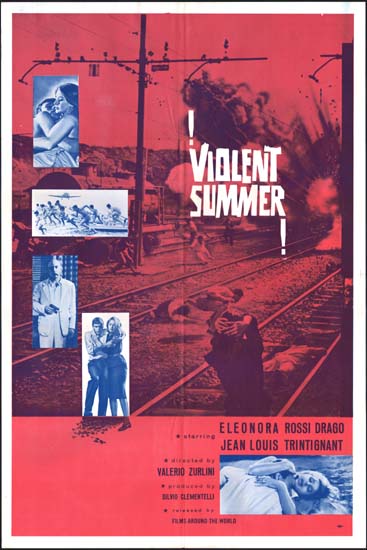
Melodrama deserves to be reviewed on here as much as horror and action cinema is. To ignore the genres I’ve missed so far would be hypocritical as a film fan who claims to watch “everything”. It is a genre that amplifies real life situations in ways that seem over elaborate, in a reality when these problems are frequent for many people, but they have enough a semblance of real life that draws us to them. Set at the dawn of the end of World War II in Italy, Violent Summer pushes the melodrama into a more contemplative area. A young man (Jean-Louis Trintignant) and an older widow (Eleonora Rossi Drago), who’s lost her husband to the war, develop of a romantic relationship, divided by the hostility it creates from her family and his friends, and the falling apart of Fascist Italy, close to home as the man’s father is a high ranking member of the Fascist party as it is being decimated. It is fascinating to think, at least for two films including The Conformist (1970), that Trintignant has played two characters placed near the end, or aftermath, of Benito Mussolini’s rule of Italy and the end of the Fascist state, both of them – one a noble, charming man stuck in his fate, the other a void, both admitting to wanting to be part of the crowd despite being opposites – liable to encounter each other within the cinematic depiction of this era face-to-face. The use of the historical background clearly shows how the lives of the populous (the characters and their fellow ordinary people) were punctured by the chaos of the war, a fighter plane flying so low at a beach, lost, that it frightens the people on it, showing the lack of boundary between the war front and home.

From http://img1.bdbphotos.com/images/orig/i/3/i316ruepjwwgwwe.jpg

It is an elegantly made film, beautiful in cinematography with one sequence, of fireworks and a night of celebration set to an American song, which stands out as well as pushes a key emotional thrust forward. As a drama, it stands well, Trintignant and Drago making compelling leads, Trintignant’s distinct, handsome face, from another era of masculinity, and Drago’s natural and graceful beauty shining through. The divisive element of the film, which prevents it from being a great work, is whether it is actually satisfactory as a dramatic work by its end or not. As a melodrama with lush orchestra music and scenes of heightened emotion, you have to be able to suspend your disbelief to be emotionally connected to the characters, which applies here still despite the obvious political undertones. The divided and antagonised relationships between the lovers and everyone around them has a sense of the completely believable, the horrible awkwardness when a friend becomes hostile to someone they know having passions for someone they believe they shouldn’t. There is however an issue though to whether certain turns in the characters actions and story shifts, especially in the last scene, feel perfectly considered or too abrupt. That will be up to you to decide if you go and look for Violent Summer for yourself to see. 

From http://www.berkeleyside.com/wp-content/uploads/2013/03/VIOLENT-SUMMER-INTEXT702.jpg

Saturday, 6 April 2013

(No Longer A) Mini-Review: Pitfall (1962)

From http://4.bp.blogspot.com/_QHH4jeoxHfA/Sh51eRCWQQI/
AAAAAAAAADU/d56CEO0gOK0/s320/Poster.png


Dir. Hiroshi Teshigahara
Japan

From http://1.bp.blogspot.com/_-9rNLVc8IZ4/SHaWMVxXsnI/
AAAAAAAAACI/GBfBRipnXtA/s400/vlcsnap-234399.png

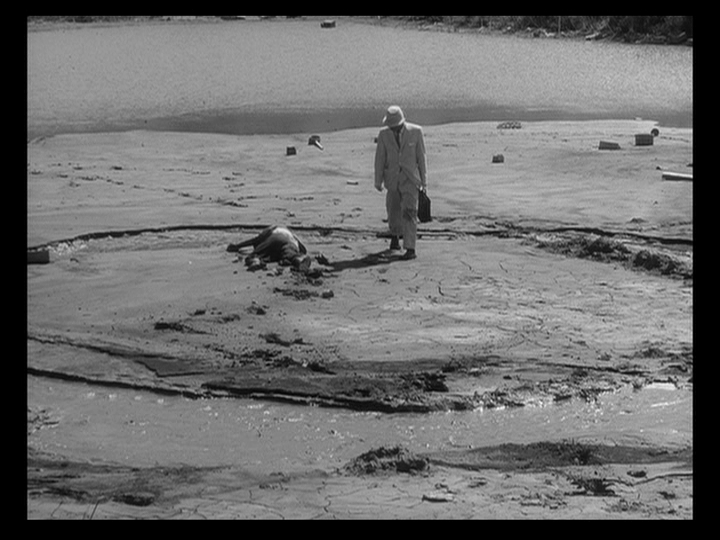
Pitfall is a fitting follow-up from Death Laid An Egg (1968), two political films with abstract tones. But Pitfall’s politics, set within miner’s strikes and evoking the post WWII political strife of Japan, is more upfront, and while Death Laid An Egg is a testament to technical skill and unconventional editing, Pitfall is a completely lyrical piece. A man is killed by an unknown male dressed completely in white, watching on at everything that takes places as a newly born ghost and wanting to know why he was murdered. In ninety minutes, the debut of Hiroshi Teshigahara manages to develop a full, fascinating narrative whose mysterious tone, questions left unanswered, makes it more compelling and emphasises a bitter political commentary that can be seen within its allegory. But Pitfall is more than this, to be expected from a director whose next film after this was Woman In The Dunes (1964).

From http://aleprod.com/wp-content/uploads/2010/05/vlcsnap-233795.png

For the most part, even at its goriest, perverted and questionable, Japanese cinema is calmer, considered and methodical in tone than their Western counterparts, the sense of contemplation emphasised in Buddhist and Shinto belief, as well as their other types of art, explicitly practiced. Even the exceptions, like director Shinya Tsukamoto, have embraced this tone for certain works when it seems appropriate, even melding it with the contrasting, more violently toned mood within the same film. Pitfall is as much about its visual and audio texture as its content. Teshigahara’s film, shot in deep focus, rich monochrome, is of sweat, blood, grains of sand or mud, the sodden shirts and skin of the characters in the hot sun festishistic and yet real, showing layers to human beings physically we take for granted. The story’s ominous tone, written by Kôbô Abe, is emphasised by this aesthetic of liquids and substances, natural or not, being graphically lensed, the murder that pushes the film into its more supernatural territory having a more impactful tone for the mess created to the participants and the pond land it takes place in. Even in animation, Japan and its countless artists have emphasised the small details of life like this, from the famous rainfall of Seven Samurai (1954) to their obsession with cicadas and their noisy cries, offering a view of terrain, natural or manmade, that pushes the cinematic image further than films made in other countries. This methodical, contemplative tone causes you to think about the content more and gives it greater impact on the viewer. It is filtered through a percussion heavy, unconventional score by Toshi Ichiyanagi, Yuji Takahashi and Tôru Takemitsu that is comparable to Death Laid An Egg. In contrast to Guilio Questi’s film though – a Godardian genre piece steeped in baroque gestures and chique aesthetics – the score set over the naturalistic, supernatural Pitfall is more gradual, less tense and underscoring the mood rather than about to break out in frenzies compared to Death Laid An Egg, whose score perfectly matches a more lurid take on murder and the noises of hundreds of chickens in a battery farm together. As the ghosts of an abandoned village merely drift along like ethereal mannequins, the ordinary industrial countryside of rock quarries and mines becomes more fantastical, the border between the living and the dead only existing because the ghosts cannot be heard or seen. The actions of the mysterious man in white, and what entails, evokes a scathing damnation of how the Japanese public may have been treated by their government, a message like with Death Laid An Egg’s that is more potent in this current recession, while also still being the machinations beyond such petty reality, white the colour of death in Eastern culture and the man comparable to Death itself in his on-looking nature.

From http://ishootthepictures.files.wordpress.com/2010/08/vlcsnap-2010-08-07-22h50m06s192.png

I have only seen two of Teshigahara’s films, already mentioned by title in this review. There is still The Face of Another (1966), science fiction on the concept of identity, his later work, and a visual essay-like documentary on the work of architect Antonio Gaudí. I want to see them all. Once Pitfall was a mere curio from the British DVD company Masters of Cinema, unfortunately so out of print now it sells for silly money; now it’s far and away more necessary and greater in its slight but rich ninety minutes than more known films. On rewatches you realised how lucky you were to have watched some films for the first time many years ago, even when you hated them then, and like fine wine, some like Pitfall become superior to others in every way. You realise what you ingested with your eyes and ears back then, when you couldn’t even appreciate a Jean-Claude Van Damme movie properly as an adolescent let along a complex, lyrical film like this, and enjoy it while being grateful for being older, even in your early twenties, to be able to appreciate it now. 

From http://s3.amazonaws.com/auteurs_production/images/film/pitfall/w448/pitfall.jpg?1303920806