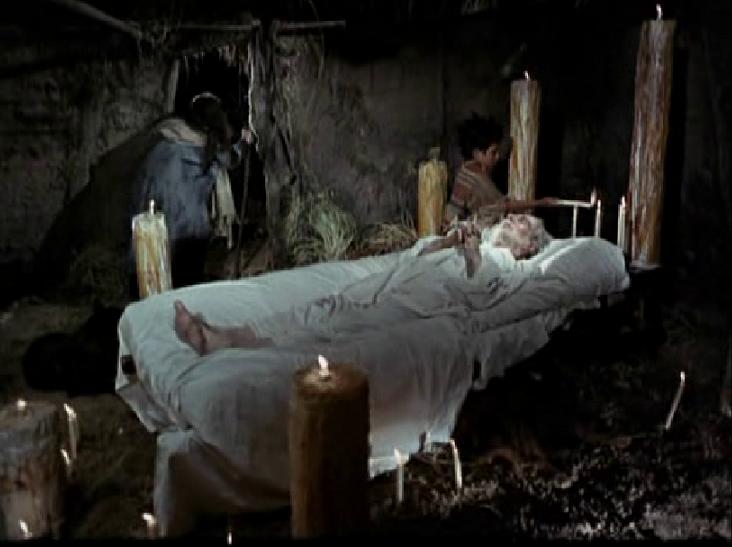
Dir. Leonardo Favio
Argentina
Based on folklore, The Nazarene Cross and the Wolf tells
the story of the seventh son, the last surviving son, of a widowed mother who
is said to be cursed by the Devil into becoming a werewolf. He is left to lead
a happy life, viewing it as a joke, until his love for the maiden Griselda
brings the Devil to him and begins the curse at the next full moon. It’s great
to widen the palette and see these primordial and universal legends, of man
becoming a beast, from numerous perspectives, as is the case for Argentina’s
official entry for the Foreign Language Academy Award for its year. Its
annoying films like this are difficult for English speaking viewers to see
outside of nefarious means though. Nazarene
Cross... is not pulpy enough for a traditional genre label, closer to drama
even with its fantastical story and a soundtrack from Italian genre cinema, but
even boutique releases of movies from countries beyond the likes of Japan and
Italy are limited unfortunately, with only Mondo
Macabro, to my knowledge, in the United States waving the flag for multiculturalism
in this area of film.
Nazarene Cross... is not perfect. It is very much a film of the Seventies,
but unlike cult movies, it does not have necessarily a distinct visual look that
stands out more, even if it is very well made, having a classical look, within
a rural setting, that has moments that stand out, particularly a trip to Hell
near the end, but is not constantly baroque or dreamlike in tone. It does avoid
wearing out its premise, folktales better off as very short length works due to
their concise natures unless a filmmaker can elaborate on it carefully, which
is to its advantage. The only real flaw is that, while it starts to work as it
goes on, the werewolf itself is botched in presentation, going for an actual
wolf rather than a wolf-like humanoid, but not really working on a supernatural
level compared to the emotional sadness added to the transformation later on. The
emphasis on the culture, the more dryer, sparser landscapes shown in Latin
American cinema frequently and the iconography, shows a clear grasp on a
folklore that is lost in a lot of Northern American cinema unless it can escape
internally or set itself in a minority community or the countryside, this film
set in a part of some older period but timeless in appearance. These films from
countries that don’t get the time or day they deserve as much seem to be more connected
to their land and cultural heritage while others like Britain have seemed to
forgotten theirs to their disadvantage. Even places that used their cultures to
create great films in the past, like many European countries, have been lackadaisical
in this in the last decade, with only Japan as a major cinematic country that
has continually emphasised its traditions, taking their legends with them to
current day. Far from suggesting a patronising tone to viewing something like Nazarene Cross..., it would be probably
healthier if films like this, which has been forgotten about outside of
Argentina, along with the celebrated works were more available and viewed. There
is something very harmful about the consumption of only the new in cinema, even from film writing, for urban-set
stories, technologically heavy works behind and in front of the camera, and
aggressive post-music video style aesthetics, compacting human emotion and thoughts
into cramp, claustrophobic mindsets that do not allow from breathing space or
pause, and seem to abandon the useful tales and emotions from that country’s
folklore, even in art cinema that is supposed to be the opposite of all of
these aspects. The old chestnut of someone becoming so sick of the urban life
that they desperately want to escape to the country applies to the viewing of
cinema and storytelling in general, the cityscapes perfect for thrillers and
Kafkaesque nightmares, fantasies that manipulated the buildings and streets or film
noir, but not places connected to the basic human fears or desires personally
through their appearance unless a protagonist has manipulated them to fit this.
Within another werewolf film like An
American Werewolf in London (1981), the city is a place that amplifies the
darkest of the story, or contrasts absurdly with bestial nature, not remind one
of old folktales and beliefs. When it does in a fantasy or horror film, it’s usually
because the characters have gone to the magic store, a religious temple or
library full of occult materials, and talk to people connected to old beliefs
like a priest or the local gypsy fortune teller who speaks in ominous messages.
If ideas generated from these folktales are brought up in environments separate
from these, in shopping malls or from the mouth of a Mark Zuckerberg-like
person, this discrepancy becomes part of the issue becoming tackled by the story
even if it wasn’t an intentional one.
This is significant with this
film as, obscure or not, this one of the most successful, if not the most
successful, box office hits in Argentina still. This is interesting as, in vast
contrast to another box office smash like Titanic
(1997), which takes traditions (historical/mythological/cultural) and pulls
them into the context of the newest technology available and newest tastes,
this feels like the cinematic and musical tropes that were new in 1975 were
pulled back into the context for this folktale as mere tools for it. This is
important as, for a purposely simple tale, Nazarene
Cross... has aspects to it which really do not conform to the homogenised nature
of what one thinks of a box office hit, particularly its more complicated take on
the Devil within the religious strand of the film. In only a few pieces of
dialogue, the film’s take on this figure is vastly different in a surprising
way that is great. My knowledge of the late Leonardo
Favio only extends to this film, but just from this, and the fact that he
was a musician as well as a film director, suggests that in vast contrast to
someone like James Cameron,
mainstream or not, Favio wanted to be
more honest and down-to-earth in his depiction of this folktale rather than
rebuild it to fit the aesthetics available to him in the period. The Nazarene Cross and The Wolf would
only work for a slighter amount of people – this kind of honesty and reverence for
traditions does not extend well to a mainstream mindset that has to be assessable
for everyone and has the current and the future in its mind only – but this
honesty makes it rewarding even if its flawed and a bit dated now. It is a
folktale that is told well over ninety minutes or so, and is better for it.

 To attempt a film shot in
entirely one single take, a feature length one, is an impressive task. Alexander Sokurov when making Russian Ark (2002), the famous film for
doing this, had to do a second take in making the film and start at the
beginning of a back breaking piece of labour for everyone on and behind the
camera involved. Even something as small as the original version of The Silent House, with only a couple of
actors and a single location, must have been a difficult task that should at
least be praised for undertaking the goal. Even if invisible cuts were made, as
the guy at the till I bought a copy of this film from told me to hunt out for,
whether they're there or not having never checked for them, it is still
applaudable how the making of the film was done. Set at a house of a man who
wants to sell it, his brother and niece go to clean it up for resell only for it to
be obvious that there is something wrong with inside the building. The whole
process of a single, continually moving camera that never cuts to a new scene
does have a tremendous effect. The advantage the film has is that it never
falls over when it comes to this potential gimmick - the only time the camera
shakes is when the cameraman clearly has to catch up to someone who is running.
It creates an immense amount of tension as the female protagonist is moving hesitantly
around the lightless rooms of the house; at first you concentrate on the fact
that the camera is still rolling, an edit to a new shot as one expects to
happen, from growing up with the rule that all films should do this, not
happening, but eventually it sucks you into a mood that is intense. It's a
lesson I learnt, and other people found, if they ever came attuned to Hungarian
director Bela Tarr. The small scale
of the film, its subtlety, is emphasised by how it prefers small shocks and
moments of creepiness for most of its length. It feels that for three quarters
of its length, The Silent House will
succeed...
To attempt a film shot in
entirely one single take, a feature length one, is an impressive task. Alexander Sokurov when making Russian Ark (2002), the famous film for
doing this, had to do a second take in making the film and start at the
beginning of a back breaking piece of labour for everyone on and behind the
camera involved. Even something as small as the original version of The Silent House, with only a couple of
actors and a single location, must have been a difficult task that should at
least be praised for undertaking the goal. Even if invisible cuts were made, as
the guy at the till I bought a copy of this film from told me to hunt out for,
whether they're there or not having never checked for them, it is still
applaudable how the making of the film was done. Set at a house of a man who
wants to sell it, his brother and niece go to clean it up for resell only for it to
be obvious that there is something wrong with inside the building. The whole
process of a single, continually moving camera that never cuts to a new scene
does have a tremendous effect. The advantage the film has is that it never
falls over when it comes to this potential gimmick - the only time the camera
shakes is when the cameraman clearly has to catch up to someone who is running.
It creates an immense amount of tension as the female protagonist is moving hesitantly
around the lightless rooms of the house; at first you concentrate on the fact
that the camera is still rolling, an edit to a new shot as one expects to
happen, from growing up with the rule that all films should do this, not
happening, but eventually it sucks you into a mood that is intense. It's a
lesson I learnt, and other people found, if they ever came attuned to Hungarian
director Bela Tarr. The small scale
of the film, its subtlety, is emphasised by how it prefers small shocks and
moments of creepiness for most of its length. It feels that for three quarters
of its length, The Silent House will
succeed...