Showing posts with label Genre: Erotic. Show all posts

Tuesday, 4 March 2014

Videotape Swapshop Review: Anatomy of Hell (2004)

http://2.bp.blogspot.com/-sL-uE1XV2K0/UC-cBc5ZaAI/AAAAAAAANzs/CKTMANmjr-8/s1600/2004+Anatomy-of-Hell.jpg

Dir. Catherine Breillat

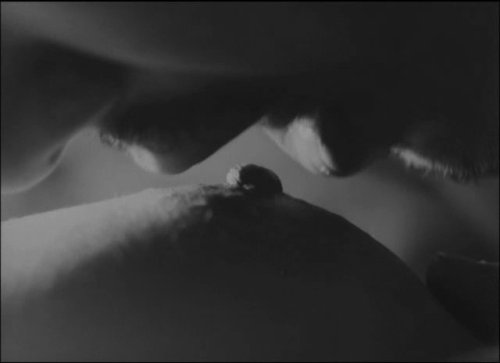
If there ever was a divisive film, this one is such an example. In fact for the most part Anatomy of Hell is viewed as awful and going too far. There is the thought though for me that this violent hatred for the content of this film that I've read justifies the existence of it. Sometimes a bluntness this strong is needed, and while there are aspects of the characters' dialogue that I disagree with on a philosophical level, it still causes me to think hard about why it was included in the film. It is better to try to grasp what the film is trying to do than to merely dismiss it as garbage, and as this review below attests to, revisiting this film, which I have not done since film studies at college over six years ago, had an immense effect on the material I saw again.

Review Link - http://www.videotapeswapshop.co.uk/19694/anatomy-of-hell-2004-director-catherine-breillat/

From http://i185.photobucket.com/albums/x66/mothsmoths/aoh19.jpg

Monday, 3 March 2014

A Little Death: Stranger By The Lake (2013)

From https://blogger.googleusercontent.com/img/b/R29vZ2xl/AVvXsEi5Wi8ykGjTTdk8ZTcEhT-UU5IHZuvXffl0XYAl1jQIoiYAqYAnC8OV9LEWY02jyMZGFMX49sk3OJdo30xrJL2F2sbWrJgsb12C9PbZD-EP3Z9S6mEw1wW-wfccMaN83s1oaZDVtVvEwms/s1600/Stranger+By+The+Lake.gif

Dir. Alain Guiraudie

Cars are left side-by-side to each other at a dead end of a country road, an improvised car park. This image repeats in Stranger By The Lake, set over consecutive days. Repetition, similar actions and events happening but with more and more complication. It's summer and Franck (Pierre Deladonchamps) goes to a beach each day, a gay cruising spot where men can sunbathe, swim, interact, or go into the woods to have sex with any of the other patrons. The film begins at first as an erotic, naturalistic drama, as Franck is unable to find a romance or even a brief sexual fling each day there. Instead he develops a friendship with Henri (Patrick d'Assumçao), a older male who sits on the other side of the beach by himself and never goes swimming or cruising. Very static shots make up the film. No music. In the throes of summer, the beach and surrounding woodland is beautiful and cut off from the rest of the world. A vast sea is shot in the brightest blue and you could get lost within the surrounding woods.

Naked men lay on the beach, explicit full frontal nudity, completely casual, in a way that makes the taboos of male nudity a complete farce. At tines these men look like deities on holiday. The sex is explicit and real, even if body doubles were used. It actually amused me to see a film with real acts of sex on a cinema screen. In fact this is the first film with hardcore sex I've seen at the cinema. As the nearest multiplex is in another city to me, the nearest art cinema to have seen this further afield, to see such an explicit work on a giant cinema screen than on DVD for once is a vast difference. Only now writing this review do I also realise, usually as a solitary viewer, that I viewed such scenes of ejaculation and sex in the prescience of strangers I didn't know, all male young and old in the day time, and that I never gave consideration to the sex itself as I left my seat to the in-cinema cafe but to the unsolved thoughts of what the film was altogether. I feel hesitant talking about sex with even my parents, yet complete strangers did not bother me with this film, too enraptured by said film and more concerned my head was blocking the screen for the person behind me. Having actually seen a film now, at a cinema, with hardcore sex that was available to see for a wide audience, even in an "alternative" cinema, now makes the fear I had in viewing any real sex, hetereo gay bi etc., completely stupid by how it never registered to me in the viewing as I was more concerned for the characters and what the director was intending to do. It also makes the fact, especailly in Britain, we're still debating this issue within cinema just as farcical. After this film ended, I walked out, passing a glance with the only other person who stayed until the end credits finished, and the only thing on my mind was wrangling the moods I felt for the film, not necessarily these hardcore images by themselves. The scenes themselves have a real, alluring eroticism that even for a heterosexual viewer like myself can feel, unbelievably passionate when experiencing viewing the film. Brilliantly though, even as Thanatos and Eros start to intermingle, the director Alain Guiraudie also has the down-to-earth and absurd also take place alongside the erotic. Condoms strewn on the woodland floor to the annoyance of someone about to make love to Franck, and a running gag of a chubby guy who likes to watch others have sex and masturbate nearby, sometimes to the bafflement of the party he's near. The fact that this man is fleshed out, character wise and literally, beyond being a gag into a loveable personality himself shows a rich dynamic to the eroticism and characterisation too that is rewarding. This is not just a misery fest like a lot of arthouse films with hardcore sex in them are stereotyped as, not helped by films including ones I admire that are this, nor neither is it flimsy hardcore. This for me feels like someone who actually cared about depicting sex in a way that even viewers like me who aren't gay can feel as much as a gay viewer could.

Part of the way through however, Franck views a heinous incident, falling in love with the mysterious but likely dangerous Michel (Christophe Paou). Their romance blossoms but as a police inspector (Jérôme Chappatte) enters the world of the beach, Franck's romance may be for the worst. Less a murder mystery than a psychological suspense drama based on one man's desire, Stranger By The Lake proves you can have a make version of the femme fatale, alluring yet dangerous. The difference is the figure of desire here is a very masculine, muscular and bearded male. There have been films where an average Joe/Jill falls in love with a very dangerous person; the director has said the film's an expedition into his own sexuality, but there is a universal aspect to the story too, the fear of potential danger and how as much it might be a draw to them, as they know how ill-advised their romance could be rather than naive about it. The inspector comments that only two to three days after the heinous incident, the patrons of the beach are acting as usual, as if nothing has happened, but the environment is a fragile one. Its cut off from everything, but it's not that far away from the rest of the world. Once, humorously, in a man wandering through wanting to meet "horny" women, but when a boat passes by its clear how thin the distance from the rest of the world actually is. Everything appears to be normal in the secluded beach too, but the murder does linger amongst the patrons at the back of their activities.

Until the end the film continues with an exceptionally engaging character drama with these characters that populate the beach. The film never leaves this location, the repetition of Franck arriving at the beach and regular faces met, including always saying hi and talking to Henri, giving the film a sense of lived-in reality, but also a rigorous structure to work around. If something strays from what is repeated before, that means something is very amiss. The erotic desires of Franck and Michel are palpable and legitimately sensual, but it's clear, especially through Paou's performance, Michel is someone "off" from everyone else. Regardless if his lovers were other men or women, there is something very amiss to him. I could be sticking my foot in my mouth, as a heterosexual male discussing a film by a gay filmmaker, but I question what critic Armond White said in that this film shows a retrogression in depicting gay men when it's a film set around a specific story with specific characters. Its beach world is incredibly normal, welcoming so, as well as sensual, the fears Guiraudie might be expressing clearly interpretable in the fact that the danger, wrapped around a potential thriller, is not linked to homosexuality itself but a concept that has existed in all the arts, and for any form of physical and emotional desire. The lover who you crave, love, but who could be harmful to you at the same time. This doesn't mean the fact that this is a gay filmmaker making a psychodramatic work around gay men should be ignored - if a film is specific, it should be allowed to. The problem is when its scrutinised under a perception outside of the individuality of films that oppresses the ability to gauge each film because a "respectable" portrait always has to be encouraged without a logical reason to. It doesn't need to do this and feels richer for this. Its greatest virtue is also being an immensely engaging, slow boiling hybrid of genre and drama. The ending, the last minutes, are not that of a Hitchcockian thriller, a blurb praise the film's been saddled with to sell it, but that of the central relationship and the theme within it. What was an abrupt one when I left the theatre screening room, realising this, becomes pitch perfect for the whole film when you consider this dark romance is the central plot.

From https://blogger.googleusercontent.com/img/b/R29vZ2xl/AVvXsEhXoQV2dMYce6a9wjqckylW8kw-LELYAvZkun9ulJcIDwgxkBgeanhKyaIF-43_V2iUYNMoQFPPTuo2cRpWOx_lHdU-4JH3A02PKxKFlQ4JBJ3UIHa7cqktvWh9TlNkr3IRBIESse3VByI/s1600/stranger-by-the-lake-14-01.jpg

Friday, 31 January 2014

Two Films From Jess Franco...

From http://media.screened.com/uploads/0/2709/264577-devilakasava_dvd_large.jpg

The Devil Came From Akasava (1971)
Dir. Jess Franco

Another Franco film. Different from the others yet very familiar like siblings. The same key is used with a different melody. There is a stone that is able to turn base metals into gold in ...Akasava. It also assaults the person who has contact with it without a protective suit on with radiation that kills you instantly. A paradoxical item of harm and lust, a Mcguffin if there ever was one which can yet effect the small narrative further because it can be implemented as a murder weapon too. Making it useful to use against people trying to claim it. Even then there are multiple groups who'll kill each other off the normal way, leading to secret agents and Scotland Yard having to get involved.

Small, limited sets are broken down into pieces of edited sequences. To Franco it's not the narrative that is of the most importance but the moments and the mood of them. The erotic dancing that a female secret agent (Soledad Miranda) does in a cover is of as much importance as a chase scene, lingered over for prolonged minutes until it's as much of the position of being there as well as the titillation that is of importance. It's too pronounced how Franco stretches out eroticism and violence in his films to say that they're just sluggish genre films, but a clearly disarming tone to them that encapsulates how much of this is very unreal cinema. The characters here are trapped in plot circumstance and twists that have taken place before, many times before, and the arbitrary nature of this actually makes the genre clichés fresh and entertaining. So close to being aesthetic messes, even though people may be divided with Franco's work, that they are completely unpredictable. Always abrupt when someone does turn the tables on another, but some moments, like the disposal of a body, actually show the director could as much make great scenes through conventional scene structure too. Suspicious people are actually working on the same side. Old women are not what you perceive them to be. The clichés of the sci-fi and thriller, despite the clear budget restrictions, stand out because the restricted tone prevents Franco from padding the twists out until they lose their effect. Although even then his cinematic style, mood before plot, meant that this is prevented in his films already.

http://i263.photobucket.com/albums/ii135/guessthefilm/devil.jpg

A lot of his great virtue is that, looked down on for his apparent sloppiness and disregard of structure, it's clear he was concerned for the structure of his films, but in terms of everything else but the plots. They are transitions. He cared about the sexuality of the human body. The sharp shock of a death. Films improvised on the huff. Contrivance like the reality has been drastically changed, even if this was not even considered by the director. ...Akasava doesn't really repeat any plotting from the films I have seen, and actually stands out as a unique film so far in viewing his work, somewhat fittingly ironic because in another person's hands this is insanely generic material. In his hands he was clearly obsessed with the cinematic image inherently as it was. Plot moments suddenly happen in his work, jarring you because the scenes before were so languidly paced. His obsession with the female body, possible contentious opinion on a male director's gaze on feminity notwithstanding, was as much about canvassing the screen in the female body (the breasts, lips, skin, pubic hair, all) in close-ups that at least showed the whole female body as part of real woman and belonging to her fully. Rather than parade a questionable attitude of putting women behind a glass screen and, while letting you look, seeing it as an abstraction of titillation. Instead of what Franco did and made it matter of fact even in a softcore tone. And he at least had women who were in control of their sexuality, in both films covered here in Soledad Miranda, than mere images, even if the characters were one dimensional pulp. Of course these films were exploitation. Of course Franco could show complete apathy with some of his films. Of course some of them fail miserably or purport tedious schlock. But with the ones I've tries to defend there is always a sense, even if it was sordid or made of tired conventions, that he impassioned and wanted to bring the viewers into them with his overload of incredibly long scene times, of characters wandering through rooms and corridors trapped in a haze, stuck in the environments on repeat by this point in his films, and sexuality less of a quick porno but a long, lingering sensation.

In having made as many films as Franco did, they start to meld together, not into pointlessness of their existence, but connecting and reflecting each other. They are very much genre films sold for their nudity and (hastily composed) action in closed hotel rooms and buildings, cut off from the rest of the world, but viewing as many of them as I have has introduced me to a slowly building universe. Happy to see Howard Vernon appear, a distinct face that, while he never got to work in Universal horror films from the thirties sadly, he did get his own world of horror films through Franco and to work with Jean-Luc Godard on Alphaville (1965). Introduced again to Franco's trademark of extreme zooms from afar. How isolated those interior locations actually are, and how even the exterior ones are cut off from all in their secret narrative. Films whose stories drift along. The fact that it's difficult for me not to repeat myself with these reviews is not a detriment to the late director but the sense of films which easily splice together into a single, self referential and formed entity. When you end one Franco film, you can transition into another and continue the atmosphere of the films in the next one....

http://classic-horror.com/files/images/shekilledin-poster.jpg

She Killed In Ecstasy (1971)
Dir. Jess Franco

Same year as the first film covered. Same universe. Maybe happening in the same time frame or another reality where these people lived completely different lives from the ones in the other film. A young doctor is barred from his career by four other doctors for an experimental that, despite intending to extend the lifespan of humanity, used human foetuses as guinea pigs. He loses his mind and eventually kills himself. His wife (Soledad Miranda again in a different personality) goes about taking revenge on the four doctors. It is a small film, only seventy or so minutes, and manages to be immensely economical in structure and yet retain the trademark prolonged, languid mood Franco made his trademark, abstracting scenes by their length and keeping the camera on moments longer than most directors. What makes this film stand out is that its brisk length allows the film to never sag, yet it's still intentionally slower paced, pulling you into the film fully if you can engage with Franco's (usually) erotic horror cinema.

As the gorgeous Miranda stalks the screen getting her revenge, the film like his best for me so far (eg. Succubus (1968)) is thick in mood and also with real visual richness. At his distinct, Franco could still make exploitation films, quickly, that stood out in a clear auteurist style, despite being a director-for-hire in his style and hundred plus filmography, and significantly different in their presentation and said style even if work was dismissed as rudimentary. The music, having seen a lot of films, and listened carefully to the soundtracks, in these films are memorable or legitimately great, especially jazz and world music used. The films, lurid horror and erotica, are constructed around simple plots but their concerns are the sense of everything but that plot except to get to the new twist, Franco more obsessed with the decor, the naked flesh, the sense of time passing. Even the compromised aspects of these films and his working habits, having to moved through numerous countries in co-productions and making countless ones within the same year, added special traits to them that are noticeable despite only seeing twenty or so films from a hundred film catalogue. The closed, limited interior sets, usually memorably well decorated, add a real sense of claustrophobia, tight reality for these characters, especially as Miranda's character becomes much more of a stalker in a prolonged sequence of her following a doctor she wants to take revenge on. Since Franco, in the sixties and seventies at least, had a tendency to cast the same actors, many recognisable to me now despite not remembering their names, it makes the films like a reoccurring dream. The same beings repeating cycles of revenge, erotic death and horror, especially as the films repeat plot points and narratives in different presentations. She Killed In Ecstasy is a reinterpretation of Venus In Furs (1969), of a woman using her sexual body to seduce people and kill them. Even if sadly her life was drastically cut short in real life, Miranda, as a woman who transforms into a being of sexual desire who can seduce both genders, was able to be a prescience onscreen immortalised in how Franco idolised her, the same with The Devil Came From Akasava where she is seen as an employee for a spy group who can switch between the alias of a prostitute and an erotic dancer and yet seem above them in her sexuality and beauty. Howard Vernon is able to become this recognisable face in the director's work, and since Franco cast himself in secondary roles countless times, he himself became a distinct face immortalised in these films too. It's also befitting he's in his own work, making himself as much a creation of his own films, while significantly, not using them as an excuse to be a lead, but always the interesting minor character in physical appearance and behaviour, and not afraid of killing himself off with his own stories.

Together with The Devil Came From Akasava, these films' minimalist attitude to plotting actually make plot swerves and twists, even ones usually cliché, become different because they are made into unexpected moments within the long sequences of the film. The plot in She Killed In Ecstasy is slight, but if you can gauge with the atmosphere led presentation, you'll engage fully with it. Both films co-exist within the same type of filmmaking context that is clearly distinct to Franco only. Even a director like Jean Rollin, who crossed paths with him in taking over Zombie Lake (1981), who also mixed the erotic with the languid, and are put together within the same part of Euro genre cinema, has a clear difference to Franco in presentation. Contrary to the appearance given to him even by cult viewers who see him as only a schlock filmmaker, Jess Franco if he is still to be a schlock filmmaker was yet clearly his own, distinct of a filmmaker in how he presented his material and in how many of films interlink very clearly together. At this point the films are now going to be intentionally melded together by myself because, despite the difficulties a hundred film or more career in terms of trying to find it all let alone complete, I cannot look at these films without them being part of one giant concept that connects fully in their mirroring of each other. The virtues I've stated for these films can be said for others I've seen, and they all befit each other if the director's work was treated like this fully. 

http://24.media.tumblr.com/332f1760d4d85b07cf722af739cf335d/tumblr_mk754t9DZU1qzrs0co1_1280.png

Sunday, 3 November 2013

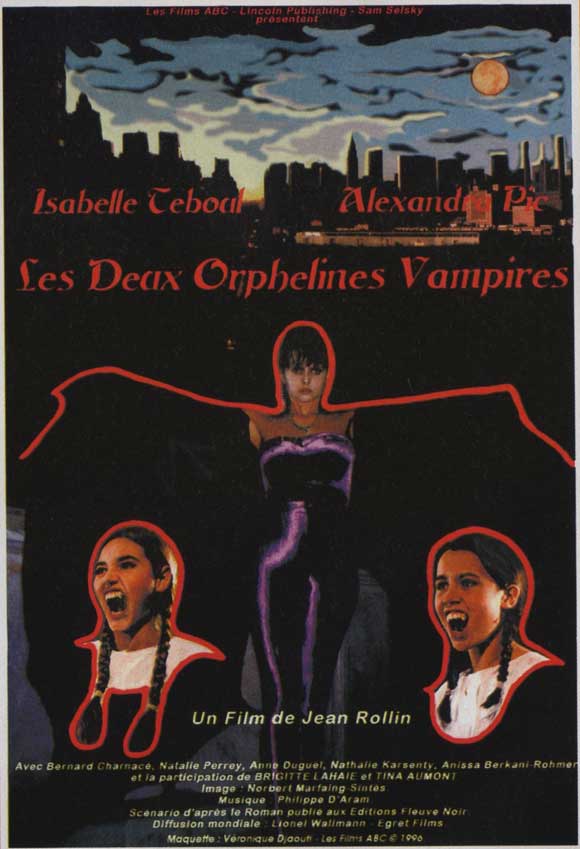
Representing France: Two Orphan Vampires (1997)

From http://images.moviepostershop.com/two-orphan-vampires-movie-poster-1997-1020492359.jpg

Dir. Jean Rollin

It's a delightful surprise that this film doesn't feel like a nineties horror movie at all. As much as I'm obsessed with the nineties, one of the reasons I'm obsessed with it is the tackiness of the era as well as the positives. Not a lot of horror films from that decade are celebrated, as compared to other eras, for this reason.  Jean Rollin didn't make a tacky film in the autumn/winter of his career here, thankfully making a very interesting one instead. It's very much an art film, against other films of his I've seen, which must be beared in mind. It's amazing too that I can compare this film to the work of fellow French director Eugène Green, of The Portuguese Nun (2009), with his long, almost Bressionian moments of dialogue, dangerously near the precipice of pretentious but ultimately charming and rewarding in being a bit more freer to let scenes play out as far as needed for mood and effect. This is the same for Two Orphan Vampires. I will openly admit it's going to be a difficult film for people to digest, including those who like Rollin films. I will also admit that I've developed a taste for films that could be seen as "difficult", with small fan bases, but this one works completely for what it intended.

From http://admin.highdefdigest.com/picture/original/32953

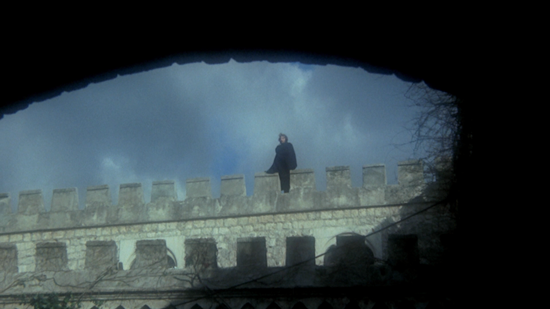
The titular vampires are two girls, Louise (Alexandra Pic) and Henriette (Isabelle Teboul), living in an orphanage ran by nuns, blind in the day, but able to see at night when they go out to feast. Immediately distinct in their identical clothes and white canes, the two are sympathetic in that, while they need to feed on the living, they are clearly close, engaging in their ponderings on existence, and obsessed with books on Aztec culture and magic while they believe they are reincarnations of the Aztec gods. The film is a series of events, ones from their previous lives, able to come back to life after being killed, as well as ones from their new life, as a doctor adopts them and they continue to explore the world around them. They do encounter other supernatural entities - a ghoul, a werewolf and so forth - but they are women too; in fact, baring the doctor, there are no male characters in the film baring extras or minor, one scene roles. (An interesting tone for the film in that it's a world framed entirely around women who have the discussions on the meaning of life as well as the small dramatic plots.) Its brief story is more of an engaging character piece, of characters doomed to repeatedly die despite their happiness, both girls concerned that they'll eventually never come back to life again at some point. Its abstract in a way that could frustrate people, but baring in mind, digging deeper with what Rollin was obsessed by, this is a waking dream of a film crossed with the kind of aesthetics of book illustrations that look exceptional when used in the opening and end credits of the film

From http://2.bp.blogspot.com/_n35PfUpWyak/TPwPrOEv2mI/AAAAAAAAZVg/
MIh3GTMdpbg/s1600/Two%2BOrphan%2BVampires%2B11.JPG

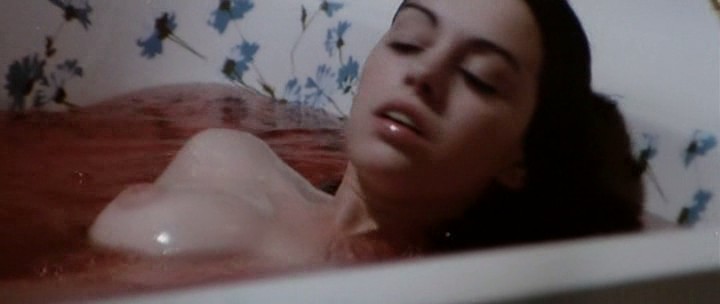
It doesn't look cheap either. I suspect it was shot on celluloid. It has an atmosphere, like the best films covered in this series of reviews, where from the first scenes it already sets up the mood immediately with the look and use of the locations and the space in them. The bright, vast locations of the day time to the blue lit environments of the night time scenes. His obsession with sexuality and sensuality is still there slightly in the vampires' relationship, including the sexual nature of how vampires bite a victim's neck that has always existed in the mythology, but barring two moments or so of nudity, this is quite a chaste film more concerned with friendship, and the bonding of Louise and Henriette, at times like teenage girls onscreen, other times very wise and adult in their reflections of the world around them. The film's mind is more on magic and supernatural creatures than carnality of other films of his I've seen. Probably the biggest reason why people could be put off Two Orphan Vampires if they're not prepared for it is because this strips away the blood and nudity in Rollin's films and leaves the unconventional plotting, where two vampires get bored of their predicament and do whatever they desire to escape it, presented not as a conventional three act narrative. For me it's nice to go through such an abstract, dreamlike film that paces itself well. The dialogue is all of interest even if its unconventional at times. It's an interesting take on vampires that doesn't compromise the mythology while adds new things for its own depiction. The two lead actresses are very charismatic as their characters, to the point that their potential ego in believing themselves to be gods is actually sweet natured and understandable pride in their existence than despairing their "curse". The distinct age fluctuation in their appearance in fact adds a strange air to the proceedings which makes their characters more interesting. The directions the film takes make sense - a world of supernatural beings who are methodical and languid, none of the hectic tone of, say, the Twilight films, and most horror films, where two vampires can kill time as best friends for most of the running time. Nothing feels contrived in the film in what happens, anything odd feeling appropriate for the dreamlike tone. It feels like spending a week with these characters in their immortal lives only with a few deaths at their hands taking place, and the danger they will be discovered and killed themselves adding dramatic tension. It looks good, and even if the score is dated synth, it feels like it's actually from the eighties, the depth of that era's music here to and adding to the material. There is nothing in Two Orphan Vampires that feels amiss, and that Rollin made a film completely against what is expected with these genre tropes is admirable, more so in that he succeeded for me.

From http://3.bp.blogspot.com/_n35PfUpWyak/TPwPhQPz1ZI/AAAAAAAAZVY/
1kZLEI5GMPc/s1600/Two%2BOrphan%2BVampires%2B12.JPG

Monday, 28 October 2013

Representing Belgium and The French Language: Female Vampire (1973)

From http://upload.wikimedia.org/wikipedia/en/d/d5/Female_Vampire.jpg

Dir. Jesús Franco

First of all, hopefully I'll be able to pick up from the few days I missed. The least expected thing - technical malfunction out of my hands and nothing to do with my computer - delayed the final stage of the season. It will have to run into November to make up for thirty one films I wanted to write reviews of. A conclusion for the series will have to be written in November or part of the next Month In Review too. To compensate today, I present a review of another Jess (Jesús) Franco film and the first in a group of reviews I wrote for Videotape Swapshop  to tie both places I write for together into this blogathon. 

It made sense, since I was diving into the director at the beginning of the year, going through his filmography slowly, to cover a film or two for this season. Considering how many co-productions he made, including for countries with no other horror films expect his to truly represent them, its befitting and also says a lot about how diverse his career was. And I have barely scrapped a body of work that's over a hundred films not including the re-edited versions. There could have been three of his films covered already, but Bloody Moon (1981), his West German slasher film, is one of the few legitimately awful films of his I've encountered. I rather champion Female Vampire. Merely poking the air next to the catalog of the late man, deciding to view his work when he sadly passed away this year, I can be thankful that its quite a solid series of films I've seen baring those couple of bad ones. Even something like Oasis of the Zombies (1982), which I reviewed on this blog, is no way near as bad as some of the films I've seen. I'm late to the party with reviewing Franco's films, with other blogs devoting themselves to his, but as a person who only saw a handful of his films before and barely had any primary knowledge of what his films were like, there's a potential for a really interesting chronology in these reviews, as the director gets the most tags to his name so far in the labels section for filmmakers, where I slowly get to know more and more about his style as I watch more films. I could be digging at his work for years, which means I may have to use other director seasons as mini-diversions, their thirty or so films a puddle next to the ocean of Franco's, and there's stuff by Franco, like his porn films, that are going to be difficult to find. Here at least I got to one of the first of his films I heard of, and I'm glad for what I saw. I only wish an available DVD wasn't very out-of-print in Region 1 or 2 as of yet. 

Also of importance, looking back on this film, is that Lina Romay deserves her own label in the Actors section of my site. Even if a lot of Female Vampire is near-explicit titillation, she was clearly more than mere window dressing in this film, turning the movie into something more sensual and interesting with her clear interest in how she presented herself. Its worth making this review link a moment of my own applause for both her and her husband Franco together. 


From http://images.dead-donkey.com/images/bscap1924wl3.jpg

Monday, 7 October 2013

Representing Greece: Singapore Sling (1990)


Searching for a mysterious woman, Laurua, who he has become obsessed with, a detective (Panos Thanassoulis) finds himself outside a mansion with a bullet in his shoulder, soaked by the torrential rain, and in an almost comatose stupor. The owners of the house, a mother (Michele Valley) and a daughter (Meredyth Herold), find him but its established in their introduction that they are sociopathic, burying the chauffeur they murdered around the same time. Together they lead themselves to a web of depravity where the three engage themselves in bondage, erotic vomiting, other fluids, and violence as the state of the detective is that of a living corpse. Singapore Sling is a notorious film, the only film by Nikos Nikolaidis that has managed to be exported outside of his home country of Greece, the film noir perverted and amplified into a disturbing yet erotic series of taboos being broken. It's the kind of one-off that exists to remain in the skull and wonder why films of its kind rarely exist as, despite for obvious reasons, such films would knock complacent viewers off their seats. It's one that justifiably horrifies and shocks people with where it goes, making some never able to view some things the same way again, but yet is created with an incredible sense of visual beauty and sensuality. It's a very confrontational film which yet could be argued to be as much of a really scabrous black comedy too. Think Luis Buñuel but with more openly explicit content, the "horrible" things viewed yet filmed in succulent, incredible black-and-white photography. The American noir hero and femme fatale - with the film running with an obvious reference point completely - are turned on their head with an almost somnambulist, mentally stunted detective who speaks Greek in inner monologues, and two women, a bilingual mother who yet has a cock, and a daughter (played excellently by Herold) who is a continually orgasming, ball of weird energy, who speak English and try to pry out of him why he is trying to find Laura, who may have been one of their victims.
The sense of horror - repulsion - is yet counteracted by the clear intention of making the material titillating in the right angle. No matter how disturbed most viewers will be by it, Singapore Sling does play off a tone with its power relationships that reminds me of S&M erotica; violent fantasies could be completely harmless and even healthy, the fantastical perversities allowed to be poured out, and the situation in this three person film, where the daughter "becomes" Laura at some point, is clearly aiming to delete and remove any moral superiority most films would have against the most perverse aspects of what is shown and seen. It's a film that dares not to have a clear cut morality to it as horror and shock cinema tends to actually have in their centres. If you could tie it to the horror genre, up to debate, its closer to the mirror side of the genre, along with exploitation cinema, where good taste and good morality is dissected and broken to pieces with the faraway possibility of perversion being cathartic. Even if Singapore Sling reaches an alternative conclusion to this on the surface, perversion still wins. Bear in mind that Singapore Sling qualifies as an art film, the term at its best suggesting something that dares to suggest bold ideas and shake the viewer out of their safety bubble, but means that you have to be patient and follow the film's route instead of instantly demanding satisfaction. At a languid two hours approximately, the film repeats its dialogue and scenes a few times, and significantly has the women continually breaking the fourth wall, talking about events, alongside the detective's narration, to us the viewer to the point subjective reality is up to debate. It will never explain the shocking aspects of urine and vomit, that scene with the kiwi fruit or all the regurgitation of food that evokes the infamous Otto Mühl sequence in Sweet Movie (1974), or why the hell a mummy is there representing the deceased husband-father.

Singapore Sling is a difficult film, but its managed miraculously, thanks partially to the American company Synapse Films, to build a reputation of its own; through a podcast called Mondo Movie, I was drawn to its existence when I was much younger and wetter behind the ears in this interest of mine. Even Dogtooth (2009), the other infamous Greek film that did one better and got an Oscar nomination, is conventional next to this with its unglamorous look and obvious use of taboos for a moral message of society, while this film look dreamlike and the content is not interested in obvious ideas on human interaction. It takes the darkened squalor of film noir visuals, back when celluloid film was commonplace, and mashes it through the philosophy of complete immorality as a freedom that feels more of 19th century literature than 20th century cinema. Befitting the decade it just got its foot through the door for, this was a perfect gateway for post modern films of the nineties, building upon the materials of the past directly to seek new ideas. But thankfully I can also say it's just a brave too. Very, very brave.

From http://s3.amazonaws.com/data.tumblr.com/tumblr_l5tedc8IDu1qzpdnho1_1280.png?AWSAccessKeyId=AKIAI6WLSGT7Y3ET7ADQ&Expires=1381271233
&Signature=6jcX2qGOAig1artZ%2BKzOLndcrhI%3D#_=_

Wednesday, 2 October 2013

Another Italian Entry, Babbling Incoherently: Black Magic Rites (1973)

Original Title
From https://blogger.googleusercontent.com/img/b/R29vZ2xl/AVvXsEgkHrB8V66rOzLuwN7nyT6pa0FIvhcqE3QYbnr_5x0Qck_DUolMaytiSRWbVsOSQ4T39AYLcZRNzgMYaTW4b-EWGKEtzpW2wHhRbj_UObL4Vq00mmhTXjbB9_s0OAsh89Kz907X_vKMkFUN/s1600/Black+Magic+Rites_005.jpg

Dir. Renato Polselli

For anyone who has seen Peter Strickland's Berberian Sound Studio (2012), this exactly the kind of Italian horror film he was channelling when he created the film-within-a-film, The Equestrian Vortex, that is heard but not seen. Made like a profound art house film but all about the gore, baring of female flesh, and various kinds of titillation. It's also completely off-the-rails in terms of tone and plotting, probably one of the oddest entries in seventies Italian genre cinema for me to see in a while. I thought I was in the groove for this area of cinema by now, but then this comes up and wobbles me off said groove. Even how I came about it and how it came to be on my To-Watch list is a mystery. Like the occult and Satanist shenanigans in the film, Black Magic Rites itself just materialised into existence. Attempting a cohesive take on the plot itself could be difficult. Not because it's very complicated and abstract, but like quite a few of these European horror films, the very simplistic plots are used more for mood and you can have the rules flipped by the creator wanting to introduce a new plot twist into it even near the end. Call it Jess Franco Logic, where nothing is to be expected from even well worn material, and if you're lucky the results are rewarding intentionally and/or unintentionally. An engagement celebration takes place in an ancient castle, only for the dark secrets to make a beeline for the women, especially virgins, in the spare rooms. A witch was burnt centuries before, and not only do Satanists want to resurrect her with female donors, but reincarnation and vampires are involved too. Don't attempt to guess the point. Right from the bat, with its swirling colour wheel opening credits, and a woman being sacrificed on a ritual table, this is a complete masala of influences, of various different ideas crammed together. What you gain out of it is up to you.

From https://blogger.googleusercontent.com/img/b/R29vZ2xl/AVvXsEhhvunEDo_50RgU9Dg647P2tk7aQEIojxe79QrgiTRndwrEgrr8dvE-v99ygD799530cbVZDxWyWwMk9zFa3P-L40pv-qLlip8dZVuqAk0KCFHgQYYFb_DhpXeb-0g_y1cvB6wObjXEWChn/s1600/Black+Magic+Rites_006.jpg

Its every obsession within European horror, from the psychedelic to the erotic, and unlike a Jean Rollin film or other Italian made films of the time with a measured pace, this is a tonal mess that's compelling for this reason. It writhes with titillation and fake paint red blood, but acts like a prog rock filled art house film, and unlike a Jean Rollin film, it's not a measured atmospheric pace being presented to cohere it together. Its diffusion of time and reality, right to the end, is a mass of chaotic moments that suddenly happen. People being in two places at the same time. Random village folks attack two women suddenly for being witches. Random comedy moments take place. Said comedy moments involve Steffy (Stefania Fassio), who fully evokes the bizarre nature of the film; a thin brunette who is over exaggerated in her behaviour, always falling over, and completely impervious (and blissfully ignorant) of the gothic horror events around her in favour of romping around in a bed with a blonde female friend and her boyfriend with an excessive facial tick. The film around is as oblivious to its content as these characters, a series of non-sequiturs, as exaggerated and ridiculous as her. Almost every actress onscreen is seen topless. No idea, such as a trap involving a crushing door mechanism with knives on it, is rejected for not making sense for that moment. It ends as one expect the story to, but how it gets there is a tangent in on itself, flighty and very camp to the point of being ridiculous.

From http://admin.highdefdigest.com/picture/original/33010

It works as it belongs to that rare breed of films that cannot be called "so-bad-they're-good" because there is a silver of real virtue to them to put them above being incompetent. Black Magic Rites has a few at least. With its music, and its willingness to go completely dreamlike to the bafflement of this viewer, it will stay on the mind for at least a while where other better made films wouldn't. A highlight is when a character is buried alive, but what's great about it is that I haven't spoilt the weirdly compelling convolutions that set it up or how the scene plays out. It would have been great if there was some control or focus to the material, but it has virtues in its mess. As for its unintended effects, it redeems a slow start quickly. A pointlessly long flashback moment nearly killed my interest in the film, but its cheesy peculiarities eventually intermingle with its erratic tone and gets interesting quickly. Is it a good film? To be honest no, but it's not bad either. It has goodness in how it is so removed from dull, plodding horror films made from the same period that sadly outbalance the good ones. There is so much to gain from just watching a film so unruly, so unpredictable, that you can't guess obvious plot points or how they have gotten there in the story. And unlike films that are random for no point, chasing after this crazed film's tone is rewarding because everything does have an effect. Randomness if done badly, or trying too hard, becomes predictable and dull, why intentional attempts at something like this fail miserably. This sort of film itself is speaking a new language and someone like me gets a high from its atonal mutterings that feel fresh as well as ridiculously silly.

From http://cdn-3.cinemaparadiso.co.uk/clp/105073-4749-clp-720.jpg

Wednesday, 14 August 2013

F Is For... Flaming Creatures (1963)

From http://upload.wikimedia.org/wikipedia/en/thumb/d/db/Flaming_Creatures.jpg/220px-Flaming_Creatures.jpg

Dir. Jack Smith

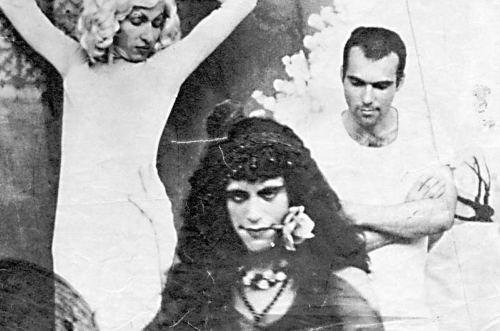
The only issue, posting this link up, is that the films of the late Jack Smith are not in availability outside of rare screenings. I'm only lucky to see his most famous film thanks to it being legally streamed on UBU.com, but even if the original film was intentionally murky, its probably a VHS rip. From my small bit of knowledge, Smith was known for re-editing and modifying his cinematic creations, which would make collecting the official versions together on DVD difficult, but it would be great to see a full length version, in a good print, of Normal Love (1963) which is only a fragment on UBU.com as well. One wishes the right person was reading this and could click their fingers to make it magically happen.


From http://blog.calarts.edu/wp-content/uploads/2009/11/flaming-creatures-2.jpg

Monday, 1 July 2013

Anime 18 Review Link: Malice @ Doll (2000)

From http://www.weirdwildrealm.com/filmimages/malicedoll.jpg

Dir. Keitarou Motonaga
Japan

Not a lot of words to say for the final link for the Anime 18 season. I intend to bring it back up occasionally or at least cover a few more of these adult rated anime for this blog or, if it suits the moment, on Videotape Swapshop, probably expanding it out to include releases never sold in the United Kingdom like the introduction suggested. And of course I intend to cover everything under the "Anime" medium including the family friendly creations. The following entry, closing this type of series off for now, is my equivalent of the film/anime/show that you randomly discover, no one else really talks about or gives raving reviews of, but fall in love with it. Its perverse to use "love" in some ways considering how nasty and uncomfortable Malice@Doll can get, but it has an odd beauty beneath its incredible dated computer animation and content. Other works have probably depicted the issues of one's condition within their own physical bodies more clearly, but this one's attempt at it is admirable and fascinating nonetheless even if its deeply flawed. I won't get into any further detail so the original review can be of some use. But I will close this post with the note that, as I'm reaching the one year anniversary of working on this blog with proper devotion, it's going to be the works like this that make up this blog's bread-and-butter, these peculiar and interesting oddities, even if they're mainstream releases, that rarely get their dues even in cult cinema reviews. Complete oddities, miscreants and the overlooked and choices that are contrariety on purpose for a reason. All of which will hopefully be interesting or I'll be pissing  hours up the wall without any sense of good work to it all even if its just for my ego.


From http://s59.radikal.ru/i164/1004/71/fa28a429f901.jpg

Friday, 19 April 2013

Mini-Review: This Transient Life (1970)

From http://somewordsandplaces.files.wordpress.com/2010/04/mujo.jpg


Dir. Akio Jissoji
Japan

From http://24.media.tumblr.com/tumblr_lsx9oqBoq41r0btqdo1_500.jpg

A provocative little film if there was any. A young man commits incest with his older sister, blossoming into a full relationship that is discovered by a monk who knows the family well. It is revealed over the nearly two and a half hour film however that the man’s behaviour goes beyond this, weaving himself sexually and transgressively with other people as he goes on with his goal to learn how to make Buddhist statues from a master woodcarver, the reason behind his taboo acts more deeper than the flesh. The main crux of the film is fascinating. It is very much a social realist drama in its centre – of morality, of religion (specifically Buddhism in Japanese culture), of sexuality and of individual isolation within human society – but it does not fall into the trap of what is stereotyped as an issue film. Tackling a very spiritual issue by its end in such a controversial way, it prefers to be restrained in its content, far in away more so than the dramatic swoops of more well known films, only switching from this with the more fantastical hallucinations the main male character has. You are not on his side, but you do not hate him, the characters in the film very complicated and compliant in the events that take place, including the ones that hurt them, both good and bad. The monk in particular could be viewed as the moral compass of the film or the most complacent and guilty party for not intervening in any of what takes place. If sinlessness is the true virtue, it must be won by engaging with the world then presuming to be higher than the sinner, as the sinner can be right in how a sinless life can lead to no true reward but is still guilty in their acts destroying others.

From https://blogger.googleusercontent.com/img/b/R29vZ2xl/AVvXsEgabeMm46iuiTWWZGXMSZd0u2lZ33wCI2gcASUNg8LgoasoC-o1aj4RaR5R4KZntxv4co3JZsJg1WR5xDSLRtH_J_Jml73CUolHDYEqmFIYSSKHZCZfkVoPO_YIj-bCL70o3pcwYw6KZdc/s1600/transient.PNG

This Transient Life is also an exceptional example of cinematography, stunning black and white photography, textured and rich, whether scenes are set in brightly lit environments or choked by shadows. It is very sensual and erotic, which compounded with some of the scenes being incest feels like deliberate provocations to get the viewer to think for themselves on the taboo. A surprising amount of Japanese art and pop culture tackles incest, for titillation and for serious dissections of morality and human behaviour, This Transient Life very much breaking down what morality is though a very confrontational protagonist who is himself, along with everyone else, scrutinised and sort through by the unconventional camerawork. Director Akio Jissoji has no limit to how a camera should move or be angled at onscreen, shades of Michelangelo Antonioni in moments where the camera leaves the people and tracks the geographic environment around them, the manmade and nature, with numerous types of camera movement and placement involved. Scenes take place shot in unconventional angles, and the camera moves as if it’s a character by itself, anxious and as much viewing the environment around the people onscreen, looming over them, as well as being as close to them in every detail as it can, their most intimate moments, especially the pleasures of sex in lingering images of naked skin, as significant in the camera’s eyes as the temples and buildings of the place depicted. That this director went on to make Ultraman films as well as more of these abstract works makes his filmography even more enticing rather than unexpected. The final results that make up This Transient Life are exceptional.

From http://wondersinthedark.files.wordpress.com/2010/08/mujo-3.jpg

Thursday, 7 February 2013

The ‘Unfairly Abandoned Film’ of Cinema [Showgirls (1995)]

From http://d.ratingmovies.com/servlet/Main/CoverDisplay/Showgirls_(1995).jpg?film_rn=996


Dir. Paul Verhoeven
France-USA
Film #27 of The ‘Worst’ of Cinema

From http://4.bp.blogspot.com/_Gdt6SgFdNNw/TFni7shemRI/
AAAAAAAASrE/DMyVFLuqjZw/s1600/showgirls_huge.png

It is amazing that Paul Verhoeven exists. There have been European directors, known for art films, which get put at the helm of Hollywood blockbusters. Verhoeven is something else. That he went from this box office bomb to the large scale 1997 adaptation of Starship Troopers – which has its cake and eats it majestically by both revealing in the nudity and gore, but with enough morality to make itself a satirical masterpiece that decimates the fascist tendencies of science fiction – is incredible. A director as intelligent as Verhoeven, and as subversive as he is still, would not walk into a film like Showgirls blindly. Following a down-and-out girl Nomi (Elizabeth Berkley) as she travels to Las Vegas with star struck aspirations in her eyes, the film is a fairytale. It is comparable to classic Hollywood melodrama, with its sweeping camera curves and brightly coloured and decorated environments, following a wide eyed young girl – Dorothy from The Wizard of Oz, Alice and her Wonderland – but one inside an NC-17 film with graphic nudity, continuous swearing, back stabbings and obscene neon lights. It’s Oz on a terrible cocaine daze, and where the monkeys don’t have wings but run amok around the dressing room and leave faeces over the stage.

From http://i68.photobucket.com/albums/i33/shannymaldonado/STILLS/AWP10SH.jpg

And wide eyed young girl is appropriate for Nomi. Berkley has been lambasted for her role, but it slowly dawned on me, once I got use to her abrasive personality and the twisted quirks of Joe Eszterhas’ script, that she is a little girl in the body of a beautiful but far-from-innocent woman. She is tough, but at times cradling or holding a symbolic teddy bear missing an eye, she’s also childish, pointlessly obstinate even to people trying to help her and consumes junk food like a five year old. She will have to learn a lot, or even less, committing questionable behaviour before she becomes Cristal Connors (Gina Gershon), giant mouth and teeth, sequined and moulded eyes and face, and Texas drawl hiding someone who has fought mercilessly, sadistically, for her top spot in Vegas. And that turns out to be Showgirls’ ignored virtue in that it’s a slap in the face, contained in a glamorous mirror, of this sort of place and of this kind of film narrative, full of betrayals that are petty rather than dramatic, slime horn males whoring out their female clients, while a strip club is at least honest and thoughtful about allowing their male client to see the women’s naked bodies, and insidious behaviour. Only Nomi’s friend Molly (Gina Ravera), a seamstress for the major Vegas theatre production Nomi becomes part of, is completely virtuous and free of sin, only to get thrown in the garbage in a horrifying way. Eszterhas’ script by itself is too lurid and ridiculous to be completely serious, but I have to wonder if Eszterhas himself or Verhoeven when he got the script realised that it worked in depicting a Las Vegas that is so wrong and bizarre as it is seen in the film and added to it. Three years later the adaption of Fear and Loathing In Las Vegas (1998) was released, but despite having only read Hunter S. Thompson’s original book way back in college years ago, the film feels too arch and kooky to work now when I rewatched it. Showgirls shows this place far more potently, more decadent and depraved, with only my memories of Thompson’s original prose as a more damning piece of this city of gold shown in the film.

From http://static.cinemagia.ro/img/db/movie/00/08/08/showgirls-853426l.jpg

The film is a sordid overload. There is so much female nudity, especially from Berkley who I did grown up seeing in Saved By The Bell (1989-1993), that it batters you senseless and yet, to its advantage, makes every moment of it stand out. The dialogue is legitimately abstract at times, perfectly conveying the melodramatic tone, of a young woman climbing up in fame in all its clichés, while being jaw dropping in where it goes, such as Nomi and Crystal, in the only time they have a friendly banter with each other, discussing eating the same kind of dog food in the past. Having worked with writers who have had absurdist ideas in their scripts, intentional or not, like the news breaks in RoboCop (1987), I can see Verhoeven in his second collaboration with Eszterhas taking advantage of how ridiculous the film gets. And if the film is camp, the Las Vegas shown is horrifying in its gaudiness in the first place, the reptile zoo Hunter S. Thompson envisioned while on mass quantities of drugs even more insane and over congested as a g-string and shrimp cocktail hellhole. Made in the nineties, the many clear layers of the film, even if moments of Showgirls do not work on this first viewing, are clear even if they are within an exploitative tone. It’s a far more fascinating take on the struggles a female performer has to go through – the pain, the leering from men – than Black Swan (2010) by embracing its scuzziness, rather than being above it, and by questioning the whole desire at reaching the goal if it makes you less of a human being. What could be Nomi’s potential love interest (Glenn Plummer) skirts between the one who got away and another victim/predator of the Vegas strip because of his human flaws, while Kyle MacLachlan’s character, perfectly played by him, shows a two faced nature that is fitting for the whole narrative. Yes, the sex scene with him where Berkley flops around like a fish in a pool is silly, but its clear Verhoeven is between a balancing act between intentional silliness for humour and kicking this type of story in the ribs in a damning way.

From https://blogger.googleusercontent.com/img/b/R29vZ2xl/AVvXsEjiddSsljyA_HCfvJsU6uQScjQZYFGo0xe0TlHa9X5s64ceAuIrV8XN4nTO74UYf8t3YZIpP6oM2dCzWGd2EIe394hBJF0d1kzVrHR40FAwxW0d6qgqBiy_-LFlOSLa8Xnc5x-Mi0l-sHw/s1600/Showgirls+1995+Elizabeth+Berkley.JPG

It’s not the sort of film, sadly, that large audiences, and more sadly, film critics like, which dares to not be a safe art cinema drama which repeats everything we know of already, or a merely okay genre film which doesn’t push itself into taking risks, but something which is confrontational, is attempting its hardest in a sincere way to be something brave even if it has unintentionally funny scenes, and more of a taboo for critics, dares to skirt and question the line between being serious and satirical, not in a cynical wink-wink sort of way accepted now, but in a way that relishes the sleaze but cautions people of how terrible it would be to see in real life. It would be viewed as hypocritical, but Verhoeven actually managed to balance out the fine line between this in his American films by making sure the critiques of his own material within the films was poignant and black humoured rather than tedious moralising. Very few Hollywood directors dare this sort of thing now sadly, with maybe a few exceptions like Neveldine/Taylor being the only ones in existence, and sadly not getting the chances to make as many films like Verhoeven let alone high budgeted ones. Probably the shift to more teenage friendly content, probably not helped by Showgirls, waving the flag for the NC-17 rating, bombing as badly as it did, has affected this, but  I would also argue we’ve let the politically correct mentality, mixed with the hipster sense of irony, undermine American cinema, where films with sexual content are not actually sensuous  but passionless, where violence is festishistic or numbingly forced like Michael Haneke fostered on the world with Funny Games (1997), when once before very violent films like RoboCop actually made you cringe with real pain and horror even if you laughed or cheered it on. Feminism in cinema has been changed from being a real drive for women’s voices to be more heard of in films to being an excuse to accuse any film which plays with titillation or real sexuality as sexist, and the desire for peaceful liberalism hides a lot more morally objectionable and sick attitudes to violence in films than what Arnold Schwarzenegger did to villains in Total Recall (1990). Most films now are ‘edgy’ but have no actual courage to offend, divide, scrutinise, dissect  or willingly blur the lines between mere titillation and real intellectual meat, and finally seeing Showgirls after all this time, its disappointing something like this no longer, unless pigs fly, will get released in multiplex theatres if it did back in 1995. I want the people who like this as a legitimately great, or flawed but fascinating, film to crush the individuals that merely view it as empty, crap trash and take control of its cult following from them, the side where champions of vulgar auteurism on sites like MUBI.com and the legendary French director Jacques Rivette can bond over it, despite being on different spectrums of cinema at times, and give something like this the due it deserves or admit that it was a brave attempt that, fittingly, has survived many of the critics of the time who lambasted it.

From http://img11.nnm.ru/c/c/b/5/9/6955bdab97576f866108dbb82c9.jpg