Showing posts with label Genre: Martial Arts. Show all posts

Monday, 17 March 2014

Videotape Swapshop Review: A Chinese Ghost Story (1987)

From http://mutantville.com/blog/wp-content/uploads/2012/01/A-Chinese-Ghost-Story-1987.jpg

Dir. Siu-Tung Ching

I've probably been watching too many trashier martial arts movies throughout the last through months. I adore their questionable dubs and erratic tones, but its good to watch one which is crafted exceptionally. Seeing this film again, you can see how much the Hong Kong cinema of the eighties was liable to catch the eye of Western viewers like me. Its also good to go back to this film when the first Siu-Tung film I covered on here was Belly of the Beast (2003) with Steven Seagal. This is not a cheap shot at Seagal, but reading the review below, or actually seeing A Chinese Ghost Story, you can see why I say this.

Review Link - http://www.videotapeswapshop.co.uk/19608/a-chinese-ghost-story-1987-director-ching-siu-tung/

From http://img.photobucket.com/albums/v394/Manos99/GHOST_STORY1-1.jpg

Saturday, 16 November 2013

Snake Fist of A Buddhist Dragon (1979)

From http://p.playserver1.com/ProductImages/1/4/7/3/9/5/593741_300x300_1.jpg

Dir. Henry Cheung

If Henry Cheung is able to read this, I apologise for the comments I'm about to make. But with only this film on his IMDB page, any film connected to producer Joseph Lai and director Godfrey Ho causes me to wonder if the director's name is actually a pseudonym. I rented this film under the belief that Ho, infamous creator of numerous cut-and-paste ninja films made from pre-existing material, directed it. He is said to have written this, and it's still a film "produced" by Lai. I have many guilty pleasures that aren't really that guilty. But there's only two in cinema for me so far that have become obsessions - nineties anime, sometimes great, more interesting when it's a fragment of a story that never got an ending, always fascinating even when bad, and c-level martial arts films with poor English dubs and terrible DVD transfers. Joseph Lai could in fact become the first producer to get his own tag on this blog because of my obsession with his films. I love the martial arts films because they are, except the occasional dull one, completely unpredictable. They exist with clear traits different from other martial arts films. English dubs that sound silly and for some reason always seem to have an accent I presume to be Australian when I could be deluding myself. Ridiculous martial art skills used in even basic situations like chopping wood. Jump cuts and tricks straight from Georges Méliès magic films. The only real sour note with Joseph Kai, depending on your tolerance to exploitative content, is the sexism more pronounced in a genre where, in Chinese and Taiwan cinema, there are very strong female characters in the stories too. You have to bare it in mind with his films, sleazier than what martial art films usually are, clinging over some scenes in this one despite one of them having a great trick from a character of spitting needles from his mouth. These films feel more and away more interesting than other trashy sub-genre work though because of how creative and bizarre they are, let alone the fact that the performers and actors are solid martial artists even in technically mediocre work.

The story begins with a group of Chinese rebels having to protect itself when an evil Manchu organisation kidnap a female member for information on dissidents. From there its somewhat pointless to try to explain it because of how vague and all over the place it becomes. It does involve revenge. An orphan raised at a Shaolin temple who is taught martial arts. Behaviour that frankly doesn't seem logical to what real human beings would do. And befitting how Joseph Lai and Godfrey Ho used to make new films with pre existing footage, a big chunk of this one is made from fight sequences that are clearly from other work, existing ones or, as Lai and Ho did as well, unfinished projects, padding out a plot from it. It becomes shambolic very early on, but this isn't necessarily a bad thing with Snake Fist of A Buddhist Dragon. There is something curious and utterly entertaining about the recycling of previous material to create new things, beyond sampling to references, the seems glued together to make this film's eventually collapsing plot work fascinating to look at rather than to mock. Barely held together with characters like White Tiger and absurd moments, usually in the many fight scenes, this feels like viewing the footage of all the pulpiest martial arts films in its purest form, churned together into a single movie. Cutting out lifeless moments when the pace sags or when it was no longer entertaining to watch on of these films because it descended into dull, expository dialogue with no gain to it.

Even with the "bad" martial art films, I've found that many still have so much to enjoy and get from as entertainment. Brief moments, even when the plot is threadbare and the swearing filled English dub for this film is hysterically poor, shining out. A fight scene that is still exceptional in terms of the agility of the performers, a rudimentary visual effect or wire work trick, like a flying tray of food at one point, all of which evokes a childlike wonder, that even a bad film can still be memorable in a special way, mixed with the adult glee of exploitation cinema and z-grade pop culture where anything can happen around the corner even if the plot's obvious. Things happen not quite as you would expect them to in this film, and it's fun because this happens. Unlike other genres, where the things that entice viewers (gore, sex) can too easily mingle with tedious, time eroding paces and forced-out plotting, the immediate advantage of even a film like this one, that the actors are still more athletically superior than even many in Western action films, and have no qualm with acting out the most brutal, ridiculous and showboating stunts on a shoestring budget, is always engaging even if the film itself is in shambles from the get-go. Even in a film like this you get all the theatrics crossed with a culture steeped in well taught martial arts whose history and beliefs still seep into a work written by Godfrey Ho. Physical people doing psychical fighting, back flips, kicks, elaborate counters and strikes. Physical stunt falls. Physical visual effects from wires to the clear camera edit, by human hand, where a person disappears and reappears a distance further in a peculiar, near stop motion effect. Even the regurgitation of pre-existing material, for a buck, and the dub are physically made, the battered print of these kinds of films, on DVDs by third-grade companies long gone, adding  to their material rawness.

As two sides collide, the good Chinese rebels and the Manchu group, the cacophony of material is compelling as if sticking random pieces of these films together into a Surrealist's cut-up martial arts film project. Where you can have razor blade sewn into your cape to slash at people, but don't fear it stabbing into you as you were wearing it. Where you can get a hostage released by sneaking into the villain's lair and cutting all his hair off in his sleep, more significant as he is legitimately dangerous when he's sober and not drinking. The vulgar, messiest and trashy of material can be the most inspiring even if it's to amuse oneself, and a film like this, and the many I can get second hand in a martial arts section of a nearby store, remind me that looking at the bottom of a barrel can be just as creative and fanciful.

Friday, 3 May 2013

Mini-Review: The King of the Kickboxers (1990)

From http://images.moviepostershop.com/king-of-the-kickboxers-movie-poster-1990-1020204106.jpg


Dir. Lucas Lowe
Hong Kong-USA

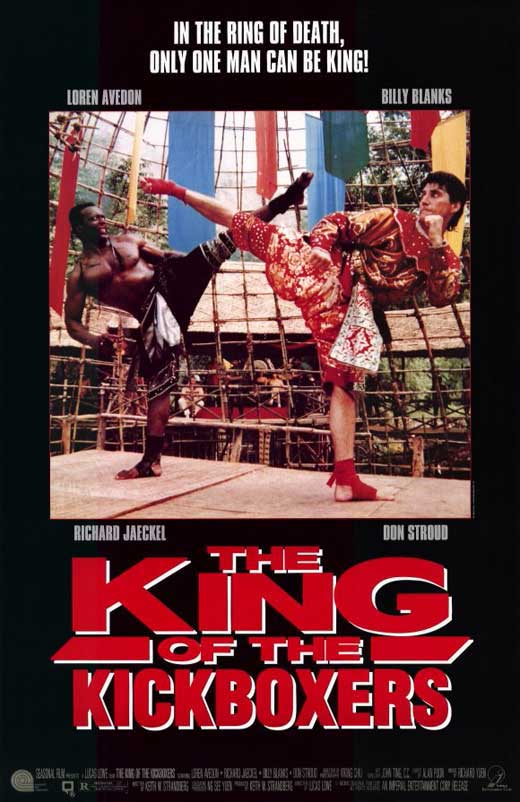
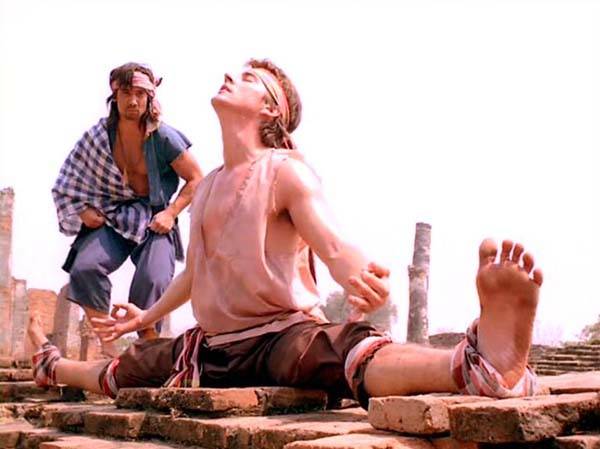
Ten years before, just after he has won the kick boxing championship in Thailand, the older brother of Jake Donahue (Loren Avedon) is killed by the uber-tough and vicious Khan (Billy Blanks, possibly influencing a couple of Street Fighter II characters just through his hair and fashion sense). Jake becomes a cop who plays on the edge, breaking protocols, who goes back to Thailand after Khan when he discovers his involvement in a series of martial art snuff films. In terms of look and ideas, The King of the Kickboxers does at least have something to bring to the table. A gruesome (and ridiculous) premise, some saltier and eyebrow raising dialogue, and an early nineties aesthetic of bright, primary colours and really dated fashion. The Street Fighter comparison is not that far off, and the final climatic battle in a bamboo cage of death is an admirable attempt at an interesting “boss battle”.

Unfortunately it’s a pretty bland early nineties martial film outside of this. Including a large segment of the hero training with comedic humour and a stereotypical blonde love interest, it never really tries anything interesting or peculiar. For a Hong Kong co-production, it also feels far too much like the (usually) blander Western counterparts. Godfrey Ho’s Undefeatable (1993) shows how these early nineties, American style martial art films can be memorable, and that film has solid martial arts fighting. The participants in The King of the Kickboxers, particularly Blanks and Avedon, are good fighters, but the fight style is limited and undermined by how the scenes, like many Western combat films, break fight sequences into pieces with the editing and camera shots. Ong-bak (2003) this is not despite the kickboxing and Thai setting. Also, blameable on the script, Jake is a completely unlikable arsehole, the snark for a hero like this pushed too far and making him an irritating individual, undermining the engagement with the protagonist absolutely needed in films like this no matter how ridiculous they are. The King of the Kickboxers is pretty forgettable.

From http://www.cityonfire.com/wp-content/uploads/2002/02/KingoftheKickboxers-KeithCooke_LorenAvedon_8bb989b4f05a522d92502e9304708243.jpg

Friday, 29 March 2013

Mini-Review: Terminator Woman (1993)

From http://wrongsideoftheart.com/wp-content/gallery/posters-t/terminator_woman_poster_01.jpg


Dir. Michel Qissi
USA

Unfortunately most films made are a waste of time, and when they have covers that suggest something rewarding, that fact stings more. I don’t even know why it’s Terminator Woman, except to cash in on James Cameron’s films, as science fiction or heavy metal lyric connotations the title has are nonexistent in this martial arts thriller. Sent over to Africa to transport a witness against the international villain Alex Gatelee (Michel Qissi), LA police partners Julie (Karen Sheperd) and Jay (Jerry Trimble) find themselves under fire. Both martial artists, Julie is kidnapped and attempts to escape while Jay, with the assistance of a boy called Charlie (Siphiwe Mlangeni) goes to get her back from Gatelee, a hidden plunder of gold bars in the centre of the web alongside the witness.

The film has two good virtues. Set in Africa, the environment in look and palette adds a unique difference to an otherwise conventional martial arts film from the United States. Karen Sheperd also stands out; while the fights are slower and less creative than their Asian counterparts, she does well as a prescience onscreen. Aside from that Terminator Woman is merely mediocre and forgettable. It pretty much goes to its expected conclusion without any real surprise to it, and Jerry Trimble, with a dated hairstyle, really does not stand out as a lead. That the cover and title is trying to sell Sheperd, the giant chunk of the narrative he takes up as the lead, without any sense of him commanding it whatsoever, makes him more incongruous. Even an abrupt, but amusing, sequence with dirt bikes cannot make Terminator Woman worth its ninety one minutes. 

African policemen are armed with crossbows to stop crime. I've only noticed this now, but its completely obvious in this screencap.
(From http://img.youtube.com/vi/EiW3xRGLIjk/hqdefault.jpg)

Videotape Swapshop Review: Street Fighter (1994)

From https://blogger.googleusercontent.com/img/b/R29vZ2xl/AVvXsEh6BOy-q4h33BceCrXBNCp98NhHtymJTHAeliSCmfZz_zV2dqtnfpyBYo2Ft5ST-jCGMVFcZWVVs4gVEmR847rpwD8Rpjk9tUQcExl29AWghWXxTCshz8uo2cRXA4fvRpjNkb6-lTyAk366/
s1600/street_fighter_1994_poster_01.jpg


Dir. Steven E. de Souza
Japan-USA

The final review for the March-ial Arts Month for Videotape Swapshop, and in contrast to Mortal Kombat (1995), this is the review of the nineties adaptation of its arcade machine rival with Jean-Claude Van Damme. Street Fighter won, but the reasons why are in the review.


From http://i836.photobucket.com/albums/zz289/05k21a0551/12-03-2011/StreetFighter1994720p-3.jpg

Saturday, 23 March 2013

Videotape Swapshop Review: Out for Justice (1991)

From https://colmseeley.files.wordpress.com/2012/05/out-for-justice-poster1.jpg


Dir. John Flynn
USA

Another review for Videotape Swapshop, and part of the ongoing story of my complicated relationship with Steven Segal.


From http://p3.no/filmpolitiet/wp-content/uploads/2010/06/Out-For-Justice-bilde-2.jpg

Monday, 18 March 2013

Videotape Swapshop Review: Project S aka. Supercop 2 (1993)

From http://i303.photobucket.com/albums/nn148/Captain_Video/ProjectS-Jposter.jpg


Dir. Stanley Tong
Hong Kong

Another March-ial Arts entry for Videotape Swapshop. Enjoy.


From https://blogger.googleusercontent.com/img/b/R29vZ2xl/AVvXsEjpvYFuuY4tN6W4Cbgak64VGj0N1O_8DhokUwRn9Wj-wNVPeXfLV0xLYfr0tuKEFYo036ykMpEcxyh9VstQo6Z7yBj8-dlLEJV-Ajg7l0El4nFdpAWbpRsZf8vWYln4JrhHNB1hxb32ADCt/s1600/ProjectS%252B1993-8-b.jpg

Tuesday, 12 March 2013

Videotape Swapshop Review: Mortal Kombat (1995)

From http://www.dbcovers.com/imagenes/backdrops
/grandes/mortal_kombat_1995//mortal_kombat_1995_1.jpg


Dir. Paul W.S. Anderson
USA

Not much has to be said about this review, the second of mine for the March-ial Arts month on Videotape Swapshop, except that fatalities, as expected from the game, are involved.


From http://images2.wikia.nocookie.net/__cb20111107190920/
mk/images/3/3f/Mortal.Kombat.1995.720p.Bluray.X264-DIMENSION.mkv_snapshot_00.27.40_-2010.07.10_03.41.03-.jpg

Friday, 8 March 2013

Videotape Swapshop: Ninja In The Dragon’s Den (1982)

From http://25.media.tumblr.com/tumblr_m81vc4RDx51qavxpso1_1280.jpg


Dir. Corey Yuen
Hong Kong

The following is the start of the March-ial Arts month on the site Videotape Swapshop. I absolutely recommend viewing the reviews by my co-writers as they touch upon some eclectic choices and even manage to slip Danny Dyer of all people into the season. How Dyer would survive in this film, with ninjas, stilt fighting and the use of ladders that would impress B&Q, I can’t tell, but the debut of Corey Yuen is still worth its weight in gold.


From http://cdn-3.cinemaparadiso.co.uk/clp/101946-6561-clp-720.jpg

Monday, 4 February 2013

The ‘Umpteenth Martial Arts Film For This Season’ [Sword of Bushido (1990)]

From http://savetorrent.ru/uploads/posts/2012-05/1336757387_d5022003a354.jpg


Dir. Adrian Carr
Australia-Hong Kong
Film #26 of The ‘Worst’ of Cinema

From https://blogger.googleusercontent.com/img/b/R29vZ2xl/AVvXsEiVB0JROqXvu2UwY_B9O_y1yj_iscYgkk0d-voR6Z3Bcfnkg95zMXJ6YuWYpO-t0nsfhoJpKg0luA7-kgWJ07YWN-vSLQAKgapOt7T5ediMYGix5EOaTkv7pnxchilT6MpJFpUOIIVfJDTN/s1600/bushido7.jpg

The amount of martial arts films I’ve covered for this season suggests that I may have an obsession, one beyond that I judged in the review Strike of Thunderkick Tiger (1982). I didn’t expect tonight’s review to be Australian though; I wondered if the protagonist Richard Norton was slipping in and out of an Australian accent in the first scene of the movies, and the end credits, yes to my surprise, informed me of this continental co-production. Martial artist/architect/marine/samurai/lothario of the ladies Norton travels to Thailand to locate his grandfather’s body and a legendary sword that, claimed by his grandfather as spoils of combat after the Pacific War ends, he wants to return back to the Japanese government. Starting a relationship with school teacher cum guerrilla fighter Suay (Rochelle Ashana), the two will have to contend with numerous individuals, including the yakuza, trying to claim the sword for themselves.

From http://s019.radikal.ru/i603/1204/6f/c3944b5231a1.jpg

Acquired because of the potential pleasure of a quasi-American Ninja film, from what the DVD cover suggested, the film for three-quarters of its length really does not go in that direction. Neither does it really present something else during that time either. Nothing really interesting happens. Its star Richard Norton is just a typical early nineties action star who doesn’t really project enough charisma needed for a film like this. He seduces a female office worker, in a really tight white office uniform in a graphically vaselined-screened sex scene, then when he goes to Thailand, he’s a almost super being, even defeating a talented Thai kickboxer who gets the green eye over how Norton and Ashana interact, but he’s not able to be more than a cookie cutter, white male action star. It doesn’t help that there is very little for him to work with, to the point it isn’t really a martial arts film.

From http://s54.radikal.ru/i145/1204/0c/db54f7b98206.jpg

The only time this film vaguely gets interesting, not redeemably so but not a waste of time, is when the yakuza get involved in the last quarter. I have no qualms with writing spoilers because this film is only worth viewing through clips. In the sole moment where a ninja, promised on the DVD cover, appears they commit one of the most embarrassing moments in ninjutsu history. While taunting the hero, after he’s had his head kicked in and is fleeing, a ninja is distracted to the point that he is hit by a bus and squashed. The entire populous of ninja cinema would want to separate themselves from the clan who has this unfortunate member, one who was taught the skills of ninja assassination but not basic road safety. The film itself becomes more relieving and interesting, not just with the climactic battle suitable for a martial arts film, but a car chase where Norton pursues the villains in a go-kart, the dinkyness of him sitting in it against the car he is chasing somewhat amusing, especially as he is the typical rugged, muscular action film lead. It cannot save the whole film. Those three quarters before this is unbearable. And even in the ending there are problems. It shows incompetence in the director, when you could have your actors speak in their first language to help their acting, you force them to perform in English, out of fear of subtitles, even more so when one of your actors Toshishiro Obata, to be blunt, is incomprehensible in what he is saying. This is dubious on the director’s part, and when Obata is your main villains, the yakuza boss, it’s also idiotic. The film as a whole is an immense mess, an erratic narrative that really is a chore to sit through until that incompetent ninja onwards appears. The surge of YouTube compilation clips was designed for films like this that have not enough quality to sit through the whole of. A sad thing to say, but where it not for those moments of pleasure, this would have been a completely arbitrary viewing experience. 

From https://blogger.googleusercontent.com/img/b/R29vZ2xl/AVvXsEiCwtXAQ1J-YXr-b9hGqIrnGMOwTYS82_17wWJJb34tX5nLSp1Jd4xTIK9V7R24jBJNDNT2xWKXwd_fm0K2bUzZT4-tTALrW2UsDIox8Xf3pvFoRkxug61WgemqTDjSvyn9mSNB_fNQDJU/s1600/bushido+3.jpg

Thursday, 17 January 2013

The ‘Dull’ of Cinema [The Ultimate Ninja (1986)]

From http://faf-media.findanyfilm.com/film_images/L_Synd4017-379635.Jpg


Dir. Godfrey Ho
Hong Kong
Film #17 of The ‘Worst’ of Cinema

From http://www.fareastfilms.com/cmsAdmin/uploads/ultimate_ninja3.jpg

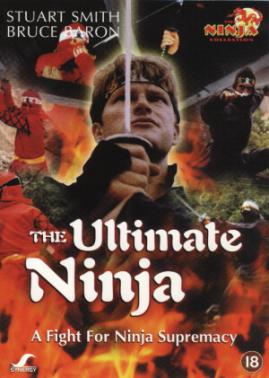
I may have hinted at this with my first review of a Godfrey Ho ninja film for this season, Ninja Terminator (1985), but his and his producer Joseph Lai’s concept of taking unreleased or unfinished films made by other people and splicing into them scenes of Westerners in cheap ninja costumes could have mixed results. While able to create films like Ninja Terminator, it could also lead to bad films like The Ultimate Ninja. The film consists of two parts that tentatively connect together. The first is a good red ninja, who we know is a ninja because the word ‘Ninja’ is on his headband, trying to get a ninja statue, of British seaside store quality in its tackiness, back from evil black ninjas. We know they’re evil because they’ve got skulls on their headbands, eliciting from my mind a moment where one of them, like in a sketch by David Mitchell and Robert Webb, looks at his headband and asking another “Hans... are we the baddies?” The second storyline, the original film redubbed into English and edited, is about a gang leader who takes over a rural town, and twenty years later, has his gang of thuggish debt collectors undermined and beaten up by an increasing amount of people who either want revenge or are fighting for the good guys.

From http://www.fareastfilms.com/cmsAdmin/uploads/ultimate_ninja5.jpg

The immediate problem with The Ultimate Ninja is that Ho attempted to make a new film with the material he had but ended up making something that doesn’t go anywhere. The original footage has far too many characters, especially on the hero’s side, which could have easily turned into a twisting of Seven Samurai (1954) or a Western with a team of heroes, but merely becomes a jumble of random scenes. Certain individuals would look identical to each other if it wasn’t for their hairstyles, awkward choice of English dubbing, and especially with one character with iron head and a sleeveless pink vest, their fashion sense. It isn’t an interesting film at all, the problem with Ho’s idea of making cut-and-paste ninja films with dull material as well as that which was entertaining, with rudimentary martial arts sequences and a blandness to its look and tone. The ninja footage doesn’t help either, with only one scene connecting the two aspects together, and not really working either by itself. There’s amusement to be had with a moustached ninja meditating on a picnic bench, but like the original footage the ninjas are interchangeable to each other and don’t get to do what Richard Harrison and ninja in other films did. They got to have motorbike sword fights, fight in car parks and suburban homes, throw smoke bombs and shoot flames from their sword handles, and do gratuitous back flips; the ninja in this are just white foreigners in low cost ninja costumes playing hide-and-seek in the bushes of what appears to be a park.

From http://www.sogoodreviews.com/reviews/tun.jpg

There are much better or at least far more ridiculous ninja films in Ho’s back catalogue. For a film called The Ultimate Ninja, the content barely stands by itself let alone live up to the title. The film is tedious. The amusement is occasionally there – including a training sequence which apparently couldn’t afford to get a trampoline, which even Turkish Star Wars (1982) was wise to have, and uses an obvious low camera to show a giant leap – but most of The Ultimate Ninja is a waste of time to view. Start with Ninja Terminator and go view other Ho/Lai collaborations instead, and only view this if you’re part of a secret, die hard cult of Godfrey Ho completists. 

"Have you noticed that our headbands actually have little pictures of skulls on them?"
From http://s3.amazonaws.com/auteurs_production/images/film/the-ultimate-ninja/w448/the-ultimate-ninja.jpg?1317228346

Tuesday, 15 January 2013

The ‘American Manga’ of Cinema [Double Team (1997)]

From http://cf2.imgobject.com/t/p/w500/kgFihiZdCqFYcvkc2udZ4BeTOz0.jpg


Dir. Tsui Hark
USA
Film #15 of The ‘Worst’ of Cinema

From http://www.thefancarpet.com/uploaded_assets/images/
gallery/1011/Double_Team_11980_Medium.jpg

An assessment needs to be made on nineties action films like this. A film like Street Fighter (1994) is in no way near as awful and reprehensible as the critical view on it is, as are many other examples like the movie I’m covering today. I am spending my twenties to slowly dissect the 1990s I grew up in, starting with cinema, and I truly do not remember the decade the way it actually was. It was a decade in hindsight that was completely chaotic, a fin de siècle decade that involved decadence, pre-millennium, millennium bug fed, anxiety and Vanilla Ice. In seriousness, it was the decade where post-modernism was felt in mainstream culture as well, something you could see especially in cinema of the time. Quentin Tarantino’s rise in popularity is pretty much the flagpole to this attitude of the era, in his breakdown of genre and self reflection, but the mindset could be seen in numerous areas of filmmaking, from Iranian art house cinema to videogame adaptations. American films of the nineties, especially the critically reviled genre franchises and adaptations of videogames, comic books etc., are a misunderstood, howling mass of gaudy colours, tonal shifts and pop cultural objects that are utterly fascinating and weird at the same time. Even by the end of the decade, where we view it through films like Titanic (1997) to Fight Club (1999), there were films like Batman and Robin (1997) and this. No one thought twice about making the immortals in the second Highlander film aliens.  No one realised the giant platform jump of making Super Mario’s Mushroom Kingdom into a grubby Blade Runner-like environment with Dennis Hopper, in Frank Booth mode, as King Koopa. And no one realised the pop cultural contusions Double Team would cause by putting together Van Damn, director Tsui Hark, in an era where Hong Kong cinema would drastically American action films from then on, Mickey Rouke and basketball star, and occasionally WCW wrestler,  Dennis Rodman within the same film.

From http://www.imcdb.org/i057066.jpg

Double Team is one of the closest things I have seen to a live action Japanese manga made entirely in the US, with the great influence of Asian and Chinese martial arts cinema, not just in Hark’s direction but an action choreography that was done by the legendary Sammo Hung. Bear in mind that manga is for all ages and genders in its home country, and of all genres and uses, so I am referring to stereotype of men’s manga that flooded the West, and I know of more through all the anime adaptations of them or within the same mindset, that were made, before the drastic change in audience after the 2000s. Action packed, a protagonist or two fleshed out enough to push forward the plotline, a twist or incident each chapter or page to keep the reader on their toes and show anything is possible in the story, and a bending, or complete abandonment, of physics to allow the author to create any imaginary set piece they can come up with. This is less bloody than this sort of material, and has absolutely no sex despite having the requisite fetish and gimp clothing from a cyberpunk anime in certain scenes, but the sprinting, delirious tone of them is clearly seen in Double Team. When he fails to capture the terrorist Stavros (Rourke), Jack Quinn (Van Damme) is sent to an island known as the Colony for spies and counter-terrorists that are too dangerous to set free but too valuable to kill off. With Stravros still on the loose, who has a personal vendetta against Quinn and targets his pregnant wife (Natacha Lindinger), Quinn has to escape the Colony and get the help of the unconventional gun dealer Yaz (Rodman).

From http://watchesinmovies.info/img/f/Double-Team-JCVD01.jpg

Van Damme’s filmography, while not thoroughly cleared through by myself, is far more fascinating than almost of his action star contemporaries that became big in the eighties, working with legendary Asian action directors like Hark and John Woo, able to suddenly star in, and act his heart out within, an abstract meta-film on himself in his home country of Belgium called JCVD (2008), and make utterly insane films like this. It is impossible to take the film seriously, and despite the negative lambasting it still gets now, this film was clearly designed to be as ridiculous as possible. That it has a serious strand to it, of Stavros having a justifiable reason to hate Quinn, fleshed as much as possible in this goofy film by having Rourke act in your film in any role, just adds a peculiar dark edge to a film that is full of elaborate tangents that are completely unexpected every time. The aesthetics of Hong Kong cinema, in its elaborate and complicated set pieces, is brought here with an even more comic book-like logic to everything that takes place.

From http://i4.minus.com/iblvPqLdpNYdEX.png

Van Damme does well, and despite being a little lost at first onscreen, Dennis Rodman at least has the visual appearance and charisma to really get into the swing of the film by its later action scenes. Even his puns based on basketball seem to have a cheesy coolness to them that is far from abhorrent. The aspect that makes Double Team work even more and makes its absurdity more distinct is Hark’s direction, very solid and made with great skill, using the camera movements and visual images to heighten the action and the lunacy. Knock Off (1998) would go even further in its experimenting – including a first person of a foot going into a shoe – but it’s easy to tell how talented Hark is even if his films I’ve seen aren’t always the best. I won’t spoil anything in the film as everyone who hasn’t seen it should go into it cold, so that the effects of the abrupt moments stand out more when you see them. It is amazing how tarnished it is even more so for me on this rewatch. It is insane, silly and comedic both intentionally and not, but far from mindless garbage when it has great action and fight scenes, looks great compared to films from the era like Double Dragon (1994) that, while I enjoy wholeheartedly, are a day-glo mess, and is trying as hard as possible to entertain the viewer. There is a sense that, not only was this not viewed within its own bubblegumish context back then, but that even now films like it don’t have the legacies of Rambo: First Blood Part II (1985) and its ilk, and have to deal with an internet culture that is far too hipsterish and ironic to view films like Double Team as sincerely ridiculous, especially when the films that are praised are self mocking or taking themselves too seriously. Thankfully people do love this sort of cinema too, and I won’t take back how much I love this film as well. I won’t call it a guilty pleasure either; I enjoy this film as a well crafted and great piece of cinematic bright coloured cinema.

From http://cdn2.screenjunkies.com/wp-content/uploads/2010/12/double-team.jpg

Saturday, 5 January 2013

The ‘Acquired Taste’ of Cinema [Strike of Thunderkick Tiger aka. My Name is 'Twin Legs' (1982)]


From http://pics.imcdb.org/0is146/strike1h.2843.jpg

Dir. Park Woo-Sang
South Korea
Film #5 of The ‘Worst’ of Cinema

Martial arts cinema is its own genre, not just a mere sub-genre it once was, with its own infrastructure to be divided into types of sub-genres, and marketable to a wider audience than many cult genres of film. Even the ordinary person on the street will find them in a supermarket’s new release section and buy it, something that The Raid (2011) will continue to a new stage for the genre.  It has its own section in the nationwide British store HMV, and its own shelf (or two) in the second hand store I frequent. The latter is a vast source of both obscure gems and truly the obscurest of this cinema, of scratched, English dub only DVDs from long vanished distribution labels of varying quality. I picked this up out of interest, but ended up (consciously or subconsciously) considering it for this season, not because it sounded awful, but because this sounded like one of those films that are usually viewed as bottom of the barrel in the genre but can turn out to entertaining viewing. Interestingly, it fitted the season as it is a South Korea film that has ended up with an entirely different person taking credit for its direction on the opening credits of the version I saw, and has the name Joseph Lai as one of the producers, the man who helped produce the films of Godfrey Ho such as Ninja Terminator (1985). This feels like the sort of films this man distributed, or at least cut from the same cloth of these low budget releases from the period, in terms of its recognisable and ridiculous English dub synonymous with films from Lai. In my experience with these films – where Godfrey Ho took credit for other people’s work, and Lai took credit for Ho’s, and where I have seen a cut-and-paste ninja film exactly like Ho’s infamous sub-genre of his own creation that didn’t have his name on it at all – this confusion with even the basic origins of this film and the disguise that it has had forced upon it is to be expected. It exists with a cheaper, more erratic or dimestore craziness than other more well regarded types of martial arts cinema, truly distinct even if it’s only written about in select films like Ninja Terminator.

From http://img.youtube.com/vi/A12Cv7bxN_Y/0.jpg

Three men steal a large amount of loot, only for one to betray the other two. When he is murdered, the other two swoop over his daughter, like hawks, to get information on where it has been hidden, only for an outsider with a dangerous skill in combat to intervene and stake his claim for the loot as well. Like the Lai/Ho films, and anything pre-existing they had their hands on, it starts as a simplistic one-dimensional film with absolutely no regard for boundaries in entertaining the viewer. As the hunt for the loot takes place – using a Rubik Cube as an important key of all things – you are bombarded by amusing digressions, dubbed voices and numerous fight sequences one after another.  From a period, decades long, where these films were being churned out, and the aesthetics of the 1990s onwards was a long way off, these low budget meat-and-potatoes martial arts films, especially those from South Korea (like this) or places like Taiwan, are fascinating. The fashion in this film – scarves, white gloves, denim jacket and jeans – alongside the hairstyles is a back catalogue of style far too concentrated in its nostalgia for most people that it would cause aesthetic diabetes of the texture cognition of the mind. The characters are one note but stand out for their looks and dubbing, including that reoccurring trend of Asian martial arts cinema of an effeminate (ie. gay) character as a joke who is as over the top in his behaviour as possible, one of the villains who wears a full body, blue stocking for part of the film and has a best boy pasted in lipstick and white blush besides him. Its eye rolling as always with this cliché, but like many of these films, at least he is a skilled martial artist who can handle himself. He’s also one of the few villains I have seen who, using an anatomy chart, goes out of his way to advise his minions about the combat prowess of their enemy to warn them of who they’re facing; it is such a poorly developed virtue in main villains that it shows so much in the incompetence of their henchmen, something this one can be grateful isn’t one of his faults. This film in the first half keeps throwing moment after moment that are charmingly goofy or insane; it stands out as eliciting one of the oddest thoughts I’ve had watching a film – “Wait, did the man bring a harpoon with him??” – only for it to become obvious, in a film that is 99% set inland, that the other main villain has indeed brought a harpoon with him to stab people to death with. When it disappears, thinking about it, the harpoon-shaped absence it leaves makes the choice of weapon even more peculiar.  This film even continues the trademark of Ninja Terminator in “borrowing” music from other sources, this time going one further and using Wendy Carlos' reinterpretation of Henry Purcell's Music for the Funeral of Queen Mary, the theme for A Clockwork Orange (1971), for one sequence.

From http://pics.imcdb.org/0is4/strike5f.3897.jpg

Watching films like this however, unlike the more infamous Godfrey Ho works, is as much an act of patience, even masochism, too that not everyone has. The martial arts in this film is solid and well done, but outside of this or the wardrobe department, no one is bringing their best to the material; it starts to become the ponderous, disinteresting work it probably should have been since its beginning and the entertainment on from this fluctuates immensely. Its charm is still there – as when it suddenly becomes a Christmas film in a montage sequence, an instrumental rendition of Jingle Bells set over images of the daughter dressing up as the anti-hero in only his shirt, jacket and a drawn on moustache – but its sporadic. Also like a lot of films from this type of martial arts cinema, including Godfrey Ho’s own sadly, there is a bitter taste of sexism, especially with having its main female character beaten up continually, including by the anti-hero himself at one point. It’s a major issue with exploitation cinema – that is designed to exploit taboos regardless of moral judgement and good taste – but it’s very incongruous considering this genre is full of strong female protagonists, and actresses like Michelle Yeoh, who stand on their own two feet as incredibly skilled and talented martial artists.

It is a film for only the die-hard viewer or the person like me who dives into piles of films and DVDs for movies like this, as it is a film that gets it merits mostly from its ridiculousness, not necessarily for a cheap laugh, but to absorb the juxtapositions put onscreen and moments of goofy surprise. A large quota of the films on that second hand shelf I cross past continually is full of martial arts films like this, costing a mere pittance and probably only viewed by those film fans willing to give their time for lesser films that could either be mere hastily made bad cinema or great c-grade pulp. Strike of Thunderkick Tiger, like many of them, elicits mixed emotions that change from bad to entertaining continually throughout it, and because of this it’s an acquired taste if there ever was one. 

From http://i.ytimg.com/vi/GrHkbqssc10/0.jpg


Tuesday, 1 January 2013

The ‘Stitched-Together Gem’ of Cinema [Ninja Terminator (1985)]


From http://img.movieberry.com/static/photos/33733/poster.jpg
Dir. Godfrey Ho
Canada-Hong Kong-United Kingdom
Film #1 of The ‘Worst’ of Cinema series

From http://imcdb.org/i194292.jpg
It seems a shame, although I hope there will be more films that I view this way throughout the season, that Ninja Terminator  has to be reviewed under a season that has the title The ‘Worst’ of Cinema. I liked the film before this review, and I love it even more without any shame; the point of the season however was to review films as well that, even if I disagree wholeheartedly with them, are dismissed as bad by other people. The film has a 4.4 rating on the Internet Movie Database as I post this on my blog – January 1st 2012 - but usually Godfrey Ho films are around 2.0 on their scale. While I fell in love with Ninja Terminator on this second viewing, and think it’s a good film in its accidental way, I can understand the low rankings it gets from other film viewers.

From http://static.megashara.com/screenshots/489190__snapshot20090424173920.jpg
Three ninjas (including actor Richard Harrison) steal from their ‘Ninja Empire’ the pieces of the Golden Ninja Warrior, an artefact that can turn your body and arms into living shields able to deflect even sword blades. Yes it has its weaknesses, such as the fact one’s legs could still be lopped off from under you regardless by a sword, but it’s a powerful artefact nonetheless and the Ninja Empire is on the hunt for the individuals responsible for its theft. When one of the ninja thieves is killed, it divides the remaining conspirators, Harrison’s Ninja Master Harry fighting for good, while his conspirator within the two years that have past is leading a crime syndicate and wants to claim the remaining pieces. Through his second in command, who dresses in a white suit and a lovely blonde, curled wig, and his own set of minions, the syndicate goes after the surviving sister of the murdered ninja to claim her piece of the Golden Ninja Warrior. To protect her, Harry sends in his own man Jaguar Wong (Jack Lam), a suave and skilled fighter who intends to help her and generally undermine the actions of the syndicate with his fist. Godfrey Ho, alongside his producer Joseph Lai, is infamous for this run of ninja films which take pre-existing films and re-edit them, intercutting new scenes of ninja combat and Richard Harrison, to weave together  new narratives using the English dubbing script and some blatant editing techniques. It was done mainly to capitalise on the bludgeoning obsession with ninjas in American culture in the 1980s, so it can be viewed as a questionable practice as well as ramshackle to the extreme.
From http://25.media.tumblr.com/tumblr_l4ftszf5E61qztwngo1_400.png
I view Ninja Terminator as an immensely enjoyable film though, but what makes it and a few other of Ho’s ninja films even better is that the attempt to combine two completely different sets of material into one single movie, through editing, inadvertently stumbles into the ‘Montage of Attractions’ theory that Sergei E. Eisenstein, the legendary director of Battleship Potemkin (1925), had developed. Like his fellow Soviet filmmakers who practiced experiments with editing and the concept of the montage, Eisenstein believed that by juxtaposing two single images together in a specific way would have a certain effect on the viewer, and that it could be used in different ways to have significant power to them. This is seen at it best with Lev Kuleshov’s experiment known as the Kuleshov Effect, where the same image of Tsarist actor Ivan Mosjoukine was spliced together alternately with an image of a plate of soup, a person in a coffin, and a young girl playing, each version having a drastic change in effect on the viewer in each combination. By utter accident, in an attempt by Ho and Joseph Lai to take unfinished and obscure films from South Korea, Taiwan etc. – not just martial arts films, but at least one softcore soap opera set in the fashion industry as well that was remade into Ninja The Protector (1986) – they ended up practicing the same methods Soviet filmmakers perfected to make numerous films over the eighties and early nineties. Some film studies students reading this may want to throttle me for comparing Ho to one of the most important directors in cinema’s history, or may be dismayed that someone used these techniques so that we can have Harrison communicating with the lead of the original film through a Garfield the cat telephone. The resulting creation turns out to be something special however.

From http://c.asset.soup.io/asset/3117/2460_5fc0.gif
With a plot that, because of two different sets of footage being spliced together, doesn’t really make sense, the film ends up being an abstracted version of these sorts of c-level movies. The tiers of each side face other but do not interact with members of their own side in other tiers, outside the moments when they are connected together by editing of course, and fights break out about almost every five minutes. Nothing is seen as ill-advised production decisions either. No one raised an issue about toy, motorised robots being the messengers of death for the Ninja Empire, walking into rooms under the veil of ominous smoke or getting stuck on the raised doorway, but its charming and hilarious to see especially when the robots boom with the voices foreboding doom on those who trespassed against them. Everything that transpires in the film either undermines conventions of plotting, such as having a henchman of the villains get his own prolonged sex scene, or what one expects in this sort of filmmaking, and would become bored by, making it almost avant-garde in its idiosyncratic savant mindset. Any moment it seems to slog through the minutes is undermined by the fact that something interesting, mindboggling or amusing is going to happen. Godfrey Ho and Joseph Lai, while they could be taken to task for their idea of generating as many films they could sell from existing materials, at least, when their creations succeeded, made movies that are entertaining, and used pre-existing materials that had something inherently watchable about them for any viewer even if they were trash. Even the ninja sequences, with stunt actors clearly doing the fighting in the cheap ninja suits for the likes of Richard Harrison, are competent and have skilled performers involved so that, despite most ninja fights in Ho’s films consisting of flips and repeated sword clash sounds, they never become poor, slapdash sequences found in martial arts films outside of Asia.

From http://img.gawkerassets.com/img/17fq078m8os00jpg/medium.jpg
Since this is a review on this site, this cannot end without briefly talking about the music. Some of it is dated but appropriate for the material. Some of it however is legitimately great; it’s not up to the quality of the famous cut-and-paste film Shogun Assassin (1980), whose score is combined with the images to add to its ghostly, phantasmagorical tone, but Ninja Terminator’s music choices adds to it immensely. Researching, it appears that Ho had no issues with “borrowing” music from other sources and there is a possibility that some of the music in the film is by Pink Floyd and Tangerine Dream. It’s an exceptionally dubious practice to take for a film that may have made money only for Ho and Lai, but decades later it is actually inspired and effective. How these films have not occurred the wrath of the original musicians, especially since they have been released on DVD unlike rip-off films that have borrowed music too, I have no idea. No one care, no one knows about their existence, or Roger Waters really adores cut-and-paste ninja films. We will never know.

From http://www.videotapeswapshop.co.uk/wp-content/uploads/2011/09/ninja-terminator03.jpg
There films of Godfrey Ho – not taking into account his self directed films, the ones he made with Cynthia Rothrock, or those made by other directors he merely put his name on and claimed for himself – can be hit-and-miss, as to be expected from a technique that can work immensely but also creates many unusable results even for artists who are using it for more than commerce. When they do succeed like Ninja Terminator, they do so greatly and its disappointing to merely dismiss them as guilty pleasures as, while it will be difficult to defend it to friends and loved ones, its Frankenstein form and tone is inspired and avoids the pitfalls of completely original material that falls into generic tropes. With this film generic tropes are cut to shred like an unfortunate watermelon Richard Harrison practices on with his katana and is repeated again later in the film to compensate for the lack of a second training montage.

From http://img.photobucket.com/albums/v218/Glupinickname/Blog%20gluparije/NINJA_Terminator_03.jpg