Showing posts with label Genre: 50s Sci-Fi. Show all posts

Friday, 18 October 2013

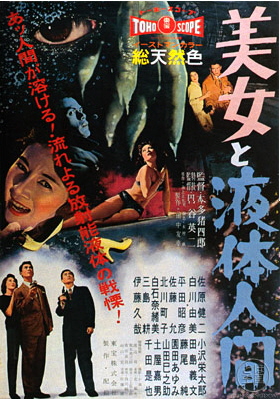
Representing Japan: The H-Man aka. Beauty and the Liquidman (1958)

From http://skreeonk.files.wordpress.com/2011/10/the_h-man_poster.jpg

Dir. Ishirô Honda

It would have been amiss not to include fifties, nuclear paranoia era sci-fi, having covered one last year, and it's one of the many choices I could have chosen from the boutique of genre films made throughout the decades in Japan. So many are there to choose; even if horror cinema only really came to be around the time of Jigoku (1960) and the influence of its director Nobuo Nakagawa, there are ghost stories and sci-fi monster films from before than I could have used. The same fears of nuclear fallout he tackled through Godzilla (1954) is yet taken to a different tone with The H-Man by director Honda. Godzilla was the ruminations of Hiroshima and Nagasaki through the wholesale destruction of Tokyo, potentially  symbolic of all the earthquakes that have beset the nation too, but with this film, it feels more concerned with the effect of nuclear aftermath, nuclear waste and radiation, the fear that a substance could get into the water. The film at first evokes acid rain in the first scene, but it gets more complicated than that.

From https://blogger.googleusercontent.com/img/b/R29vZ2xl/AVvXsEgav9iwKDDTF1fh4GPr0RNExpL-0xcwNQRdCNbvmZOTX6cy1Ujw2u9RVOd1emBOfGOHTLY5gOL4Ej48_ZVRWdddrCwwecKZdBVhoLr2UQxbCvVYDVCH62TFjzpXM188ACHu9nrHxHvjb9wI/s400/H-Man+%25286%2529.jpg

A drug runner suddenly vanishes one night when trying to transport a large package of narcotics. In the middle of a street, in heavy torrential rain, all that is left of him is a pile of clothes dumped on the road. It's presumed, logically, by the police that it's just a bizarre coincidence surrounding the per usual yakuza infighting, where the gangs are going after each other and the drug runner has ran for his safety, leaving his girlfriend, a club singer, to fend for herself. But said to be hopelessly in love with her, to being the kind of person to still try and see her even at his own risk, his complete absence is a mystery, and while there is still an issue with the drug related crime, another person vanishes leaving only their clothes. Only a scientist who studies nuclear radiation, who to the bafflement of the top police detective takes interest in the case, could have the answer, and it may show a horrifying threat for the entire Tokyo population. Very much sci-fi at its most fantastical. Horror as well, especially with an extended flashback including a "ghost" ship. Pretty gruesome when it shows what actually happens to the victims in sloppy, wet detail. Even if they're replaced with fake ones, toads get the worst of it in the name of figuring out what the protagonists are dealing with.

From https://blogger.googleusercontent.com/img/b/R29vZ2xl/AVvXsEi6tT0e7uDIJpdj2HZRGs6BaXUxCUOW9TUJpYN04ogYuFPRZN-zqYnclHNxc-bD1TbFD16N71kJv-bx0heh4GYEfPXzNeA1zhOIDby0EXn2hxz15tOwJrqqS3BafvA9nNtzR79joH16ocT9/s1600/AIP-2012-05-14-14h25m32s51.jpg

The Japanese sci-fi/kaiju/monster genre is barely tapped into in my viewing of Japanese films as a whole, but it's such a distinct genre in what I've seen while also having pieces of it that bleeds into other areas like anime. The bright colours to the images, glossy and rich, its foot between reality with the films between the fifties and seventies, but also close to both illustration and manga. A big thing about these sci-fi films, alongside yakuza films, is the amount of Western influences and how they almost drown out the Japanese origins of something like in The H-Man. Jazz instead of traditional instruments. (Great jazz pieces at that). The female heroine sings longue songs in English. Proto Pop Art deco for swanky, alcohol soaked nightclubs, one a prominent location in this film with local girls doing showgirl performance numbers in spangled bikinis. The gangsters here are in suits, slicked back hair and only carry guns, inching the film closer to the area of mukokuseki, cross-cultural works on film, that Seijun Suzuki went to with a film like Branded To Kill (1967). Post Second World War, when Western culture entered Japan in vast amounts, this is not a film that questions and or scrutinises this, like a Shohei Imamura film would, and even Godzilla had the first quarter of it set in rural Japan with its traditions clearly visible. No one raises a question about it, and baring certain things like the housing with interior paper walls, nothing pronounces it as "Japanese", more concerned with the story of people randomly disappearing. But it still manages to feel very Japanese paradoxically. The methodical pace. The willingness to depict such a premise completely seriously. The take on the fears of nuclear destruction spoken from experience. Even in being completely nationless in look, it's still very much a creation of Japan only.

From http://skreeonk.files.wordpress.com/2011/10/hman5.jpg

The H-Man is a b-movie. Pulp. The first viewing I found it dull and disappointing. This time I liked it. Opinions change in hindsight sometimes. It still drags by the end, probably because the cause of the incidents is not something like a kaiju that is visually frightening unless the icky practical effects are used, having to rely on the crime subplot for enough menace. But for a b-movie it was made with consideration. It has a grace to it, and at moments it becomes both freakish, and at least once or so far more sexual and edgy than anything that could have been dared done in an American film at this time. There's another example of the bravery in Japanese pop culture here which is willing to show with more vividness fears and anxieties, desires and fantasies even in something like this with its premise. Even in the simplest terms with The H-Man, just making something entertaining its creators went further and made this bright, gangster sci-fi hybrid film which mixes sultry, elaborate jazz orchestration with ominous fears of every drain pipe housing a dangerous entity based on real national scars. With an ending, without spoiling most of it for you the readers to watch it fresh, where you see the bay of Tokyo on fire, the water itself an inferno of flame, with a warning of the events possibly happening again, it neither comforts the viewer into believing it could never happen again, or that such an event couldn't happen in reality in terms of what is scientifically possible, not wrapping itself up in a quickie, happy package. It's still a happy ending, but unlike an American film of this genre, its Japanese counterpart, after seeing the brunt of war and the nuke, still desires to tell its viewers of the era, even if they're entertained in their cinema seats, not to be complacent about the dangers that a nuclear weapon or radiation, or a natural disaster or chemical fallout, could have when it's not a H-Man or a giant, god-like lizard destroying Tokyo. In the American sci-fi film I watched last year, while superior and still creepy, it was about the norm triumphing over an alien outsider. With The H-Man, it's not an issue of the norm being even in the centre of the threat, but that the folly of mankind, regardless of norm, can doom itself, and that even if the threat was an alien, mankind is responsible to keep on their guard rather than take their lives after for granted in a gee-whizz, apple pie mentality. 

From https://blogger.googleusercontent.com/img/b/R29vZ2xl/AVvXsEjCHFDge1ZJ6HTwI3tb9-70QxNVtuktY1CGjv0rPF4IlSfNKTilGOMr6vGB9w68Cc1Lh-3IZT6iOn8q363DOUg1QFapWMwg3wNpD6WX98bw6rTZVGROfCVnY49t7qbZW44j93bAN3UfVBVH/s320/hman22.JPG

Tuesday, 12 February 2013

The ‘Older, Eccentric Statesman’ of Cinema (Plan 9 from Outer Space (1959))

From http://1.bp.blogspot.com/_lKibK3oDtTk/S6uob2PsxII/AAAAAAAAABg/
doUnSx2Dqw4/s1600/plan_9_from_outer_space_poster_01.jpg


Dir. Edward D. Wood Jr.
USA
Film #11 of The ‘Worst’ of Cinema

The following is the start of the missing reviews for this season being made available on the Videotape Swapshop site. This film’s reputation is very well known, but what did I think of it?

Monday, 11 February 2013

The ‘Z-Movie Which May Be Smarter Than It Is Said To Be...’ [Robot Monster (1953)]

From http://3.bp.blogspot.com/_aoZjamlF5VE/S_iwdNVQYYI/AAAAAAAAAYw/
GXsovXTiA5Q/s1600/robot_monster.jpg


Dir. Phil Tucker
USA
Film #28 of The ‘Worst’ of Cinema

From http://2.bp.blogspot.com/_s_30zQFJp4g/SCdGyxnticI
/AAAAAAAAEEM/cpFJb70Ka68/s320/RobotMon.jpg

"The trouble with modern day films is that the actors and actresses seem to be showing off rather than acting...don't you think."
- YouTube Comment -

From http://i.imgur.com/jjRn1.jpg

I will argue that American genre cinema is not as unbridled and uninhibited as one wishes it could be. Japan sits on top of both categories as the unchallenged king, able to have deep questions on the human condition alongside two androids melding together into a phallic-headed man. After that every country has vast quantities of these ideals, especially in Europe and Eastern Europe. American cinema has its fair share of imaginary phantasmagoria, but there is also many ‘should-have-beens’, films which could have been more artistically creative, more pulpy, more crazier, despite the great ideas they had to start with. Fifties science fiction is becoming for me a vast area of all these virtues in American cinema even if the films are bad. The obsession with nuclear annihilation and the Cold War, mixed with an innocent sincerity, despite the darker aspects of the era, and the development of technology like 3D, creates a distinct tone to these films where everyone I’ve seen is difficult to forget, even if I am bored by them, because of their moods created from all this. Robot Monster, dubbed one of the worst films of the genre, is a lot more potent in its tone and creation than a great deal of bad films, as has been brought up with other films reviewed in this season, made decades later.

From http://24.media.tumblr.com/tumblr_m9vatnb3Ti1ra8pzzo1_500.png

When the entire human race, in a quite gruesomely nihilistic fashion, is destroyed, except for eight people, by cosmic death rays by the alien species the Ro-mans, the survivors have to content with the Ro-man charged by his grand leader to eliminate the last survivors. It is impossible to take Robot Monster seriously, but considering how legendary this film is for its titular monster, a man in a gorilla suit with a diver’s helmet for a head, this should vetoed from being a justifiable criticism. A real criticism is that, while this could have worked fully with such a low budget and small cast, a great deal of its sixty or so minutes is of the Ro-man wandering around the countryside and cave hideout. There is a fine line between moments of introspection and just having actors waddling about the shooting location, and just like being too reliant on exposition dialogue, it has undermined a terrible amount of B- and C-level films and quite a few blockbusters too. The sense of the gap in ‘bad’ cinema, the pregnant pauses and long, awkward passages of dialogue and action that catches itself out in comparison to ‘good’ dialogue and acting, which blends into the cinematic world seamlessly, is an obsession for connoisseurs of these sorts of films. There is a concern however that the border between the profoundly languid and comedic, and the utterly tedious, is up for debate. In the case of Robot Monster, for its benefit, it blurs, but other times you wonder why anyone would find any worth in a long drawn out of scene. Perversely this is the same concern that exists in areas of art cinema, the difference between Michelangelo Antonioni and Bela Tarr, in their use of slow, methodical camera takes, to a hack who leaves the camera on not knowing what to do. The difference is the latter isn’t discussing the awkward transitions in Plan 9 From Outer Space (1956) where actors move across screen to the next plot point or their next line.

From http://i851.photobucket.com/albums/ab75/paul_ayche/robotMonster33-03.jpg

Robot Monster is also peculiar – not weird, but peculiar in how goes with the concept of the end of humanity by an extraterrestrial force through a young boy’s mindset. This may spoil this film, or the one I am about to evoke if you’ve seen Robot Monster, but this film has the same narrative structure of The 5,000 Fingers of Dr. T (1953), the only film Dr. Seuss worked on, and one has to wonder, even if the film has glaring flaws, whether the writer of this film’s plot was purposely playing off the story as the sort of thing a younger boy would conjure up. With an opening title with sci-fi comic books and paperbacks in the background on top of each other, and the boy character wandering around in the first scenes with a toy space helmet on, with a toy ray gun pretending to disintegrate his little sister, is this film purposely playing itself off as, without revealing too much, a child’s flight of fancy? Considering the structure of the film, where an older archaeologist he meets becomes his father, his real one dead, and his assistant becomes the love interest for his older sister, and somehow this film that is dismissed as garbage manages to be actually interesting as cheapy sci-fi pulp that was shot in four days in 3D. This is not to defend Robot Monster as a great film, but like a lot of these films, it was an attempt at sincere filmmaking, and in this one, that sincerity shines through. The peculiarities of the film, of what Ro-man looks like and, more oddly, of there being scenes of stop motion dinosaurs or actual lizards fighting on tiny, model jungle opening sets, whether for the film or pre-existing footage, used numerous times including to depict mankind’s end, makes the film stranger. Why dinosaurs and overlarge iguanas? It is better not to ask and go with the surrealness of it. The Ro-man himself falls in love, or has inklings of physical passions for the older sister, and has an existential crisis about his function in life. The sister herself, an independent and technologically gifted genius, is literally tied up by her father and lover who refuse to let her act by herself by meeting the Ro-Man and having a negotiation of their lives with him in favour of a relationship. This sort of thing is far more interesting than what usually counts as entertainment in ‘so-bad-its-good’ films. Boom mikes popping up in the corner onscreen are amusing, but they don’t hold a candle to a creature, made from a gorilla suit and a diver’s helmet, being given a personality and a conflicting crisis about his existence of a drone.

From http://horrornews.net/wp-content/uploads/2010/08/Robot-Monster-photo-5-400x300.jpg

This nature of what Robot Monster is – of what could have been a legitimately great film but is still memorable to see – is far more worth its weight in gold for me after a season of films like this than something ‘so bad’ you laugh at it. It’s a compelling failure rather than an excuse in film making product – like Sunday School Musical (2008) – that is completely worthless. I didn’t find Robot Monster to be the most rewarding of films of this ilk I’ve seen, but playing out as an adolescent’s imagination in cheap location scouting and costuming, it proves to be more than its reputation as a golden turkey suggests even if it’s just to illicit surprise and little else.

From http://wrongsideoftheart.com/wp-content/gallery/stills/robot_monster_02.jpg

Wednesday, 3 October 2012

An Inch Above Sand [Them (1954)]

From http://imagecache6.allposters.com/LRG/40/4058/AMKLF00Z.jpg

Dir. Gordon Douglas
USA
Film #2, for Tuesday 2nd October, of Halloween 31 for 31

While we may laugh at the saucer-tin saucers and the effects, modern film viewers forget that the American science fiction B-movies of the 1950s are all inextricably connected to the culture they came from. Following an outbreak of giant ants that have grown because of nuclear radiation and may become a threat to human life, this is completely threaded into fears of the nuke and nuclear fallout  of the period, after the atomic bombings of Japan and the after-effects, and in the middle of the Cold War and the fears around it. The film also admits that for most human beings, insects are disgusting creatures to them. Completely different to mammals with their exoskeletons and their mandibles, insects along with other invertebrate species are unsettling in their differences to us.

Considering all the other giant/killer/mutated animal films throughout cinema, from giant shrews to sharktopuses, rabid dogs who were once loving companions to our (potential) evolutionary ancestors the ape, humanity fears even its own fellow mammals, and all other species, subconsciously. Despite our apparent higher consciousness, and souls depending on your spiritual beliefs, we still cannot stand that the ‘mindless’ animals may survival long after our species perishes or that, if the favour was tipped to the other’s side, the chances of staying in the top rungs of the ‘survival of the fittest’ would be 50/50. As one of the characters points out directly, ants have intelligence and are a species with a concept of war and hierarchy, and if they developed higher intelligence, or grew to the size of the ones in Them, it would make them difficult competitors in a conflict with us. All genre films, even if it involves accepting many are made for money only and having to either improvise or pull ideas out of your backside, show metaphors and fears of humanity within them regardless of the quality of the product itself, or at least show a perspective on social anxieties and thoughts. And it doesn’t have to descend into pretentiousness either as many can be read immediately and sometimes just before watching the film, only adapting it afterwards and the actual material redevelops the establishing thoughts. The films so far for my Halloween viewing all have layers even if one was paper thin. Vampyrs (1974), the aborted first film for my work which is still useful to pull from and as a scapegoat until I get over it, continues vampirism as a metaphor for libertine, alternative sexuality viewed as evil and degenerate by stereotypical Western, heterosexual, Christian society, and yet secretly is titillating and tempting, keeping with Christian issues of temptation and sin, especially if it involves nubile lesbianism. Even with the open minded liberals, including myself at my dumbest, they can see alternative sexuality as merely exotic titillation and nothing else, especially if it involves nubile lesbianism. Footprints On The Moon (1975) depicts a metaphor of how psychological breakdown can be viewed as completely alien, sending sufferers into places of their mind different from the world around them, and something that merely exists on another planet to certain members of society who wish to ignore it. Them shows how, despite our apparent love for animals (usually the cute ones), most of us subconsciously hate the fact that we’re animals like the untamed ‘them’, part of the food chain, and would want them removed, or eliminated with fire, from our human society. Also the fact that, if one grew to the size of a small skyscraper, we would fall to the bottom of the food chain immediately. That Godzilla has ‘God’ in his name may have more metaphorical significance then we all thought...that and the fact that, considering their history of Kaiju films I’ve still to dive into, the Japanese still show utter respect and understanding to nature and animalism even if its rampaging through Tokyo nearly every week and scaring the tourists.

Them does suffer when the ants are finally seen. It is solid, nuts and bolts filmmaking which does suffer from its constant expeditionary dialogue, and desire just to show mechanically created ants menace the cast and not go further with it, far from the opening segment where there is quite a menace that the preconceived notions of this film did not inform me of. Destroyed, isolated areas, bizarre noises in the vast emptiness of the desert setting where it starts in, traumatised children, all established by considerably striking black and white cinematography. As invisible menaces, even if you know what to expect and what they look like, they are sinister, hidden in the outdoor landscape despite their size and yet able to create vast amounts of casualties and damage. When the awkwardly moving, but visibly impressive ants do appear, the film sits a little on its laurels onward afterwards around them. That said it was still solid, good entertainment that gets over this problem, one of the few films in a while that was able to find humour in itself and yet, impossible to do now unless someone was brave enough, taking itself seriously and was matter-of-fact within its world. Almost every character accepts the concept of giant, radiated ants as true and get on with their work, while most genre films in the sixty or so decades afterwards would have the protagonists spending whole chapters of a film convincing people they are not crazy and this is actually happening. It’s refreshing when most of us horror and sci-fi fans are probably excruciatingly sick of the cliché, and I am surprised by a more ‘naive’ film from a ‘naive’ era cutting through the cop-out pretences and getting on with things. Also despite its flaws, Them still has the advantage in that, combining its premise with practical effects, it has the sense of the icky fantastic; the scenes likely to stick in my mind are within the ant’s nest in the desert near the beginning, vast isolated tunnels in the earth full of giant ants and egg sacks. I can’t help but reference videogames with one of the few I’ve played in years, and the rare one I actually loved, called Earth Defense Force 2017 (2006), whose primary enemies were huge swarms of giant ants and had countless levels in repetitive, claustrophobic mound tunnels; the game has probably made the already great Starship Troopers (1997) more entertaining as well as a satirical gem, and as a B-movie game probably influenced by this and Japanese cinema, it has made films like this for more joyfully engaging in their imaginative pulpiness. That it has the seriousness too and explicitly weaves ideas of the Cold War, atomic power and our fear of primitive animalism within its B-movie story adds to its charm. Eventually I may encounter a ‘bad’ film and have to review it, unlike Vampyrs, but two days in there is this great optimism that even the films like this - which despite its classic status and Oscar nomination for effects is a true B-movie at heart and is unapologetic about it like true art - will stick out and not waste time with laziness. It helps that, in reference to the introductory post I wrote before the reviews that, when talking about films you find in your local library that give you something different, this was a DVD I kept seeing in my local city library and was not disappointed by when I finally rented it. While most of the films the library stocks are new releases, regardless of the few eclectic choices, it’s nice to see a fifties film, an old timer, snuggled just above the children’s section and near films like Who’s Your Caddy? (2007) waiting for someone to catch it out of their eye out of intrigue. 

From http://s3.amazonaws.com/auteurs_production/images/film/them--2/w448/them--2.jpg?1289438382