Showing posts with label Genre: Crime. Show all posts

Monday, 2 June 2014

Nuits Rouges (1974)

From http://s3.amazonaws.com/auteurs_production/
post_images/11316/NuitsRouges_German.jpg?1340371135

Dir. George Franju

Pulp has an inherent artistry that is badly ignored. You can tell, even if you can't say how, when a story or a work defies the best of what the word means. No matter how unrealistic the set piece that takes place is, it makes logical sense within a great work of pulp as part of the world it builds. A western can satisfy going through all the usual tropes even as a chamber piece. An animated science fiction work can work a complete lack of realism with a tangibility. This applies to every genre or concept. It's mood. Franju, to his testament, took immense concern with this sort of idea - in an article, The Haunted Void based on an interview with Tom Milne, he went as far as dividing the kind of films he did in three categories. The cinema fantastique, le cinema de l'insolite (the unusual), and le cinema de l'angoisse (anxiety). In his defined terms, it's the concern of utmost respect for the material whether it's completely seriousness or a willingness to be silly on purpose without undermining the importance of the content. That it's about the unusual, the fantastical, the angst generating, mood and tone. What is not seen but felt. There are countless ideas in this area, about the notion of emotional reaction - the fear of the unknown, the uncanny, the erotic or pornographic, to defined cinematic ideas like Alfred Hitchcock's bomb-under-the-table metaphor. All of these examples, including Franju's, and more, are powerful when done properly. Unfortunately, you don't need to rant about the current climate to say that these ideas don't get their due. Which is strange to say when there are countless examples of filmmakers, critics and audiences praising the concept of pulp and yet it's still neglected in places. Probably because its dismissed compared to art house films a lot of the time even now. Fitting a French film I'm reviewing, France has contributed a great deal in this area, from the auteurist theory to the running joke about them loving Jerry Lewis  films, contributing to a consideration of this area of cinema they deserve praise for as cineastes. French takes on pulp in their own cinema from what I've seen, for the most part, have always been rewarding and their reflective tones add as much to them.

From http://image.toutlecine.com/photos/n/u/i/nuits-rouges-1974-04-g.jpg

This is as much of interest as, while not connected to his work, co-writer and star Jacques Champreux is the grandson of legendary Les Vampires (1915) director Louis Feuillade, the same tone of pulp aesthetics celebrated as in his grandfather's work is here as well. Also interpreted in a longer TV mini-series, which I am clamouring to see, Nuits Rouges follows a man without a face (played by Champreux), a man of disguises, head of a secret crime syndicate of black masked individuals, a thief, murderer and dabbler in illegal activities to boost his power and wealth. His most distinct trait is a cloth, crimson red mask, the only visible features uncovered being piercing, sadistic eyes. Learning of the potential lost treasure of the Knights of Templar, he murders a historian connected to the subject, and left with nothing, targets his son and anyone who possibly has clues to the whereabouts of that treasure. By any means necessary to reach his goal will be done - automated taxis, henchmen including an alluring femme fatale assistant, even the creations of a deranged brain surgeon, lobotomised people who can be controlled like walking corpses to perform assassinations. In his way is the son of the murdered historian, his girlfriends, a hired detective, the police force, and the greatest threat, a sect of the Knights' Templar not at all happy with one of their members being killed. A series of set pieces are loosely connected by this narrative, as if the film is an entire serial set within a hundred minute feature, the characters existing to represent their archetypes, absurd situations taking place, and a knowing humour mixed with moments of ghoulish brutality. A minimalist work in style. Loose narrative threads that play out in natural exterior locations and closed-in interior ones, with a muted colour and aesthetic look baring the use of deep, blood red. White Franju undercut the influence of Feuillade, there is still comparisons to be made with Les Vampires in that both used straightforward styles, limited use of camera movement if none, but inherently were dreamlike in tone because of how the content was depicted in such ordinary environments. So casually do events take place that it pulls one into a logic separate from conventional reality, with anything from kidnappings to police pursuits being performed with heightened tones. The characters have enough to them that you engage with their situations, yet by being minimal in characterisation, it creates a celebration of this type of plotting for the sake of it. Like his take on Judex, Franju can make the completely absurd sound in the context of the film's structure, and the intricate parts of the this content is clearly a Herculean task in having had to pull off. To be able to make a film that, as pulp, carries weight to the images and can accept the fantastical into its core without jarring is enough as it is. It's even more of a challenge if you don't use a self-reflective, stylised framework to express the content.

Very subtle uses of the camera are used, a close-up of a small detail given monumental importance. Despite the lack of camera movement, it frames scenes within rooms and exteriors with a scope to them that emphasises the events about to take place. Like the best pulp, one doesn't need to concern yourself with concrete, logical continuity, instead enraptured by the scenes carefully woven together at the right times so they build off each other and never become disjointed. Every criminal act is enthralling in its tenseness, every death stings, every plot point is exciting in ways not found in boring mainstream films. To be able to make the film as it is, despite being simple on the surface, the director probably had a difficult task on his hands with this. The work is a paradox, between classic turn-of-the-century crime thrillers and the seventies, the cars and technology of the time mixing with intrigue and suspense from a long gone era. It helps to add a fantastical picture to the film, more so now decades later, and places Nuits Rouges amongst the genre films of the era which exist in their own ghostly worlds, Euro pictures that feel alien even now. Like them too, this had the benefit of a Seventies synthesiser being used, adding a nice motif and thus proving its out-of-time placement when it was release was to its advantage. The film's roots lay in an older era in terms of how the story telling is, but that doesn't make it predictable on the first viewing nor the second when you know how the story concludes, as the events seen exist in themselves and, thankfully, have originality and jest to them that is sorely missing in newer films. It helps too Nuits Rouges avoids having contrived subplots and plotting additions that usually undermine genre cinema, no pointless romantic story to speak of for example, and instead lets the spectacle of the main plot, and its own tangents, engage the viewer.

From http://media-cache-ec0.pinimg.com/736x/f7/f7/3d/
f7f73dd9f68b0350f9d294a09c1453b1.jpg
When stripped down to its bare essentials, like here in Nuits Rouges, the concept of pulp storytelling is shown to have incredible artistry. Again, its perplexing to say that this kind of artistry is given its needed due, through fans of this sort of cinema, and yet is not, dismissed and with most critical accolades given to the stereotype of the art or morally improving picture, a dicey world of failed and contrived storytelling when it disappoints, when it badly needs the rigor of the genre pictures' filmmaking. Admittedly, pure luck is involved in some of the best of genre filmmaking, and everyone has encountered it at its laziest and worst. But when it works, the emphasis on a sound and study craft is lionised in these films the most, one that is badly ignored when you see how many throwback or homages to older cinema fail so completely. They are the filmmaking that led to Manny Farber to create the term 'termite art', the 'white elephants' opposing them not elaborate art films for me, but those films that are big, unwieldy and overrated movies that the moment you find one flaw completely destroys their foundations and collapses them, while the termites work silently and do make a big song-and-dance of their creation finally when they prove careful or at least rigorous style is the best way forward for the best films. In comparison to the magic of Judex, Nuits Rouges is the meat-and-potatoes of these sort of crime storytelling devoted to completely for a whole feature, of Machiavellian villains, a grittiness that is nasty but can given way to humour, and a constant pace where even the dialogue scenes have a trajectory to them. It manages to be merciless in its violence yet somehow be appropriate for children to watch according to the British film certificate on it, a contradiction its perfect craft allows. Its precarious in its plotting, yet manages to succeed, where the Knights Templar can suddenly be reintroduced near the end and not undermine what's happened before. Champreux sits in the centre of the creation he helped bring to life, almost bloodshot eyes piercing through everything in the mask, and managing to make the character dangerous even after his first scenes have him dressed up and impersonating an old woman running a sewing materials store. No one around him is allowed to merely be boring and paper-thin, everyone in a series of events that leave no random individual being shown onscreen with no contribution. Even if they exist only to die, it still hurts, good or bad, for them to kick the bucket. The film proves no illogical concept should prevent a film being a great piece of art, and a film like this in fact shows the illogical is a craft that outclasses realism in cinema at its best. Mood, tone, what makes you jettison trite attitudes like dismissing the reality of a film, is of the greatest importance in a film like this, verisimilitude that of its own world with its own logic, not yours you bring as a bias to the film. That this film can do this without heavy stylisation, which manages to be its own style, makes Nuits Rouges such a rare treat to see when, surprisingly, this is not as easy as you'd presume to film and make.

From http://nistagmus.files.wordpress.com/2010/09/nr07.jpg

Saturday, 21 December 2013

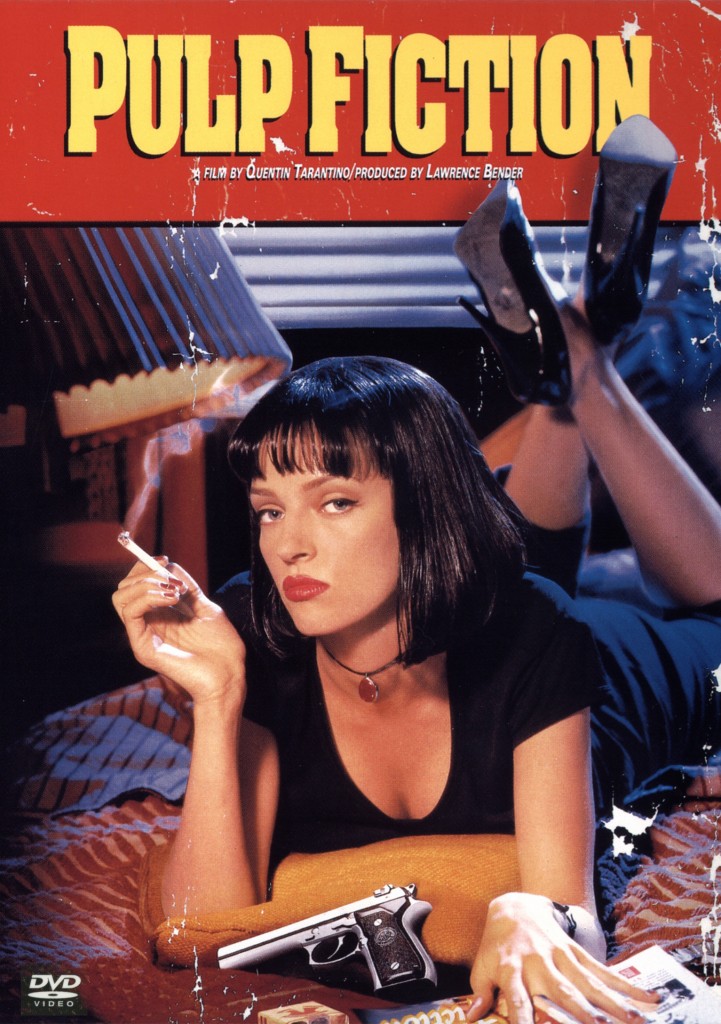
To Clear Through The [Re]Watch List #1: Pulp Fiction (1994)

From http://ahmedalkiremli.com/wp-content/uploads/2011/05/Pulp-Fiction.jpg

Dir. Quentin Tarantino

It's bizarre to actually watch Pulp Fiction. It's not a pop culture UFO everyone references and says is the best film ever made, let along made in the nineties, that people have only seen many years ago. You're not just saying "Royale with cheese" to yourself and imaging the film you watched in your adolescence years ago, a century almost for me now in how I've changes in my art tastes in only less than six or so years. You're actually watching it with near decades having passed, and with how Quentin Tarantino is now as a director, trying to reappraise it. It's amazing now that such a legendary film that, for better and unfortunately for worse in areas, drastically changed cinema culture and style was such a little film. Its effectively a slice of life indie movie...that just happens to use characters and plotlines from crime fiction and expand everything they do to pass the time into further importance at points. Rewatching this evoked the likes of Wayne Wang's Smoke (1995) and Jim Jarmusch as much as it did classic film noir and Reservoir Dogs (1992). Despite its length, the manipulation of time, and its cast, its far more concerned with imagining two hit man going to a drive-thru burger joint, even though this example doesn't happen in the film, and debating whether to get a cheese or Hawaiian burger between them. A former video store clerk who, in making Reservoir Dogs and Pulp Fiction, had completely sacrificed part of his memory bank entirely to cinema - flights of fantasy, sleaze, glamorous crime, which are purely fiction - but was as obsessed with how he and his friends would be sitting around shooting the shit eating Captain Crunch. The paradox still exists in his main auteurist flourishes now even though he's expanded the material to much more epic proportions now in his last two films.

My relationship with Tarantino as a director has been a complicated one. Like everyone, when I got into cinema as an adolescent, I was immediately drawn to Pulp Fiction and Reservoir Dogs. Then came the disappointment of Kill Bill Vol. 2 (2004), and my sole viewing of Death Proof (2007) was a painful experience to view its entire length, having such an effect that Inglourious Basterds (2009) would be a make-and-break on whether I would follow his films anymore. It was good but flawed back then, and Django Unchained (2012) was divisive for me back at the cinemas in January this year. Unfortunately the cult of personality that surrounding him, one that once encouraged people to find obscure genre and cult films, has become a plague on cinema in general, which would dampen your view of him unless you separate them from the filmmaker himself. By himself, Tarantino is becoming for me one of the few American directors whose actually an auteur, has the talent and makes films that are unconventional yet I can actually see in a multiplex because of how Britain embraced him from the beginning. Rewatching Jackie Brown (1997), I found an incredible film, and Inglourious Basterds has became ingenious in its ideas in its head on the rewatch. Pulp Fiction in comparison, is a minor work frankly, the transition from the lean Reservoir Dogs to the style that would be last to now, with failures, with stuff not as good as his later work, but a lot to love nonetheless. Despite potential issues with his style, his perceived glibness, he was touching on tics that were clever and underrated that he would expand on later.

From http://theartdepartments.files.wordpress.com/2011/03/pulp-fiction-144.jpg

What immediately becomes the key to seeing a lot of what Pulp Fiction is about is the Jack Rabbit Slim restaurant hitman Vincent (John Travolta) and Mai Wallace (Uma Thurman) go to. It's a place that's too cool to ever exist in real life - fifties b-movie posters on the walls, $5 dollar milkshakes that are actually worth the money - but it also comes off as a metaphor of having to reassess the culture of the 20th century, and even further back in history, and what individuals are faced with in connecting it back into something relevant. Directors have been heavy in their referencing of other materials long before Tarantino, especially with Jean-Luc Godard, but Tarantino has drastically changed the notion of doing this. However, even if he was to get a nosebleed and an erection just being in the proximity of a long unmanufactured brand of breakfast cereal, he was still able to step back and question whether there was any real meaning or point to how people assessed this kind of material in its littlest details. It's about the "little details" as Vincent describes being in Europe to his co-hitman Jules (Samuel L. Jackson), and in many ways their own existences, along with the others characters, is changed and affected by Tarantino by the little details he adds to them onscreen. It's cool for Tarantino to reference this stuff, but where is its place nearing the Millennium and onward? When everyone knows who Marilyn Monroe is but with context of her of an image, not as an actress let alone a human being. When no one has no idea who Mamie Van Doren is, more ironic when I've only discovered who she is within this year and have yet to see any of her films, except Vincent. That he also still says that the restaurant is a waxwork museum with a pulse despite digging it. The entire film, begun with a definition of what "pulp" is, is effectively trying to assess the place of these pulp characters - hitmen, gangsters, a bribed boxer, femme fatales, a pair of romantically together robbers - in a world where there's more concern about the meaning of giving another man's wife a foot message while a hit taking place is a per usual nine-to-five job. Its befitting in that definition of pulp he also includes the other use of it as a word to represent churned matter, as particularly in the nineties, an entire century's worth of pop culture seemed to collapsed in on itself in a concentrated mass, which asked the question of how one would use it from then on. It's not surprising Tarantino became the person to define this aspect in how he tried to work with it. Everything that he is obsessed with is reassessed in the context of what his day-to-day life outside of the cinema probably was like, and in doing so the concept of being connected to pop culture material was given to the characters within said material through his take on it.

And it is this that gives the film the best virtues, while the aspects that made Pulp Fiction iconic are, while good, of lesser interest or are even major flaws. The plot of hitmen Jules and Vincent is good, but suffers from Jackson feeling a minor character in his own pieces and a trite spiritual turn for his character later on. Yes, the Marvin (Phil LaMarr) sequence is something to remember, but the two characters have the best moments separate from each other. Jules with a word based standoff with Tim Roth and Amanda Plummer as lover robbers Pumpkin and Honey Bunny. Vincent with Mia Wallace. It's not the Ezekiel 25:17 speech which is the best dialogue for Jackson in that scene, it's that the use of language as a weapon, amplified the most as a concept for Tarantino in Inglourious Basterds, existed back then in the director-writer's work with Jules and the Big Kahuna Burger. It's not Thurman and Travolta dancing which is the best part of their plot, but their cute and awkward bonding. The dialogue is great from Tarantino, but for a man dismissed as not knowing when to stop talking, a lot of this film gets incredibly quiet and stand out immensely, especially one between Travolta and Thurman which leads to her talking about those "awkward silences". It's not the main plot about boxer Butch (Bruce Willis) on the run from mob boss Marsellus Wallace (Ving Rhames) that's the best parts of his story, but two quiet scenes with Willis and two actresses. With a taxi driver (Angela Jones) discussing what it was like to kill a man in the ring, and with Butch's girlfriend Fabienne (Maria de Medeiros) whose brief passage on how she wants a potbelly fills her out as a fully formed character in a single dialogue chunk and, for a director probably more obsessed at this time with Sonny Chiba films than romance, showed he could yet write emotional and passionate exchanges between characters. Even the music, which is a key aspect of Tarantino as well as his casting choices, is not the "trendy" music for casual tastes, but deep cut pop music for those who want to relax with something different. The rush of Dick Dale's take on Miserlou - quick, urgent, very short instrumental around what is effectively a quick, fast fingered guitar solo as a whole song -  over the opening credits is pitch perfect to get you quickly into the film. But the rest of the music, even with the iconic Urge Overkill take on Girl You'll Be A Woman Soon, is calm and lethargic. It's not aggressively cool music, but surf rock to ride waves on, bubblegum pop or very unconventional song choices that are great music, especially something like Flowers On The Wall by The Statler Brothers, but young adolescent fans of Tarantino would never give the chance to listening to. How he uses the music is completely against the image of cool soundtrack music, with characters just turning a radio or music player on to unwind, like Butch singing along to Flowers On The Wall while driving despite what has happened a few moments ago with him.  

From http://www.squabblebox.co.uk/admin/wp-content/uploads/2013/01/pulpfiction1994-3.jpg

The main issue within Pulp Fiction, even if it wasn't the one Tarantino intended in writing the stories contained in it, is what exactly to do with these fictional pulp characters he's watched countless times in films to keep them alive for the next few decades. By seeing what they'd be doing in their off-time. Literally what burger a mob enforcer would eat, and how'd he describe it, and far from a pointless discretion it forces you to actually think about these archetypes more thoroughly - in the plots, the dialogue, the switching of tones and all the pop references. Far from someone who just glorified violence, the violence is actually even more sickening because of being within the context shown onscreen, where even if you laugh at some aspects, the incident at the end of the Vincent and Mia Wallace segment is gristly. Far from shown as a blackly humorous as I thought it was, the rape scene in this is actually discomforting. It's just that Tarantino, in probably the only time he's ever had something legitimately weird in one of his films, still glorifies a samurai blade and makes the appearance of a leather gimp humorous around it. The film as a whole is flawed trying to be a pulpy genre film, because transitioning from Reservoir Dogs, he wasn't able to make it as interesting as in later films. But the important digressions from the plots is the virtue of the film, and when the two sides can co-exist fully, like Jules and the Ezekiel speech in the hotel, or Vincent and Mia Wallace's whole plot together, its seamless and vivid in character depth despite being archetypes.

The only real issue with this film, barring the flaws Tarantino would hammer out in his newly evolving writing and structural style from Jackie Brown onwards, is the issue of him using racial epilates in his dialogue that has been in criticism of his work for years. Immediately, the fact that I'm a white male means that I could be making excuses to defend something he should be taken to task for. But for me it's a lot more complicated than this. Both Reservoir Dogs and this film have very course language at times, but not only is it usually spoken from characters who exist within crime organisations and the underground, who would not be soft spoken and politically correct in reality or fiction, but it feels more like Tarantino was a very young guy too enamoured with edgy dialogue which he would transition away from. Django Unchained made me uncomfortable in its use of racial language, and its content in general, but that's a film intentionally making you uncomfortable and tackling American slavery head-on, meaning that Tarantino is at least now addressing these issues fully even while riffling on gory exploitation cinema. The only time he seems to step too far in Pulp Fiction by accident is the infamous "dead nigger storage" speech, which is made more unfortunate by the fact he's playing the character saying it, who suddenly from this aggression at Vincent and Jules tags along behind Harvey Keitel like a shadow for the rest of his screen time. The issue for me, and I understand I may be violently disagreed with in this issue, is that a white male is using terms like "nigger" in his scripts' dialogue but not in the context of a Oscar nominated film about racism.  But with characters using it in its various contexts as well as alongside edgy, pulp characters. I've encountered examples of this that I find far more controversial to me honestly -  the novel L.A. Confidential (1990) by James Ellroy is far and away more of a issue to digest, even for its virtues, because its the omniscient third person narration that is riddled with coarse language full of obscenities upfront. Here, Tarantino feels like a white man who listened to a lot of hip-hop and rap music, but may have stumbled badly in moments of Pulp Fiction over the context of certain words with loaded and complicated histories to them. But he improved drastically in this area immensely, where you can have Inglourious Basterds make an exploitation film surrounding the issue of the Holocaust, but not trivialise it and also make the film an issue about the nature of propaganda that ruminates on it. There are so aspects about the context that need to be thought about too. That Samuel L. Jackson and Ving Rhames are the kind of people who would not only flat-out refuse to act in a film they found offensive, but would have kicked said director's skull in. That Jackie Brown exists and Tarantino, adapting a novel, changed a white protagonist to Pam Grier. That more questionable material is allowed to be celebrated with a muted backlash to them - particularly in cinema where The Birth of a Nation (1915) is still seen as the beginning of modern American cinema. It's a debate that needs a whole term devoted entirely to itself. It needs writers and commentators of African descent to have the first words. I need to read up on it. But for me, Tarantino was a juvenile person writing Pulp Fiction, who would drastically grown up internally in Jackie Brown despite still wanting to make films like Kill Bill.

In its entirety, Pulp Fiction is a good film, great to return to. But it's a minor film. It doesn't make sense for this to be the best film in existence or even in the director's filmography. It's an experiment, a starting point for the directorial and writing style he has made his idiosyncrasy. Jim Jarmusch made better films than this. Tarantino's made better films. And unfortunately I have to wonder if an infantilism is involved here - a film you would encounter and dig as an adolescent, but you're unwilling to move on in your favourites of his in case it decimated your found memories of it. If someone has this as their favourite? I won't argue, good for them. For me, it's good, but its either Reservoir Dogs or a later film that makes him worth existing. This is a masterpiece only for the fact of its great individual moments, and that's taking into consideration I may become fonder and more appreciative of it on more rewatches. That he became who he is thanks to its success. Because this film is why I can see the director's peculiar and unconventional take of filmmaking in a multiplex for his last two films so far, at least giving me something different when everything else is not really interesting for me that week at the pictures.

From http://sgtr.files.wordpress.com/2013/11/pulp_thumb.jpg?w=590&h=378

Monday, 21 October 2013

Representing Switzerland: Jack The Ripper (1976)

From http://upload.wikimedia.org/wikipedia/en/3/31/Jack_the_Ripper_FilmPoster.jpeg

Dir. Jesús Franco


The Ripper (Klaus Kinski), a doctor, is prowling the streets of fog covered London, a Euro-specific version where everyone is speaking German and the world shown is built from German-Swiss construct, killing prostitutes because of an internal psychosis. However the police are slowly closing in on him, with the love of one detective (Josephine Chaplin) willing to gamble with her life to drag out the killer. Even if it could be the influence of the producers and crew on this film, a higher budget film from the director, this is not the only film from Jess Franco this atmospheric and very well made. With a career that has travelled numerous countries co-producing the work, the late director was very talented at his best, and Jack The Ripper is reminiscent of the British co-productions in their lavish looks. Unlike the British co-productions, this German co-production feels far more lenient to allowing Franco to express his more lurid, trangressive side along with mood. Far from the most lurid of Franco's work, far from the most violent or sexually explicit film ever released on British DVD, and definitely not the most violent or sexually explicit take on Jack the Ripper with the original graphic novel of Alan Moore's From Hell (1999 collected) in existence. But there is still things in this that, even with obvious prophetic effects, still cause one to wince with what is shown or implied, while still not overdoing for the sake of shock. Mixed with the mood the film has, expansive sets and darkly lit streets, it works together very well.

From http://farm5.static.flickr.com/4037/4317835170_08ba0ec4d3.jpg

Some may have issue with how most of the film is slow paced and has quite a few dialogue scenes, but maybe it's my personal taste here, but even with the plot reaching its obvious conclusion with or without the scenes, the dramatic and police investigation sequences were immensely engaging. Probably because, unlike an awful Franco film Bloody Moon (1981), these sequences are actually of interest for characterisation, plot or just detail. It was great that there's a side character, a blind man, whose amplified sense of smell and sound would ultimately doom the killer, in the beginning, to at least escaping the police by the skin of his teeth. That from the beginning he's going to be found out quickly, Kinski's character more desperate than calculated. That he's shown to actually be a person as well as a killer as a doctor. That there's comedy with bickering amongst the police and witnesses, and the witnesses themselves. That the cliché reason behind the killer's psychosis gets distorted through two very distinct scenes, the first through visual manipulation, the second a two person dialogue sequence played out through extreme close-ups of Kinski's face, showing that even if off-screen he was a reprehensibly being, he was still compelling onscreen in genre films like this. That, even if she becomes the per usual potential victim, Chaplin's character has a more calmed relationship with her detective boyfriend and gets involved with tracking the killer down entirely on her own initiative. The film, while possible to dismiss as perverse gloss, has far more subtlety than most films in this genre. Altogether its one of the better of Jess Franco's films. Not one of his best, but at least rearing the silver tier. It proves the work of Franco has quality to it, its graphic content mixed with a tense sense of tone. 

From http://farm3.static.flickr.com/2436/4317100987_12a8d5bab3.jpg

Sunday, 24 March 2013

Mini-Review: Family (2001)

From https://blogger.googleusercontent.com/img/b/R29vZ2xl/AVvXsEiVxMeGVkrfH0kEBrQKX5LK2q11xQ73bF1oUcVJfhLFVZbiWGyZzFByCnUUMPkrGgOq6aVuyY4o7ZQOgTFhbbLc64WQqgNzF8ZIBIWFDfngbJAHQ5HIZcIuIJR7LHdeWRqpBkVWBDcEt2Ml/s1600/family.jpg


Dir. Takashi Miike
Japan

I am a huge fan of Miike, but I realise that from a self proclaimed director-for-hire the massive output and the variety of formats he works in could lead to an erratic filmography. Sat between truly great films like Audition (1999) and Ichi The Killer (2001) is this work, bizarrely split onto two discs as two eighty or so minute films. A manga adaptation about warring yakuza, backstabbing and a budget large enough to afford a tank and a water-ski shootout, Family has the traces of all that makes Miike interesting. Brothers from a family broken into pieces by yakuza in different areas of the crime underground, a viewpoint from minorities in Japan, and a female character who is a Christian. Unfortunately it is an exceptionally dull story. Nothing in the film is inherently original or of interest, worsened by the technical quality. It is filmed on a cheap digital camera, which looks awful; Miike can use digital to his advantage, such as the probing of the image and voyeurism in Visitor Q (2001), but here it makes everything sparse and lacking. Miike also sadly continues the trend of using generic heavy metal music, at pointless loud volumes, over sequences that comes off as noise, surprising when he is very adept in his sound and music track choices.

It is a slug to get through both parts. It also makes the more gruelling sequences, such as a prolonged rape scene starting with molestation with feet, dubious. I will defend Miike over stuff like this, especially since he always, even in lurid genre works, makes such sequences discomforting and prevents the viewer from being able to shrug them off as merely sequences, but Miike needs to have made a good film around such sequences to prevent them from being merely tasteless, the result of which adds depth to them or sticks a metaphorical knife in the viewer’s brain to startle them. Since this is a poor film, barring some experiments with sound and image, such sequences just come off as pointlessly offensive, not helped by the fact that, while Miike is known for improvising or changing his scripts and stories during filmmaking, he is dependent on scripts being good or having something of interest for him to run with like many other directors. Family as a whole has no sense of Miike being fully engaged with it. It was made between some of his best work, showing this is a minor blip in his filmmaking, but unfortunately it is one of those true mistakes in a director’s filmography that discolours it. It is not an interesting failure one can learn to appreciate or actually love, by itself or in context of an auteur, but something so rudimentary you don’t want to own it even if it means a gap in the filmmography of one of your favourite directors.

Saturday, 23 March 2013

Videotape Swapshop Review: Out for Justice (1991)

From https://colmseeley.files.wordpress.com/2012/05/out-for-justice-poster1.jpg


Dir. John Flynn
USA

Another review for Videotape Swapshop, and part of the ongoing story of my complicated relationship with Steven Segal.


From http://p3.no/filmpolitiet/wp-content/uploads/2010/06/Out-For-Justice-bilde-2.jpg

Monday, 18 March 2013

Videotape Swapshop Review: Project S aka. Supercop 2 (1993)

From http://i303.photobucket.com/albums/nn148/Captain_Video/ProjectS-Jposter.jpg


Dir. Stanley Tong
Hong Kong

Another March-ial Arts entry for Videotape Swapshop. Enjoy.


From https://blogger.googleusercontent.com/img/b/R29vZ2xl/AVvXsEjpvYFuuY4tN6W4Cbgak64VGj0N1O_8DhokUwRn9Wj-wNVPeXfLV0xLYfr0tuKEFYo036ykMpEcxyh9VstQo6Z7yBj8-dlLEJV-Ajg7l0El4nFdpAWbpRsZf8vWYln4JrhHNB1hxb32ADCt/s1600/ProjectS%252B1993-8-b.jpg

Saturday, 16 March 2013

Beasts and (Savages (2012))

From http://www.cinematoria.com/images/films/savages_2012/wallpapers/savages_2012-en-1-1920x850.jpg


Dir. Oliver Stone
USA

A new review and something more recent. In the last week especially, in just two days of viewing films released last year, I’ve become more enamoured and optimistic about the quality of cinema still in just three films. And, gasp, they were mainstream films like Skyfall (2012)! Even Paul Thomas Anderson’s The Master is more a mainstream work because it’ll be more available than an obscure documentary about textiles from Uzbekistan or something that actually exists to my knowledge. It shows my concerned issues from before, that dangerously put me close to a snob, will always be about the film culture surrounding the movies instead. That and the large percentage of overrated films and those I should have avoided the moment I felt trepidation that I viewed. I realise that, as this thought grows, that the concept I had before becomes stronger as well. Do I qualify as a contrarian to the eyes of the likes of Rolling Stone magazine and The Guardian newspaper, or are there issues to be brought up of the damning of Oliver Stone’s new film that’s taken place? Before I get into the meat of the review, it becomes clearer that the need for self consciousness in one’s self is required. A film critic is supposed to teach the reader as well as recommend things to them, but as anyone who has gone through education should realise, as I did at university but could be learnt as far back as a child in primary school, it’s that for an education to work the student (the hobbyist, the fan, the scholar etc.) must be taught (and teach themselves) to think for themselves even if it means questioning the Master, to borrow the symbology from Paul Thomas Anderson’s film, to get there. To think for oneself allows skills to increase, and knowledge to have a use, while allowing you to separate yourself from herd thinking. Looking at Savages, and thinking about it, one wonders if it’s as much a cheap shot at Taylor Kitsch again (after John Carter [Of Mars] (2012) and Battleship (2012)), and the sense that Oliver Stone is no longer the ‘cool’ director loved in the eyes of popular film fads, that has coloured the apparent negative reviews of the film.

From http://images5.fanpop.com/image/photos/30400000/Savages-2012-upcoming-movies-30420931-725-463.jpg

Oliver Stone can be divisive for me. Some of his films I’ve seen are failures, but he made Platoon (1986) which is a great work. Savages is an interesting borderline between his political and sociological dissections, of the process of negotiations and methodical pacing, and the more erratic, and contextually and visually more confrontational works like Natural Born Killers (1994) and U-Turn (1997). The two sides create a perfect bed for the content, easy to dismiss as a generic thriller with a winking tone, but far more of a complicated animal I will praise Stone, co-script writer Shane Salerno, and author of the original novel it is based on Don Winslow for. When they reject the partnership with a Mexican cartel, the incredibly successful duo of pot merchants Ben (Aaron Johnson) and Chon (Taylor Kitsch) find that their shared love of their life O (Blake Lively) has been kidnapped by the group as a ransom and fight fire with fire in return. What could have been a generic, one note story of good and handsome heroes rescuing a damsel in distress from evil Mexican drug dealers is a far more layered, dense work. What I have had to learn as well is that, as much as I champion innovatively made films when I feel they deserve it, I have learnt how exhilarating it is to see well worn tropes, in plot, structure and tone, given freshness and richness through craftsmanship and a distinctiveness as seen in this film. It started with weariness for me at first with Lively’s constant narration over the first few scenes, fearing it would be an incredibly empty, ‘hip’ crime story, but it sinks in early on how no one in this film is clean-cut and morally black-and-white. Many films are like this, but Savages actually enforces this idea fully, staring back at you about this issue sternly as you follow its intentionally lurid, rush of theatrics it is playing out in its hands. Even if Lado (Benicio del Toro) the cartel’s heavy is a monster who assaults his wife and does sadistic things, the fact that early on we see him at a son’s baseball game as a dysfunctional father does not let the viewer get away scot-free from being on equal grounds with all the characters. As Chon keeps telling his friend Ben repeatedly, they will always have to resort to violence eventually and the world ‘changes you’, and Stone emphasises this. The well worn clichés and expected beats, because of the methodical tone of the film, are scrutinised – the corrupt FBI agent (John Travolta) is a family man with a dying wife and some semblance of consciousness still in him, the psychopathic Lado and all the Mexican cartel are human beings with families, and the loss of innocence for Ben and Chon, from the director of Platoon, and their transformation to mirror reflections of the other side is more apparent, as “Savages.” is used by both sides at the other at least once each. Ben’s Buddhist influenced desire to help the world is sincere and praisable, but that his best friend Chon, a former soldier in Afghanistan, has to be an enforcer to collect money from people who didn’t pay up shows that, long before the violence that takes place, he was already exhibiting the crippling flaw of hypocrisy that he doesn’t even recognise in himself.

Then there are the non-conventional aspects of the film. The pan sexuality of Ben and Chon, that O shares them as lovers and that, beneath it all, they love each other just as much, or more so, plays a fascinating (and applaudable) card of knocking over gender and sexual stereotypes from the creators of the film while emphasising the bond of the protagonists and adding to the script’s complexities. That this aspect isn’t made an upfront part of the narrative in a patronising, half-hearted liberal way shows a skill and greater subversiveness from everyone involved including Kitsch and Johnson in the roles. Also significant is that the leader of the Mexican cartel, the lord who presides over the riches with a bloody fist, is a woman, a mother in fact. Playing Elena, Salma Hayek is beautiful, even more so now as an older woman, but that also brilliantly by her in her performance and Stone’s part adds to the character. The expected gender roles of a woman to be followed in a patriarchal society – the doting mother who looks after the home, the paradox of the beautiful, sensual siren hybrided with the faithful widow who never remarries and has flings – are melded with statuses usually assigned to male archetypes. Elena is also the sole home figure (and breadwinner) in a family where most of the men were killed, the businessman, the leader, the boss, the bloodthirsty, the ends-justify-the-means brutalist who, to survive the precipice her group is near, deems it needed to behead opponents with chainsaws through the likes of Lado and has the footage sent to white, pot selling, naive surfer-types to frighten them into becoming business partners for her and her extended family to last. The mother estranged from her daughter emphasises a far deeper use of stock characters by her position within the characterisation. It is fitting, learning of this in university classes, looking back at this film through the knowledge that, at least in Britain before the twentieth century, there were housewives who, far from flimsy submissive creatures, had control of everything in the house (especially finances and what was done inside the home) and likely had far more control of the family than the husband. Elena is the mother who, having taken the cartel over after her husband’s death, proceeds to manage it as carefully and fully as she can, regardless of the carnage and its dwindling future. That this is furthered in making her captive O a quasi-daughter to her more sympathetic and thoughtful to her than her real one is to her shows a compelling dramatic licence that is sadly absent from films which were praised to the heavens, unlike this, but even to my virginal twenty three year old mind, were the creations of cynical hollowism, crass one-dimensional characters and unbearable whinging to the material.

From http://www.ferdyonfilms.com/wp-content/uploads/2012/11/benicio-del-toro-salma-hayek-savages-2012.png

The only potential issue I had with Savages is its ending which pulls the rug from under the viewer. It is wonderfully abrasive, but my issue with it at first, rather than being angry with it being a cop-out, was that not so long before it a gruesome plot point is introduced between O and Lado, who paws over the captive hostage constantly, that could make the ending queasy in the wrong way, as if ignoring the weight of what was introduced. Preparing for this review however, I reread the Sight & Sound review of the film by Nick Pinkerton that made me interested in the film (October 2012, Volume 22, Issue 10 for those interested), and a point he makes is that her narration is “selectively omniscient, occasionally unreliable” and while I won’t call her a “sybaritic sun-worshipper with a THC-soaked brain” like he did, she is just as compliant in the events that take place. A true victim of unjustified brutality, she nonetheless - emphasised (on purpose?) by Lively’s physical appearance, close to the tween high school girl fetishisation that, while not her fault at all in any way, is becoming a fad with male fantasies and Hollywood cinema – is also a blasé rich girl who, for her clear sincerities, is also ignorant. With a lack of concentration likely caused, as Elena states, from smoking pot since eighth grade, she fails to realise the obvious and tragic coincidence, when Ben and Chon resort to more extreme tactics, and how they mirror her captors’ behaviour. A man as intelligent, talented and skilled as Stone, regardless of his failures, would not put a disturbing plot point into a film and seem to shrug it off afterwards; it becomes obvious that, along with the carpet pull twist ending, that it, along with the violence beforehand, is supposed to leave an unclosed, festering wound in the viewer’s mind to stop them from forgetting the film and remind them of the ideas beneath the gunfire.

Fittingly, after the compelling but ultimate failing of Natural Born Killers, Stone melds its aesthetic with a strong core this time, director of photography Dan Mindel creating retina burning images and composer Adam Peter combining spaghetti western guitar riffs to pulsating electronica, a foundation that proves that great genre and pulp material can convey universal ideas of humanity more thoroughly than serious dramas. With one side ingeniously using their image of themselves from America, of gardeners and immigrants, to their advantage, alongside ruthlessness, against California types with ex-marine tactics and computer hacking, it allows Stone to prod American culture thoroughly. But it also allows him, even for a man like myself who has never held a gun let alone see a person die in front of my eyes, as someone who lived through the Vietnam War, to show that even if violence is necessary at times, it still means that your enemy is a human being who becomes a pile of blood and organs with a pull of a trigger. In hindsight to the first paragraph, it will be films that can do this that can keep me optimistic for current cinema rather than pine in a nostalgia I wasn’t born into. It must however involve questioning the mass consensus through my continuous education, causing one to view film opinion as idiosyncratic forks of personal opinion, as well as fact, and taking advantage of that. Hence, I’m going to have to defend Savages in a lengthier review like this because it brought these thoughts out from me.

From http://3.bp.blogspot.com/-rWdVTSEHV5k/UEBWLUJHKKI/AAAAAAAAVVM/fqfT-Bhx6aM/s1600/Taylor-Kitsch-and-Aaron-Johnson-in-Savages-2012-Movie-Image.jpg

Wednesday, 27 February 2013

Videotape Swapshop Review: Les vampires (1915)

From http://image.toutlecine.com/photos/v/a/m/vampires-1915-01-g.jpg


Dir. Louis Feuillade
France

Continuing with my Videotape Swapshop reviews, this is the oldest work I have probably reviewed yet anywhere, the legendary film serial from the same creator of Fantomas (1913), which I need to reinvestigate and actually watch all the way through. This serial is excellent though by itself.