Showing posts with label Genre: Psychodrama. Show all posts

Thursday, 22 May 2014

City of Pirates (1984)


Dir. Raoul Ruiz

Nobody can say why you go chasing a pirate down
the street but such a state of affairs makes possible
a certain number of anxiety dreams. Was it the pirate,
you ask yourself, or was it the paranoia?
          
from 'When the privateers returned from their pillage' by Steve Spence

There is no Johnny Depp in eyeliner complaining about why the run's gone in City of Pirates, a film by the late Chilean director Raoul Ruiz, a film made to be intentionally difficult to gain cohesiveness over, nor are there galleons or people walking the plank. A pirate can denote something outside of law and order, and honestly, it's too literal and tedious to immediately go to Depp when the idea of a place suggesting pirates is far more mysterious and befitting this film's dreamlike structure.  Many viewers will complain that there are no actual pirates in the film, nor cities of any kind, dismissing the allegorical versions offered. Personally I wasn't disappointed, the lights that seasonally brighten up on a bush in a character's "Garden of Allegory" representing the ones readied for a war between pirates and the country of Spain, but some may be taken aback by the fact that this never becomes important for an overall narrative, merely detail in a world to add character, and that one should be concerned for the battle on this plant when its discovered Spain has lost.


I admit to finding the film a struggle to sit through in the beginning, but in dealing with the film, the issue of what I brought to it in terms of residue biases is part of the subject itself. Isidore (Anne Alvaro) comes into contact with Malo (Melvil Poupaud), a young boy who is in fact a killer, descending into a non linear trip that includes murder and an island where a man Toby (Hugues Quester), owner of the Garden of Allegories, has an entire family living in his head. It felt too close to the stereotype of pretentious art cinema originally. But befitting the film, either it was intentional, or that I fully absorbed the tone of it, and avoided forcing my own subconscious tagging by narrative cinema onto it.That Ruiz partially improvised the film, creating dialogue just before shooting scenes, was a dicey thing to do, in terms of how it would affect the tone of the work, and I'm still at the stage as a viewer, while falling in love with City of Pirates by the end, that the opening quarter of difficult films like this can frustrate me until I acclimatise to them. I've only seen four of Ruiz's films and one short, from a man who made over a hundred films, shorts and television work. As well as difficulty in actually seeing his films, including this one, sadly you can have critical writing be very vague when it comes to the maze-like nature of his work - like the key needed to unlock the mystery in the centre of his The Hypothesis of the Stolen Painting (1979), the description needed to entice you into Ruiz's world, rather than make it sound like obtuse navel gazing that'll put the casual viewer off being curious, is usually missing.

Yes, many viewers will find City of Pirates' completely disinterest with linear cohesiveness frustrating and dismiss it, but the film is far from obtuse. Again for a second review in a row I can reference Un Chien Andalou (1929), and how it was made with every rational idea purposely excised from the finished work. With City of Pirates, anything that connected together the content in terms of a narrative was removed during the editing process. Ruiz, and I dare stake this claim, in a film set by the ocean as depicted in lush almost candy-like colours - hazy burnt pinks, oceanic blues, blistering oranges - despite seeing little of his work, is an individual who suits the metaphor of the Chinese boxes well. Even if the conclusion is there by the end, the greater significance is that the route through the films seem to be continually expanding as you go along, and altering into more and more tangents as they go. Like the following too:


As a film, any plot for it boils down to the protagonist tagging along with the child as his "fiancée", after he (or likely she) has murdered her adopting father, only to be pushed into an increasing sense that she herself is hiding a more homicidal person within her. What the draw of the film is, the greater importance clearly, is how this is represented. It's worth remembering too that City of Pirates is a film that's playful in tone. A lot of my problems with the film disappear when the adoptive father leaves quite violently, in an unintentional shift in tone, or possibly on purpose. The beginning of the film is jarring against conventional norms of narrative cinema. A sentient white ball that bounces by itself, the mother talking to the dead, random appearance by policemen, and the one unfortunate aspect that was either Ruiz intentionally mocking pretence or something that flaws the film a little, the use of actors quoting very descriptive poetry. I'm not a fan of poetry where elaborate vocabulary for whole verses is common, rather than use of metaphors, grounded yet imaginative verse, or completely visionary or intentionally nonsensical wording choices. There is still the poetry in the rest of the film, usually in duelling voiceover, debating existence and life, but it's not as problematic. That the more irritating aspects of the dialogue were all quoted by the father, who is continually offering his adoptive daughter/live-in maid money as if soliciting sex behind his wife's back, it is the possibility that its intentional.

It becomes clearer than mood and fluxations of it drives City of Pirates, and what appears to be slight and close to pretentious drastically changes if one remembers what their dreams are like. Far from a cheap defence, it's a remainder to reconsider the context for viewing a film like this then the critical opinion. Dreams can have narratives, but they also dispense of any 'rationality' and inherently disregard notions of storytelling which required a 1-2-3 creation of characters and story. In this context, the film works perfectly. After a beginning stumble, it works as an increasingly darkening dream. One that is clearly humorous. One that has black humour and purely unconventional images. The most distinct, in the beginning, is the camera from inside the father's mouth, looking out between the teeth at his wife inspecting them.

City of Pirates

Instantly with this image, you should realise this is a deliberately absurd work. Especially if you use an example not from the film like this to emphasis the absurd camera shot -

Justin Quinnell's Smiley Cam Research Project
Large portions of the film are like this. The protagonist lost amongst a potential lover who offers her everything from radios to food, to Toby himself, where the mother of the family inside his head never heard from but only heard of from the other individuals juggled about from his consciousness. Surrounding this Ruiz is technically accomplished at making the shots seen have a distinction and a logical, tangible frame to house these illogical aspects. In dreams, the depth is gained from the resonance of the images and the events, not the background behind them. The meaning and emotions felt are already there for you beforehand as, in deep sleep or day dreaming, you are pulled away from the necessity of having a rationality to all that you encounter or sense. The difficultly one may have in trying to gauge with 'difficult' films, books and such materials could easily, possibly, maybe, be removed if you could go through them as one would encounter dreams in sleep. Maybe even the poetry I had a bugbear with may have made more sense in the film's place if I could have fully embraced the film in a resting state fully open to its content. The film's too deliberate in tone to be merely random, even if partially improvised, and the film's technical brilliance means that obvious motifs can exist which string together.

It's darker content reveals itself to be a fully darkened core to the work rather than mere shades to it. I can laugh and include the ridiculous juxtaposition of images just before, but parallel as well in City of Pirates is an incredibly uneasy film while still being tongue-in-cheek and playful. Nasty in its violence, the boy floating paper boats made of money in a river of a man's freshly split blood. Almost Italian giallo in its use of knives and blood spillage:

City of Pirates
Dario Argento's Deep Red (1975)

With Toby, despite a friendship taking place, his treatment of Isidore at first, locking her up in a prison cell, is immensely unsettling. When its changed into a friendly relationship, it's not a jarring and offensive shift. In dreams, opposites can sleep so much closer together while in the everyday the idea of them moving into being different and one-and-the-same equally is disturbing. The same applies to Malo, the killer boy, sarcastic but with the halo of a cherub. No wonder, when actor Poupaud grew up, you'd want to hug him in François Ozon's Time To Leave  (2005). But the boy is also a serial murderer and rapist. Later he takes on the status of a deity for murder, more of an entity. (Alarmingly Ruiz makes one of his names Peter Pan.) The childish innocence of the tone - pirates, bright colours - is hiding a tragic tale. A woman who lost romance, as she explains her backstory, and, in the symbolism, may be a killer as well. The film is open to interpretation. You can argue she's a mass murderer. Argue, with a shot of a man's face reflecting at her in a mirror, that it's the guilty of a man by proxy of his anima. That everyone's dead and this is purgatory as viewed as a coastal paradise of hazy, post-shooting highlighted, eighties colour coding. It's a not a cheat, a con, for Ruiz not to answer this, to be intentionally vague. His job here clearly was to make a waking dream. Dreams inherently have each viewer/listener of them making their own interpretations of what they mean.


There's always been a paradox in that, structurally, cinema is of audio and visual content. Even when either is removed, the lack of either and the sense of this takes up the gap left. However, the paradox, is that narrative is seen as more necessary within films. Narrative is not inherently of cinema, especially as editing, or lack thereof, is more of the connection of images in new meanings. Dreams are of the same idea. (So, fittingly, Sergei Eisenstein and Salvador Dali can exist in the same club house). Even if a narrative exists, like you wakes up naked in class on the day of an exam you haven't prepared for, my own experiences in dreaming have shown that the sensation of progression, through events, is more dictated by the effect of what happens than a story with a beginning, a middle and an end being shown. How narrative got to be the main priority in cinema is probably the result of theatre and novels influencing the material filmed, through either can remove it from themselves as well. Unfortunately, this means City of Pirates is seen as experimental because it negates the importance of narrative cohesion. My difficultly with the film at first is as much a subliminal printing of all the Hollywood films we see as children. This is important as I had difficulty writing this review - asking why I suddenly loved the film halfway through, when my mind originally was numb through the first quarter, and what I got from it when I loved viewing it. Sensations. The sense of dread, curiosity, wonder. The last image has stuck with me. Two women talking by a window. A man with a rotting face points a gun at the side of his skull. The women become skeletons even though without ligaments, muscle, a tongue or a vocal box they couldn't talk. Death. Unease.


A woman lost without love who'd likely slit her adopted father's throat for a lark and deep seated revenge against him. Her adopted mother doesn't care about the various murders, and still loves her. Death still existing from a child, completely against the notion of childhood innocence. Fittingly comparable to the last film I reviewed here - The Strange Colour of Your Body's Tears (2013). I know too Ruiz was an exile from Chile when it became a dictatorship. When Isidore is imprisoned, was that on his mind? Yet he's still playful. A white ball, clearly on a string above, being spun around the mother's head as if possessed by the dead feels too whimsical on purpose to be a fault tonally. There is no need for Ruiz to have to divide this from the serious side of the film, as the viewer should themselves and the film is structured so these abrupt parings make sense together. The conscious structure of these irrational pieces was ignored by me at first, which I regret when I finally noticed and understood them. Rather than hold one's hand, the film lets you feel when you react to individually in seeing said images. With this film in particular, it emphasises for me the absurdity of letting narrative being a driving force when images and sound are the more important factors for a film. That, and as taking its cues from dreams, it already possesses a cohesiveness, but that cohesive structure belongs from something, dreaming, where the rational to have something explain all of itself to you, rather than take from it what you can, is literally asleep and not allowed to be involved in experiencing the dreams. With City of Pirates the point is to experience the sense of dreaming it. The try and make a narrative out of it makes little sense to do and is patronising to it and yourself.

========
Images, in order, from the following sources:

1. http://1.bp.blogspot.com/_zlc81EWkeDU/TKedkC6nJdI/AAAAAAAABFU/jyKLN328ND0/s1600/vlcsnap-2010-10-02-15h55m18s148.png
2. http://img233.imageshack.us/img233/7813/ruiz5qu7.jpg
3. http://www.utopia-britannica.org.uk/Assets/maze.jpg
4.  http://dcairns.files.wordpress.com/2010/08/vlcsnap-197666.png
5. http://1.bp.blogspot.com/
-bbwrZ9IoKEA/TzLR1daBeII/AAAAAAAAAC0/wm_XH2UcfZU/s1600/Screen+shot+2012-02-08+at+11.08.56+AM.png
6. http://deeperintomovies.net/journal/image11/cityofpirates06.jpg
7. http://cdn.filmschoolrejects.com/images/deep-red.jpg
8. http://s3.amazonaws.com/auteurs_production/post_images/6403/city%20of%20pirates.png?1314026129
9. http://www.jonathanrosenbaum.net/wp-content/uploads/2011/08/cityofpirates-window-red2.jpg

Friday, 9 May 2014

The Strange Colour of Your Body's Tears (2013)

From http://twitchfilm.com/assets/2013/07/StrtangeColorPoster-1.jpg

Dirs. Bruno Forzani and Hélène Cattet

As a side note, the viewing of the second feature length film of the directors of Amer (2009) does come with a strange anecdote of going to see it. There were tests being run just before a 3.20pm screening, and after some delay, the first images on the cinema screen were mute clip from The Truman Show (1998). If Jim Carrey had actually been in an avant garde psychodrama cribbing from the texts of giallo films from Italy, my head would've exploded. I have no grief with said cinema just to let the reader know. The screening was late but all the trailers usually played in front of films were skipped, and the film was presented to its best as a visual and audio barrage, so I have nothing to concern myself with. It's just that odd moment is very memorable.

It's befitting the type of film The Strange Colour of Your Body's Tears is that this kind of breaking up of cinematic conventions was done by accident before the film actually started. Done completely sincerely, it nonetheless takes the conventions of the giallo, a murder mystery story, and inverses them. Dan Kristensen (Klaus Tange) arrives back in Belgium from his work abroad, only to find his wife Edwige (Ursula Bedena) is nowhere to be found. The building complex they are living in is a maze of hidden secrets and perplexing circumstances surrounding the environment. The fellow occupants have their own hidden sides, and nothing is what it seems. Joined by Detective Vincentelli (also played by Klaus Tange), reality becomes less and less tangible as the walls hide older ones, a killer is clearly within the building, and the circumstance are so severe Kirstensen even becomes his own killer, victim and witness at the same time one restless night. It is not a good comparison to say this is close to an original giallo. They could be campy, schlocky and significantly different even when they were stylish and artistic. For all their abstract moments, even Dario Argento's, they had a simple narrative that was followed closely. The Strange Colours... has a narrative, unlike Amer's three segments, but is likely going to be the more difficult of the two for people because it purposely goes away from what is easily understandable, using symbolism and outright surrealism for plot points. The film is very unconventional on purpose, the experimental style of the directors made clearly apparent again like in their previous work rather than for them to be making a throwback film. Umberto Lenzi's Eyeball (1975) this is not, a trashy and wonky Italian pulp film, but violently nasty, pulsating with sex and weird imagery, as much Art with a capital A and a sensority experience.

From https://static-secure.guim.co.uk/sys-images/Guardian/Pix/pictures/2014/4/10/1397138290671/Aping-Bu-uel-a-scene-from-010.jpg

It feels right on point that critic Anton Bitel, in Sight and Sound magazine reviewing the fillm, suggested this was a treatise on the mind of a psychologically damaged man, Kristensen's possibly. When the Detective and the protagonist are played by the same person, it immediately suggests, to paraphrase a title of Video Nasty film, that this is nightmares of a damaged brain we're seeing. Amer, despite its three separate pieces that made its whole, had an obvious connective tissue - the growth of a girl into a woman, puberty and sexuality inbetween - while The Strange Colours... jumps from its narrative tracks to follow the mental environments of its characters. This is furthered by the trademark style of the directors, an exceptional and total cinematic flourish. It's not just the striking use of colours. Or the unconventional use of ordinary objects. It's the obsession with the smallest of details, amplifying them greatly. Rarely in films do you get the sound of leather stretched. As the sole other person in the theatre with me said, afterwards, there was an extensive use of added sound effects. Concerning one with all the aspects of a film - visuals, sound, editing and so forth - with as equal care never feels apparent in quite a lot of cinema when you many movies. Far from giving attention to itself with this, pushing you away from engaging in the film, it is as immersive as a dream, no matter how abstract the film around is, all interconnecting in a way perceived to make rational sense. Instead of becoming impatient in wanting a standard A-to-B narrative, which is a danger when viewing a work like this, this has its images and scenes connect together by themselves in a way that explains what is going on that you have to be willing to follow on their own accord.

When the detective has his own flashback to previous assignment, involving voyeurism and vengeance with red wrapped "sweets" and rings as claws, that seems to have no connection to what is originally taking place, it's clear it's not as random as Kristensen points it out to be in being mentioned as the film goes along. It's just one part of a clearer connected tissue of moods and ideas. The anxieties and lusts of a male where his wife interchanges with many other women, sex and death juxtaposed and combined as the apartment complex becomes a host of a single mind than a building. Turning an all changing entity of photo-optic tricks in the opening credits, that can house the most sadomasochistic acts, including an uncomfortable situation with glass, to the curiosity of a young boy. Never has the goal that Luis Bunuel and Salvador Dali had in mind with Un Chien Andalou (1929) been a clear reference point for a film that is also indebted to a specific area of cult genre cinema, but it's the case with The Strange Tears..., especially the notion of removing anything that had an obvious explanation but using a well known narrative structure to construct a film around this irrational material. Everything has a purpose or is designed to juxtapose in unconventional ways. It becomes very obvious what has happened to Edwige, but the reason why it has happened, and the individual involved, who may be connected to the disappearance of an older man years before, as seen in someone else's flashback, is left a mystery. And it becomes more and more obvious as the film becomes more unconventional that the individual responsible is not necessarily a mere killer, and that something more complicated is going on. When a box of toys suddenly appear, with spiked wheels and erotic imagery amongst them, or a chapter on the desires of a woman, likely Edwige's, plays out involving a bowler hat, stop motion straight from Jan Svankmajer, and an inspired scenario taking place onscreen which uproots conventions of a chase sequence from giallo or slasher films. Even the title, a beautiful one, turns out to be a very obvious reference to something the viewer sees in the end but also hides so many potential signifiers within it, particularly with the amount of wounds and injuries that are inflicted to the human body. The previously mentioned scene of Kristensen literally being duplicated and taking on multiple roles against himself, harming himself, eventually, long after the film ended, becomes the obvious sign of the hidden paranoia of his that becomes more obvious as the other scenes play out.

From http://diaboliquemagazine.com/wp-content/uploads/2013/10/STRANGE-COLOURS-MIDLINE.jpg

It's not that rare to see experimental artists use pop culture that is seen as un-progressive and below high culture for a source of inspiration. Actually, its more common than you'd think. In most cases it's the reasons the material were criticised for that are the aspects latched onto by the artists to replicate in their work, Andy Warhol the obvious example. There is definitely a fan vibe to this film when the protagonist, part of an intercontinental telecommunications company, has so many main themes from Italian giallo on vinyl and plays them at convenient moments, the film littered with tracks taken from the original inspiration and providing the theme of Killer Nun (1978) an expecting resurrection as a tense and inspired ditty that gets into your head. And The Strange Colours... inherited the lurid side of the giallo - the nudity, the sexuality, and the linking of death and said sexuality together that'll be shocking for some viewers. A razor blade and a woman's anatomy, an image repeated multiple times, is something that you see at the beginning of the film and lets you in on what to expect for the rest of the running time. I admit I was concerned the film was going to get silly or undermine itself with questionable content, especially from a scene early on where a woman is completed naked on a balcony of the apartment complex for no discernible reason. But when, around then, it seemed to progress dangerously close to tasteless, fitting as it references giallo, not a good thing when it's trying to be a serious avant-garde film too, the equal opportunities attitude to both genders in what happens takes place and a much more complicated tone is revealed by the halfway point that prevents it from being mere ultraviolent softcore. Its a work of pure style, I confess that, but its a gem of this because it uses its style to create a tone of fear linking with anxieties of sexuality and violence that gives a depth to the proceedings. Using the ability of dream logic to transform moods into sensations that are more than enough to have a profound effect on you. The works that take their influence from "disreputable" objects tend not to stick with the structures and meanings of the originals, and transport them into a new context. As Kristensen becomes more entangled within a situation that becomes more of a cloud over him for the viewer watching the film, the sense of reality being altered that is apparent in giallo, where each plot twists changes the rules of how everything works, is here as well but with a significant difference. Each piece of information in a giallo, far from a breadcrumb to get one home, is a further complication in these films, but there's a conventional narrative surrounding them nonetheless which is not found here. Dropping the conventional narrative, this is no longer a stylish pulp journey for the sake of twists and turns that a giallo usually is, but concentrates itself, using the sub-genre's style, on the sensation of tension and sensuality. While Amer was about female sexuality, this is clearly about male sexuality. Amer had danger, death and fetishism, but this feels more chaotic, nastier and paranoid in tone to the earlier film. They mirror each other, but this one feels the more intentionally horrific once it gets to its ending, all stemming from a complete lack of understanding in femininity once you get what its title originally means. You could argue the reason why Amer ended as it does is explained in this film like a metaphorical prequel, although rewatching Amer is a must for me now.

After the viewing, when the lights came up after the end credits finished, I was the sole person in the screening room, the other individual who watched the film having already left as (presumably) the end credits rolled, creating a sense of having been dropped back into real life suddenly. It was startling. With its blasts of sound, heavy percussion based music cribbed from the original inspirations, visual manipulations and moments of editing that felt like a knife piercing flesh, it felt like the sensual overload I went into the screening hoping it would be, having left me disorientated for a long while after the viewing. The lights of the nearby bathroom were a heady, sickly yellow of artificial lighting, a cramped claustrophobic toilet cubicle with a grill behind you when you sit down. What's behind the grill, something I actually asked myself jokingly but with curiosity. Complete blackness. Maybe behind it, what was a respectable art cinema with modern architecture hid a secret or two like is found in the film when a wall is broken down. While The Strange Colours of Your Body's Tears doesn't provide intellectual meat to leave on, its a film that causes you to look and listen carefully around you when you leave the cinema and step back into the real world, causing one to see it through senses and emotions. Everything pulsated when I got on the train for the long way trip home, even though it was a bright English afternoon and no one was being killed by someone in leather gloves nearby like an Argento film. Probably the reason giallo was the object of obsession for the directors Bruno Forzani and Hélène Cattet is that it's the sub-genre where style and what is seen, felt and heard was so extravagant and obsessed over, from the music to the colours. And a story of murder and sex is always about sensation too even if it's pure fantasy. What's truly cinematic is when you can feel a film, not just look at pretty pictures on a screen. With a success rate of two out of two feature films, a great segment in the wildly varying (but underrated) The ABCs of Death (2012) and short features, the duo behind this are few of the only individuals who take reference from the history of cult cinema seriously and create results that actually have virtue to it. Not through indulgence, sarcasm, or merely presuming to replicate the older films, but by turning it into their own voice even if its divisive and for only a few. It's going to feel like hell for me waiting for their next film now. Even a short would suffice!

From http://www.critic.de/images/the-strange-colour-of-your-bodys-tears-03-The_S.jpg

Monday, 3 March 2014

A Little Death: Stranger By The Lake (2013)

From https://blogger.googleusercontent.com/img/b/R29vZ2xl/AVvXsEi5Wi8ykGjTTdk8ZTcEhT-UU5IHZuvXffl0XYAl1jQIoiYAqYAnC8OV9LEWY02jyMZGFMX49sk3OJdo30xrJL2F2sbWrJgsb12C9PbZD-EP3Z9S6mEw1wW-wfccMaN83s1oaZDVtVvEwms/s1600/Stranger+By+The+Lake.gif

Dir. Alain Guiraudie

Cars are left side-by-side to each other at a dead end of a country road, an improvised car park. This image repeats in Stranger By The Lake, set over consecutive days. Repetition, similar actions and events happening but with more and more complication. It's summer and Franck (Pierre Deladonchamps) goes to a beach each day, a gay cruising spot where men can sunbathe, swim, interact, or go into the woods to have sex with any of the other patrons. The film begins at first as an erotic, naturalistic drama, as Franck is unable to find a romance or even a brief sexual fling each day there. Instead he develops a friendship with Henri (Patrick d'Assumçao), a older male who sits on the other side of the beach by himself and never goes swimming or cruising. Very static shots make up the film. No music. In the throes of summer, the beach and surrounding woodland is beautiful and cut off from the rest of the world. A vast sea is shot in the brightest blue and you could get lost within the surrounding woods.

Naked men lay on the beach, explicit full frontal nudity, completely casual, in a way that makes the taboos of male nudity a complete farce. At tines these men look like deities on holiday. The sex is explicit and real, even if body doubles were used. It actually amused me to see a film with real acts of sex on a cinema screen. In fact this is the first film with hardcore sex I've seen at the cinema. As the nearest multiplex is in another city to me, the nearest art cinema to have seen this further afield, to see such an explicit work on a giant cinema screen than on DVD for once is a vast difference. Only now writing this review do I also realise, usually as a solitary viewer, that I viewed such scenes of ejaculation and sex in the prescience of strangers I didn't know, all male young and old in the day time, and that I never gave consideration to the sex itself as I left my seat to the in-cinema cafe but to the unsolved thoughts of what the film was altogether. I feel hesitant talking about sex with even my parents, yet complete strangers did not bother me with this film, too enraptured by said film and more concerned my head was blocking the screen for the person behind me. Having actually seen a film now, at a cinema, with hardcore sex that was available to see for a wide audience, even in an "alternative" cinema, now makes the fear I had in viewing any real sex, hetereo gay bi etc., completely stupid by how it never registered to me in the viewing as I was more concerned for the characters and what the director was intending to do. It also makes the fact, especailly in Britain, we're still debating this issue within cinema just as farcical. After this film ended, I walked out, passing a glance with the only other person who stayed until the end credits finished, and the only thing on my mind was wrangling the moods I felt for the film, not necessarily these hardcore images by themselves. The scenes themselves have a real, alluring eroticism that even for a heterosexual viewer like myself can feel, unbelievably passionate when experiencing viewing the film. Brilliantly though, even as Thanatos and Eros start to intermingle, the director Alain Guiraudie also has the down-to-earth and absurd also take place alongside the erotic. Condoms strewn on the woodland floor to the annoyance of someone about to make love to Franck, and a running gag of a chubby guy who likes to watch others have sex and masturbate nearby, sometimes to the bafflement of the party he's near. The fact that this man is fleshed out, character wise and literally, beyond being a gag into a loveable personality himself shows a rich dynamic to the eroticism and characterisation too that is rewarding. This is not just a misery fest like a lot of arthouse films with hardcore sex in them are stereotyped as, not helped by films including ones I admire that are this, nor neither is it flimsy hardcore. This for me feels like someone who actually cared about depicting sex in a way that even viewers like me who aren't gay can feel as much as a gay viewer could.

Part of the way through however, Franck views a heinous incident, falling in love with the mysterious but likely dangerous Michel (Christophe Paou). Their romance blossoms but as a police inspector (Jérôme Chappatte) enters the world of the beach, Franck's romance may be for the worst. Less a murder mystery than a psychological suspense drama based on one man's desire, Stranger By The Lake proves you can have a make version of the femme fatale, alluring yet dangerous. The difference is the figure of desire here is a very masculine, muscular and bearded male. There have been films where an average Joe/Jill falls in love with a very dangerous person; the director has said the film's an expedition into his own sexuality, but there is a universal aspect to the story too, the fear of potential danger and how as much it might be a draw to them, as they know how ill-advised their romance could be rather than naive about it. The inspector comments that only two to three days after the heinous incident, the patrons of the beach are acting as usual, as if nothing has happened, but the environment is a fragile one. Its cut off from everything, but it's not that far away from the rest of the world. Once, humorously, in a man wandering through wanting to meet "horny" women, but when a boat passes by its clear how thin the distance from the rest of the world actually is. Everything appears to be normal in the secluded beach too, but the murder does linger amongst the patrons at the back of their activities.

Until the end the film continues with an exceptionally engaging character drama with these characters that populate the beach. The film never leaves this location, the repetition of Franck arriving at the beach and regular faces met, including always saying hi and talking to Henri, giving the film a sense of lived-in reality, but also a rigorous structure to work around. If something strays from what is repeated before, that means something is very amiss. The erotic desires of Franck and Michel are palpable and legitimately sensual, but it's clear, especially through Paou's performance, Michel is someone "off" from everyone else. Regardless if his lovers were other men or women, there is something very amiss to him. I could be sticking my foot in my mouth, as a heterosexual male discussing a film by a gay filmmaker, but I question what critic Armond White said in that this film shows a retrogression in depicting gay men when it's a film set around a specific story with specific characters. Its beach world is incredibly normal, welcoming so, as well as sensual, the fears Guiraudie might be expressing clearly interpretable in the fact that the danger, wrapped around a potential thriller, is not linked to homosexuality itself but a concept that has existed in all the arts, and for any form of physical and emotional desire. The lover who you crave, love, but who could be harmful to you at the same time. This doesn't mean the fact that this is a gay filmmaker making a psychodramatic work around gay men should be ignored - if a film is specific, it should be allowed to. The problem is when its scrutinised under a perception outside of the individuality of films that oppresses the ability to gauge each film because a "respectable" portrait always has to be encouraged without a logical reason to. It doesn't need to do this and feels richer for this. Its greatest virtue is also being an immensely engaging, slow boiling hybrid of genre and drama. The ending, the last minutes, are not that of a Hitchcockian thriller, a blurb praise the film's been saddled with to sell it, but that of the central relationship and the theme within it. What was an abrupt one when I left the theatre screening room, realising this, becomes pitch perfect for the whole film when you consider this dark romance is the central plot.

From https://blogger.googleusercontent.com/img/b/R29vZ2xl/AVvXsEhXoQV2dMYce6a9wjqckylW8kw-LELYAvZkun9ulJcIDwgxkBgeanhKyaIF-43_V2iUYNMoQFPPTuo2cRpWOx_lHdU-4JH3A02PKxKFlQ4JBJ3UIHa7cqktvWh9TlNkr3IRBIESse3VByI/s1600/stranger-by-the-lake-14-01.jpg

Saturday, 30 November 2013

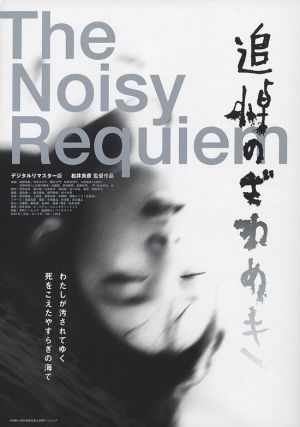
Nihilistic Love: Noisy Requiem (1988)

From http://i1253.photobucket.com/albums/hh590/thedarkpoet411/11158629_800_zps1bed6e82.jpg

Dir. Yoshihiko Matsui

Noisy Requiem is set in desolate places. Junk yards. Building rooftops. Red light districts and pachinko parlours. Obscure business offices. Backyard fields of weeds and industrial concrete. Any contact with the wider world, in this independently funded film, taking my steps into the rarely available jishu eiga underground films, is 'stolen' with documentarian capturing of the images without permits. Or distant like there are glass walls and ceilings baring the characters of the film to be noticed. In some cases the outside world runs away from them. It is mostly slum area. Shin Sekai, Osaka, a place of immense homelessness. The entire economic and social ups and downs visible on the locations onscreen like if you could film the council houses here in my own country. There is a violent young man whose only existing love for another, any love to anyone as he may even hate himself, is for a female mannequin, planning to raise a child with her. Going as far as giving her the organs needed from unwilling donors. A man and his very young sister, his care for her beyond convention. A homeless man who drags around a tree stump the shape of the lower half of a woman, perfectly so you wonder if a poor tree nymph was killed and cut up for firewood. A midget brother and sister, who run a sewer cleaning business, she feeling the immense distance from the world and progressing to random acts of destruction in a need she may not even know of. It sounds purposely transgressive. It is trangressive. It breaks so many taboos. It sounds absurd and the Japanese answer to Pink Flamingos (1972) before Takashi Miike's Visitor Q (2001) came to existence. People would dismiss it as another example of weird Japanese cinema, but with only the films to go by themselves, in their own worlds and contexts, many of them are more reflecting and artistically minded than you think.

Noisy Requiem is black and white. Beautiful in its ugliness and ugly in its beauty. Made independently, director Yoshihiko Matsui used the fact he was making a guerrilla movie to his advantage. Handheld cameras move with the dexterity I've only seen in the films of Akio Jissoji. Encapsulated, as the violent young man berates two disabled veterans of World War II, by the cameraman running around the water fountain behind them, on the other side secretly hearing on them and not getting involved, twirling around, thinking better of it, and running back to watch defencelessly as the violent man eventually gets a claw hammer out of his back pocket. Tinny synth doesn't detract from the film, and there is moments of tender piano music to counteract this music choice. To get high, almost eye-of-God shots, someone sat on a roof. Recording in one scene schoolgirls, like the pigeons the young man kills in the beginning, fleeing on  mass like running, liquid mercury. A rooftop was set on fire, and the person(s) who hid filming real fireman assess the damage never got caught and managed to get the footage into the film. Independent cinema here is suicidal in its bravery in getting the shots desired. In trying anything. Blurring the lines between fiction and real when it seems characters are hassling real people. It is not a static camera in a room filming dull conversation between the characters no one cares about like in other films.

You are forced to follow characters who have no moral grounding. There is incest. Blood. The desire for another literally consuming. But Matsui is on their side, having called this a film about true love. "True love", such an odd choice of words at first against such nihilistic, taboo breaking material where someone shows their love to another, a mannequin, by licking bird shit off their cheeks. But even if the characters could never be real, at least to a rational, "normal" society, the film is calm, lingeringly slow to the point you follow it carefully. Rationalising this behaviour from the characters' perspectives. Some of it is so twisted its sickly humorous, but you feel pity, then ask if they're the miscreants or if the ordinary public barely seen are worse. The only people from this part of the society, who are sympathetic and aren't faceless, are two schoolgirls in the beginning. One recounts the dream she had which is the central idea of the film, a white dove prevented from getting seeds by pigeons, and turning into a black crow who kills to survive. To live in this film's outskirts, you have to even harm other, and normality itself can be even more grotesque and sadistic, as takes place on a public bus full of bulling, sideshow caricatures. The main characters for all their crimes they commit are trying to rationalise their own existences let alone the one outside theirs.

At two hours, nearly forty minutes, Noisy Requiem becomes trance-like. You stop being offended by the content because you're living through the characters' eyes for so long, the daily rhythms, that you live in their place outside of perceived existence. Switching between characters, the film becomes confusing at times, what actually is happening in reality up for debate, but keeps a consistent and enticing tone. Fantasy eventually breaks through to sit alongside the disgusting, vomit and blood matched by rivers existing on rooftops and a split in time, a split of a body into two, long before Uncle Boonmie Who Can Recall His Past Lives (2010) did it too twenty two years later. If the film is depressing, it at least gives you characters to care about. If its vulgar and offensive, it at least lingers on the aftermaths with thought, that causes you to actually feel pain than let the incidents merely pass, as if they were acceptable, as in politer mainstream films. If it's rough, messy in presentation, maybe too long, it at least tried. And trying means more when you see a film like this that feels something. Characters searching for true love. All from an area completely isolated from the rest of the world. The homeless, the lost, the physically and mentally disabled (by birth, by accident or by war), those born with dwarfism, minorities or those to paraphrase Hunter S. Thompson are "too weird to live". Pity changes to showing your own hypocrisy. Even if these fictitious characters are miserable, at least they're trying to live. The last image of the film is an extreme close-up of a woman's face. You've seen her wander aimlessness. And the film actually makes you care for her when something else would make her a freak to gawk at or to only pity with a clear distance between you and her. There's no distance in Noisy Requiem.

From http://s3.amazonaws.com/auteurs_production/images/film/noisy-requiem/w448/noisy-requiem.jpg?1289474103

Friday, 1 November 2013

Representing China: Song At Midnight (1937)

From http://photos1.blogger.com/blogger/1574/278/400/28_1_b.jpg

Dir. Ma-Xu Weibang

The last of the Videotape Swapshop reviews for this series, and this is the sort of film that represents this edition of Halloween 31 For 31 the most. It shows where I want to take this blog in covering films like this too, but I can gladly say there are quite a few reviews of things like this now on here. The only other thing I will say is that, seeing this film, there's a huge area of thirties Chinese cinema that needs to be more available, just for how stylish it could be, from this one, when its very early in the era of cinema when sound was introduced globally. I can only hope that Ma-Xu Weibang is known for me beyond this film even if its thanks to a fan posting his work, out of their own free time and with the possibility of having it pulled down, who did it. Even if the subtitles for the version I saw were far from perfect, the fact that person actually made the film available with English subtitles is something I am grateful for.

Review Link - http://www.videotapeswapshop.co.uk/17058/song-at-midnight-1937-director-ma-xu-weibang/

From http://www.horrorphilia.com/wp-content/uploads/2013/02/YeBan2.png

Sunday, 13 October 2013

Representing the USA: The Lords of Salem (2012)

From http://cdn.bloody-disgusting.com/wp-content/uploads/2013/03/1-lords-of-salem.jpg

Dir. Rob Zombie

With Halloween II (2009), Rob Zombie got interesting as a director. It was, reflecting back on it since covering within the first months of this year, a frustrating film but this was where the meatiest, fascinating pieces were, the parts that made the film more rewarding than straight forward horror movies praised by those who trashed Zombie's film. At this point, Zombie intends to make The Lords of Salem his last horror film for at least a while, which could expand his directing skills but could affect whether his work is just as interesting from beyond now. The Lords of Salem admittedly is more frustrating, out of his work this time, but that doesn't mean virtues aren't there.

From http://cdn.bloody-disgusting.com/wp-content/uploads/2012/06/2-the-lords-of-salem-060712.jpeg

The problems with this film really surround the fact that the stereotypical Satanism and evil witches being drawn from cinematic history are not that interesting in this film's context. Considering how the symbolism in Halloween II was in no way as interesting as having the gall of making Laurie Strode, once played by Jamie Lee Curtis, an incredibly damaged character, the really interesting aspects of two-thirds of this film is the incredibly casual nature of it all. Set in Salem, a radio DJ Heidi Hawthorne (Sheri Moon Zombie) finds herself, along with her co-hosts, with a recording from an unknown band from the town called The Lords which, from the moment it is first played to her, throws her into a slowly distorting world linking back to a mass witch burning that took place there and connects to her. The film for most of it scraps pass fully with an ominous mood more engaging than other movies. It's not really a "horror film" in the traditional or perceived sense of it as in recent times. Jump scares linger far too long, showing too much, but it feels purposeful, as much the eliciting of a jump from the viewer but far more creepy in how, say, a living corpse waits impatiently in the corner of a kitchen wall for when the evil curses of the town eventually get the control back. It says a lot about the film that the cursed song that sets it all off is a languid, ambient percussion piece, not black metal with lyrics straight from Dimmu Borgir that is almost satirised in one of the first scenes. You're introducing Captain Obvious to the film by saying perverse, evil witchcraft and demons will eventually raise hell, and the first three quarters of it embraces this fact. The references too establish this and are removed from the usual Texas Chainsaw Massacre aesthetic Zombie has used before. Song choices lay more with The Velvet Underground's Venus In Furs, slow, dense sensual strings, disturbingly calm. Its referencing silent cinema and showing black-and-white crime thrillers on the televisions in scenes. The obsession with long corridors and densely patterned wallpaper is à la The Shining (1980). It sets up a compelling tone.

From http://cdn.bloody-disgusting.com/wp-content/uploads/2012/06/4-the-lords-of-salem-060712.jpeg

The film is far more interesting, like with Halloween II, when it tries to be more subtle and goes against the expected horror tropes, the potential to become something spectacular there as it builds up to the final act.  When it starts bringing in a potential romance between Heidi and fellow DJ Herman 'Whitey' Salvador (Jeff Daniel Phillips), and Heidi's history of drug addiction.  The slow pace. The bizarre, tiny demon with flippers like a penguin in a scene that melds Federico Fellini, Ken Russell, black metal corpse paint and potential tentacle porn in a strange centrepiece. The fact that the real villains of the piece have reasons to be as angry as they are, and are so nonchalant in their behaviour, like villains in a Hammer movie at their best, that when they bludgeon someone to death, they shrug it off and fancy another pot of tea afterwards. Then the finale of the film takes place, when The Lords play a concert, and it sadly becomes a disappointing conclusion to a movie that needed a good ending to actually work as a whole. The problem with the choice of material eventually cannot be ignored - the po-faced, black metal version of Satan is frankly silly. It goes against what the silent docu-drama Häxan (1922) did, bringing the reality of witchcraft out and pushing the fantastical further than the per usual. Considering some of the interpretations of Satan, including one where his sin was loving God too much and developing ego and jealousy from it, making the version depicted here, in a very serious film, this comic book and music video take on it feels out of place. Its sticking a cartoonish goat devil in a film that could all be a metaphor, if altered a little, of Heidi's mind falling to pieces, and psychological and drug effected psychosis. The shift to completely abstract, heavily edited images is when the film loses its point, what I don't expect as someone who wishes films did this more often, as it becomes completely uninteresting and generic in what it actually shows. Undead cardinals masturbating red, gummy penises is too obvious and feels out of place in a film that is trying to be subtle rather than a crazed, heavy metal film with a sense of humour.

From http://cdn.bloody-disgusting.com/wp-content/uploads/2013/03/6-lords-of-salem.jpg

As a result of this, it's difficult to say whether The Lords of Salem was any good. Unlike Halloween II which ended very well, The Lords of Salem unfortunately moves Rob Zombie closer back to the uninteresting films he made like House of 1000 Corpses (2003) and The Devil's Reject (2005). Those films were about shocking the viewer and music video aesthetics without any sense of impact to them. Halloween II  left you sad, depressed and melancholic with real emotional weight in it, taking a franchise that got terrible or at least completely uninteresting when Halloween III: Season of the Witch (1982) was rejected for safe slasher scares, and turning it inside out with some power. With The Lords of Salem however, like a lot of films being released this year in Britain alongside the few great ones, the promise it has is squandered by the ending, doing everything expected of it without any interest and failing to live up to the virtues of the rest beforehand. It's still better than most horror films, but the failure in its end leaves me with a conflicted view of it that hurts immensely.
From http://www.zekefilm.org/wp-content/uploads/2013/04/16-the-lords-of-salem.jpg

Saturday, 12 October 2013

Representing South Korea: A Woman After a Killer Butterfly (1978)

From http://upload.wikimedia.org/wikipedia/en/a/a5/Killer_Butterfly.jpg

Dir. Kim Ki-young

After being tricked into a suicide pact with poisoned juice by a female stranger, a male college student enters a suicidal depression of his own despite surviving, but many things get in his way of a literal closure. The first an old man who refuses to die even when burned alive. The second a two thousand year old woman. The third, the key narrative, a history professor whose specimens of of Mongolian descent may be provided to him from fresh victims, and his daughter who has connections to the suicidal woman in the beginning. Kim Ki-young has been growing in stature, slowly, within the last few years. In the right areas you may know of The Housemaid (1960), his most well known and completely available film so far, and may have actually watched it for free thanks to cinema preservation and Martin Scorsese. The existence of a remake also from Korea also helps, but Ki-young beat the remake bandwagon by reimagining the movie in at least a few more re-adaptations. I can also say proudly, while a DVD release of this would be great, that this review is possible because the Korean Film Archive have placed films like this, difficult to see, legally on YouTube with English subtitles for anyone to watch. It's wonderful, considering the sorry state of availability of many films still, that a cinematic organisation is making a canon of South Korean film history available, all there for me and others to pick through when we find it, and including stuff like Killer Butterfly next to the arthouse dramas.

From http://3.bp.blogspot.com/-3LHL6RAV1xQ/UE0ePUfeNcI/
AAAAAAAAFfk/DZBWX25Rnms/s1600/Killer%2BButterfly%2B23.jpg
Ki-young's film isn't exactly conventional genre fare though. With the growing amount of idiosyncratic, unconventional films making themselves stand out for this year's Halloween 31 For 31, against disappointing, bland or even unfinished movies, Killer Butterfly is just as different. In another's hands this would be a melodramatic mess which drops plotlines all over the place, but with Ki-young, it's both an immensely engaging journey but also all connects together into the central themes. The male student is forced into what is revealed, in an ending just as out-of-the-blue as The Housemaid but set up clearly, to be a crisis in his existence, debating if life is worth it at all. Three things stop him. The first is where one's will, the old man's, refuses to die and refuses to leave him alone. The second, including human livers and sex surrounded by increasingly created pastries (?!), is the potential for life or sacrificial death that he squanders because of either the moral cost or his own life that it would involve. This pulls him into the third, especially the daughter, where he is pushed away from how he wants to snuff his life out, or actually, how he wants to live.

From https://blogger.googleusercontent.com/img/b/R29vZ2xl/AVvXsEjX4EBtT1GazqQBtwULq3Xs3uXj0JZnFo7kYb2WBIMtBD019F24fwH8wKMeronZFxAFr1bsITKI6mqS3fFiPYjKZA-3Cz_-ZfVV0EnFv6dbmddtOigp9cEky6Dv_VMCZIuxMDANfCUKw6E/s1600/KB03.jpg

To achieve this, Ki-young has no issues with using genre tropes with heavy aesthetics. Bright coloured lighting and coloured gels, and distinct decor designs for interior scenes all create a distinct, hyperactive tone for a film which knowingly gets ridiculous in tone. It's very much in touch with lurid b-movie horror and thriller films, but like immensely auteurist works created with one's own determination, it feels like you are swimming through the creator's id. Gender divide and conflict are very much an issue for the director, especially when it gets to the third part, as are sexuality, and the clear themes of death and one's existence. The fact that the three parts do connect together, in the tone of a complete fever dream, is a success for Ki-young being able to make such a tonally bizarre film work on a simplistic level when you understand the wavelength he is on. Once you do, is also becomes apparent that our protagonist is far from likable while yet still understandable decades later now - a miserable, selfish youth who only cares about offing himself, yet aimless in his existence and alone in poverty, eating the same noodles day-in-and-day-out, he understandably suffers from a lack of any progression in his life that can only be shocked out of him when he sees the absurdity and weirdness that death can involve. Even the Professor and his daughter are trapped in themselves, the former through his obsession with historical ethnography of his ancestors, which could make him an accidental accomplice to murder and corpse desecration, and the later by a pact and the fragility of the body that makes this pact grow to an impossible place to abandon. The absurd push in the ending, like The Housemaid's, feels like Ki-young wanted to viewer not to walk out of the cinema with a clear cut conclusion that would close the idea and make them able to ignore it. When the protagonist gets a new lease on life, so should we think about it while admiring such demented imagery the film has. Heady stuff indeed, but to Killer Butterfly's credit, mixing these ideas with lurid genre tropes makes the ideas more significant. Instead of cased in petrifying drama, the oddity of it gets stuck in your mind, and gives the late Ki-young more potent messages, his will like that of the old man still managing to survive through them and the most ridiculously awesome use of a model skeleton you could find in cinema.

From https://blogger.googleusercontent.com/img/b/R29vZ2xl/AVvXsEhlM12IWqsbjQ4lS1o338PB0aK-snIyj7u8Kfsd2EGbgrEqOVI6zjr2on2jvytZt8Hl4xzHkul5nFdmxQZGq43UV4nSht7WQ-zEtoKBn6-3fp8f4zSM-Bv0l6vmpfK2e67GhysuFzj2bfQ/s1600/KB01.jpg

Tuesday, 3 September 2013

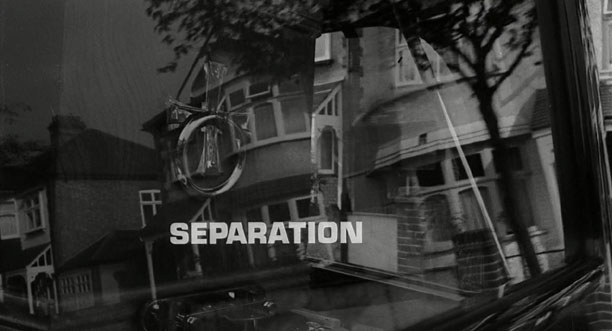
S Is For...Separation (1968)

From http://infini-tropolis.com/reviews/images/separationHEADER.jpg

Dir. Jack Bond

Probably one of the more divisive films for me in this series, but Separation managed to still have some great virtues of it. This review will probably show me becoming more admiring of the film if I was to see it again. It'll probably be like The Otherside of the Underneath (1972), the sole, single directorial credit for Seperation's main actress Jane Arden, another difficult experimental film uncovered from British cinema history I will have to ruminate on.

Review Link - http://www.videotapeswapshop.co.uk/15730/s-is-for-separation-%E2%80%93-1968-director-jack-bond/

From http://s3.amazonaws.com/auteurs_production/images/film/separation/w448/separation.jpg?1289466373

Saturday, 17 August 2013

Stoker (2013) vs. The Stepfather (1987)

From http://itsblogginevil.files.wordpress.com/2011/10/stepfather871.jpg

From http://zombiehamster.com/wp-content/uploads/2013/06/STOKER-4.jpeg

Dir. Park-Chan Wook/Joseph Ruben

So many coincidences take place in life that surely it happens in your film viewing too. I finally caught up with Park-Chan Wook's American debut one night, then the next night I saw the cult horror film The Stepfather. In the first, after the death of the father, the unknown uncle (Matthew Goode) enters the remaining family only to reveal a sinister side of him that startles the daughter (Mia Wasikowska), a girl who herself has a potential dark side. In the later, the daughter (Jill Schoelen) suspects that her stepfather (Terry O'Quinn) is more than he says he is, obsessed with having the perfect family. Unlike Stoker, it's made upfront that there's some psychopathic behaviour being thrown about in the first few minutes. One high prestige film from a South Korean alumni, one love budget Canadian film. It's amazing Stoker can be traced back to the later...and that its completely pretentious and barely watchable in comparison. Neither is good, but at least The Stepfather has a lack of strained artistry.


Both films involve a revelation taking place for the young, female protagonist near the ice cream freezer in the cellar. Both involve the sexualisation of them in the shower. In The Stepfather its brief nudity that could be either an establishing shot or an abrupt moments of titillation in a film that is only adult in its occasional gore. In Stoker it's a scene linking sex, death, and death fantasies through masturbation that, depicted with all the subtlety of a sledgehammer, made me want to punch Park-Chan Wook and scriptwriter Wentworth Miller. Both replications perfectly describe the films together. The Stepfather is lurid genre cinema that yet is completely relaxed and comfortable with what it is. Stoker protracts these moments found in other genre films like The Stepfather, and strains so badly to be "high art". Both depict a conventional nuclear family - mother, daughter, a new father figure - after the passing the original father and being replaced by a surrogate who is an invading parasite of masculine and patriarchal ideals. In The Stepfather, the desire for the peaceful, quaint happy families of magazines and fifties America. In Stoker, mental and psychological disconnect and sociopathic desires. In Stoker, there is nothing profound in its dialogue to support its excessive stylisation, hollow and without tension, and without any gravitas. The Stepfather is a generic horror film, but it has so no sense of pretention whatsoever.

From http://s.mcstatic.com/thumb/7613400/20760803/4/flash_player/
0/1/the_stepfather_1987_attacking_stephanie_part_2.jpg?v=4

From http://thatfilmguy.net/Pics/Stoker.jpg

To The Stepfather's advantage, it has charm. While with a type of recluse anti-social young adult character who exists in reality, Wasikowska is completely unlikable and uninteresting. Completely overdone in being anti-social, and because of the complete lack of good characterisation,  she's also completely vacuous. The depiction of her growing dark side just emphasises an uncomfortable and childish fetish for violence, that shower sequence representing its nadir. It also causes me to worry about rewatching some of the Park-Chan Wook's earlier films, especially Oldboy (2004) and how violent and twisted in its plot it gets. With Schoelen in The Stepfather, you get a character, while one dimensional, who is charming, likely because the real actress was off-set. It's a generic character, but she's allowed to smile, isn't stuck in an overwrought, unoriginal take on Expressionist set design or with violence taking place every minute around her. Her mother is charming despite her one note nature too and has more interaction with her daughter. Nicole Kidman in Stoker shows what happens when a Hollywood actress feels their prescience is enough when it doesn't, making me wish all her films were like Lars von Trier's Dogville (2003) where she was forced to actually act. In the surrogates, O'Quinn is far more interesting than Goode. O'Quinn could be seen as hammy, but his character's obsession could have made a fascinating black comedy around how he acts the role out. Goode comes off as a bad version of what Casey Affleck does so well in films like The Assassination of Jesse James by the Coward Robert Ford (2007), an uncomfortably confident, quiet male who has the potential to be charming but is liable to snap as well. Even if I hated The Killer Inside Me (2010), Michael Winterbottom's controversial novel adaptation, Affleck did this type of role properly with real emphasis. And unlike Stoker, in The Stepfather the boys in the protagonist's school are not all potential rapists the moment you are alone with them. While I'm not a fan of a lot of eighties horror films, there was some sort of attempt in many at likable teenagers. It was only generic storytelling that failed them, not the actual characterisations.

Ultimately the coincidences prove an unfortunate truth that some films are completely identical to dismissed b-movies, and that they can be far worse and lifeless than said b-movies. I wasn't that fond of The Stepfather, but it has more virtues. It knew what it was, and had charm for that reason. The protagonist had some charisma, and a subplot involving her psychiatrist/councillor invokes a brief but tantalising moment when he gets to examine her stepfather's mind. And while I've forgotten Stoker's score, baffling consideration it was composed by Clint Mansell, the score in it is the cheesy synths that I've developed an un-guilty love for. Stoker becomes the poor man's b-movie in that it tries to think its above one but doesn't have the material to judge itself even next to one. Prolonged gore with no weight and a po-faced darkness. The casual lack of seriousness to The Stepfather turns out to be the more artistically mature attitude to making a film because it's a b-movie that knows it's one and just tries to entertain.

From http://farm5.staticflickr.com/4050/4583515050_68f8892046_z.jpg

From http://www.moviefancentral.com/images/pictures/review29390/matthewgoode-nicolekidman-miawasikowska-STOKER.jpg?1367185181