Showing posts with label Genre: Splatter. Show all posts

Monday, 18 November 2013

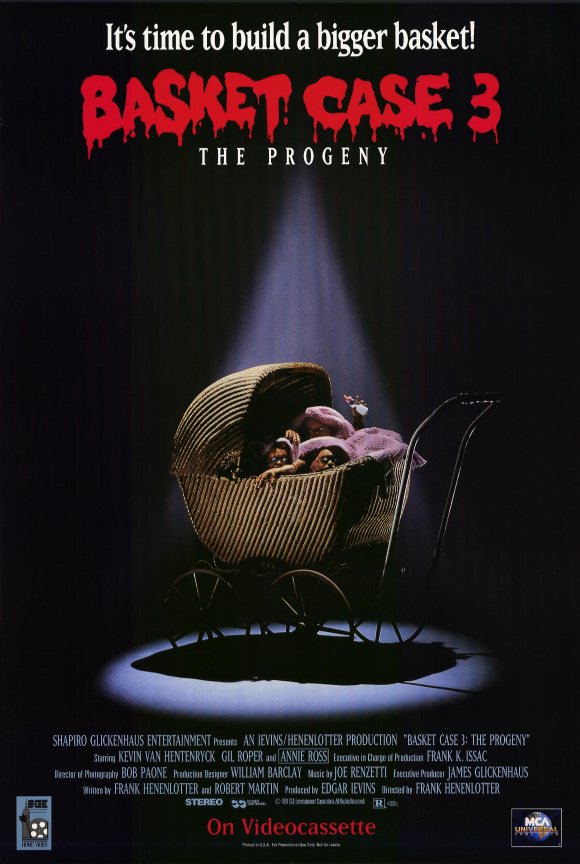
Videotape Swapshop Review: Basket Case 3 - The Progeny (1992)

From http://images.moviepostershop.com/basket-case-3-the-progeny-movie-poster-1992-1020210067.jpg

Dir. Frank Henenlotter

During this week I'm going to clear through the Videotape Swapshop reviews that have not had links posted up on my personal blog. I'll start with one of two films I choose for the site's "Threequels" series, the second sequel to a cult favorite. There's not much to say this time because my thoughts were pretty much written down in the review.

Review Link - http://www.videotapeswapshop.co.uk/16647/basket-case-3-1992-director-frank-henenlotter/

From http://www.coffeecoffeeandmorecoffee.com/archives/basket%20case%203%20c.jpg

Tuesday, 5 November 2013

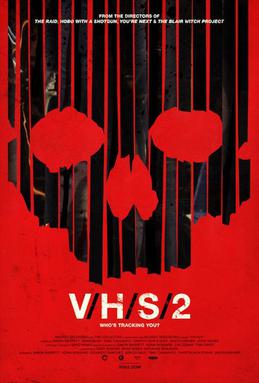
Made From Ingredients From The USA, Canada and Indonesia: V/H/S 2 (2013)

From http://upload.wikimedia.org/wikipedia/en/9/94/V-H-S-2_Poster.jpg

Dirs. Simon Barrett, Jason Eisener, Gareth Evans, Gregg Hale, Eduardo Sánchez, Timo Tjahjanto and Adam Wingard

Like a beautiful coincidence, I cover the original V/H/S (2012) months earlier, and like this sequel's release in Britain, you get V/H/S 2 the same year near Halloween. How many franchises get both the prequel and sequel debuting in the UK in the exact same year to each other? There is a slight caveat to the words "beautiful" though. The original V/H/S wasn't a good anthology film. Set around a mysterious series of VHS tapes found in a house, a Wunderkammer of death or an atrocity exhibition, the first film in hindsight was the creation of directors who clearly wanted to make dramas than horror shorts for the most part, and barring one legitimately good segment, none of them were good at the drama in their work either. They dangerously became films that symbolised some kind of elite club of white, middle class, male twenty something horror fans rather than horror shorts for everyone; if the grindhouse phenomenon has (thankfully) died on its backside, its unfortunately been surpassed by a vocabulary of mostly swearing, quasi-drama with no interest and power dimensions amongst peers that really didn't need to have been fed by accident with V/H/S 1. It was a nostalgia for a format (VHS) without considering the potential mysteries of the object in question, and with no real sense of atmosphere and tone, a bane on the genre's existence that has frankly sabotaged it for decades long before I was even born. 

Harsh words, very harsh words, but while I have suddenly become enamoured with this new era of anthology films, at the moment like giving bloodied candy to a four year old, the first film was the one blot when its sequel and The ABCs of Death (2012), for their flaws, had been enjoyable in their fragments, and for both showing potential new talent and even bringing back interest in directors I was cold to. V/H/S 2 can still be criticised for many things, and is as much as an all men's club frankly, in an era where one would hope for more female horror directors to exist, but it's still a drastic improvement on the original. No longer, thankfully, preoccupied with evil women as the segments in the first did barring that one good one which skewered the notion. While still wadding in violence, some sex and general misanthropy, it's for more inventive and trying to do something generally interesting in all the key segments. And, aside from returning contributors Simon Wingard and Simon Barrett,  you've got clear outsiders with different ideas now to bring to the table. A Canadian Jason Eisener, whose work with Hobo With A Shotgun (2011) and his short Youngbuck for The ABCs of Death is that of someone obsessed with visual style and bouncing off the walls in his anarchic tendencies. Eduardo Sánchez, co-directing with Gregg Hale in one of the two contributions done by a duo, one of the directors of The Blair Witch Project (1999), the beginning, legitimately, of the found footage subgenre that this anthology is part of, the drastic shift from that film to a decade or so later adding a potentially fascinating layer to Sánchez's contribution. And finally, expanding the film beyond North American soil, there is the pairing of Indonesian director Timo Tjahjanto and British director Gareth Evans, the later significantly known for martial arts action cinema, not horror, and bringing a drastically different perspective to the material because of this.


From http://media.tumblr.com/5fd0d1b998deb3c5771e411bb34cac86
/tumblr_inline_mpopgjsUxO1qz4rgp.jpg

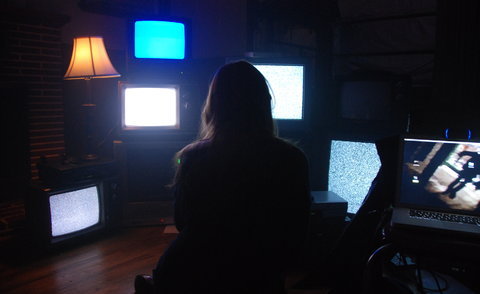
Tape 49 (Dir. Simon Barrett) - V/H/S 2 needs some suspension of disbelief to make it work fully. This is not a criticism at all, as most films need one aspect, or a couple, that need to be accepted as they are. That's the nature of fiction, and of cinema. But it has to be bared in mind, all these occult and supernatural events put on videotapes, with some of the events composed of more than one camera, all existing in the same world as two private detectives search for a young man. They instead find an abandoned house full of these tapes and one of them watch them to figure out what's going on. It's fascinating to imaging whole worlds within one bigger one, subjectively questioned by the film without it realising it, all of which may have more disturbing effects on a viewer than showing mere gristly demises. As the wraparound story that bookmarks the four key segments, its vastly superior to the one in the first film because it actually makes sense. The first one was a clusterfunk of bad pacing and editing, while this actually has a pace. It's the weakest piece alongside Adam Wingard's, the directors alumni of the prequel pointedly, but it at least fits the improved quality of this sequel by being interesting to view. What brief titbits it has about the meaning of these tapes' existence is tantalising this time as well; I hope if V/H/S 3 ever happens it suddenly turns into Videodrome (1983) in the implications made here. Brian O'Blivion would be proud of the idea this nudges towards, but just needs the final push if another sequel is made.

From http://cdn.bloody-disgusting.com/wp-content/uploads/2013/06/V-H-S-2_Naked_Chubby_Banner_6_3_13-726x248.jpg
Phase I Clinical Trials (Dir. Adam Wingard) - A man (the director himself) is given a robotic eye transplant, with recording equipment inside it for the creators to monitor its functions, only to find that he can see things with malevolent tendencies he didn't see before. The reason this is the weakest of the key segments is because its difficult to write a lot about it. It's a supernatural story reminiscent of The Eye (2002) but with a very short length, cutting it down to a basic structure, and a gimmick of being recorded from an eye in a quasi-Enter The Void (2009) first person. But it's still a higher quality work than almost all the shorts from the first film. It raises the interesting question of how someone got hold of the footage in the first place, an enticing what-if rather than a logical flaw. It's fascinating for a film in this anthology to be seen through a person's eye. It also starts the greatest virtue of V/H/S 2 - that it takes advantage of two key aspects of the found footage genre and uses both well. That they're filmed on various video recording devices, and that, when done properly, it's very kinetic and all about movement. None of the segments are mindless shaky camera, with even the chaotic moments where the image is incomprehensible being appropriate for the moment. It's far from perfect, and you will raise your eyebrows at the sex scene that suddenly happens, verging close to the same questionable, laddish mentality of the first V/H/S film your dread even if you would find it titillating in a perverse way, any potential eroticism undercut by the fact that, frankly, it's an excuse for nudity without just admitting its an erotic moment and objectifying the actress for no justifiable excuse in the context. But it's a good start to lead to better shorts, ending well in a panicked state, with an interesting idea, leading on to segments which are superior with running with these ideas that can top it easily.

From https://encrypted-tbn1.gstatic.com/images?q=tbn:ANd9GcR62Pn0_XJpuoIqtC0nQZAvEhsn-qdqcCzzjYfAiu2afqHO3zwz

A Ride In The Park (Dirs. Eduardo Sánchez and Gregg Hale) - A male mountain biking aficionado straps a head-mounted camera on and goes to record a morning bike trek in the local woodland park. Unfortunately he rides into a zombie outbreak. What happens is a really clever take on such a tired subgenre, the zombie film, as he is bitten and becomes a member of the undead, shown through improv zombie-cam. It's great to see one of the founders of the found footage subgenre, and a producer of said original film, bringing something very interesting here in such a simple thought, one that someone would come up with while drinking one night and be amused by it.  In fact it may actually be superior to the more acclaimed segment Safe Haven for the amount of emotions that the premise suddenly holds when its presented as well as it is here. How curiously charming it is to see the world from the shuffling dead, almost like flesh eating newborns who, in a nice touch, will chew on anything before they figure out what they're supposed to sustain themselves on. How a victim, as they're being eaten, will suddenly become undead and the attackers suddenly stop and welcome them in the horde, wandering off together. How hilarious the film gets in a sick way even when the zombies get to a birthday party, the use of various camera, while a leap in logic too, helping the film significantly in tension. And also how deeply sad by the climax the story becomes and how it plays out. All these emotions co-exist in the same minute within the film too, forcing you to feel them all together for maximum effect. It's short, its succinct, but brilliant for it.

From http://diaboliquemagazine.com/wp-content/uploads/2013/07/VHS21.jpg

Safe Haven (Dirs. Timo Tjahjanto and Gareth Evans)- The biggie. The short everyone talks about in this anthology. The centrepiece in its longer length and bombast. Set in Indonesia, a group of filmmakers manage to get inside the home of a controversial cult to interview their leader, dubbed only as Father, and let him speak on his own terms about their beliefs without opposition. In the middle of the interview, a bell rings and Hell on Earth tales place. It's the most maniac, insane, and downright violent of all the segments, but it's also incredibly complicated in structure. It has numerous camera the footage is recorded from, all that needs to be co-ordinated so the viewer gets what it going on, and doesn't get to know everything at the same time, before and during the chaos; and for all the madness that takes place, it's also as much a story about the filmmakers too, while simplistic, where there's conflict and a strained relationship in their camp which turns the final act into more darker implications. I have seen only one film from each director who made this, and while I am very open to them now, those two works weren't good. Evans is famous for The Raid (2011), but for its visceral fight scenes and their craft, its completely bland in the ideas it actually has. Tjahjanto I know of only from his few minutes long contribution to The ABCs of Death, L Is For Libido, a potentially interesting piece, very well made, that becomes pointlessly shocking for the sake of shock value, almost becoming silly when it tries to cram as many taboos as it can into its short length. There is a possibility, on another viewing, that this ridiculousness was actually a really clever, unexpected moment of self consciousness from Tjahjanto as a horror director who realises the perversity of upping the disgusting sakes for viewers mentally masturbating over it, but it'll have to wait until rewatching that piece to see if I change my mind on it. As a duo thought, I want to wager they cancelled out the other's flaws. Evans pulling Tjahjanto back from pointless gruel, but Tjahjanto getting Evans to try to create something very interesting. It's been seen before in terms of the ideas of the short, and may be pointlessly twisted at times, but Safe Haven is a gem because it's clear in its goal, and baring some disappointingly obvious CGI, works. It could be off-putting in content or how it uses very well used clichés in horror cinema, but it never feels pointlessly sick or insipid, and ends on such a high note that, honestly, this should have been the final segment of the four that leads to the wraparound story's own conclusion. And while I am open to these directors now, I think the two should work together more, likely to boost Indonesian genre cinema up again as a pair combining styles.

From http://zanyzacreviews.files.wordpress.com/2013/10/rtyrtrty.jpg
Slumber Party Alien Abduction (Dir. Jason Eisener) - It's unfortunate that Eisener had to follow Safe Haven. His short - the name on the tin says it all, but with a large part of it recorded on a camera attached on a dog's back - should have been between the zombies and Indonesian cults. Its flawed, the second weakest of the key segments, but I admit I have hope for the director. As someone who likes putting works as one single, giant creation of its creator(s), I wish Eisener gets better and better. Hobo With A Shotgun has an ending the annoyingly peters out, but the energy of the first three quarters was so infectious and legitimately daring than tedious in tone like so many neo-grindhouse films. His segment for The ABCs of Death was structured like a politically incorrect music video, which he pulled off perfectly. If there's another flaw with V/H/S 2, all the segments are structured around chaos suddenly taking place. For the most part it failed, but at least the first film has a varied choice of plot structures. But this short's still fun. Still scary when it gets hectic, with strange aliens that clearly hung around a Edvard Munch painting or two, and the premise of making most of the film shot from a dog's perspective, aside from some hijinks early on from the young cast, again takes the kind of premise joked about in a night's trip to the pub but makes it interesting. From the "eyes" of a small dog, looking up at the world, or crawling in the undergrowth outside, you are truly lost in what is going on, which makes it very interesting as a concept short. The result is still impressive even if it's in the wrong place in ordering the segments together.

From http://media.naplesnews.com/media/img/videothumbs/2013/06/04
/158794_med_1_thumbnail_t320_240.jpg

Altogether, there are flaws, but this still raising the bar higher than per usual horror films of now. With this and The ABCs of Death, as I've already stated, there is a potentially wonderful phenomenon approaching of genre anthologies like this becoming a subgenre of interest. I still have some reservations admittedly, when directors coasts, or that they spend their time making entries for these anthologies than actually making feature films. But in the subgenre's favour, you cannot rest back on the worst aspects of genre filmmaking - padded plots, workmanlike aesthetics, tired clichéd structures - in such a restricted short length and small budget unless you want to be the one the viewers dub the bad entry in said anthology. It can potentially cut the chaff from these directors so they can improve, and as this film and the upcoming ABCs of Death 2 show, the combination of so many unconventional choices of directors from various generations, nationalities, even not known for making horror films, could make for some interesting combinations. What needs to be done with the subgenre if they're now in vogue, funded by theatre chains, DVD labels, or in this case Bloody Disgusting, creating an interesting ouroboros in horror films and their audiences, is to prevent it from what unfortunately happened with the first V/H/S, a small club whose language is befitting a small clique that bars outsiders and the new perspectives from it. Here at least there were four different nationalities in the director chairs, and even the plot structures are similar, you have people of various areas, including one from outside of horror, nonetheless making a film with a very consistent tone. Leaner with less segments, clearer but replacing the vagueness with material that adds layers to the segments, and a kinetic grace to all the segments in using the cameras mixed with experimentation. It's a shame it has to replicate the obnoxious end credits style of the first film - abrasive music, and a barrage of sex and gore scenes more closer to a thirteen year old boy or two writing the project. The film that preceded it, while still schlocky, was far more interesting than this.

From http://media.sfx.co.uk/files/2013/10/VHS-2-bloody-chair.jpg

Tuesday, 29 October 2013

Also Representing Japan, For The Anime Slot: GenoCyber (1993)

From http://1.bp.blogspot.com/-UHDL9E8qiyY/T6G9pHHGMmI/AAAAAAAABvs/gx_ZO_DVw6Q/s1600/genocyberposter.jpg

Dir. Koichi Ohata

Note that the version of the five part original video animation (OVA) I saw was with an English dub. Dubs for anime, unlike Italian genre films from the seventies, can drastically effect the actual work. Liberties were clearly taken with GenoCyber's script even without seeing a version with the original Japanese language track, and like a lot of reasons why dubs are notorious, it is mostly poor. It's not without flaws - it befits the first episode - but I would want to find the original version. Be ready, if watching the English dub version, for ridiculous acting performances and "fifteening", a controversial practice of English company Manga Entertainment, from their older days of existence, of adding swearing to the scripts to help boost the age ratings when the anime they sold was being certificated by the British film censors. I will have to deal with the dub in this review, but my greater concern is what GenoCyber is as a notorious anime.

From http://1.bp.blogspot.com/-KRtpNLSqcHA/T7GaXjx8PdI/AAAAAAAAB3E/safDPMzJg0U/s1600/geno.jpg

Controversial, ultraviolent, and just a mess. GenoCyber is a mess finally seeing it, hearing of it like the many bogymen, infamous works, in anime's history for all these years, but actually viewing GenoCyber is more complicated than this. Its twisted, and for a lack of a better term, fucked up, but having to actually watch it is a drastically different experience than something merely infamous. The first part - the work splits into three stories between Part 1 (A New Life Form), Part 2 and 3 (Vajranoid Attack & Global War), and Part 4 and 5 (Legend of the City of the Grand Ark I & II) - definitely shows everything that made the anime infamous. Nihilistic, complete hatred for humanity, horrifying images of dismemberment and mass death, body horror taking advantage of sci-fi tropes' most gruesome potential, and the episode was made with barely a budget. Barely a budget. Events abruptly happen with no pace. Live action inserts were used. The animation looks aesthetically foul and scuzzy in a horrifically compelling way. And it does fascinate. In a world where nearly every nation plans to unite into one peaceful, global utopia, a corporation sticks out as a potential threat in its self ostracization from everyone else. Taking advantage of a scientist's discovery of "mind shadows", latent psychic abilities he could unlock through a machine he made called the Mandala, (yes, there are clear Buddhist and Eastern spiritual symbolism here), they have human beings, as young as children, as potential weapons. Very much like Akira (1988), potentially dangerous psychics. Two of them are the twin daughters of the original scientist. One, Diana, is one the side of the corrupt scientist in control of the knowledge, left from birth with a completely crippled body which leaves her as a head supported in an android frame. The other Elaine, on the loose in the city of future Hong Kong, is physically healthy but with the mind of a savage animal, befriend a young boy. The corporation ran by the scientist wants Elaine back, employing android mercenaries, his pack of masked psychotic minions, and her own sisters after her and to silence anyone in the way. But not only is Elaine a very dangerous psychic, but when the two sisters are together, they could become one and become the titular GeonCyber, a horrifying demonic creature that could wipe out anything and everything.

From https://blogger.googleusercontent.com/img/b/R29vZ2xl/AVvXsEjnj2byz76P8my7jBqyVg_Z70Tmm931HYk1k0k5YdgKIQ7SBOsypsCNhJmhUbdtb9r2eBVbKlN5_03WmZYsUceF-Kv1snr-c8yh7bFF9TanEzxn0xqTt81k16hJBoteAyrfNVMuAtFFFDA/s1600/Genocyber11.jpg

The first episode is a complete car crash of gore, disturbing images of viscera and exposed intestines, wrapped in such a misanthropic work in its message. But its compelling. Body horror with no self censorship. Actually missed by myself in the later episodes greatly, the director went further to make the gore disgusting by using images of actual wet clay being smashed for icky effect. Its only done twice or so from what I registered, but its an incredibly lurid effect that should have been used in the later episodes, the kind of reckless idea, on such a cheap production, that lifts it up from just being trash but something legitimately interesting. It has nihilism that actually feels like it's from the bowels of the creators', the director and co-writer Shô Aikawa, guts than that a cynical liberals going for a cheap pop, discomforting but driven by a narrative where two mangled young women come together, and their collected rage collects to created a being on the scale of Cthulhu. Koichi Ohata is already controversial for his creation MD Geist (1986), to some one of the worst anime ever made, along with its sequel, but a best seller in the US. Aikawa is incredibly twisted in just the few works he penned I've seen. He's managed, of all things, to become the scriptwriter for some of the Full Metal Alchemist franchise, an incredibly popular work with a large, mostly young audience, but the man also wrote the scripts for a lot of the Urotsukidoji series and Violence Jack (1986-1990), the former the most controversial work in anime in the West, the later only really known for its drastically censored English dub version, and from I've read and heard, probably for the better for your stomachs. His filmography has a lot of notoriously bad, ultraviolent or scuzzy work, but Aikawa has a sense of body horror, and surprising potent ideas of the manipulation of the body and political ideas that managed to get into even Full Metal Alchemist. It's not surprising that GenoCYber ended up as it did with just him, let alone with his co-writer and director. It's no way near the most disturbing anime in existence, when Neon Genesis Evangelion: The End of Evangelion (1997) exists, but even if I am desensitised from a lot of this sort of thing, and frankly view it as merely animation on a cell not reality, it still leaves a gaping, nagging wound in your memory whether you see merit in it or not. With how this part ends, there was no real need for any other episodes. It could have stood up as one single, forty or minute piece of disturbing anime. It's a mess in quality control, but it its memorable and potent in what is seen. The only other work of the director I've seen before this was the TV series Burst Angel (2004), which was legitimately poor, all the most generic tropes, even in designing the female character designs meant to be lusted over, of current anime. That was the kind of anime that is truly bad. This episode, from the same director, is something uniquely itself even in its screwed up existence.

From http://i1.ytimg.com/vi/fd5uF17mXkA/hqdefault.jpg

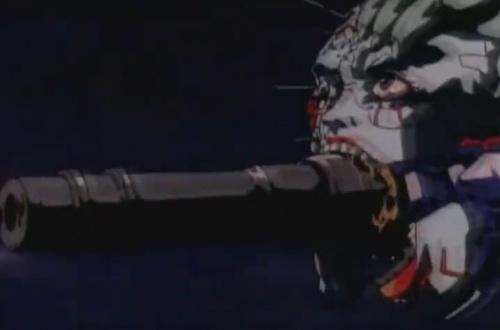
But more episodes were made. Parts 2 and 3 probably have some importance though. Part 2 contains the most controversial moment in the whole work where, in the first scene, the first actual scene, young kids are chain gunned into gristly, fully detailed body parts. Its tasteless, its shocking, never done in any other anime I've seen yet, but doesn't compare to the kind content in the rest of this story arc or in the first episode. It's no way near as disturbing for me, in a story where a prototype android eventually goes out of control and literally melds with the whole of a naval warship, as just having a character, seeing the atrocity around her, suddenly throw up in revulsion in detail. What really disturbs in the whole of GenoCyber, what really makes it justify its reputation, is the mood and ideas rather than the gristly results. Shô Aikawa's writing, when it's not garbage, is far more disturbing in what he implies with full detail or not. His work is very Cronenbergian even when he's in a completely different genre like with Hades Project Zeorymer (1988-1990), an anime which shows a legitimate best with how, for its flaws, the ideas and where he goes with them are truly compelling in a startling way. This story arc is still an worthy inclusion for this. How our hero - Elaine and Diane one single being who are rescued by the warship and set off the android when it see them as a threat - is actually a monster who can destroy everything. That no one is sin free, or those who are good people will be killed, even children, or go insane. That this series, for all its disgusting gore designed to only shock and its shonky look, still forces the viewer to think of the consequences of man's brutality. That its use of body horror, in visuals and the concepts, is immensely imaginative, and downright disgusting and disturbing because of the ideas behind them, especially with part 3. These two episodes do deserve to exist, because while weaker they still fit the tone of the first one and are just as interesting.

From http://www.imfdb.org/images/thumb/2/27/Genocyber_Minigun1.jpg/500px-Genocyber_Minigun1.jpg

Which causes me to ask - what happened with parts 4 and 5, and why were they even made? Suddenly you are forced to watch legitimately awful pieces of anime. A drastic shift takes place. The GenoCyber has completely decimated all human populations in the world and is now gone, leaving all the clichés of anime of this era to repopulate the scorched planet in their tired flourishing. A utopian city exists which is actually a dictatorship, the writing suddenly losing all its distinct nihilism in favour of a generic tone without any real bite, where there's the corrupt rich, and the rebels in a terrorist group and a religious cult. Suddenly you're forced with two new protagonists, a young man and a woman, moving to the city and making their way barely as a knife throwing act and through street based mysticism. We're supposed to sympathise with them because she's blind and they're a couple about to be crushed by the evil city, not because they're of any interest. At this point, I cannot ignore the English dub. It was poor in areas before this arc and the added swearing was unnecessary, but some of it actually fit the tone. Here the dialogue readings, ignoring the tedious plot, are atrocious, with the voice actor for the main male protagonist performing some of the worst line delivery I have ever had to endure legitimately in a long while. It's up there with some of the worse I've ever encountered actually, clearly playing the character as everything people say about Keanu Reeves in Bram Stoker's Dracula (1992) at one point. This is why anime viewers like myself, let alone fans, eventually switched to Japanese dialogue with subtitles completely unless it wasn't available for certain releases or the English dub was actually exceptional. The entirety of this story arc, even though it's from the original manga the anime was adapting, is abysmal, a huge blot on the whole work. The blind woman encounters Diane through her mind, or an alternative world, befriends children living with the underground rebels, as you do in anime at this time, and eventually the obvious happens when GenoCyber awakes. You rise the memory of this arc from your mind and, if the whole work ever gets a DVD re-release, the only reason you would ever see this again is to check the disc(s) work. Suddenly it's not the original anime of the first few episodes but a completely different work, written by someone with no real grasp of what corruption means and merely using it as an excuse to bash the upper class and real life society in a cheap way to come up with a dystopia narrative. One, as in all the live action films that do it as well, that would put people off actually questioning their society and leaders because its trivialised to such an extent and because they don't want to suddenly become the characters in a crappy GenoCyber story arc. OVAs at this time in the nineties were also notorious for how abrupt their productions could be - anime works suddenly ending on a cliffhanger with no sequels ever to finish them, or with wildly different tonal shifts like here. Sometimes it's part of my fascination with these nineties anime, but here it's painful.

From http://www.animeclick.it/prove/serie/Genocyber/Genocyber8.jpg

Altogether, anyone with a strong stomach should attempt viewing Part 1 of the work. It's not a series to watch on a loop, too bitter, too misanthropic in tone to digest except occasionally. Its indefensible, but it doesn't feel like a mere mindless piece of anime ultra violence that the whole medium was lumped into by newspaper tabloids. Parts 2 and 3 are also worthwhile, but if it was possible to remove Parts 4 and 5 from existence I would do such a task. It has to be beared in mind that this has content that would even startle people used to animated gore and depravity, but it's a creation of individuals with throats full of bile for humanity rather than making cynical jabs, for attracting peoples' simpleminded views of anti-humanity and selling product by using such naive views on corrupt society. As perfectly put by an anime reviewer, it's the equivalent of punk rock, shambolic in production, offensive but with vitriol and energy you wish was there more often.

From http://www.anime-planet.com/images/anime/screenshots/genocyber1.jpg

Friday, 7 December 2012

…fear of hamburgers and gardeners…’ [A Cat In The Brain (1990)]

From http://25.media.tumblr.com/tumblr_lpcl2mQvm91qchg6eo1_r1_500.jpg


Dir. Lucio Fulci
Italy
Film #12, of Friday 12th October, for Halloween 31 For 31

After a long delay, I can finally add the twelfth review from the Halloween 31 For 31 project from October. Thank you for your patience for this review.

Saturday, 1 December 2012

“You are on the road to Hell my children.” [Hell’s Ground (2007)]

From http://horrornews.net/wp-content/uploads/2010/11/hells_ground_2.jpg


Dir. Omar Khan 
Pakistan-UK

Originally intended to be a film for the Halloween 31 For 31 in October, I am happy to have seen the first Pakistani splatter movie in existence finally. It is a flawed film, but in keeping with my belief that film viewing is a geographical and culture expedition in celluloid form, this nightmarish West Asian horror film fits that idea greatly while spilling goo and blood. On their way to a music concert, a group of young adults end up on their way to Hell, an area of countryside that, after significant pollution problems, had become a place of death. Zombies roam the long grass and a white burqa-wearing killer awaits them as well. From this premise, it is clearly a mix of pre-existing horror iconography – Lucio Fulci, The Texas Chainsaw Massacre (1974) etc. – but it has a delirious charm to the whole work. Tonally erratic it may be, it adds a sense of unpredictability to the film emphasises the hellishness of the characters’ situation. It also helps that, despite being a lower budget, shot on digital work, the director and his director of photography actually attempted to add some visual distinctiveness to the film. When night rolls through for the main crux of the film, it feels atmospheric, most of the screen completely swallowed in black and with fog clouding areas of the image, giving this low budget film a character. Even before these scenes it helps that the sense of space is conveyed and that, despite being something all directors should know, the camera is actually pulled back from the actors once in a while and the scenery is allowed to be seen; that later point is utterly ridiculous to say, but it is amazing how many films, mainstream and straight-to-video, have the camera jammed up an actor’s nostrils all the time, or are locked by the cookie-cutter editing, resulting in visually flat looks. Combined with the appropriately intense music put together by musician, cult cinema writer and author Stepher Thrower, and Hell’s Ground sticks out.

From http://s3.amazonaws.com/auteurs_production/images/film/hells-ground/w448/hells-ground.jpg?1303225408

There is the issue that, by viewing this film because of it came from a different country, and celebrating it for this, can inadvertently become patronising and dubious. With Hell’s Ground it cannot be argued against though that, while its very influenced by the West, being a Pakistani horror film, with clear differences from the likes of American splatter films, is a factor in why it’s a lot more interesting a film. It’s not because it’s merely from a different country though that this is the case. The diegetic music for example, continuing with the sonic virtues of the film, is very different in sound, regardless of its country of origin, to the kind of music used in Western horror films, the distinct, vinyl-like sound to most of the songs adding a dreamy quality usually non-existent in this sort of content and helping the film greatly. It’s more downtrodden locations, of massive water pollution part of the plot, lower class population and transsexual prostitutes, in such a close proximity to the countryside and thick forests of trees is very different from the many Western horror films too with the obvious exceptions, as is the obvious cultural differences and the occasional references to (Islamic) religion. It is not merely that Hell’s Ground stands out for the better because it’s from a different country, but because the distinct differences from Western horror cinema, separating nationality from them, offer new perspectives on such repeated material. Hell’s Ground is still your basic gore film which is loose and ping-pongs through numerous sub-genres without a fully coherent story, but this crazed flippancy with its uniqueness feels fresh and invigorating for me compared to a lot of redundant horror cinema elsewhere.

From http://shenanitims.files.wordpress.com/2012/11/hells-ground-burqamans-knife-is-the-star.png

Sunday, 28 October 2012

“Have you ever had… an Egyptian Feast?” [Blood Feast (1963)]

From http://s3.amazonaws.com/auteurs_production/images/film/blood-feast/w448/blood-feast.jpg?1289453010


Dir. Herschell Gordon Lewis
USA
Film #24, for Wednesday 24th October, for Halloween 31 For 31

At the beginning of October, I was contacted by the website Video Swapshop to write reviews for them. My delayed 24th film for this Halloween project is one of the reviews that is published on their site, and can be viewed here.

[Note – My delayed 12th review for the blog was completed a few weeks ago for Videotape Swapshop as well, but will be delayed until during November or later. My apologies for any inconvenience but it will eventually be posted.]