Showing posts with label Country: Brazil. Show all posts

Saturday, 11 January 2014

Finis Hominis aka. The End of Man (1971)

From http://4.bp.blogspot.com/-3_6fZrSHru0/UciCfn5WeBI/AAAAAAAAWME
/SyaWZ0VGDdU/s1600/THE-END-OF-MAN.jpg

Dir. Jose Mojica Marins

Revisiting the films of Jose Mojica Marins, the creator of the Coffin Joe character, the attempts at philosophy and meaning within them, while completed confused at times, is one of the most interesting aspects of them as poverty budget experiments in lurid genre. His famous alter-ego Coffin Joe is a Nietzschean superman, an atheist who believes in the power of reproduction and offspring only. He blasphemes and mocks the superstitions of others, and while he loses, it's never directly considered to be divine intervention, always hazy of whether its real or hallucinations of the character's mind. Out of the films I can get hold of by Marins though, the films outside his famous two, At Midnight I'll Take Your Soul (1963) and This Night I'll Possess Your Corpse (1967), are even more complicated and interesting in how attempts at ideas against the limitations Marins had making the films lead to the results onscreen. The Strange Hostel of Naked Pleasures (1976), for example, is upfront in being a tale of the afterlife, an area Coffin Joe the character dismissed as delusions. And then there's this film, The End of Man.

A man, later dubbed Finis Hominis, like the Brazilian title, seems to have walked out of the seas completely naked. Played by Marins himself, he appears to be able to perform miracles and continually intervenes in different situations around the town he's appeared in, developing followers and raising questions from the officials and government. On a surface level, it's a spiritual film, Catholic even. A potential messiah figure who helps the people. Possibly a conservative film, because one scene shows this man distrust hippies in their faithfulness in their ideology. But it's a lot more complex than this even for an exploitation film. First of all, as an exploitation film, and one from a director whose had little budget to work with usually, and significantly, someone who had his previous work get into trouble with the Brazilian government, Awakening of the Beast (1970) one year earlier completely banned. Even though the film, altogether, is completely unconservative in idea at least, the level of how much Marins had to deal with to even get films made would affect the final results. That and it still had a lot of titillation and sex. Baring in mind that subtitles for the versions I saw are in question in quality, the actual ideas in Marin's films can be contradictory or vague, especially in his tendency to have long onscreen monologues to the viewers. But there's clearly more going on in this film regardless of that factor, and many others, which make than more interesting than being mere genre films. It feels like entire ideologies alongside Brazilian culture are being collided in the films messily, and the director can catch you off guard with some of the thoughts he brings up in them. Such as the abrupt ending of this one, out of the book of ending plot twists for horror films, which questions the whole tone of the film narrative before it. Even if religion is treated well here, it feels more like the spirituality not the organised religion that is treated with more respect.

Certainly Marins has no love for officials or groups, a cynical look at people in general inflected in his work. Even if Coffin Joe was defeated, he got the words on about others being lead by blind faith or questionable behaviour as wrong as his. Hypocritical middle class or deluded individuals. Hospitals are staffed by the lazy in this film, and the police will arrest anyone just because they look suspicious. An entire passage of the narrative, an entirely different story, is of a family conspiring to off their wealthy uncle. Even with the hippies, it's because the potential messiah throws coins between them all, thus proving that they would sell themselves out very easily. Marins is too enamoured with having messages or lengthy speeches in his films to outright dismiss their point in them, even if they clutter and fall on each other abruptly. One detail that especially works with this film, which he expressed in the documentary The Strange World of Jose Mojica Marins (2001), is where he described being a religious man who went to mass all the time, only to be late to one and refused in a crude manner by a priest to be able to go into the church, leading to Marins never going to church again. The films, even if God did win, are completely sceptical about the point of the organised, material religion, flat out desecrating it. An apparently religious film like this - also bearing in mind its twist ending where, (Spoiler Warning) it turns out Finis Hominis is from a hospital for the psychologically disturbed rather than a messiah (Spoiler Ends) - its more the case that a man can do so much more, even cause a woman to be able to walk again and more such miracles in unconventional ways, while a religious leader or official group are completely useless. Finis Hominis is for peace, unity and love in his message, but the film has complete disregard for people, especially those of higher classes, palpably. Its mocking yet doesn't concern itself with mocking spirituality because its people themselves the director has to put up with.

It's a rough film, in pace and content. I didn't like the first viewing of these films at all, and it was because they're very slowly paced and messy in structure. Sex scenes take an incredibly long time to play out, even if you see little. The rich uncle subplot is an unexpectedly long segment  by itself. And there is a lot of repetition, same vignettes and stiltedness to many scenes. It's a film made from what could be found and done. But this rough unpredictability, like the politics, is what makes this now so more compelling as an exploitation film. The film begins with a lengthy prologue of the destiny of mankind before the story starts proper, which is disjarring from what is usually expected in this sort of cinema, but breaks from monotonous structure. The tangents are frequent, abrupt music cues in a languid and lengthy moments, which yet make sense when the audible pun, or accidental displacement, happens when you react to it, and you can feel that the editing was sudden to get the film finished. There's even an interesting switch between colour and purplish monochrome at times, that could have been the limited film stock Marins actually had at hand or on purpose. It's the work of someone who makes films to be able to make more films, the content and the obsessions showing that he was interested in each film's content before he went to a new one.

The murkiness of the ideas feel like an overactive mind that is having to work around the concepts, and its messiness befits the complicatedness of it. It's the pulpiest of low budget genre cinema - very roughly made and sketched out, padding the running time out - but what makes me really interested in Marins is how his work has always been like this. In desperation or inspiration, the quirks of his work stand out - echoed distorted sound, bizarre images, odd colour and film grain tones, disjointed plot tangents, all amplified in a compelling way. The style is entirely his own, but any of these traits would immediately make more of a fascinating and entertaining viewing experience by themselves. Its ramshackle, but the chaos makes the results more vivid and distinct. Rather than viewing them as fascinating failures, a film like The End of Man is so much a better film than a "better" made one. Its directing ideas with more interest in them within itself. The flaws are amusing, and the moments that do work stand out. The coarseness of the whole film adds character that cannot be gained just making something ordinary. I can't claim yet that Marins is a great director, because the work is too inconsistent in tone, but the films give so much more of what it's like to have been in Brazil at the time, stood watching him film scenes outside with extras that were the local populous. In this satire of a religious messiah, he benefits from not mocking Christianity cheaply, but people themselves when reacting to a messiah figure appearing, even considering using him to promote commercial goods. Heavy handed yes, but the point still stands strongly to learn from even from this film. The roughness shows this is the work of an ordinary man, not some vague studio system, and the only real objection you could have is the one that surrounds exploitation films is the amount of sexualisation of actresses but not of the males. Whether you object to the sexualisation or not. But this is an issue that has to be brought up with every film including those presumed to be feminist. And it also depends on if we ever got films where the actors were just as equally sexualised as the actresses, or if Marins could have actually written female characters equivalent to a Coffin Joe in a film or two. Aside from that, a ramshackle film like this is more entertaining it what fails to do, as well as in how it succeeds, than just doing the same thing again glossily made. 

From http://img15.imageshack.us/img15/6678/finishominis5.jpg

Saturday, 28 December 2013

Prata Palomares (1972)

http://titlovi.com/images/posters/Prata-Palomares_dfb6e998.jpg

Dir. Andre Faria

Honestly, as physically availability becomes less of a concern in how I treat what I look to watch for in cinema, the question of how cinema itself is treated is subjected to questioning. The notion of what cinema is meant to do and represent; as I watch this sort of cinema more, concepts such as tone, politics and structure are broken down. The lack of availability of a film like Prata Palomares, and the fact that its use of Gimme Shelter by The Rolling Stone at the end will make it difficult to release the film uncut, makes the influence of films like this one more powerful for me, the suppression of films like it for distribution reasons adding to the potency of things it breaks. Films like this become difficult to gage with because of this, but have a more pronounced effect on your thoughts when you can gage with them. It's a perverse irony that this Brazilian film, made during a military government that prevented the film from being shown at two Cannes Film Festivals, is now only available for me to see, in a period of freedom of speech in most places, from a copy ripped from a VHS tape from an unknown dimension. Consumerism turns out to be more powerful than a dictatorship.

The film itself is about the dangers of compromise. Two wounded revolutionaries wait in a church in a local village for a mission to be started. One pretends to be the priest that was supposed to take over the church, at first using it to bring the people together against the corrupt upper-class family that runs the town, but through an existential crisis becomes a lapdog for their words. All of this is presented in an abstract and unconventional film which shifts from the polemic to the gruesomely surreal. There's material reminiscent of Alejandro Jodorowsky and Glauber Rocha. The violence reminds me of José Mojica Marins too, whose horror films made him an unexpected political rebel when the same Brazilian government that suppressed this film banned his too. Prata Palomares is its own unique, charged film though, which like many films from South America I've seen, have a rawness where local culture, of countries and regions, meet the complications of politics, morality and urbanisation with a vivid metaphorical and phantastical bent. There's a brutalness in the violence and despair felt by the lowest in social ladders even in an abstract presentation. It's incredibly passionate filmmaking that is desiring to create real rebellion.

I confess the first part of the film, where the rebels are by themselves in the church, shouting at each other, was a struggle. In fact, for its moments of goodness, it's the worst of experimental polemic cinema, that which would actually compromise any revolutionary message in how it feels like it's a herd mentality wrapped in broad, unintentionally ridiculous pretence. But when a woman, a possible Virgin Mary figure for the revolutionary cause, enters their bubble and one of them becomes the "priest", the film truly starts to become a great work. Full of transgressive imagery - cannibalism, a church as a literal execution dudgeon, police death troops assaulting people - the issue in the middle of its message of how the left wing revolutionary can become compromised, distorted and a tool for the state is still relevant today and gives this messy film power. How anyone can confuse what they should do, regardless of political bench they're sat on, and end up being a lapdog or a deluded liberator. It does have some compromised thoughts. At first this sole female character of note is there only to give birth to the children of revolution, although this thankfully changes, in a film of archetypes and stereotypes, when even destroyed she's still the strongest force of the rebellion. It's also a revolution where one of the evil, decadent family - American, older woman pasted up in make-up, corrupt little girl who adores the violence - is clearly signposted as such by being effeminate and gay. This is a minor detail but it's another irony to write about with this film, where the issue of what one character's revolutionary ideals are questioned, that the message of the film is questionable in small details, the danger of this coming off as a brutish, heterosexual masculinity being projected from the film rather than an idealism for a new political utopia apparent in aspects like this. Details that could retrograde these ideals to the same mentality of the decadence its rebelling against. With someone like Alejandro Jodorowsky, he had the right idea of presenting decedent sexuality not in terms of specific sexuality, but when all sexuality becomes merely to consume another through corrupt and visually grotesque tackiness.

Despite these few details though Prata Palomares still has a great deal to stand out. The "priest" at first has the right idea - that the Christian God and Jesus were subversives for the downtrodden, or at least question God but use the cross as a symbol of unity - but he compromises himself into the puppet for others who wish to crush humanity through brainwashed spirituality. His desire for peace and non violence becomes as a means to shut up the anger of the downtrodden in a very clever flourish at one point. What makes the film spectacular when it fully immerses itself into its plot is how complex and unconventional it is. Even when corrupted, or just insane, the "priest" can be right. He destroys his comrade's revolutionary streak, in the best scene of the film, by pointing out that for all his polemic words, he's lost the one word needed to make his desire for upheaval of worth. Christians just need two sticks together in the shape of a cross he says, and his friend doesn't have this but empty phrases. But the "priest" is also a coward and easily manipulated, suffering from the same flaw. When revolution is seemed to have been won in the ending, what he does is no less ugly than what the former leaders did - in fact its more pathetic and off-putting in its farcical delusion of utopia. The one sole exception who is consistent is the woman, a politicised Mary Magdalene, who beret the men throughout the film for their compromises, but even she is literally silenced.


The film is difficult, shifting in place and full of dialogue that needs to be digested. The acting is stylised, with large portions screamed at high levels and a character at one point ramming his head into walls out of self mutilation. Sometimes the rebels just scream for large passages over what they're witnessing. It's an aggressive and abrasive work which matches its rich, ideological questions with the form of a blunderbuss shot, surreal images and a unconventional time structure even when following its small plotline. Unfortunately this reckless, difficult filmmaking is rarely seen now because even alternative cinema seems to have a tendency to copy mainstream filmmaking. By the seventies film could be trangresssive and legitimately dangerous, with many films that are still difficult to assess or handle even today for the modern cinematic canon. Prata Palomares is chaos onscreen and it's not surprising it was suppressed by the Brazilian government of the time, not just because of its message, but its tone and erratic nature which obliterates any sense of good taste. The difficulty of the film, even that sluggish first quarter, is now a nectar for me as a viewer. I am bored by what is to be expected and safe; it means nothing because I will forget it and, even by the virtues of mere entertainment, not have enough to actually entertain me. A film like this challenges my perceptions and my politics, and for glaring flaws, the challenge is rewarding as a film viewer but also in expanding the thoughts in my mind. Sadly films like this can only be seen, literally, on a muddy VHS rip from origins I don't know of. Thus it feels like a need to find films like this is a minor rebellion to clean out what I've been stuck with as cinematic art. Less elitism, more bored frustration, and befitting a film made to promote subversive ideology for utopian ideas, its complexity asks as well that even the concept of cinema should not be left to follow one style but question it continually. 

From http://i39.tinypic.com/10zwdmt.png

Wednesday, 20 November 2013

Going Through The To-Watch List #1 - Bare Behind Bars (1980)

From http://wrongsideoftheart.com/wp-content/gallery/posters-b/bare_behind_bars_poster_01.jpg

Dir. Oswaldo de Oliveira

With this I'm starting a project that this blog will be incredibly useful in pushing along - clearing out my To-Watch pile. It's not a significant problem, avoiding an obvious pun considering the first film I'm covering, but I want to clear and rewatch through films I've had for up to five years now. It's going to last up to next year, and while I won't review all of them, and there will likely be some bad films I have to go through, there will be at least some peculiar choices within this project. Like Bare Behind Bars. Note the version I viewed was technically censored. For me a single second can have a drastic change on a final film, but I can still fully review this Brazilian women-in-prison film once banned in Britain because, while 1 minute and 35 seconds have been removed by request of the BBFC here, I don't think it drastically changes the film. If an uncut version was available would I watch that one and get a new review from it? Maybe, but this one is fine as it is.

From http://24.media.tumblr.com/tumblr_ly5v2gvflA1qziwcjo1_1280.jpg

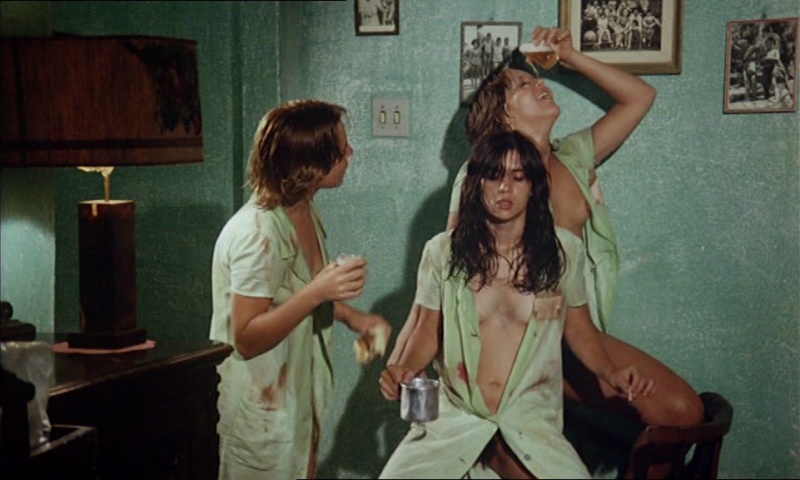
This is certainly one of scuzziest films I've reviewed on this blog, barring of course Alien From The Darkness (1996) for Videotape Swapshop, the difficulty in finding screenshots that have no nudity in them a little harder here because it's a key point of the film and rampant in this content for eighty percent of its sum total. I've avoided nudity and sex in a lot of my screenshot choices over the year or so of adding them to my blog reviews, out of a desire of not coming off as another male film fan whose just obsessed with bared breasts and nudity, thus alienating any potential female readers, but this review is going to have a bit of perversion this time. There was an explicit tag before you enter this site for this reason.

From https://blogger.googleusercontent.com/img/b/R29vZ2xl/AVvXsEja6XrEhvskeE9CCgnDmB4H_-iBurP2CMC0HsBpOgAC69Iw06J5jpnFM0OEjryAY4g_QA5zR0Z2y1B4xzmzH2s8yVl2iIckAtmcytXjNz_XFXsU67rztW0mj5aE9p5ux9mp1SezPhEImc0/s1600/barebehindbars2.jpg

There's actually not a lot of plot here in the film. A group of convicts in an all female prison slowly plan to escape. Aside from this, the film is bordering on aimless porn but only reaches softcore which just skips to the sex instead of much actual plot. In a rat infested, oppressive prison of torture and neglect everyone has given up and, barring that group who want to escape, decided to shag her nearest neighbours, even prison guard, no stop. The head warden sleeps with her prisoners or sends them off to be playthings for older women, the guards are sleeping with everyone, the bubble headed nurse is in a relationship with one prisoner full of bizarre habits, and the prisoners themselves are literally passing dildos on the same fishing line, from one cell to the other, they trade secret messages on. It truly feels like porn, the removed footage for the British television screening (?!) actually pornographic content, and emphasises this tone by crash cuts to any random sexual acts it could imagine taking place, from 69ing to a phallic cut pineapple being licked. Instantly the area of the male subconscious called "guilt" is reached and asks "should I be watching this?", only for the answer to be a lot more complicated when thought about carefully. The film itself is trashy, with no regard for eroticism, emotion, romance or relationships, just wall-to-wall nudity and titillation. Like the nurse character, high on her own ether stocks and completely weird even if she wasn't on it continually, this film is off-its-gourd in tone. Bafflement is a more likely response to it than actual offense.

From http://1.bp.blogspot.com/-VEACBqMkU6w/TwO-5-nM7ZI/AAAAAAAADBY/Wi1PUrr9AOg/s1600/Bare-Behind-Bars-Girls-Conspiracy-6.jpg
What do you react to in a film like this? Honestly, to get offended by it, if you're not the target audience who would find it a turn on or giggling at its brazen tone, is pointless. There is worse in existence. There are obvious issues still with the content but even an absolute greenhorn like myself in the area of sexuality has learnt how complex this and gender politics actually are. Some will be understandably shocked by the sexualised degradation, with some torture too, but it's no way near as shocking now and barely scrapping the world of BDSM that, despite my little knowledge of it, still has humiliation and dominance scenarios more extreme than shown in here. And that's not taking into account completely fantastical scenarios or sexual masochism like with the direction the late artist/performer Bob Flanagan took it to. The potential gender issues, of a film made by a man for men to drool over stereotypes of lesbians, is more of an issue for me in the discrepancy of material made by people of both genders and all sexualities. If there was a market for it, and people were allowed the budgets and international distribution these exploitation films had, there should have been women-in-prison erotica made by lesbians for lesbians. There should have been ones set in an all male prison with homoerotic longings and lusting over the pained and battered male bodies. These films may actually exist, but in cult circles its patriarchal, heterosexual films like Bared Behind Bars that get the coverage and DVD releases, which is the discrepancy. This film is an example of a more significant issue to tackle in society, not the problem itself.

From http://1.bp.blogspot.com/_aStn38p4Q1o/TTa_DzBwJQI/
AAAAAAAAE30/w6gCUJzYdlU/s1600/cap.jpg

The actual, eye rolling issue with the film for me is, forgiving the actual pun of the review, the movie eventually loses its balls. For three quarters of it length, there are no male characters. One man appears and sleeps with a guard in the storage room, where everyone seems to go to have more intimate relationships, but it's a passing moment of fun between them with no connection to anyone else. The prison setting is one of misery, but the porno tone actually makes it seem that everyone is enjoying themselves way too much, where even taking a shower together sets the prisoners (and their watching guards) off, emphasised by the continuous amount of sex and nudity throughout. The head warden gets to the point she's completely knackered by the next morning from her relationship with one person each night before. Accidentally, for the exploitation content, the film suggests women characters completely disconnected from men and being perfectly content with their own company. When the escape story takes place it goes over to even more subversive areas at the beginning. Then a male or two panicked. The horrible moment in these exploitation films where social norms must win and patriarchy must dominate happens again. Suddenly female characters have to shack up with hairy men, rearing out that damn chestnut that "really, all women desire the love of a man", which is obnoxious, and honestly, feels like the threatened ideology of males jealous of women and compensating for a lack of testicular fortitude of their own. An all-male police force crack down on everyone, a male prison governor gets involved, and while you may be sympathetic to the anti-hero women, it feels like, in masculinity taking power from the female "perverts", my own gender was taking a dump in my mind and embarrassing itself again. This is the real piece of offence of Bared Behind Bars, not lots of very naked women grinding into each other, or in one case, bringing out the strap-ons.

From http://www.dvdbeaver.com/film3/dvd_reviews53/bare_behind_bars_
/bare_behind_bars_arrow_dvd_cap07.jpg
The film even before this crumbles because it has no real plot or tone, just a series of sexual events. It's usually funny when the nurse is onscreen because, along with her English dubbing voice, everything she does is incredibly weird. But the film is dated. It's surprising how far this film goes in content but it's not shocking anymore. It's so full of sex every few minutes that it's not actually titillating, and being mere softcore it cannot become masturbatory material either when viewers could get actual porn online. It could have been sexually potent if there was actual eroticism, but set in dull, oppressive grey prison sets, the camera shows too much of the clearly artificial sets, and the content, upfront and with inmates writhing each other willy nilly like the contents of a gummy worms sweet bag on a vibrating chair, is comically trashy instead. There is something far more transgressive about this film than many others, befitting a country of origin that also gave birth to Coffin Joe, but barring this its nothing shocking or memorable unless you like the car crash of arbitrary nudity and that nurse's ridiculous behaviour. Compare it to Japan's Female Prisoner Scorpion films and it's a sitting target against those films and their technical craft and unconventionality. Its junk and its unfortunately not very memorable junk unless you include the moments where you ask "are those two women really doing that in the storage room?". But this is not memorable in a way beyond catching you off guard and being the moments you immediately conjure up separately then remember the rest of the film fully. My desensitisation to this kind of material influenced this opinion definitely, as I clear through films like this on my to-watch pile, but once you get to that point, you realise what is legitimately shocking and what's just tacky. There's a tacky thrill to the film, but while I'll defend it from accusations of the content, I'm not that fond of it that much by the end.

Your guess is as good as mine. 
(From http://atrocitynights.com/Watching/Images/bbb.jpg)

Thursday, 6 December 2012

An Aesthetic of Violence and Hunger [Antonio Das Mortes (1969)]

4.bp.blogspot.com/-s9o3YLgHKU4/
TnCSnrJ3YDI/AAAAAAAAAcM/z_6QV8TNM2c/
s1600/Drag%25C3%25A3o%2Bda%2BMaldade%2BContra%
2Bo%2BSanto%2BGuerreiro%252C%2BO%2B---%2B1969.jpg

Dir. Glauber Rocha
Brazil-France-West Germany
Aka. O Dragão da Maldade contra o Santo Guerreiro

The disparity between a nation’s cinema and the amounts of films that are available outside the country is significant with the Brazilian director Glauber Rocha, whose filmography on purchasable disc is only three films available from the company Mr. Bongo; this is problematic in that, despite my little knowledge of Rocha, what knowledge of him I know of is that of a very important director in Brazilian cinema and Latin American cinema in general. Founder of the Cinema Novo movement in the continent, Rocha also wrote a very important manifesto on the Aesthetics of Hunger, calling on film directors in third world countries to draw from their plight – poverty, government corruption etc. – and channel it into left wing political cinema that could spark revolutions. In the vast numbers of Latin American cinema of the 1960s and 1970s that is waiting for me to see then, within a period of political strife during these decades for countries like Chile and Brazil, Rocha looks to be one of the most important directors of the continent, making the lack of access to his films even more disparaging. Antonio Das Mortes can be said to be a sequel to Black God White Devil (1964), in which the titular Das Mortes was introduced as a secondary character, a bounty hunter who targets Cangaceiros, ‘mythical’ bandits who fought for the people. Played by the same actor Mauricio do Valle, the film gains a lot from being a continuation but can be viewed by itself, and it takes the character on a very different path to before.


From http://s3.amazonaws.com/auteurs_production/images/film/antonio-das-mortes/w448/antonio-das-mortes.jpg?1309012930

Set decades after Das Mortes has killed the last Cangaceiro, he is an older, less confident man, filled with regret and yet also left without a purpose. When he is called upon to deal with a leader claiming to be a Cangaceiro, it gives Das Mortes new purpose, but it leads to him taking a drastic turn in his life from what he has done before. The film sounds like a Brazilian western in plot, which it pretty much is, but it is something far more drastic in tone from genre. Not only is the film set in a more modern day environment, the older myths being crushed under modernisation and completely losing the battle long before the film’s narrative, but the film is definitely a political manifesto onscreen. It is very unconventional in tone, willing for three quarters of its length to have prolonged scenes of characters talking to each other and straight to the camera directly, interlaced with overlapping dialogue over visuals and folk music, the Western driven plot dissected for the purposes of Rocha’s ideas as Das Mortes’ alliances drastically change. It is very much its own film and completely unique to itself, its dialogue and literary subtext combining the fantastical with politics and reminding me of William Blake’s more political and visionary writings. The growing intensity of the film, intercut with scenes of violence, eventually grows into a finale that is a barrage of merciless death, the only way tyranny can be overruled, genre and political revolution as a cacophony of gun fire and blood that is brief and startling, with a humorous and lyrical guitar song played over the screams that makes it an event already immortalised during its length. The use of music is exceptionally important for Antonio Das Mortes, the sense of ordinary people within the narrative being able to speak through songs, emphasised by the continuous singing that commands the soundtrack at one point and drowns out the voice and gunfire of the capitalist landowner and his henchmen. The music breaths life through the film while giving it an even more mythical tone alongside its symbolism.

From http://www.theoneonefour.com/wp-content/uploads/2010/05/Antonio-das-Mortes_still1.jpg

The final film needs to be adapted to, but by its end it is startling in its effect, the violence and rage of the content emphased by its messy yet very considered structure, its deep 1960s colours almost making it look like the paintings that bookend the entire film. The use of mythology with political fury is clearly biased, with no regard for balance, but made in a period that could only get worse when a dictatorship took over Brazil, forcing Rocha to leave the country in exile, it is a creation of strife and the desire to change the world when it was drastically needed. As the man who wrote a manifesto of channelling one’s anger into one’s cinema, Rocha made a furious film that is effecting even if it loses you at first with its unconventional tone. Pretty much like most world cinema once you start to dig deeper into it, it will break down your views on what ‘cinema’ should feel and be like, and the lack of Rocha’s films in terms of availability is even worse when I consider that Antonio Das Mortes, with its desolate ending, encourages one to continue through the director’s filmography, a vast one even if he tragically passed in his forties that is out of hand’s reach.

From http://cf2.imgobject.com/t/p/original/voOUcsIgQQYPlLvIDPKeSJ0CT3h.jpg