Showing posts with label Genre: Eastern European Cinema. Show all posts

Sunday, 20 October 2013

Representing Russia: Faust (2011)

From https://blogger.googleusercontent.com/img/b/R29vZ2xl/AVvXsEiN-0OtsMQEBcNHRzyHGNA3SWcCQxNEaesRc2xYLXWnYhCV8u4eOcltA2VUcGdCFDIUw2qnpmsmQKauwSbb94CyhzV64K9pfHja4mCkqTqH3-CVh7h0qZaypYlFUNJ49Z_cnnhQ6Dp0R7Y/s1600/faust-2011.jpg

Dir. Aleksandr Sokurov

Even for those who only know of the Faust story though the idea of it, a man who signs away his soul to the Devil, Sokurov's take on it, the final piece of the legendary director's tetralogy of films that concentrated on three real world figures (Hitler, Lenin and Hirohito) beforehand, is a bizarre, legitimately bonkers film which is yet an intellect crafted work about the placement of wisdom and trying to find meaning in existence that may have no God. The connection to those first three works immediately brings about issues - having seen two of the three, it's clear that the issue of power compounded against the ordinary, contradictory behaviour of human being is shared, with this story being the proto-diagram of the real life individuals. It still has to be digested how the Faust story, where the titular character (Johannes Zeiler) needs money and finds himself pulled into a series of strange events with a demonic moneylender (Anton Adasinsky), is turned into this mass of ideas from existential musings to full-on body horror played as a joke at points as well as being gross. It is almost, if not, a perverse buddy film where Faust is less of a friend of the moneylender than dragged behind him in a series of squabbles, pulled into his hands finally when a youthful beauty Margarete (Isolda Dychauk) becomes an obsession for Faust. But the moneylender, as the Devil exists less as an evil being here than a bulbous imp, a literal mass of fat flesh when you see him completely naked at one stage, acts in all his dealings with Faust as if it's a normal transaction or deal, or as a comedic buffoon who wrecks havoc with anything he touches.

From https://blogger.googleusercontent.com/img/b/R29vZ2xl/AVvXsEh5kLSl25j-QYFv8er0SBVyipeaVBZlL48Tlg8QEGDuHdvo77N_9bJXgEGLRHZOo3k8hqh9se6v8vehvm3o1Z4np5PQO7wCrbIzGHnj52aGViHsd-7iSrG3sqCBOsDR6taAhulXwydLKOBc/s1600/shot0013.png

Sokurov's film is dense. Long at two hours twenty minutes. A vast, distinct world of German origin,  interpreted through Russian production, depicted onscreen with a heavy, symbolic tone. But its dense not because it's a grand scale morality drama - F.W. Murnau did this with his silent adaptation in the twenties - but because for such a critically lauded auteur, as I slowly get into his work tiny piece by piece, Sokurov has such a peculiar film here in the final results. Grotesque definitely, the first interior image of the film a giant close-up of the penis of a male being cut open by Faust for research and long passed his mortal coil. That doesn't even begin to explain what the moneyleader actually looks like naked, or when Faust's assistant Wagner (Georg Friedrich) brings out a project he claims to be his to impress Margarete, suddenly evoking Frank Henenlotter in the middle of a serious, austere film. An austere Russian film which yet clearly plays for laughs the moneylender entering a church to empty his bowls blasphemously after drinking the hemlock solution Faust wanted to end his own life with. What Faust as a film means, there's a very obvious idea that, stripping the pretence, the titular protagonist here is no longer the Faust of Murnau who wanted to help people, but wants money, later wants a young, baby faced woman just for a night at least, having to deal with her mother's clear hatred of his presence, but despite coming off as a detestable man, eventually shows the human being who was a professor of great acclaim who finally gets his desire for knowledge back even if it's too late to save himself. The Sun (2005) and Moloch (1999), the two films of the tetralogy I've seen, made frank comments that the characters, Hirohito and Hitler respectively, were human beings, especially with the later despite his disgusting crimes against humanity. The later film needs a re-watching for me, but it at times was comedic, Hitler apathetic and only kept awake in life by his love Eva Braun, his minions like Joseph Goebbels bitchy and whiny, making Quentin Tarantino's Inglourious Basterds (2009) not that different to Sokurov's film in the mindset of depicting the real life individuals. The Sun, which had actual comedic scenes too, while not showing the atrocities Japan and America did in World War II, showed a man believed to be the human incarnation of God for the nation of Japan as a human being, wanting to know and learn of the world too in his interests, forced to show his nation he was only of mortal flesh. Faust had the potential to be a great person, but has yet signed his soul away by the end of this film for the mere ability to have sex which he later regrets, the most obvious of metaphors but perfect for being the central pieces of the other three films before it in this series. As the moneylender points out, a Devil who yet has moments where he is wiser than anyone else, if Faust cannot help heal people, considering he has medical knowledge, or console them, he is useless.

From http://lincolncen.3cdn.net/9e2f1d0fe667d09fc5_ccm6b3jid.png

The film is presented as something very different from most fantasy and art films. Alongside the many mentioned moments in the review, and ones unmentioned, the film presents itself in a very unconventional form. Murky while also visually splendorous, moments in the film are shown through a distorted, tilted camera lens, fitting something that is both sincere in its prestige seriousness but also close to wading through literal faecal matter with its fart jokes, pulsating flesh and extreme distortions of human body parts like genitals. Like Moloch and The Sun, the serious subject is nonetheless counterbalanced with a far more expansive view of humanity which can be bizarre and downright vulgar. Faust is extremer in tone and content than those films, but even with something like Russian Ark (2002), Sokurov combined very difficult content to digest with seemingly out-of-absurdities and humour that yet fits the material and deepens it. Faust is definitely a difficult film, at its length an immense amount to soak in, but it succeeds immensely. As much a very potent take on finding meaning in life through the "comedic" hijinks of Faust and the moneylender as they visit place to place bickering about each other's beliefs. Its swerve to the danger of desiring power, through Faust's gamble for love, shows that even in the simplest wishes, as Sokurov's depictions of Hitler etc. showed too, people can damn their souls through their moral failures. It's a weird film, a gruesome film, abstract when it ends, using Icelandic shooting locations, nearing Max Ernst's landscapes, but as a whole Faust manages to make all of itself work.

From https://blogger.googleusercontent.com/img/b/R29vZ2xl/AVvXsEiJLmxfK-QAg7m5RYewfdHvdBRoGtlx1XVxa__2k9dBKUhpxyaDj1yEI1Scw0GWpB_4kxVYUOlAFa9Y3IGbLXhs4whpn5vro7nPVNo6mYP3B1PFVSbonO80z-2FrIZ_ohgL1zt01uJ9cCE/s1600/Screen+Shot+2013-05-10+at+5.16.03+PM.png

Thursday, 4 July 2013

Mini-Review: On The Comet (1970)

From http://s2.postimg.org/jn8fpk7k6/Cometa.jpg

Dir. Karel Zeman
Czechoslovakia

A later film is Zeman’s filmography, making films since the later forties, On The Comet takes its influence from turn-of-the century literature. Literature which pre-existed before political correctness, as this film is set in a colonial ruled Middle Eastern country, but is still enriched with the imagination of authors of the time that mixes science fiction and fantasy together and never lets this fact take away from the creativity and fun the stories give. To the surprise of everyone within a colonial town – the French occupiers housed in a fort, an invading group of Arabs helped by the Spanish and the protagonist, obsessed with a girl that seems to have appeared from a postcard and his dreams – a rouge planet skims over the Earth’s atmosphere and pulls the entire town and its populous onto its surface. The warring groups still want to fight each other, as the protagonist and his love interest sit in the middle of it all, despite the fact that the prehistoric occupants of the satellite and the fact that it’s still moving in the universe between planets should be of greater concern.

From http://farm3.static.flickr.com/2190/5808942180_fc159777cf_b.jpg


Significant to Zeman’s style is his mix of live action and animation. In most cases, it is stop motion animation figures imposed on real sets. In Zeman’s work it is real actors on animated and artificially built sets. The results compare to Georges Méliès, or for a more modern example which borrowed from Méliès, to the music video Tonight Tonight by The Smashing Pumpkins. The results create a very appropriate tone for the tributes to classic storytelling, a peculiar mixture of adventure story with science fiction, romance and a handful of rubber dinosaurs. It’s not as extensive in terms of its look as with the director’s A Deadly Invention (1958), but the results, presented in tinted yellow and colour shading like a old silent era film, still fleshes out the results. It also balances out this fantastic plot with satire about the groups involved. The French especially are shown to be comically ridiculous and capable of pointless amounts of dominancy, with plans for any sort of event possible and liable to arrest anyone suspicious when there are flies as big as a man’s head. It would be interesting what this film would be like on an equal adult and child audience – dinosaurs and short length for the kids, a different (from current cinema) take on pulpy adventure stories for adults – and this satire adds a nice caveat to the film. Without the canons the French occupiers, despite being the good guys, would be on equal terms with everyone else and have soldiers who are not as reliable as they would wise. In the colonial era it also adds a nice, modern thought on this issue, replacing soapbox condemnation with a cheeky sense of humour. By the end, the film leaves off with a charming aftertaste to it, managing to feel full for such a short length and never lagging at the same time. And any film with a bipedal pigfish, for a brief scene, deserves an extra mark as a cherry on the top. 

From http://farm4.static.flickr.com/3024/5808919410_dd473c9498_b.jpg

Sunday, 30 June 2013

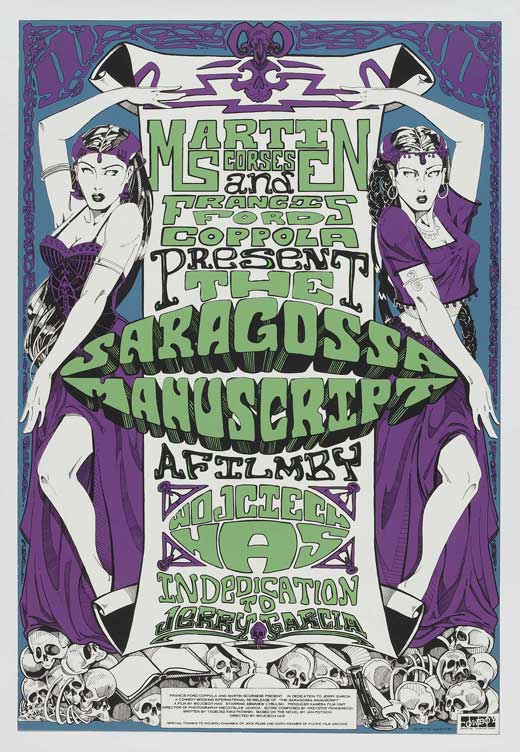
Wrapping Around Upon Itself By Its Tongue: The Saragossa Manuscript (1965)

From http://images.moviepostershop.com/the-saragossa-manuscript-movie-poster-1965-1020703017.jpg

We are like blind men lost in the streets of a big city.

Dir. Wojciech Has
Poland

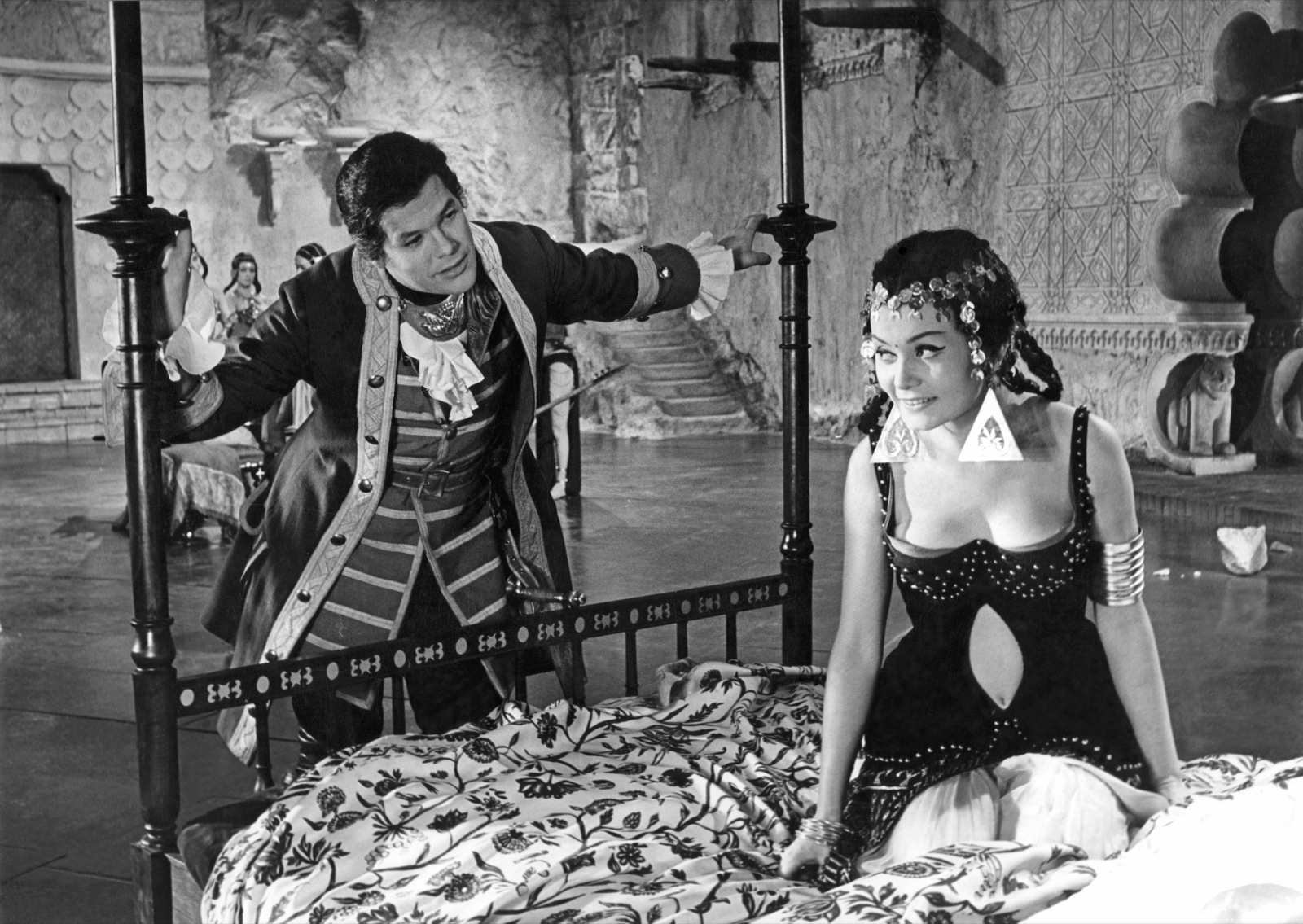
From http://verdoux.files.wordpress.com/2011/05/the-sargossa-manuscript-still.jpg

Storytelling itself is inherently beautiful even if the story being told has no end. My younger self, admittedly only five or so years ago but a vast jump to now, didn’t understand this and only got a lot from films which explained everything about themselves. With exceptions that would eventually chop away at this mentality, most films that rejected or subverted narrative fully were pretentious and dull in my eyes. I found The Saragossa Manuscript to be boring, and as the dinglebat I was, got rid of the DVD version I viewed. Like the ghosts that haunt Alfonse Van Worden (Zbigniew Cybulski), an officer for the Walloon guard who travels to Spain and finds himself unable to escape from a continuing loop, all the films (so far) I once dismissed are creeping out the grave I put them in as some of the films I praised the most turn rotten and feel pedestrian and lacking. The discarded films prove to be more potent now I realised the virtues of dreaming, plotting structure by itself and throwing yourself into something without any idea what is exactly going on. Films like American Beauty (1999) are vacuous and insignificant while The Saragossa Manuscript, seen again finally after all these years, runs rings around it in content and presentation.

From http://www.dvdbeaver.com/film/DVDReviews11/Saragossa%20Manuscript/Saragossa
%20Manuscript%20dvd%20reviewPDVD_007001.jpg

The film is a celebration of storytelling, starting off with a framing beginning of the protagonist’s future ancestor, and the members of the opposing army he’s fighting about to capture him, becoming transfixed with the titular manuscript, a beautiful, giant tone (presumed to be) written by Van Worden and with evocative illustrations. It goes into the tale of Van Worden, unable to leave an inn and the area around it, stuck in a labyrinth that circles back onto its beginning point, whether it is two Tunisian princesses who want to marry him or the Inquisition after his hide who drag him back to the starting point. He becomes a minor figure in his own tale as everyone else speaks of their lives. The film becomes a story-within-a story-within-a story as it juggles these characters’ tales of cuckooed husbands, demonic possession, pranksterish attempts to marry two people and duelling injuries with figures of the film interweaving and entering others’ stories. The film even becomes a story-within-a story-within-a story-within-a story-within a story, topping the one moment joke of Detention (2011), a film I covered on this blog, by making this an extended, multi-layered tales within tales narrative that humorously admits to the absurdity of this structure at one point. Like dreams-within-dreams-within-dreams, pockets open up in the film’s existence which develops pockets of their own.

From http://deeperintomovies.net/journal/image10/saragossa6.jpg

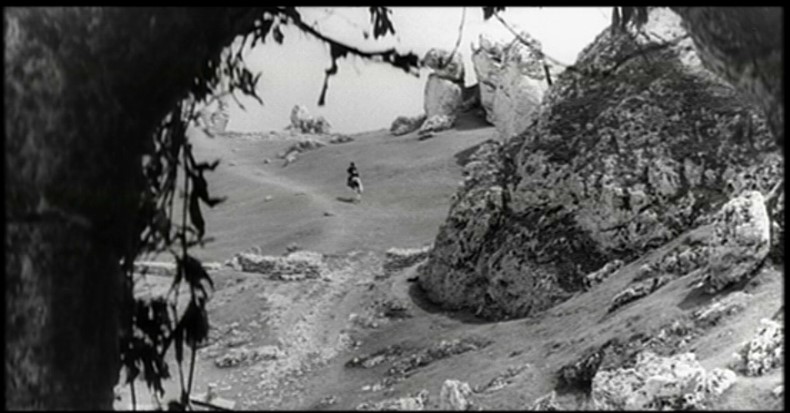
The film is elaborate in tone, with clear nods to Surrealist art but also with a dense visual look of extensive sets and moving camera shots. From a source material that, from what I’ve looked into, is even more dense and full of more pockets in its obsession with tangents – a book I’m adding to my To-Read list at the top now – this layered and vast film manages to breeze past despite being three hours long, but the sense of joy to it all is fully felt and intoxicating. Despite its obsession with death – piles of skulls, hanged men, fencing duel deaths, rotting flesh and demons – it’s on the side of the macabre that is playful. The score by Krzysztof Penderecki, electronic noises and layered demonic yabberings over the Napoleonic Era setting, is anachronistic but adds to the unearthly nature of what’s onscreen. As the film progresses, it’s clear Van Worden will never reach his destination, permanently in this loop that, unless he is only dreaming it, will continue timelessly. Far from a bleak end, it suggests the sense of the Ouroboros, the snake that eats its own tale and keeps existing, that reality has always repeated itself, and in a place of these stories-within-stories, of gypsies, princesses, pranksters and merchants, Van Worden at least is somewhere which is vivid in its life and populous despite the insanity that he may end up in. The story could have gone for six hours, spiralling into further tangents and areas, and felt succinct with its long length making sense to the material. Van Worden is a figure in the middle of a storyteller going through their tale, the onlooker as it continues as long as the narrator can muster it. This richness vastly outmatches other films I once praised for their lack of this depth, like films like it I unfair have given premature burials of. Such a controlled stream-of-consciousness, The Saragossa Manuscript is a welcomed self discovery for me. If my reviews of films like this dangerous veer towards being identical in their praises of the work, it is only because they end up intertwining together in one form showing how movies can be both entertainment but open up one’s perception of their creation and form. If there’s a virtue to my dismissive attitude I once had, it means that now I’m rewatching these films with a new perception it feels like each one is a first time viewing with new eyes. The revenge of The Saragossa Manuscript on me for wanting to fall asleep in the middle of it once was justified but was good for me too.

From http://deeperintomovies.net/journal/image10/saragossa2.jpg

Sunday, 14 October 2012

Human Flesh Frappé [Little Otik (2000)]

From http://i2.listal.com/image/productsus/1000/B000077VS5/movies/otesanek-little-otik.jpg

Dir. Jan Svankmajer
Czech Republic-Japan-UK
Film #13, of Saturday 13th October, for Halloween 31 For 31

With this Czech director Jan Svankmajer makes his third mark on the blog, making him an immediate candidate for a Hall of Fame or Mount Olympus of the Region Incognito site. Adapted from s Czech fairytale called Otesánek, this is an odd choice at first to include in a Halloween festival were it not for the fact that, as with a lot of fairytales themselves, its macabre take on childbirth and human attitudes is equal to the nasty interpretations horror stories make of reality. The husband of a childless couple digs up a tree root that vaguely looks like a child and presents it to his wife as a gift, only for her to start treating it as an actual child. The tree log, dubbed Otik, becomes a living being, but is constantly hungry to the point that it starts eating other living beings within the apartment the couple lives in.

From http://s3.amazonaws.com/auteurs_production/images/film/little-otik/w448/little-otik.jpg?1289443833

This, on another viewing, is probably not recommended viewing for expecting or pregnant mothers and possible readers of this blog and in hindsight may have a different effect on female viewers than to male ones. Otik is transformed into a literal child – its movements at first created from pieces of wood of certain shapes connected together like building blocks to ‘animate’ him, later through puppetry and costumes made from wood – but also a manifestation of both chaos and the id to just consume anything without ever feeling full. Pot after pot of baby food, meat, maybe even a postman, Svankmakjer plays up the horrifying nature of childbirth and how parents have to look after babies. The daughter of a neighbouring family in the apartment Alžbětka, who studies textbooks on sexual dysfunction hidden under the covers of fairytale stories, is obsessed with the concept of childbirth and having a friend to play with, making her a main character throughout the film when the peculiar Otik catches her attention.

The film tackles serious adult issues in its blackly humoured tone, and as with Svankmajer’s other work as a proclaimed Surrealist creator, he does not hold back in terms of content, invoking implied cannibalism, matricide and patricide, and following on after the Tokyo Zombie (2005) review, an old man who ogles Alžbětka from afar and is called a ‘paedophile’ by her at one point. Unlike Tokyo Zombie, Svankmajer’s take on such a controversial subject, like the rest of his work, is barbed and forces you to think about it as it is depicted in such a confrontational way through the animator’s mind. The film is as much about the apparent ‘normality’ of the people living around Otik as it is the wooden child, Alžbětka’s mother constantly afraid of the outside world because of news stories on the television, and her father drinking constantly and sitting in front of said TV as biased ads for meat steaks say that their competition’s product is ‘full of worms’. The absurdity of human life, and the most sacred in childbirth and childrearing, is upfront as Otik’s hunger is more insatiable and he starts growing in size. That the original fairytale is told during the film, in beautiful two dimensional animation, and reveals what the ending will turn out to be signifies this; as with almost all adaptations of stories, it will stay the same but it’s how they go to it which is of more importance.

As is the case with Svankmajer, the animation and puppetry effects are a masterclass and a deep creative well of images and ideas. Using wood and tree matter extensively, his trademark of using textured material is emphasised in a character in Otik, who is a living, almost sweet, creation, but is also unbelievably alien and off-putting at the same time, constantly crying for food, and gesticulating and spasming with its branch limbs and ever changing mouth with teeth and a single eyeball within it to glace at its next meal. This film also puts one of Svankmajer’s most obsessed about topics, food and the act of eating, within the centre of a feature work. His cinema is a food – cinema of goulash, cinema of stew, cinema of soup, cinema of meat and vegetables – but while the food is lovingly rendered on screen in close ups, likely to cause the viewer (like myself) to hunger for Svankmajer’s interpretations of such dishes to be available in their kitchen, said close-ups also make their liquid-solid, sauce rich matter disgusting as well or too rich for the eyes and thoughts you have of them to handle let alone the stomach. It reminds me as I write of what Vincent Price’s character in The Fall of the House of Usher (1960) (Review Here) must have felt when he could only consume the most plain of substances. In such detail, and with soundtracks full of slurping, crunching and the sound of the human gullet and mouth chewing and ingesting food, it both reveals in the concept of eating but sees (and feels) how disquietingly strange such a primal concept (to nourish oneself) is. While I may have brought this up in another review of his work, Svankmajer’s history of dietary problems as a child, and the attempts to correct it by his parents and doctors, is a piece of autobiographical information that explains so much about this obsession. Otik consumes for the sake of food, not just as sustenance, but of the concept of consuming any other matter for whatever metaphorical reason, without desires of normal morality and codes of the people in the apartment block have, but just to fill its little wooden belly. Eating as an aggressive act, as in most of his films especially the 1992 short Food, but also admitting how meat, sauce, dumplings and creams are all as much surrealist materials to play with as Salvador Dalí put boiled beans in his paintings or was inspired to create his famous melting clock motifs from melting Camembert cheese. Bread shoes, lobster telephones, the Surrealists played with the motifs of food, but Svankmajer would also subvert the concept of eating itself as well amongst the other thought lines and interests in his work, existing in most of his short and feature work but directly part of Little Otik.

The availability of the film is problematic in the United Kingdom. Most of his cinematic output has been thankfully put on DVD on some point or another, this year especially thanks to New Wave Films, but if it can be located by you the reader, including non-British readers, in some way it is quite a good start into Svanmajer’s work, balancing his live action filmmaking with animation, with a story that is dark and adult but has a clear narrative through its fairytale origins that eases new viewers into it. It is certainly a film that suits the Halloween season more than some actual horror films, its gruesomeness at times undercut by prompts to question and learn from the gristly eating onscreen. Even if he believes in pure imagination as the most important tool of creating his work, Jan Svankmajer especially in his feature work always leaves critiques and distortions of conventional society throughout them, prodding one to question its validity against the animated creations of wood, bone, toys and even meat and preserved animal parts, that have been given as much life on-screen as the puppet-like actors.

[Note: My apology for the pop-up that appears in at the start of the trailer. Thankfully it does not disrupt the rest of it.]

Wednesday, 22 August 2012

Surviving Life (Theory and Practice) (Jan Svankmajer, 2010)


Since I discovered the short films of the Czeck filmmaker Jan Svankmajer in college, borrowed from the private stash of DVDs in the office of the Film Studies tutors, I can say he is one of my cherished filmmakers.  Having seen all the other shorts and films, the through line from the famous short works to long form movies is a fascinating progression. One of the best living animation directors, his knowledge of traditional techniques (puppetry, stop motion etc) is matched by a distinct use of everyday objects – toys, wood, metal, animal bones, even pieces of meat – that are moved and crafted in ways that pushes the films into the areas of texture as well as sight and sound, allowing the viewer to ‘feel’ them by their nature and the grain and details you can see. This trademark, through decades of shorts, was combined with various types of ideas, from adaptations of Edgar Allen Poe and fairytales to satire, and his idiosyncratic obsessions such as childhood to food and the act of eating, the later the result of digestive issues as a child, and the attempts to fix it by doctors, that made him fascinated and disgusted by them. (Going into a Svankmajer work, you will both see food as a beautiful substance and utterly vile, which Surviving Life continues with the new addition of projectile vomit.) With his first feature film Alice (1988), Svankmajer would incorporate live action, but not in just having actors in front of the screen but having them being as much figures for the director to animate as well as actual people. Svankmajer incorporated this in short films, 1983’s Down To The Cellar a predecessor of his debut Alice, but after he started to concentrate on feature films, this has become a central part of his work. With Lunacy (2005), the film before Surviving Life, the live action would have completely taken over were it not for the continuous scenes of animated cow tongues that are intercut between plot points. With Surviving Life, Svankmajer’s fanbase is either met with an experimental tangent from his previous films, his bitterly humorous opening monologue to the camera introducing the film as a result of a lack of money for production, or a potentially new direction for the next decade.

Created using cut-and-paste photographic images, ‘like old children’s cartoons’ as the director compares it to in the opening introduction, Surviving Life follows an older man Eugenie whose life is punctuated by dreams of a beautiful, red dressed woman whose name continually changes and exists in a dream reality which continually fluxes out of his hands. Becoming a patient for a psychoanalytic doctor, and delving into other methods of guiding  his dreams, he tries to understand the images he sees every time he sleeps.

The plot sounds quite common and paradoxically, this is the closest for me yet Svankmajer has gotten to a ‘conventional’ story - including the layer of clues and images you discover on a second viewing - but is one of his least conventional works in a filmography that would be viewed as abstract against traditional views of animation. The cut-up images that make up the entire film, spliced with live action moments (usually close ups of intricate actions or gestures), is incredibly different from what I have encountered in cinema. If anyone, like I did as a child, used to cut out images from magazines or comics and either moved them about like toys, or spliced pieces of them together to create new ones, this is what the entirety of Surviving Life feels like, only taking to it to an entire feature length film, from the background to most of the moments, being created from two dimension images cut out and finished digitally on computers.

This style of animation has been used by Svankmajer previously, including outside his film work, but here it is allowed to breathe out into this entire construction. The results are surreal, human beings and their photographic copies alive and mixed with a story where dreams are in the centre of the narrative. As he describes in a making-of for the UK DVD, Svankmajer has played with the concept of dreams in his filmography, but this is the first one where they are the central subject. With this, expect Freudian images of everything from eggs to flowers, giant hands coming out of windows to drag bystanders up to their doom, a dog with a suited office worker’s body, and an entire film where reality and the dreams, while separated, still bleed into each other, continuing Svankmajer’s message at the start of the film, through quotation, of how only by combining the both of them together can a human being be full. The result is unconventional even for animation, incredibly creative with its imagination and technical production, and with a wonderful sense of disgracefulness in Svankmajer’s old age, a newly acquired sense of vulgarity that did not even come out in Conspirators of Pleasure (1996), his take on sexual fetishes, but erupts in this wonderfully in its sex obsessed, puke filled, poodle fucking mentality filtered through the obsessions with childhood, food and the fantastical. This may have started in Lunacy, with its combination with the Marquis de Sade with stories by Edgar Allen Poe, but while that film was serious in its takes of blasphemy and of the concepts of freedom, the self proclaimed follower of Surrealist Art Svankmajer has properly added a sliver of crudity to his repertoire with Surviving Life and uses it perfectly. The film is also abstract in that, it does not only look at dreams but incorporates psychology. My knowledge of the area is slim, but my small reading is enough for me to realise that this adds further complicated strands to the plot. The plot is incredibly obvious by its ending but by invoking the ideas of Sigmund Freud and Carl Jung, personifying their real life combative and disagreeing views of psychology through living portraits which fight each other, Surviving Life introduces layers that, while very easy to grasp, cause the scenes you see to take on new and peculiar lights to them.

Upon watching this and Lunacy this year, I realise I am biased for Jan Svankmajer, but it’s through his skill of an animator and as a creative figure, still able to create such imaginative and stimulating work after fifty years or so since his first projects. To step into a Svankmajer film, while part of a rich culture of animation (especially European animation), is to encounter a truly unique voice, driven as much by ideas behind the images as by the creations on screen. Surviving Life combines a full narrative with this, as seen in his other features, and gets the best of both worlds. That it is also humorous and, by its ending, deeply poignant also adds to its quality.

Abstract Rating (High/Medium/Low) – High
Personal Rating – 10 out of 10

Monday, 12 September 2011

Alice (1988)


Dir. Jan Svankmajer
Czechoslovakia-Switzerland-West Germany-UK


Note: At least with the UK DVD release, the original language version of the film is available, so don’t be put off if the English dub shown in this clip is off-putting.

What Is It?
A pretty faithful adaptation of the Lewis Carroll story Alice in Wonderland viewed through the eyes of surrealist animator Jan Svankmajer, who made his feature film debut after a few decades of acclaimed shorts.


And?
Alice is almost a continuation from Jabberwocky (1971), which combined another Lewis Carroll work of the same name with Svankmajer’s perception of childhood, existing in the same universe as each other. Immediately from the start of the film, it is less a children’s film and more of a surrealist fantasy art film, where Wonderland is interpreted through corridors of a home and its habitants are stop motion creations made from bone, fur, thread etc. It also separates itself from many children’s films in that its child protagonist is not an idolised version of a child, innocent and yet aware of their surroundings, doing what they can to be kind to others. The Alice in this is a more accurate portrait of a young child, very naive and learning about the fantasy environment very slowly, more slowly than the viewer. Also in one scene, at least for myself, where she is trapped in the White Rabbit’s house made of toy bricks, she shows a selfish spitefulness without any malice where she does not follow the requests of others for the sake of it, a rarity in child characters in mainstream cinema.

For those who have not encountered Svankmajer’s work – and you really should, as they are not just for animation fans, but for any film viewer - his work is distinctive in that the man-made aspect of his animation (and even the positioning of real people as actors) and their textures are upfront and as much part of the films as everything else in them. His stop-motion, and surrealistic flourishes, are usually created using everyday objects both man-made (paper, tools and utensils etc.) and natural objects that are manipulated by human beings (stones, taxidermy animals and bones); he has worked with paper animation and puppetry as well amongst other things, but the emphasis on the materials, and their textures and appearances, is still apparent. (Both these styles appear in Alice as well, and are completely inseparable from everything else). Every scene feels like it has by crafted by someone’s own hands, with the flaws of manipulating and moulding everything into place as much part of generating the atmosphere of his work, be it a short or feature film work.

In the context of other adaptations of Carroll’s story, Svankmajer’s style looks far more ‘creepy’ and ‘unsettling’ compared to something like Disney's, an aspect which is purposely emphasised by having such images as loaves of bread suddenly spurting nails from inside them or the White Rabbit continually losing sawdust from the gaping tear in his chest. However the style is able to go from this to charming and humorous as well, the later a definite part of many of the director’s other work even if its black humour. For its source material it is perfect, adding to the adult sense of whimsy which appears in the original story (which, as well as being a surreal fantasy, satirised attitudes of the British culture of that period, as seen when Alice is put on trial by the King and Queen of Hearts). As an interpretation of childhood, it is just as good, enforced by the use of old style toys that look Victorian at times in appearances. A universal nature in Jan Svankmajer’s work can be seen in the fact that these everyday items are ones that viewers probably possessed or know of greatly – owned by themselves or relatives, found in their attics, or even found on car boot sales and in antique stores – regardless of their country of origin. Svankmajer is also an imaginative filmmaker who, as a practicing Surrealist who works in other mediums as well as cinema, has a keen eye for inspired contrasts and juxtapositions. How fitting is it that the portals to Wonderland and between each part are desk’s drawers, part of a piece of furniture stories like this would be planned and written upon?

Sadly Svankmajer’s other feature work after Alice have been hard to find in the United Kingdom, but having seen Conspirators of Pleasure (1996) and Little Otik (2000) he has affectively taken all of his obsessions from his short work and combined them into longer form narratives that show the craft of a talented veteran filmmaker. Also worthy of praise, especially with Alice, is Welsh film producer Keith Griffiths who helped this film, and other Svankmajer works, to be made. I ask of you the reader to look at his IMDB page, which I will provide in this post, and look at his producer credits. Even though I have disliked or hated some of the films he has produced, Griffiths has contributed to cinema in general immensely, helping such filmmakers aside from Svankmajer like Chris Petit, Apichatpong Weerasethakul and the Quay Brothers (who are huge admirers of Svankmajer and made a short work in tribute to him) to make interesting and unique works. Having Alice and Conspirators of Pleasure in one’s producer credits is worth applauding, but Griffiths’ is even more incredible than this.

Alice is not my favourite Svankmajer feature (that would be Conspirators of Pleasure) let alone out of all of his filmography, but it is a great achievement, a fantastical and surreal work which matches its subject material like a hand to a glove. The film was finally released on UK DVD this year thanks to the British Film Institution, part of a sudden surge of interest in Alice in Wonderland in cinema that started in 2010. Hopefully his other feature films will be made available, but this by itself was worth the wait for me.

Keith Griffiths’ IMDB Page - http://www.imdb.com/name/nm0341702/