Showing posts with label Genre: Body Horror. Show all posts

Tuesday, 18 March 2014

Celluloid Wunderkammer: Call Me Tonight (1986)

From http://i1091.photobucket.com/albums/i386/jgespi/caratulas/CallMeTonightRedux-1.jpg
Dir. Tatsuya Okamoto


Contrary to the provocative image that I've included at the beginning, this short piece of obscure anime flips the expectations for hentai into how perverse the concept of tentacle erotica is. I've been lucky to discover these fascinating obscurities released straight to video, mainly thanks to the Anime News Network article series Buried Treasure - found here - and thankfully these works that have never been released on DVD even in their home country have been discovered by Western fans, subtitled by said fans, and made available online. I admit to haven't even see key anime works like Cowboy Bebop (1998) yet seen the likes of Call Me Tonight, my habit for digging deep into the depths of my favourite things sending me to material like this, made back when money was plenty enough for a subversion of anime sexuality, when anime hentai was only birthed within the same decade, to be made. If this material was made available on DVD, when pigs fly, they would be fascinating curiosities for anyone to see.


Review Link - http://www.videotapeswapshop.co.uk/19348/celluloid-wunderkammer-call-me-tonight-1986-director-tatsuya-okamoto/

From http://s3.amazonaws.com/auteurs_production/images/film/call-me-tonight/w448/call-me-tonight.jpg

Sunday, 16 March 2014

Directly Through The Ribcage: Organ (1996)

From http://rkummer.files.wordpress.com/2013/11/organ_flier02.jpg

Dir. Kei Fujiwara

In the industrial outskirts, isolated from a social environment, a police detective - tall, swaggering and confident, even if it means breaking rules - with his partner awaits to burst an illegal organ harvesting operation. The environment is dark, run down and moody in the night-time darkness. Inside, a factory environment covered in plastic sheeting and dulled metal, the film shows a coarseness that feels rancid even before Organ's more gristly events. The bust goes badly wrong. His partner, seemed to be dead, goes missing. Without his limbs and with an infection growing on him, he is locked up in a secret room of a biology teacher's office. The teacher is the surgeon who was performing the illegal operations.  Slowly disintegrating, a repulsive pus-infected growth developing around the liver area of his stomach, he has the compulsion to kill the female students in his school, while a female member of the staff, a sultry woman who yet views him in contempt as a "hentai" (pervert), recognises that something is amiss with him. The surgeon, while hiding this cover, is struggling with his sister (the director Kei Fujiwara herself, medical eye path, long messy hair, bold facial features, the actor-director radiating a toughness that is far removed from a shrinking violet) to keep control of the organ harvesting operation from the yakuza who've hired them. The yakuza seem to feel that their lucrative business is being threatened, as the twin of the missing police partner, a youthful man, is searching for him, blatantly sitting outside their headquarters. The police detective, disgraced and on leave, drunk and intoxicated by guilt of what took place, abandoning his family to the wolves, stumbles around the wastelands of industrial Japan also searching for his partner.

The film is messy. Bloody and gruesome. Rust. Puke. Dilapidated buildings and public lavatories. Pustulating, rotting flesh. Cancerous even. Knife stabbing. Blunt force trauma. Beatings. Injection by syringe. Nothing in Organ as it escalates is clean, even the plotting. As each group or person try to gain control, the result is more brutality and icky body horror. In the police raid that sets the story plotlines up this tone is set up, the climax a ramshackle, desperate battle with participants writhing on the floor, and bottles and syringes being used, people kicking about on said floor and battering each other in an "operation room" with limited space and lighting. This tone continues throughout the film - chaotic and desperate. The lowest ebb in people's lives, the worse cases of isolation, neglect and madness. Even a struggle involving a samurai sword in an underpass is a scramble rather than a masterful Zatochi moment, beginning with a farce involving an old man, and descending in a brawl where a gun doesn't necessarily win a fight and a car is more effective. The messiness also comes from the oppressive tone. My original interest in Organ, many years ago, was because the director/co-star was the lead actress in Tetsuo: The Iron Man (1989), which, after some background reading, she worked alongside its director Shinya Tsukamoto doing the cinematography as well as acting with him on-camera. She only has two directorial features in her filmography, including this one and ID (2005), but it's still inspiring to see not only another female director who has a clear voice here, which is still something lacking even now in the apparently politically correct era, but doesn't make a safe stereotype of what a film made by female director should be. In fact, with its  electronic/industrial soundtrack, Organ stands out as one of those examples, alongside others such as Baise-moi (2001) and Trouble Every Day (2001), as films by female directors who push boundaries more so than many male directors attempting to make provocative films. Targeting themes that interested the creators and with no ground deemed too violent or sadistic to prod. Organ is just as oppressive as many a one by a male director, maybe more so than many. One where moments that this is a woman's view on this material stands out, how her character is just as strong as the males, and any sexuality is not titillation but something extremely provocative. Where the casualness of how someone, just after a traumatic event happens to them at their lowest, urinates on newspaper on the floor causes your gut to twist in itself in horror. The similarities with Tetsuo are there - the claustrophobic, muddily lighted sets, the decay physically onscreen in industrial and urban environments, and that aforementioned score, but there are clear distinctions as well. Tetsuo was a sonic assault, while this is a slow lingering death, which ends with a lack of moral lessons being learnt and pointless murder. Blood spilt, people abandoned, guilt felt by some, and evil not being punished. While Tsukamoto tries to address the nature of human people crushed by society, this is not even an attempt to address it but to depict this at its worse.

I confess, those years ago when I first saw Organ, I utterly despised it. Returning to it, while positively, I understand why. It is completely repellent in tone for most of its narrative, continually violent, nihilistic and lingering on disease and injury in a way more sickening than even some notorious Japanese gore films like the Sushi Typhoon works or even Takashi Miike's more extreme movies. The narrative and tone can also be choppy, erratic and floating between dreams and half-remembered quasi-psychic links to other events at the same time. The plotting is admittedly sparse and messy, which effected that first viewing, but the emphasis is on the images and they stand out. The message is likely, if one is to be found, about the prolonged effects of violence physically and mentally on people. The missing police partner becomes this, a symbol of regret as he takes at the same time the role of another character's nagging conscious. So are the surgeon and his sister who, told in flashback, were maimed as children by their mother, while the effects of the police bust in general leaves all devastated. The violence is gristly yet strangely compelling. Gristly - such as the bloodless yet painful scene of someone being pinned to a wall by a small truck. Strangely compelling - sexual gratification through disease and pain, and an incestuous dream of a butterfly woman birthing worms as she leaves her cocoon. The David Cronenberg sense of the physical disorders being as much representative of the characters' states of mind is obvious, though the nihilism is something idiosyncratic to it, more bleak and nasty than even Cronenberg's work. At times, it evokes Noisy Requiem (1988) - reviewed here - if it was a gore genre movie shot in colour.

The structure and the pace of the film is still suspect returning to it. It could be a case that I'm merely battling between the perceived ideal of a clear filmic structure and my growing adoration for the completely disruption of these rules by accident or purpose. I wouldn't be surprised if many find it off-putting in tone and content, as it ends with a bleak view of humanity. Its film's abrasive, low-res tone, set against content with the small, closed-in-on characters in a constant state of damage, is not palatable for people who cannot stand intentionally nasty material. In utmost respect for Kei Fujiwara this is a bold way for anyone to make their directorial debut. I want to see the other film ID and regret that's the only film that also exists, my view on Organ drastically different as I've come to embrace these chaotic and unsettling works now as an adult. I was willing to embrace Ichi The Killer (2001) as a young guy, still powerful and unsettling now, but with a style to its darkness, while this intentionally sordid creation was too far for me then and tested my patience. Now it's something legitimately good in extreme Japanese cinema. It's not surprising in hindsight Fujiwara made this film, she who starred in a film like Tetsuo: The Iron Man, and what happens to her character in it, and does to another character in a dream sequence within it too. She wasn't going into making Organ to present a stereotype of a female director but instead created something that leaves a nasty, and well placed, mark deep into the skin and eyes of the viewer. 

From https://blogger.googleusercontent.com/img/b/R29vZ2xl/AVvXsEiCl8z1Igi_qgbd_iAJYFiZ31qTuDvf8pe0viVXkgMkMRmJYoF1VTFe2bGQGZcsMsgl7mFJ51XQaxmMt0olWYS5K4w-6-qAq0qV8RQyvU5nm4vy1FYY4r53EXacwqhc7LnbwsXLXoRfP_E/s1600/Organ+6.PNG

Monday, 18 November 2013

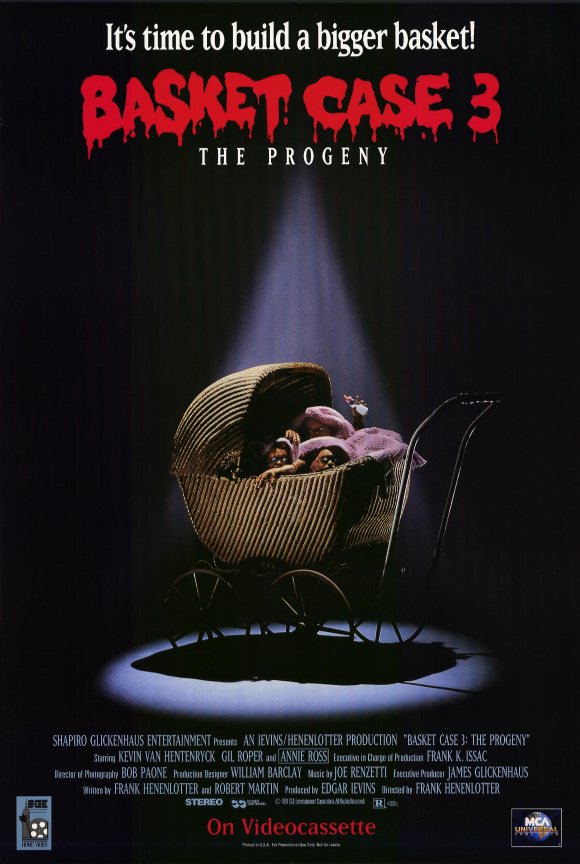
Videotape Swapshop Review: Basket Case 3 - The Progeny (1992)

From http://images.moviepostershop.com/basket-case-3-the-progeny-movie-poster-1992-1020210067.jpg

Dir. Frank Henenlotter

During this week I'm going to clear through the Videotape Swapshop reviews that have not had links posted up on my personal blog. I'll start with one of two films I choose for the site's "Threequels" series, the second sequel to a cult favorite. There's not much to say this time because my thoughts were pretty much written down in the review.

Review Link - http://www.videotapeswapshop.co.uk/16647/basket-case-3-1992-director-frank-henenlotter/

From http://www.coffeecoffeeandmorecoffee.com/archives/basket%20case%203%20c.jpg

Tuesday, 29 October 2013

Also Representing Japan, For The Anime Slot: GenoCyber (1993)

From http://1.bp.blogspot.com/-UHDL9E8qiyY/T6G9pHHGMmI/AAAAAAAABvs/gx_ZO_DVw6Q/s1600/genocyberposter.jpg

Dir. Koichi Ohata

Note that the version of the five part original video animation (OVA) I saw was with an English dub. Dubs for anime, unlike Italian genre films from the seventies, can drastically effect the actual work. Liberties were clearly taken with GenoCyber's script even without seeing a version with the original Japanese language track, and like a lot of reasons why dubs are notorious, it is mostly poor. It's not without flaws - it befits the first episode - but I would want to find the original version. Be ready, if watching the English dub version, for ridiculous acting performances and "fifteening", a controversial practice of English company Manga Entertainment, from their older days of existence, of adding swearing to the scripts to help boost the age ratings when the anime they sold was being certificated by the British film censors. I will have to deal with the dub in this review, but my greater concern is what GenoCyber is as a notorious anime.

From http://1.bp.blogspot.com/-KRtpNLSqcHA/T7GaXjx8PdI/AAAAAAAAB3E/safDPMzJg0U/s1600/geno.jpg

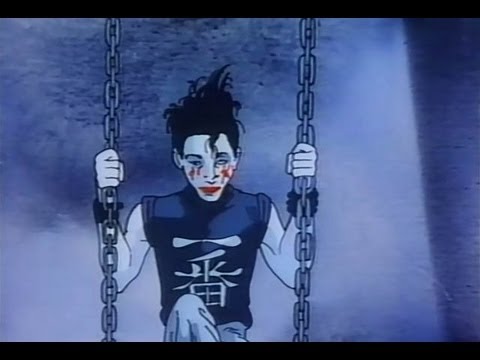
Controversial, ultraviolent, and just a mess. GenoCyber is a mess finally seeing it, hearing of it like the many bogymen, infamous works, in anime's history for all these years, but actually viewing GenoCyber is more complicated than this. Its twisted, and for a lack of a better term, fucked up, but having to actually watch it is a drastically different experience than something merely infamous. The first part - the work splits into three stories between Part 1 (A New Life Form), Part 2 and 3 (Vajranoid Attack & Global War), and Part 4 and 5 (Legend of the City of the Grand Ark I & II) - definitely shows everything that made the anime infamous. Nihilistic, complete hatred for humanity, horrifying images of dismemberment and mass death, body horror taking advantage of sci-fi tropes' most gruesome potential, and the episode was made with barely a budget. Barely a budget. Events abruptly happen with no pace. Live action inserts were used. The animation looks aesthetically foul and scuzzy in a horrifically compelling way. And it does fascinate. In a world where nearly every nation plans to unite into one peaceful, global utopia, a corporation sticks out as a potential threat in its self ostracization from everyone else. Taking advantage of a scientist's discovery of "mind shadows", latent psychic abilities he could unlock through a machine he made called the Mandala, (yes, there are clear Buddhist and Eastern spiritual symbolism here), they have human beings, as young as children, as potential weapons. Very much like Akira (1988), potentially dangerous psychics. Two of them are the twin daughters of the original scientist. One, Diana, is one the side of the corrupt scientist in control of the knowledge, left from birth with a completely crippled body which leaves her as a head supported in an android frame. The other Elaine, on the loose in the city of future Hong Kong, is physically healthy but with the mind of a savage animal, befriend a young boy. The corporation ran by the scientist wants Elaine back, employing android mercenaries, his pack of masked psychotic minions, and her own sisters after her and to silence anyone in the way. But not only is Elaine a very dangerous psychic, but when the two sisters are together, they could become one and become the titular GeonCyber, a horrifying demonic creature that could wipe out anything and everything.

From https://blogger.googleusercontent.com/img/b/R29vZ2xl/AVvXsEjnj2byz76P8my7jBqyVg_Z70Tmm931HYk1k0k5YdgKIQ7SBOsypsCNhJmhUbdtb9r2eBVbKlN5_03WmZYsUceF-Kv1snr-c8yh7bFF9TanEzxn0xqTt81k16hJBoteAyrfNVMuAtFFFDA/s1600/Genocyber11.jpg

The first episode is a complete car crash of gore, disturbing images of viscera and exposed intestines, wrapped in such a misanthropic work in its message. But its compelling. Body horror with no self censorship. Actually missed by myself in the later episodes greatly, the director went further to make the gore disgusting by using images of actual wet clay being smashed for icky effect. Its only done twice or so from what I registered, but its an incredibly lurid effect that should have been used in the later episodes, the kind of reckless idea, on such a cheap production, that lifts it up from just being trash but something legitimately interesting. It has nihilism that actually feels like it's from the bowels of the creators', the director and co-writer Shô Aikawa, guts than that a cynical liberals going for a cheap pop, discomforting but driven by a narrative where two mangled young women come together, and their collected rage collects to created a being on the scale of Cthulhu. Koichi Ohata is already controversial for his creation MD Geist (1986), to some one of the worst anime ever made, along with its sequel, but a best seller in the US. Aikawa is incredibly twisted in just the few works he penned I've seen. He's managed, of all things, to become the scriptwriter for some of the Full Metal Alchemist franchise, an incredibly popular work with a large, mostly young audience, but the man also wrote the scripts for a lot of the Urotsukidoji series and Violence Jack (1986-1990), the former the most controversial work in anime in the West, the later only really known for its drastically censored English dub version, and from I've read and heard, probably for the better for your stomachs. His filmography has a lot of notoriously bad, ultraviolent or scuzzy work, but Aikawa has a sense of body horror, and surprising potent ideas of the manipulation of the body and political ideas that managed to get into even Full Metal Alchemist. It's not surprising that GenoCYber ended up as it did with just him, let alone with his co-writer and director. It's no way near the most disturbing anime in existence, when Neon Genesis Evangelion: The End of Evangelion (1997) exists, but even if I am desensitised from a lot of this sort of thing, and frankly view it as merely animation on a cell not reality, it still leaves a gaping, nagging wound in your memory whether you see merit in it or not. With how this part ends, there was no real need for any other episodes. It could have stood up as one single, forty or minute piece of disturbing anime. It's a mess in quality control, but it its memorable and potent in what is seen. The only other work of the director I've seen before this was the TV series Burst Angel (2004), which was legitimately poor, all the most generic tropes, even in designing the female character designs meant to be lusted over, of current anime. That was the kind of anime that is truly bad. This episode, from the same director, is something uniquely itself even in its screwed up existence.

From http://i1.ytimg.com/vi/fd5uF17mXkA/hqdefault.jpg

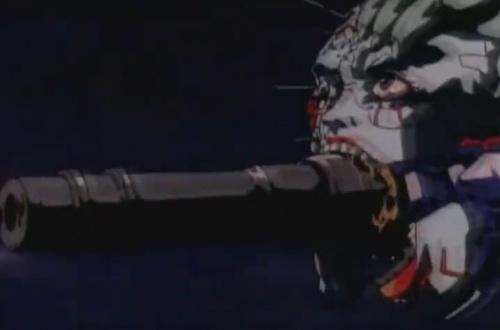
But more episodes were made. Parts 2 and 3 probably have some importance though. Part 2 contains the most controversial moment in the whole work where, in the first scene, the first actual scene, young kids are chain gunned into gristly, fully detailed body parts. Its tasteless, its shocking, never done in any other anime I've seen yet, but doesn't compare to the kind content in the rest of this story arc or in the first episode. It's no way near as disturbing for me, in a story where a prototype android eventually goes out of control and literally melds with the whole of a naval warship, as just having a character, seeing the atrocity around her, suddenly throw up in revulsion in detail. What really disturbs in the whole of GenoCyber, what really makes it justify its reputation, is the mood and ideas rather than the gristly results. Shô Aikawa's writing, when it's not garbage, is far more disturbing in what he implies with full detail or not. His work is very Cronenbergian even when he's in a completely different genre like with Hades Project Zeorymer (1988-1990), an anime which shows a legitimate best with how, for its flaws, the ideas and where he goes with them are truly compelling in a startling way. This story arc is still an worthy inclusion for this. How our hero - Elaine and Diane one single being who are rescued by the warship and set off the android when it see them as a threat - is actually a monster who can destroy everything. That no one is sin free, or those who are good people will be killed, even children, or go insane. That this series, for all its disgusting gore designed to only shock and its shonky look, still forces the viewer to think of the consequences of man's brutality. That its use of body horror, in visuals and the concepts, is immensely imaginative, and downright disgusting and disturbing because of the ideas behind them, especially with part 3. These two episodes do deserve to exist, because while weaker they still fit the tone of the first one and are just as interesting.

From http://www.imfdb.org/images/thumb/2/27/Genocyber_Minigun1.jpg/500px-Genocyber_Minigun1.jpg

Which causes me to ask - what happened with parts 4 and 5, and why were they even made? Suddenly you are forced to watch legitimately awful pieces of anime. A drastic shift takes place. The GenoCyber has completely decimated all human populations in the world and is now gone, leaving all the clichés of anime of this era to repopulate the scorched planet in their tired flourishing. A utopian city exists which is actually a dictatorship, the writing suddenly losing all its distinct nihilism in favour of a generic tone without any real bite, where there's the corrupt rich, and the rebels in a terrorist group and a religious cult. Suddenly you're forced with two new protagonists, a young man and a woman, moving to the city and making their way barely as a knife throwing act and through street based mysticism. We're supposed to sympathise with them because she's blind and they're a couple about to be crushed by the evil city, not because they're of any interest. At this point, I cannot ignore the English dub. It was poor in areas before this arc and the added swearing was unnecessary, but some of it actually fit the tone. Here the dialogue readings, ignoring the tedious plot, are atrocious, with the voice actor for the main male protagonist performing some of the worst line delivery I have ever had to endure legitimately in a long while. It's up there with some of the worse I've ever encountered actually, clearly playing the character as everything people say about Keanu Reeves in Bram Stoker's Dracula (1992) at one point. This is why anime viewers like myself, let alone fans, eventually switched to Japanese dialogue with subtitles completely unless it wasn't available for certain releases or the English dub was actually exceptional. The entirety of this story arc, even though it's from the original manga the anime was adapting, is abysmal, a huge blot on the whole work. The blind woman encounters Diane through her mind, or an alternative world, befriends children living with the underground rebels, as you do in anime at this time, and eventually the obvious happens when GenoCyber awakes. You rise the memory of this arc from your mind and, if the whole work ever gets a DVD re-release, the only reason you would ever see this again is to check the disc(s) work. Suddenly it's not the original anime of the first few episodes but a completely different work, written by someone with no real grasp of what corruption means and merely using it as an excuse to bash the upper class and real life society in a cheap way to come up with a dystopia narrative. One, as in all the live action films that do it as well, that would put people off actually questioning their society and leaders because its trivialised to such an extent and because they don't want to suddenly become the characters in a crappy GenoCyber story arc. OVAs at this time in the nineties were also notorious for how abrupt their productions could be - anime works suddenly ending on a cliffhanger with no sequels ever to finish them, or with wildly different tonal shifts like here. Sometimes it's part of my fascination with these nineties anime, but here it's painful.

From http://www.animeclick.it/prove/serie/Genocyber/Genocyber8.jpg

Altogether, anyone with a strong stomach should attempt viewing Part 1 of the work. It's not a series to watch on a loop, too bitter, too misanthropic in tone to digest except occasionally. Its indefensible, but it doesn't feel like a mere mindless piece of anime ultra violence that the whole medium was lumped into by newspaper tabloids. Parts 2 and 3 are also worthwhile, but if it was possible to remove Parts 4 and 5 from existence I would do such a task. It has to be beared in mind that this has content that would even startle people used to animated gore and depravity, but it's a creation of individuals with throats full of bile for humanity rather than making cynical jabs, for attracting peoples' simpleminded views of anti-humanity and selling product by using such naive views on corrupt society. As perfectly put by an anime reviewer, it's the equivalent of punk rock, shambolic in production, offensive but with vitriol and energy you wish was there more often.

From http://www.anime-planet.com/images/anime/screenshots/genocyber1.jpg

Sunday, 8 September 2013

W Is For…Wax, Or The Discovery Of Television Among The Bees (1991)

From http://sharetv.org/images/posters/wax_or_the_discovery_of_television_among_the_bees_1992.jpg

Dir: David Blair

I will openly admit my gratefulness for the internet. The director of this film has, thankfully, released a hypertext version of this film on his own site, but the original feature film version of Wax... is difficult to find. I confess I am grateful for the internet for making it possible for me to view and review this film, hoping that one day a version is released more commercially for more people to be able to see it. Its the kind of film you want to discover and talk about on a film blog, and even if its a small review, I hope this encourages more people to go out and track it down. Maybe if enough people are interested Wax... could get a great reappraisal from attention like this.


Review Link - http://www.videotapeswapshop.co.uk/15720/w-is-for-wax-or-the-discovery-of-television-among-the-bees-%E2%80%93-1991-director-david-blair/

From http://b.vimeocdn.com/ts/123/541/12354136_640.jpg

Tuesday, 3 September 2013

The Curse of Kazuo Umezu (1990)

From http://i1.ytimg.com/vi/K8LOCE1mMko/hqdefault.jpg

Dir. Naoko Omi

There's a surprising lack of horror anime in existence. Even in the golden era of straight-to-video anime in the eighties and nineties, where in most cases it was of higher production quality than TV series and could get away with more adult content, there was a rare amount of them only. Now, with these straight-to-video works, OVAs, sorely missed and needed to be brought back, there's a gap left what can be released. Films are rarely made already, let alone horror ones. TV series have restrictions in content, and even those which have shocked Western viewers like Elfen Lied (2004) were probably censored on broadcast or showed past midnight. Only hentai could get away with more horror related content; its already porn, so aside from certain Japanese laws, you could probably get away with more. Manga is usually where horror thrives, slowly being dripped into the West in bookstores. As for those rare horror anime that do exist, The Curse of Kazuo Umezu is a truly rare one, which I only discovered the existence of within a few weeks. It's not even included in the version I've read of The Anime Encyclopedia by Helen McCarthy and Jonathan Clements, which catalogues every anime ever made from 1917 including all the hentai tapes. Its existence, once released on video in its home country in 1990, meeting it myself in a VHS rip probably taken from a Japanese VHS a Western otaku has acquired and made available, shows how deep the well anime is outside from what its usually labelled as.

From http://24.media.tumblr.com/tumblr_lq3fz7Ko1H1qc1tyfo1_500.png

Kazuo Umezu is a well regarded horror manga author. He's apparently obsessed with red and white stripes, which would make passing a barber's shop and a candy cane stand bliss for him, and I confess to having yet to read his work, as most or nearly all of his work is not available in the West at all. This anime consists of two stories over forty five minutes. The first, a schoolgirl suspects that the new transfer student is a female vampire, but thanks to videotape the truth is more horrifying. The second is of a group of schoolgirls going into a haunted house to their peril. The most distinct aspect of the anime, bookended by a mysterious thin narrator/crypt keeper who entices us with morality tales, is the visual look of the anime. Clearly there was an attempt to replicate the style of Umezu's manga, black lines heavily used and very grotesque imagery. It shows in the female characters, if just their eye lashes and eyes, who dominate the entire anime. I cannot help but think of Western influences such as gothic art to maybe even dolls with the look of the anime, more so when showing moments of terror for the characters through excessive use of said black lines. It looks good in terms of design, and the format allows for more nastier material. The first story brings in a freakish level of body horror that the cutesy break between two stories cannot make into a complete joke - think of very, very big teeth. The second story, lots of raspberry jam smeared everywhere.

From http://i4.minus.com/jblxSZqXNvhyss.jpg

In terms of quality in other areas, it's not a great work if I'm completely honest. It's grown on me, but this must be stated. The visual look is distinct, but the actual animation is rudimentary. The obsession with moments where the characters freeze in terror do go on a bit, and the stories are very predictable. In terms of entertainment value, it's about the presentation of what's on screen, not originality, that will be whether you like this anime or not. Interestingly, the stories do occupy themselves with the ideas of seeing something only to live to regret it, curiosity killing the cat literally. The first centres around how a video camera can reveal the truth, pre-empting the obsession with technology's tangibility in Japanese horror, only for it to reveal too much. The second, cut into by the narrator, becomes purposely abstract, reality cut to pieces by going to the wrong place. It even gets a bit dreamlike and also reflective of itself, the main two characters watching horror movies, including one called the Curse of Kazuo Umezu, before they end up investigating the haunted house.

From http://zapodaj.net/images/7c2f99d4811ee.jpg

It's a completely minor work. The technical and plotting failings do undermine it. But it's still fascinating, immensely fascinating. Beginners to anime shouldn't view this first - this is for those looking for the deepest, obscurest cuts of anime or horror, forgotten in history and made unique for this and its appearance. Done in the era of hand drawn animation, it still has a textual quality, despite rudimentary animation, that stands out far more than the plastic sheen of post-2000s work made on computers. Almost carnivalesque in its horror - the subversion of body parts and the body, obsessions with toys - it's encouraging to investigate the author's original work, and despite the failings of it, it has stayed on my mind since seeing it. The rarity of horror anime helps it, but it's a strange beast by itself, its forty five minutes memorable. A layer of eeriness trickles throughout it, emphasised by the likelihood the version I saw was an original Japanese videotape release from 1990, having survived to reappear in some form for someone from a different country, me, to find. Myths, legends, eroticism, body horror, historical and cultural information, even Western and Eastern pop culture seeps throughout a great deal of anime and its animation plates alongside the genres within it. They feel far more rooted in deeper and more interesting influences than a lot of Western animation, where even a minor work like The Curse of Kazuo Umezu has something incredibly distinct despite its predictabilities. And since horror anime is rare, its great to see one that brings something interesting with it instead of fail miserably. 

From http://i1.ytimg.com/vi/xnB1Q8adRa4/hqdefault.jpg

Monday, 1 July 2013

Anime 18 Review Link: Malice @ Doll (2000)

From http://www.weirdwildrealm.com/filmimages/malicedoll.jpg

Dir. Keitarou Motonaga
Japan

Not a lot of words to say for the final link for the Anime 18 season. I intend to bring it back up occasionally or at least cover a few more of these adult rated anime for this blog or, if it suits the moment, on Videotape Swapshop, probably expanding it out to include releases never sold in the United Kingdom like the introduction suggested. And of course I intend to cover everything under the "Anime" medium including the family friendly creations. The following entry, closing this type of series off for now, is my equivalent of the film/anime/show that you randomly discover, no one else really talks about or gives raving reviews of, but fall in love with it. Its perverse to use "love" in some ways considering how nasty and uncomfortable Malice@Doll can get, but it has an odd beauty beneath its incredible dated computer animation and content. Other works have probably depicted the issues of one's condition within their own physical bodies more clearly, but this one's attempt at it is admirable and fascinating nonetheless even if its deeply flawed. I won't get into any further detail so the original review can be of some use. But I will close this post with the note that, as I'm reaching the one year anniversary of working on this blog with proper devotion, it's going to be the works like this that make up this blog's bread-and-butter, these peculiar and interesting oddities, even if they're mainstream releases, that rarely get their dues even in cult cinema reviews. Complete oddities, miscreants and the overlooked and choices that are contrariety on purpose for a reason. All of which will hopefully be interesting or I'll be pissing  hours up the wall without any sense of good work to it all even if its just for my ego.


From http://s59.radikal.ru/i164/1004/71/fa28a429f901.jpg

Friday, 28 June 2013

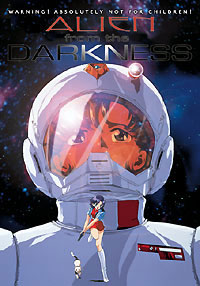
Anime 18 Review Link: Alien From The Darkness (1996)

From http://www.themanime.org/images/reviews/alienfromthedarknessbox.jpg

Dir. Norio Takanami
Japan

Well, to not seem like a hypocrite when I put in the website page's tagline that "everything will be covered", it seems befitting to have covered this.  I feel that I come off as defensive in the review, despite the fact I shouldn't care about what the content I covered was, and I think that happened because, brutally, the work was bad even if compelling. There's no way of circling around the low quality of mid-nineties pornographic anime with a tasteless premise which, censored in the version viewed, makes it even more scuzzball in presentation. But this is what most motion works - film, one-off animations etc. - are, tasteless, pornographic in various, ridiculous and found in second hand stores on DVD, and its quantity over everything else cannot be ignored. When you know what you are getting into buying it, let alone watching it or reviewing it, you are letting yourself into this material and there's a clearly reveling in the content even if you find yourself off-putted by some of it or embarrassed. The more rarer ones, like this kind of hentai anime, which get Western releases, especially in Britain, become fascinating looking glasses into what was going on in someone's head making it. Entire pieces of human culture could probably be extracted from such miscreant works, and unlike trying to watch something like a bad parody film like Disaster Movie (2008), or really gross porn, something like Alien From The Darkness - despite being really queasy sexual fantasies, tacky and scatterbrained in tone even for its short length - goes so over the top with its tone that, knowing how indefeasible it is, it engages you even in the worst of ways. And its just forty minutes long and I'm a sucker for anything animated to the point it'll give something an extra point unless its truly painful for me to sit through.

Let's be honest too, sex is a commodity in culture, and the more eyebrow raising ones like this anime plays with, along side the sapphic softcore that one would find in live action porn, is something that has existed in many forms back in painting and literature. Its better to prod it with a stick, to paraphrase the words of someone I knew in secondary school, than to leave it as it is and get embarrassed by it. The censorship of the version I covered show as well how something can be drastically changed, even if a single second was removed, in how you react to it especially if a censor gets at it. I cannot say anything truly profound beyond this because, as much I confess to finding a perverse pleasure in the car crash, I still was reviewing a bad anime called Alien From The Darkness.

Review Link - http://www.videotapeswapshop.co.uk/14865/alien-from-the-darkness-%E2%80%93-1996-director-norio-takanami/

From http://i.ytimg.com/vi/MhNQPi0f7T0/0.jpg

Thursday, 27 June 2013

Anime 18 Review Link: Apocalypse Zero (1996)

From http://www.dubbedepisodes.co.uk/static/apocalypse-zero.jpg

Dir. Toshihiro Hirano
Japan

If there is one other thing to add to this review, I will say that a work that provokes any kind of reaction and "wakes" you from viewing it from a safe distance, where you can forgot it immediately afterwards, is worth taking seriously even if the material could be viewed as dubious to other opinions. This bizarre and ultra-gross anime, if I had viewed it back when I was between sixteen or seventeen, would probably be viewed as garbage. Now, rather than thinking I've regressed in my thoughts by giving it praise, I think its more the realisation - as someone who became obsessed with provocative art like the Dada movement before films, as mentioned in the review - that even in the most foul of areas a streak of subversion can be seen and given some merit. Back then, I didn't try to defend films that were clearly badly made like I did now, or defend works like this anime with questionable content, and probably would be viewed as having a better taste in films if one views cinema through the IMDB Top 100 list of films. I also however had such a narrow minded view of cinema and art in general that presumed anything that didn't follow a clear narrative or clear point was bad, including films by the likes of Jean-Luc Godard and truly great works of abstract cinema. Now my willingness to suggest that I find something like Apocalypse Zero to be a work of worth has also developed my ability to see the virtues of the likes of Godard and abstract cinema too because, after some of the films I've seen and covered on this blog, I'm prepared for films to take directions in content and presentation that the presumably "artless" works had. The erratic nature of the less defended films only differ from the celebrated works because they're repugnant to most or ended up the way they were by accident. That this anime may actually be intentionally getting a reaction out of the viewer, as I try to explain in the review, makes me want to defend it more.

As one find in live action, exploitation films, the most base of material can be the most daring in poking at taboos other filmmakers, or creators, are too cowardly to tackle. Yes, they can end up being offensively conservative at times, but others push the content in ways that make them impossible to view as celebrating bland stereotypes. In simple terms, sometimes the best weapon is to purposely show things so deeply "wrong", and in this case make it look like a Saturday morning cartoon on crack, and attack good taste even if the purpose of the anime was to just be an entertainment product. Rather than merely be offended or baffled by it, its worth actually thinking about why being offended by the images in a work happens and see if it has virtue from it. Plus, frankly people, including myself, get a perverse pleasure from these transgression and weird images, and to not admit it is lying to yourself. Sometimes its more healthier to submit yourself to something that isn't just blood for blood's sake, but something legitimately bonkers and throws images like "Double Big Tit Bomb" and other distorted animated images at your retinas. Far from viewing Apocalypse Zero as just an excuse to view Japanese culture as "peculiar", something like this is just in an entirely different orbit to anything else regardless of its country of origin. And far from being conservative, I seriously doubt anyone, except those who is going to celebrate how perverse the anime is, will come out as a fan of it. 


From http://www.videotapeswapshop.co.uk/wp-content/uploads/2013/06/az2.jpg

Monday, 12 November 2012

Cold Steel Flesh [Crash (1996)]

From https://blogger.googleusercontent.com/img/b/R29vZ2xl/AVvXsEg3cyZxzYZbnuS3sWkagfMDL0yiw8mOTt55M-NsMM66KVKo1s_DdgPxbweHwv_6BIOC8-21XNOrg1NXgPy-WeWmFVJV_aCM2lbyJAgdGBwE7UonIq8VdYXmZ0lVH_wJaHM3l2ll2rNAOFY/s1600/crash_1996.jpg

Dir. David Cronenberg
Canada-United Kingdom
Part of Videotape Swapshop’s ‘The Uncut Season’

At the beginning of October, I was contacted by the website Video Swapshop to write reviews for them. This film is part of a season for this month to coincide with the British Film Institution’s screening of controversial films within the history of the British film classification organisation the BBFC. Along with reviews written by me, there will be others by one of the site’s other writers Rich, so I recommend keeping an eye on the Swapshop page regularly this month as well.

Sunday, 28 October 2012

The first phase is hallucination... [Body Melt (1993)]

From http://s3.amazonaws.com/auteurs_production/images/film/body-melt/w448/body-melt.jpg?1313599007


Dir. Philip Brophy
Australia
Film #20, for Saturday 20th October, for Halloween 31 For 31

At the beginning of October, I was contacted by the website Video Swapshop to write reviews for them. My delayed 20th film for this Halloween project is one of the reviews that is published on their site, and can be viewed here.