Dir. Satoshi Kon
Japan
Film #16, of Tuesday 16th October, for Halloween 31 For 31
The day the late Satoshi Kon died at 46 of cancer proved
to be a deeply saddening one in 2010. Not only was a talented creator lost when
he could have made more great films, but in the anime industry of Japan he was
still considered a young upstart. Many directors and designers from Japanese
animation, televised or film, of stature are older or old men, and there are
not a lot of fresh visionaries to replace them when they die. This even affects
people who have no real knowledge (or interest) in anime in that Studio Ghibli, which even the mainstream
knows about, is mostly structured around the films of Hayao Miyazaki and to a lesser extent Isao Takahata; the
occasional director who is someone else (like their last release Arrietty (2010)) is a realisation from
the studio that once Miyazaki and Takahata have passed on there will be no
one to replace them unless someone is given a chance. Unfortunately, the
Japanese anime industry has not let new talent get the experience as much as it
needs, and as most anime caters to niche fan bases who regurgitate other anime
and short skirted schoolgirls, nothing really creative is getting made to push
the exiting talent excluding the odd director allowed to follow their own ideas
or studios like Studio 40C who
used their music video and commercial work to fund their more unconventional
projects (and one wonders, since they’re working on the new ThunderCats (2011) series, what they
will create by themselves when they have time in-between it). To be blunt, the
industry is in utter trouble if new talent is not allowed to breathe within it.
Losing Satoshi Kon is a blow both as
a director I discovered while getting into anime, and completely admired for
his craft, and for the fact that the term ‘auteurism’ - despite the fact that
teamwork and collaboration is needed to create anime and every member of staff
deserves credit for a great work - in all its meaning of a distinct worldview
and full creativity applied to him.
Originally supposed to be a live
action film until it was decided animation would be cheaper, this adaptation of
a novel by Yoshikazu Takeuchi, and Kon’s debut, had an incredible impact
after its 1997 release, even to the point of Darren Aronofsky buying the American rights to the film and
replicating a sequence for Requiem for a
Dream (2000). (That a live action adaptation from 2002 also exists adds it
to my To-Watch list). Retiring from the
life of a getting-past-adequately pop singer to become an actress, Mima Kirigoe
is faced with a harsh reality when it slowly starts to disintegrate on itself.
Death threats escalate to murders and Mima’s personality seems to split into
another version of her who mocks her and acts on its own will. As she sheds her
pop idol image, from pressure from her manager, through acting out an rape
scene in a popular television series and a nude photography session, the
stalker who views her actions as traitorous forms into a full blown
disconnection from reality for Mima between her life, her character and masks,
and the days themselves within a packed 81 minute narrative.
The closest to what Perfect Blue is structured like came in
2006 with David Lynch’s INLAND EMPIRE, longer, more abstract,
but continuing with a similar theme of an actress, an ordinary woman putting on
masks for a career, being sucked into a vortex within herself as a result of an
outside threat. That film dealt with a cursed Polish film, while Mima has to
deal with her immediate past as an ‘innocent’ pop idol idolised and lusted
after by otaku, and a maturing young woman who wants to become a serious
actress, even if she hates the idea of doing sordid sequences for a TV show,
just to prove herself and have a good career from it. Alas, the evil influence
desires the old, now fake Mima, and pushes her to the point that she questions
her physical existence. The scenes of her ordinary life blur with that of the
television show, the sudden poor quality in colour of the animation revealed to
be footage played on video on a TV screen, or dialogue linking on into a new
time period or day. Even the ‘it was all a dream’ motif, infamous in some of
its uses, is used repeatedly but in a powerful way as the repetition creates a
nulling effect on Mima as she slowly becomes the equivalent of a walking corpse
barely able to cope with the fear and misery of it all. The script by Sadayuki Muraiis is such a brilliantly simply
one, structured in such a short running time, showing that this type of story
is possible to do well; why it succeeds over many other films is that the
others overcomplicate themselves or botch the structure of their plots. Finally
viewing the original Japanese dub for the first time, what is quite a bloody
pulp thriller is very carefully written, breaking its own form in the smallest
of details down and subverting them. Even rape, an uncomfortable image onscreen
in a film, is undermined as, when part of a recorded scene for the television
show Mima is part of, she and the male actor who is playing the perpetrator
interact as actors between the takes and the director says ‘Cut!’ to re-do the
sequence from the beginning.
Satoshi Kon’s trademark was that the border between reality and its
opposite (dreams, hallucinations, the artificial) was paper thin, melding into
each other seamlessly as part of his characters’ existences. Even Tokyo Godfathers (2003), his most
conventional film, has the buildings of Tokyo start dancing in their spots in
the ending credits. As was the case with his work, the animation is
exceptional, far from the stereotype of female characters with big eyes who
look like young girls, a figure within a scene show in extreme close-up briefly
showing the drastic contrast to Perfect
Blue’s more realistic character designs, and full of detail in nearly every
image. Kon’s trademark of the
intangibility of reality is assisted by the fact that, as high quality
animation, he was able to use the complete plasticity of the form, completely
made from scratch, in the smallest or biggest manipulations and touches to
create the world onscreen. The desperation the character Mima feels is
exemplified by how, through the placing together of sequences or manipulating
the content of them, it is felt through the environments around her and is influenced
by her emotions. The music by Masahiro Ikumi is just as important too. Beyond the
pop songs within the film’s story, his score is just as vital to creating the
intensity to the scenes depicted, switching between an electronic score similar
to the legendary one of Tetsuo: The Iron
Man (1989) and choral chanting that adds an unnerved air to the material
too.
While a completely animated film,
it follows through one of the basic tenements of genre cinema like this in that
the worlds portrayed are reflected through the characters’ mental states. This theme
has been very reoccurring in my choices for this project - Footprints On The Moon (1975), The
Fall of the House of Usher (1960), Kill
List (2011) (even if I felt the film was a failure), The Hands of Orlac (1924) and so on – all in very different ways
and types of films but fully involving the visual and textual states of their
filmic forms for the moods and atmospheres generated. Even Detention (2011), more of a comedy than horror, followed the same
suit to reflect the characters’ heads filled with pop and retro culture. When Roger Corman himself, legendary producer
and director of The Fall of the House of
Usher (1960), described Perfect Blue
as what Walt Disney and Alfred Hitchcock would have created if
they collaborated together, it was very high praise, but his choices are also
perfect for this idea even if my viewing of their films is limited. Disney, whose studio, regardless of your
thoughts of them, creates new worlds or reflect ours through fantastical
imagery, and Hitchcock a director who
abstracted the ordinary in terrifying ways, his inherent Englishness fed
between the provocations of striking tension in the audience influenced by
German Expressionism (ie. The Hands of
Orlac) and varying styles within the films I have seen, from Vertigo (1958) and its Technicolor
melodrama to Frenzy (1972) and the
grubbiness of British exploitation films that would be made through that
decade. The films I have chosen, like Mima’s own realities, inextricably melded
together as perfect bedfellows; even the dialogue editor for the English dub
was Les Claypool III, not to be
confused with the lead singer and bass player for Primus, who did the music score for The Guyver – Dark Hero (1994) too, another film I
have reviewed for this season. This concept of a subconscious depth in cinema is the cinema I attach myself to the
most, probably reflected as someone who for personal difficulties with a mental
disability is withdrawn in new situations and is constantly in thought and
daydreams when not interacting with people I am comfortable with. For me the
philosophical concept of the world only existing within one’s mind and senses is
a tangible concept even if there are plenty of justifiable arguments against it,
and in such a world, these films which depict it as morphing, for the good and
bad, depending on the protagonist(s)’s world view is a more realistic way to
depict reality than actual reality many times. This type of cinema – from the
Expressionistic to the Gnostic – is also a huge part of its legacy, not just in
genre cinema but some of the most acclaimed (Ingmar Bergman, Jean Cocteau,
even Jean-Luc Godard in his
manipulations with cinematic form) and the most popular cinema (The Wizard of Oz (1939)) too.
Perfect Blue is part of a vast network of film history, and
considering Satoshi Kon’s influences
included cinema such as the 1972 adaptation of Kurt Vonnegut’s Slaughterhouse-5,
this was clear from the start of his (sadly) short career in hindsight. While there
is nothing wrong with anime referencing other anime, as with films referencing
other films in the last few decades, unless a wide array of mediums are evoked
or the meanings and origins of the fellow works are used as well as their
iconography, a stagnation occurs. Even Quentin
Tarantino, dangerously becoming obsolete in my eyes after Kill Bill Vol. 2 (2004) and Death Proof (2007), showed himself and detractors
in Inglourious Basterds (2009) that
the film geek who spent his youth working in a video store still could provoke
fascinating ideas about history and propaganda, beyond cinema itself, through a
reinterpretation of a Enzo G. Castellari
film. Tarantino’s also-rans did not
follow this, and with there being more of them than him, created more mindless
copies of his work than anything with depth. Satoshi Kon was only one man in a vast industry and his passing has
left a huge black hole in it. The films he left however will be remembered, and
while Perfect Blue plays out like
the crime thriller programme Mima acts in, or even closer to the Italian giallo
genre in hindsight with its obsession with questioned realities and graphic violence,
the elegance of the whole anime is unrivalled compared to live action thrillers
as well, its crafted nature adding a sense of art to its layering mystery and
psychosis that is unforgettable.

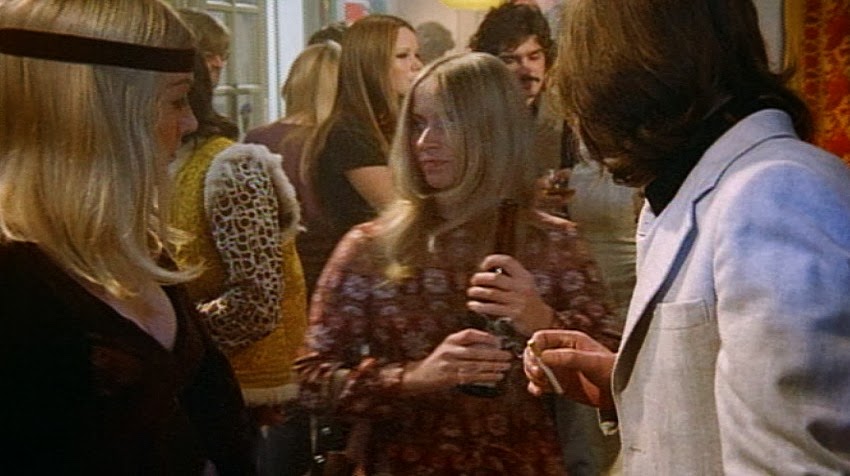
 Voodoo Passion is straight-up softcore. There is a story of such,
but the main and consistent part of the film is the nudity of its female
actresses and sex. It feels like a Franco
film, a slow and deliberate pace, dream-like, but its streamlined back to the obsession
with the female form more so than Female
Vampire (1973). Your ability to like this film depends on your liking of
mood in Franco's work. A newly wedded
wife of a government official moves to Haiti, only to feel that her sense of
reality is dissipating as she believes she's murdered people. As this happens,
the sensuality of the local music, and the draw of both her husband's platinum
blonde haired, and horny, sister and their maid servant, is becoming too much
to handle.
Voodoo Passion is straight-up softcore. There is a story of such,
but the main and consistent part of the film is the nudity of its female
actresses and sex. It feels like a Franco
film, a slow and deliberate pace, dream-like, but its streamlined back to the obsession
with the female form more so than Female
Vampire (1973). Your ability to like this film depends on your liking of
mood in Franco's work. A newly wedded
wife of a government official moves to Haiti, only to feel that her sense of
reality is dissipating as she believes she's murdered people. As this happens,
the sensuality of the local music, and the draw of both her husband's platinum
blonde haired, and horny, sister and their maid servant, is becoming too much
to handle.