|
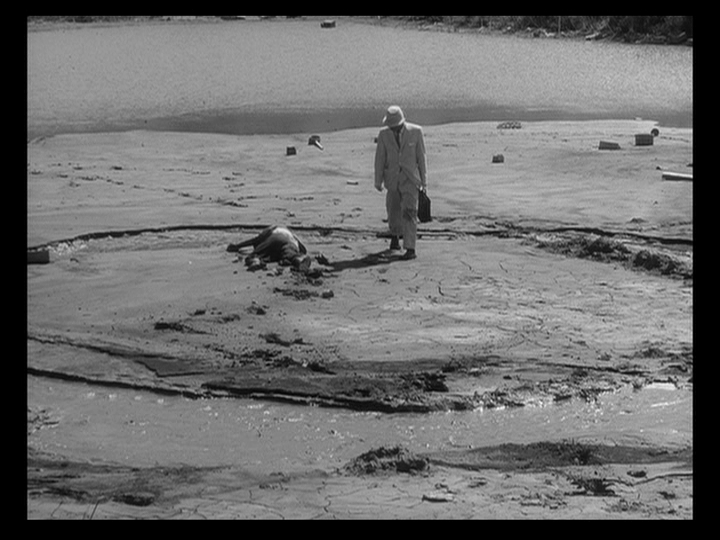
| From https://cinecube.files.wordpress.com/2012/06/ieenappuxkzv4kracgu9nlybhpj.jpeg |
Dir. Seijun Suzuki
 Having talked about its
granddaughter, Pistol Opera (2001),
its befitting to talk about the grandfather Branded To Kill. It's been a very long time since seeing the film
for the first time, back when, getting into cult and world cinema, I delved
into films like this through LoveFilm
but was unable to appreciate a lot of them. I'm only just now at least six years
later getting to quite a few of these films again, obscurities and regarded
gems, after once only viewing them under the notion that only cult and
non-English films acclaimed the most by mainstream film magazines were the zenith
of cinema. If you believe they are still, I'm happy for you, but it became
apparent the dismissed ones, or those occasionally brought up in a feature of "masterpieces
you've never heard of" were the really interesting examples of cinema. Branded To Kill was that film
that got Suzuki barred from making
films for Nikkatsu after working for
them for many years, when the studio's then-president saw this film and hated
it. It was the product of extreme boredom with the type of projects the
director was stuck with, as "overrated" directors like Shohei Imamura got the prestige projects,
and worse, had Suzuki's work be the
b-films to his and other prestige a-films. Sick of churning out conventional
gangster films over and over again, with a team of fellow minded people in the
studio helping him rebel against this repetition, Suzuki in a film like this and Tokyo
Drifter (1966) decided to completely undermine the tropes of the scripts he
was stuck with, creating artistic, farcical endeavours and actually being able
to get away with them until this film! I cannot help but think of what Martin Scorsese, in A Personal Journey with Martin Scorsese Through American Movies (1995),
talked about when he described some American directors in the Hollywood studio
system as "smugglers", hiding messages and subversions against the
norm in their work, the b-pictures especially because of their low cost and
purpose just to fill up cinema programmes gave them greater freedom, even with
the production restrictions, for more bold personal ideas to come through. Suzuki with a film like this showed the
fullest extent to what such a freedom could be. It was unfortunate the outcome
of how Nikkatsu reacted to this film
meant he only made a single feature length film throughout the whole of the
seventies.
Having talked about its
granddaughter, Pistol Opera (2001),
its befitting to talk about the grandfather Branded To Kill. It's been a very long time since seeing the film
for the first time, back when, getting into cult and world cinema, I delved
into films like this through LoveFilm
but was unable to appreciate a lot of them. I'm only just now at least six years
later getting to quite a few of these films again, obscurities and regarded
gems, after once only viewing them under the notion that only cult and
non-English films acclaimed the most by mainstream film magazines were the zenith
of cinema. If you believe they are still, I'm happy for you, but it became
apparent the dismissed ones, or those occasionally brought up in a feature of "masterpieces
you've never heard of" were the really interesting examples of cinema. Branded To Kill was that film
that got Suzuki barred from making
films for Nikkatsu after working for
them for many years, when the studio's then-president saw this film and hated
it. It was the product of extreme boredom with the type of projects the
director was stuck with, as "overrated" directors like Shohei Imamura got the prestige projects,
and worse, had Suzuki's work be the
b-films to his and other prestige a-films. Sick of churning out conventional
gangster films over and over again, with a team of fellow minded people in the
studio helping him rebel against this repetition, Suzuki in a film like this and Tokyo
Drifter (1966) decided to completely undermine the tropes of the scripts he
was stuck with, creating artistic, farcical endeavours and actually being able
to get away with them until this film! I cannot help but think of what Martin Scorsese, in A Personal Journey with Martin Scorsese Through American Movies (1995),
talked about when he described some American directors in the Hollywood studio
system as "smugglers", hiding messages and subversions against the
norm in their work, the b-pictures especially because of their low cost and
purpose just to fill up cinema programmes gave them greater freedom, even with
the production restrictions, for more bold personal ideas to come through. Suzuki with a film like this showed the
fullest extent to what such a freedom could be. It was unfortunate the outcome
of how Nikkatsu reacted to this film
meant he only made a single feature length film throughout the whole of the
seventies.
Like Pistol Opera, the world depicted is one of assassins who are set up
in rankings. (Strangely, while I confess to only knowing of them, not playing
them, the idea would decades later exist in the videogame series No More Heroes where colourful
assassins are part of a secret organisation and have ranked positions. How far
has Suzuki and this film influenced
Japanese pop culture?) The film seems to start off normally. Drenched in
beautiful monochrome cinematography, elegant and cool in tone, jazz in the
score, as we follow the ranked No. 3 assassin for an organisation, Joe Shishido whose character in this
would appear as a secondary character in Pistol
Opera. He is an accomplished, in-control killer of the highest order
despite only being no. 3 in the ranks, talented in a task that starts the first
quarter of the film helping protect a man, more so when a former member,
banished, a taxi driver and an alcoholic, is placed against him. Unfortunately
a freak accident, a split second failure, compromises No. 3 and has him pursued
by his own group. In fact the No. 1 assassin, who is viewed as a chimera, a
non-entity with presence, may be sent in to take Shishido's assassin out. (And again, instances including a rift on
that freak accident were replicated in Jim
Jarmusch 's Ghost Dog: The Way of
the Samurai (1999) in homage, asking how far Suzuki has influenced Western pop culture too.)
 |
| From https://s3.amazonaws.com/criterion_images/current/current_brandedfg.jpg |
Having only seen a few of Suzuki's films, I can nonetheless see
that his work feels closer to performance art than directly with literary and
dramatic styles. It is work where the world and everything within it - the
colours or monochrome, the costumes, the movements and actions of the
characters - are as much of importance as the plot, and even then, in a film
like this one, Suzuki wasn't really
interested in plot. It's here that my lack of knowledge of Japanese culture,
despite my enthusiasm to learn of it for the last six years or so, is not as
strong as it should be, as moments in Branded
To Kill feel like each scene is an individual set that has been influenced
by countless mediums. In using plot conventions it slowly becomes more and more
distinct per scene that comes along. I wish I knew more of the various forms of
Japanese theatre, as especially as the two later films I've seen, Pistol Opera and Heat-Haze Theatre (1981), have stages that are sets and some scenes
played out as theatre. I wonder if he was influenced by manga at all, more so
when I know he has an anime feature film in his filmograpy, part of the iconic Lupin the Third franchise. I wonder of
what carnivals, circuses and festivals he might have seen over his nineties
years that might have inspired him in these films. And also I wonder how
western and non-Japanese culture may have influenced this film, as Branded To Kill can qualify as mukokuseki,
borderless and existing in its own world, with that jazz score, western suits
and a potential femme fatale played by Indo-Japanese actress Mari Annu, distinct in her appearance
and large, deep black eyes. Even before the film goes off the rails into a
complete disruption of this tone, what starts off as a conventional film still
has the mark of being outside from traditional tropes and presentation.
In contrast to Pistol Opera, and the film's reputation
as being deemed incomprehensible by the studio that had it made, Branded To Kill actually has a plot
that is expansive and doesn't need to be soaked in as with Pistol Opera's to get it clearly. If Suzuki had no interest in the plot, he still uses its structure
here more than that later film to be able to go through the digressions and
tangents he wants to have. Even before No.3 fails a mission that could cost his
life, the ranked assassins are already trying to kill each other, and the
entire tone is of an edgy, scintillating, sleek crime film. But as it goes
along conventions start to fall over as the lurid aspects turn in on
themselves. Joe Shishido, even though
his infamous cheek implants gave him peculiar "chipmuck cheeks", is
calm, calculated and strikes a mean pose as an assassin. His fetish that he can
only get an erection after smelling cooked rice forces you to realise from the
beginning that something is amiss in the film's conventions. It forces to
realise all that is not presumed in the first half, as how decades later Takashi Miike would in his yakuza and
crime films play with absurdity amongst the conventions. But the Shishido character is still a hard
boiled archetype, still having the air of an elite master of his craft. As the
film goes along thought, credit where its due to Shishido's performance, the unlikable nature of the character at
times is followed by him becoming more exasperated, panicked and falling to
pieces as his control of the situation is lost. By the end of the film, the
archetype of the stoic assassin is completely undermined by Suzuki's film, probably both a required
purging of all the films he was stuck making, and a desire to prod at the
notions of a male lost in a wider labyrinth. By Pistol Opera, while given a moment of glamour with an old flame
using wine glasses as target pratice, the character is a comedy figure, while
the new female protagonist asserts herself against all the assassins she has to
face without fear. In Suzuki's hands,
the notion of tough crime pictures are distorted with sexual oddities,
absurdity and farce-related moments.
The film is at its best playing
off the conventional clichés. The meeting of assassin No. 1 is a conventional
confrontation, played perfectly out into a psychological battle in a boxing
ring at the end, but before this the absurdity is heightened when, using fear
to unsettle No. 3, the two literally become conjoined at one point so they can
keep the other in sight. The result of the film's origins, despite rejecting of
the skeleton it made out of, is that, perversely, it's a damn fine crime movie
as well as good in its later transgressions, Suzuki in the right place to be able to decimate the tedious plotting
and explore ideas in the same way a performance piece would take place. As it
goes along, more and more the abstract and the surreal takes place, but also
the exceptional use of sets and images to emphasis this. The famous set for Mari Annu's apartment, with butterflies
in mass pinned onto the walls. The blackened, shadowed boxing ring of the
climax. The abrupt use of animation to depict the protagonist losing his grip
of the environment around him. The continuous use of falling shower water,
falling water in general, glass windows and stair cases, a layering effect used
to give a greater depth to everything. Tokyo
Drifter pushed boundaries in terms of aesthetics, and the two later films
I've seen are testaments to how good Suzuki,
and his collaborators on those individual films, were, creating distinct,
visually rich works.
Revisiting this film, the
emphasis on how much its style, its genre dissection, its oddness are all
interconnected to effect one another is more obvious, my realisation over reviewing
Pistol Opera twice for the site was
that the apparently disconnected pieces, even if some were merely improvised or
by themselves, had an inherent reason to be together. Every flourish and streak
in colour or symbolism was done in a way that it directly effects what is
taking around these inclusions. A director like Tarsem Singh (of The Fall
(2006) and Immortals (2011)) is
praised for his visual style, and he deserves credit for choosing individuals,
especially in costume design, who create incredible pieces of art, but his style
is mere surface gloss. The style doesn't directly affect the foundations of the
films like they should. A film like Branded
To Kill, while based on clichés acting within a disjointed universe, uses
its visual, cinematographic and structure flourishes to effect the narrative
that plays out. Instead of a conventional work with a shiny lick of cinematographic
paint, the result here is closer, for analogy, to the a theatre set where the
set itself and everything on it have a direct effect on the material too. The
standard story is manipulated into its own deconstruction of itself. I hesitate
to use the word "post-modernism" because the word gets used far too
much in the wrong contexts. Suzuki
with this, and the few films I've managed to catch, are hyper fantastic rather
than ironic. Instead its willing to take this narrative seriously...but the
plot is instead how a movie assassin is a perverse archetype, rice fetish and
all, who with his idol looks still unravels when backed into a corner. The
ending is that he doesn't win, but paradoxically he's technically won. Watch
the film to see what I mean.
 |
| From http://2.bp.blogspot.com/-Ysfylx8RO94/TyjUeH_rAyI/ AAAAAAAABFo/abim-viOzm8/s1600/BTK03.jpg |