Showing posts with label Genre: Historical. Show all posts

Sunday, 24 February 2013

A Loving Review of...Fellini’s Roma (1972)

From https://blogger.googleusercontent.com/img/b/R29vZ2xl/AVvXsEg3WIUEk8Tv4Du6fEcBe1Oy2EryeWVZV1dyHl-DIcLQXenfCw8M_kBsp-u7EZayiyX0i-MM-s1QttoI5bN9oq1Ohg23bI2XZuLs4Hc_QQ-J8uuTcbXmhGtHl-_9jULQvLRQF1VPnWiwopn7/s1600/roma1.jpg


Dir. Federico Fellini
France-Italy

From http://img2.imageshack.us/img2/6719/felliniromaimg1.jpg

In many ways one’s autobiography would have to include the place you had grown up in. This has been a small streak within cinema from Fellini’s films to Guy Maddin’s My Winnipeg (2007). Both films thought, alongside others like Terence Davies’ Of Time and the City (2008), have had to tackle within the running times what it means to be born in a certain country as well to explain this – My Winnipeg is as much about Maddin being Canadian as Of Time and the City is of Davies being a Briton of a certain generation as well as a Liverpudlian. Federico Fellini’s Roma however is completely upfront about this aspect. Roma has no clear narrative. It is a series of interconnecting, or separate, segments about Rome. It shares aspects of classic history of the previous theatrical film to this Satyricon (1969) and his childhood under the rule of Benito Mussolini that would be tackled more in his very well regarded Amarcord (1973), but tackles it in a further grandness even compared to his other work in explaining what Rome means to him as a place.

From http://image.toutlecine.com/photos/f/e/l/fellini-roma-1972-02-g.jpg

It is an exceptionally well made film, one that could only be made within the seventies sadly, able to juggle classical period scenes, usually with a young representation of Fellini within it, and the current Rome with the same grandeur. It has within itself the old Rome, the real one of ancient history and culture, against the new Rome of rebellious students and alternative culture. Fellini himself shows a key issue of the film by having an older man desire from him to not make a film about the lowlifes, prostitutes and ‘tranvesties’ that he felt would make Rome look bad to the world, and then immediately after it students wanting him to show the political and poverty issues of the city, placing the various separate and divisive aspects of the city together in one varying image of it. Fellini is a baroque classicist, showing the period of World War II as a time that, despite the war, people could still function as joyful human beings. That he shows the rightwing propaganda of the Mussolini reign at the time alongside these warm, jubilant scenes is not a troubling concept as it could have been. Not only did Fellini undermine the image of Mussolini greatly in Amarcord, including a bizarre sequence with a giant head, but in this film he shows the period with honesty, growing up within it, and how the fascist ideology was going to fail in hindsight. A scene at a vaudeville show, a standout within a film consisting of standout scenes, shows a lovingly hilarious and bawdy series of moments that is undercut by both a bombing of the city, and within an air raid shelter, a man who believes Mussolini and Nazi Germany will win the war against one who doubts the war completely.

From http://1.bp.blogspot.com/_cwkM0jdVSWc/TBKTSjwisuI/
AAAAAAAABTY/j2c591ZThuU/s1600/FelliniRoma.jpg

Technically, Roma is a masterpiece as well as in its content. Breaking away from conventional cinema, and being meta about the filmmaking as well, it keeps the film’s content within a consistent framework by the quality of its making. A masterful sequence on a Rome highway, following a vehicular crane with a film camera on it, also being filmed from another car, shows exceptional skill with the use of filming, editing and sound as it shows the numerous drivers and vehicles on the roads. And Fellini makes sequences like these more than mere technical exercises by having humour, vibrancy, life, and in his obsession with full, heavily made-up women with large bosoms, a virile sexuality to certain moments. It is also more than a nostalgic view of the past as Fellini is certainly aware of the problems of the time it was made in. He sympathises with the new generation and their hippy culture, and in a bravura sequence, shows that ancient history, of the most beautiful, can be lost by the badly planned incursion of modernism and urbanisation. Then there is the ecclesiastical fashion show sequence dubbed by the late Amos Vogel to be a parody of ‘the wealth, commercialisation, and corruption of the contemporary Church*. With roller-skating priests and freakish skeleton displays moving across a catwalk, it is an inspired and surreal twisting of Catholic iconography that was clearly made by a director who has a lot of admiration for Christianity but has the foresight of a critic, and the weight as a great director to get away with it, to slam the state of the Vatican church this mercilessly.

From http://image.toutlecine.com/photos/f/e/l/fellini-roma-1972-13-g.jpg

In comparison to another Italian film about a director’s life and the world around it, Giuseppe Tornatore's Baarìa (2009) about three generations from his home village, which was sluggish and had the tone of a Hovis Bread advert rather than a film that tackled the director’s childhood, Italian politics including socialism and World War II, Fellini’s film Roma is way and above it, reminded of its failures in comparison to a film that is willing to break beyond the conventional narrative arch in favour of showing the life of Rome, good and bad, in a mass collage of images. Ending with a breathtaking sequence of a mass of youths on motorcycles and scooters in unison on the streets of Rome, driving place iconic architecture like the Coliseum, it is a loving film of the city while also reframing from being a musky, lazy ode that lacks the passion to do the task properly. Instead it ends with a jubilant picture of the future Romans of the time taking the streets, no end credits needed to spoil the power of this image.

From http://www.ffffilm.com/uploads/dan/snapshots
/2009/12/shots/03885ef78edb0c57febba946098830bd3036833a-700.png

*Quote taken from Vogel’s exceptional book Film As A Subversive Art. Find it and read it. 

From https://blogger.googleusercontent.com/img/b/R29vZ2xl/AVvXsEhko2qn2uQQgYAsK2GtZpwLmP_Gh085IZ-q8hKVwvU8ofIKd1v0v-xdZyikSMLkdUtoT5g4W0ZDBqJgroHoW6TS8VDZg47B3UZSRDmQpFkbgGEK1n5Q517lt9USRrmPzG6GqaYsTlsjTHt6/s1600/fellini-roma-1972-03-g.jpg

Wednesday, 31 October 2012

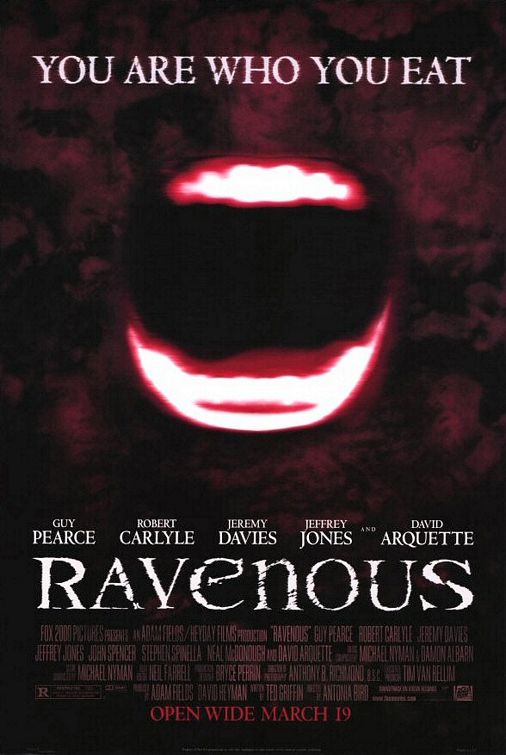
Meat Is Murder [Ravenous (1999)]

From http://www.impawards.com/1999/posters/ravenous_ver1.jpg

Dir. Antonia Bird
Czeck Republic-United Kingdom-USA
Film #30, for Tuesday 30th October, of Halloween 31 For 31

It is sad to think that to have a film for this season directed by a woman, I have to specify a slot in the season to do so, as it slowly closes, when I should have gotten a few in the 31 selections without any specific design to have a gender balance but because there are enough films in existence. I could have had a whole season of 31 works all directed by men just by coincidence, which is startling when I consider it more and more, and while every aspect of film making is just as importance and can be contributed to by women, especially in the case with Ginger Snaps (2000) (Review Here) and its screenwriter, the obvious disparity despite the many women who are making films now is disorientating. Thankfully there are many existing female directors since the beginning of cinema and they are growing in quantity, but the vaster amount of films directed by males that dwarfs it is still a great deal to take into consideration. The fact that, as a male writing this, these words can be interpreted as patronising adds a further problem, in that the apparent disparity, even if it’s a little off from reality, is liable to make film viewers and critics pay more attention to a director’s gender than her work and its merit. I have always viewed gender politics through the metaphor of an unmarked minefield, the path unknown and the ground within a step liable to detonate and harm anyone on multiple sides. Considering the Millennium was ten years ago, the fact that we’ve yet to get a balance in gender within a single global industry like cinema let along remove the lingering bigots and glass ceilings is embarrassing. I can thankfully say that Antonia Bird, in terms of a director, created a film called Ravenous which deserves immense merit by the film’s own qualities. That it slipped into obscurity is a cruel and pathetic act by fate.

Set in 1847 during the Mexican-American War, a soldier (Guy Pierce) is sent to an isolated fort consisting of a skeleton crew and a potential new page in his life where nothing will happen for a long while except getting drunk or being bored for years of his career. Bursting this potential life is a stranger Colquhoun (Robert Carlyle) who stumbles to the fort frost bitten by the torrential snow fall outside and claiming to be a survivor of a party that descended into cannibalism. Warned by one of the Native American members of the fort about the legend of the Windigo, men who become powerful from eating other’s flesh and developing an endless hunger for eating other people, the soldiers at the fort will find themselves dwindling in number and suspicious food substances in the stew.

Within the first image of the film of two quotations on a black screen, Ravenous stands out as much as a black humoured piece as well as a horror film set in 19th century America. Set in a period of American history, off to the side of the Western Expansion of immigrants usually depicted and before the Civil War, which is fresh for me to see onscreen, this immediately starts as an engaging blend of the macabre and the sickly humoured. With a small cast of various nationalities, it has the closed sense of isolation fitting for the story, within the yet-open expanses of the landscape around them, and adding a sense of the dramatic of theatre without sacrificing the fullness of a cinematic work. The story itself is also a fascinating blend of mythology and the tropes of the western, British perspective and the American culture blending into an outsider’s viewpoint of the country without descending into an arch pastiche. Even with the upscaling levels of violence and humour, there is never a sense that one is viewing an over-gritty imitation or descending into clichés of westerns. That it is set in a period where the variety of immigrants was prominent in unchartered land, also allowed an actor as talented as Robert Carlyle to work with his normal accent, adds a sense of the lawless where the country was yet to fully form as the United States of America and these acts of cannibalism could go completely unknown by the existing populous. The acting is solid as well, not just from Pierce and Carlyle, but from the whole of the cast.

Continuing the analysis of music scores I have done multiple times in this season of reviews, the score by Michael Nyman and Damon Albarn is exceptional by itself as with the other great soundtracks I have talked about. Albarn may be immediately known for his music career – Blur, Gorillaz and his many other projects – but Michael Nyman is a very well regarded musical composer, his most famous work with Welsh director Peter Greenaway, his eclectic and unconventional work matched by a specific pristine sounding use of string instruments that is Nyman’s trademark until they fell out after the production of Prospero’s Books (1991). My musical knowledge of Albarn is very limited, but the folk and blues rock influences sound clearly like his contributions, while Nyman’s use string compositions blends effortlessly with it to create something that stands out. When the shift to the scenes of growing intensity take place - director Bird using editing or lack thereof and the acting of Pierce or Carlyle to depict growing insanity as the starting pieces that work fully - its blending of types of music prevents it from becoming invisible but is put together so that it supports the visuals and acting fully.

It’s relegation to being a under viewed gem is tragic considering it stands out in terms of quality and the individuals involved in various areas of the production. That it is as much a British made horror film too also adds to the disappointment that a great genre from our country, partially shot in the oppressive yet beautiful Eastern European countryside, is forgotten when disappointing and minor ones get credit. That Bird went back to television, her career before involving TV series and a couple of films, is also sad as this showed a director who could have progressed to films just as good or greater. If this review can introduce more people to this film, it could hopefully improve its status.

From http://s3.amazonaws.com/auteurs_production/images/film/ravenous/w448/ravenous.jpg?1289437626