Showing posts with label Genre: Tokusatsu. Show all posts

Friday, 18 October 2013

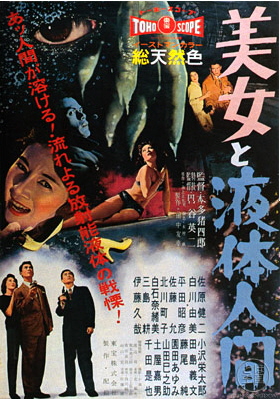
Representing Japan: The H-Man aka. Beauty and the Liquidman (1958)

From http://skreeonk.files.wordpress.com/2011/10/the_h-man_poster.jpg

Dir. Ishirô Honda

It would have been amiss not to include fifties, nuclear paranoia era sci-fi, having covered one last year, and it's one of the many choices I could have chosen from the boutique of genre films made throughout the decades in Japan. So many are there to choose; even if horror cinema only really came to be around the time of Jigoku (1960) and the influence of its director Nobuo Nakagawa, there are ghost stories and sci-fi monster films from before than I could have used. The same fears of nuclear fallout he tackled through Godzilla (1954) is yet taken to a different tone with The H-Man by director Honda. Godzilla was the ruminations of Hiroshima and Nagasaki through the wholesale destruction of Tokyo, potentially  symbolic of all the earthquakes that have beset the nation too, but with this film, it feels more concerned with the effect of nuclear aftermath, nuclear waste and radiation, the fear that a substance could get into the water. The film at first evokes acid rain in the first scene, but it gets more complicated than that.

From https://blogger.googleusercontent.com/img/b/R29vZ2xl/AVvXsEgav9iwKDDTF1fh4GPr0RNExpL-0xcwNQRdCNbvmZOTX6cy1Ujw2u9RVOd1emBOfGOHTLY5gOL4Ej48_ZVRWdddrCwwecKZdBVhoLr2UQxbCvVYDVCH62TFjzpXM188ACHu9nrHxHvjb9wI/s400/H-Man+%25286%2529.jpg

A drug runner suddenly vanishes one night when trying to transport a large package of narcotics. In the middle of a street, in heavy torrential rain, all that is left of him is a pile of clothes dumped on the road. It's presumed, logically, by the police that it's just a bizarre coincidence surrounding the per usual yakuza infighting, where the gangs are going after each other and the drug runner has ran for his safety, leaving his girlfriend, a club singer, to fend for herself. But said to be hopelessly in love with her, to being the kind of person to still try and see her even at his own risk, his complete absence is a mystery, and while there is still an issue with the drug related crime, another person vanishes leaving only their clothes. Only a scientist who studies nuclear radiation, who to the bafflement of the top police detective takes interest in the case, could have the answer, and it may show a horrifying threat for the entire Tokyo population. Very much sci-fi at its most fantastical. Horror as well, especially with an extended flashback including a "ghost" ship. Pretty gruesome when it shows what actually happens to the victims in sloppy, wet detail. Even if they're replaced with fake ones, toads get the worst of it in the name of figuring out what the protagonists are dealing with.

From https://blogger.googleusercontent.com/img/b/R29vZ2xl/AVvXsEi6tT0e7uDIJpdj2HZRGs6BaXUxCUOW9TUJpYN04ogYuFPRZN-zqYnclHNxc-bD1TbFD16N71kJv-bx0heh4GYEfPXzNeA1zhOIDby0EXn2hxz15tOwJrqqS3BafvA9nNtzR79joH16ocT9/s1600/AIP-2012-05-14-14h25m32s51.jpg

The Japanese sci-fi/kaiju/monster genre is barely tapped into in my viewing of Japanese films as a whole, but it's such a distinct genre in what I've seen while also having pieces of it that bleeds into other areas like anime. The bright colours to the images, glossy and rich, its foot between reality with the films between the fifties and seventies, but also close to both illustration and manga. A big thing about these sci-fi films, alongside yakuza films, is the amount of Western influences and how they almost drown out the Japanese origins of something like in The H-Man. Jazz instead of traditional instruments. (Great jazz pieces at that). The female heroine sings longue songs in English. Proto Pop Art deco for swanky, alcohol soaked nightclubs, one a prominent location in this film with local girls doing showgirl performance numbers in spangled bikinis. The gangsters here are in suits, slicked back hair and only carry guns, inching the film closer to the area of mukokuseki, cross-cultural works on film, that Seijun Suzuki went to with a film like Branded To Kill (1967). Post Second World War, when Western culture entered Japan in vast amounts, this is not a film that questions and or scrutinises this, like a Shohei Imamura film would, and even Godzilla had the first quarter of it set in rural Japan with its traditions clearly visible. No one raises a question about it, and baring certain things like the housing with interior paper walls, nothing pronounces it as "Japanese", more concerned with the story of people randomly disappearing. But it still manages to feel very Japanese paradoxically. The methodical pace. The willingness to depict such a premise completely seriously. The take on the fears of nuclear destruction spoken from experience. Even in being completely nationless in look, it's still very much a creation of Japan only.

From http://skreeonk.files.wordpress.com/2011/10/hman5.jpg

The H-Man is a b-movie. Pulp. The first viewing I found it dull and disappointing. This time I liked it. Opinions change in hindsight sometimes. It still drags by the end, probably because the cause of the incidents is not something like a kaiju that is visually frightening unless the icky practical effects are used, having to rely on the crime subplot for enough menace. But for a b-movie it was made with consideration. It has a grace to it, and at moments it becomes both freakish, and at least once or so far more sexual and edgy than anything that could have been dared done in an American film at this time. There's another example of the bravery in Japanese pop culture here which is willing to show with more vividness fears and anxieties, desires and fantasies even in something like this with its premise. Even in the simplest terms with The H-Man, just making something entertaining its creators went further and made this bright, gangster sci-fi hybrid film which mixes sultry, elaborate jazz orchestration with ominous fears of every drain pipe housing a dangerous entity based on real national scars. With an ending, without spoiling most of it for you the readers to watch it fresh, where you see the bay of Tokyo on fire, the water itself an inferno of flame, with a warning of the events possibly happening again, it neither comforts the viewer into believing it could never happen again, or that such an event couldn't happen in reality in terms of what is scientifically possible, not wrapping itself up in a quickie, happy package. It's still a happy ending, but unlike an American film of this genre, its Japanese counterpart, after seeing the brunt of war and the nuke, still desires to tell its viewers of the era, even if they're entertained in their cinema seats, not to be complacent about the dangers that a nuclear weapon or radiation, or a natural disaster or chemical fallout, could have when it's not a H-Man or a giant, god-like lizard destroying Tokyo. In the American sci-fi film I watched last year, while superior and still creepy, it was about the norm triumphing over an alien outsider. With The H-Man, it's not an issue of the norm being even in the centre of the threat, but that the folly of mankind, regardless of norm, can doom itself, and that even if the threat was an alien, mankind is responsible to keep on their guard rather than take their lives after for granted in a gee-whizz, apple pie mentality. 

From https://blogger.googleusercontent.com/img/b/R29vZ2xl/AVvXsEjCHFDge1ZJ6HTwI3tb9-70QxNVtuktY1CGjv0rPF4IlSfNKTilGOMr6vGB9w68Cc1Lh-3IZT6iOn8q363DOUg1QFapWMwg3wNpD6WX98bw6rTZVGROfCVnY49t7qbZW44j93bAN3UfVBVH/s320/hman22.JPG

Thursday, 4 October 2012

It Came From Within... [The Guyver: Dark Hero (1994)]

From http://www.assaultonplaneta.com/wp-content/uploads/2012/08/guyver.jpg


Dir. Steve Wang
USA
Film #3, for Wednesday 3rd October, of Halloween 31 for 31

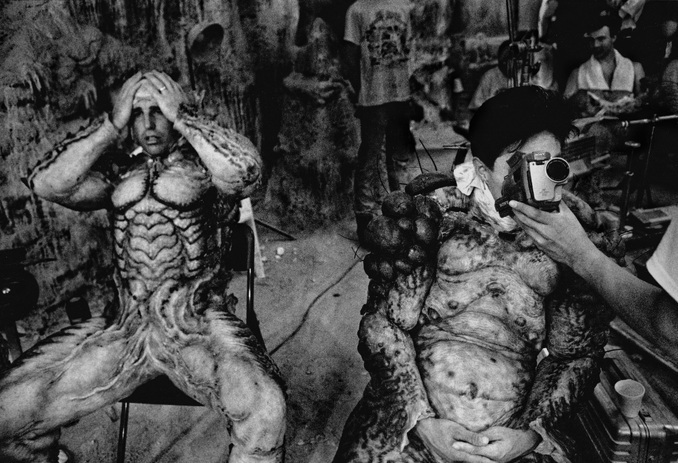
Practical and computer effects have been a major sticking point for anyone who caught the bug of genre cinema. CGI, after replacing almost all practical effects in mainstream and genre cinema after 2000, has been kicked to pieces by fan communities for years and I myself have contributed a few punts into the ribs while it was down. However it is not the fault of CGI itself – it is a tool that needs good craftsmanship to use. Even bad computer effects, or dated effects, can have a beauty (intentional or not) if it matches the context. If used subtly, it works greatly, or if used as an intentionally artificial or cartoonish flourish, it adds to the mood. The problem is that, as a tool for art, it is used because it seems to be what should be used rather than the right tool, probably more the case than for budgetary reasons, overused and without artistic consideration in most films. It either is a hollow mess with no emotional or primal effect to it, or if done in a way that is ‘supposed’ to be bad (rather than using ‘bad’ techniques purposely, or admitting its artificiality, to disrupt the sense of verisimilitude or adding an unrealism to proceedings), comes off as lazy, as with most intentionally ‘bad’ films in general let alone their production ideology. Practical effects can be just as badly used though, and like CGI, it needs the right craftman (and in all respect an artist like a film director) to use it properly. Why practical effects are so loved however, aside from the obvious nostalgia of the previous eras of genre cinema, especially the 1980s where it had it glory days, is that as physical material or a trick involving existing objects it also evokes the feelings of texture and material, flesh and bodily fluids, metals and mechanics, physical presence to the space away from the effects, and so forth. Practical can go from a simple blood effect to reaching into other artforms such as illusion and puppetry. CGI is closer to animation, and its unlimited possibilities, and even as far as illustration and painting. Practical effects go into sculpture, performance art and tangible creation. Bar the few examples that blur the lines, and the times when CGI and special effects are used together and cross each other lines separately, CGI is more of an art of the eyes and subconscious thought if viewed away from the obvious exceptions, unbounded by physical restrictions, while practical effects are a conscious art that evokes one’s ability to ‘hold’ something, or feel the space of a body or entity distorted or be abstracted under the contradictions of the creator’s imagination against the limits of the optical illusions or materials in their access. And when you have trained stuntmen and martial artists, in practiced fight sequences, in rubber monster suits combating each other the physical aspect of practical effects is taken to a literal idea.

From http://s3.amazonaws.com/auteurs_production/images/film/guyver-2-dark-hero/w448/guyver-2-dark-hero.jpg?1289461430
Adapted from a manga by Yoshiki Takaya, and made after two animated adaptations in its original home of Japan, The Guyver: Dark Hero is a sequel to a previous American adaptation called The Guyver (1991) which had Mark Hamill in its cast, and watched by itself there is the obvious issue of the introductory set-up being missing. I have not seen the first film yet, although in my favour I have seen the 2005 animated TV series and padded out the missing information, despite the localisation differences, from there. Past the missing set-up though for the whole concept, the story is rudimentary so that this does not become a problem when you have the gist of what is going on. Sean Barker (David Hayter, later screenwriter for comic book adaptations such as X-Men (2000) and Watchmen (2008), and voice actor for Solid Snake in the Metal Gear Solid videogame series) became fused with an alien symbiote/weapon known as the Guyver, able to cover the host with an alien bio-armour with provides him superhuman abilities and an arsenal of weaponry. Driven by its infection of him, Sean follows a lead at an archaeological dig to try and discover the origins of it. Unfortunately, member of the Cronos Corporation, the villains of the original Japanese work and the first film, are prowling around the site, made of beings known as Zoanoids, men who can turn into beast humanoids of immense power. Power Rangers, Japanese pop culture entertainment involving its heroes fighting Kaiju and monsters, and considering its origins as a manga and its anime adaptation, the influence of them, all are mixed into this. Then of course is the specific melding of animalism, body horror and biomechanics that has permeated Japanese culture, and is distinctly their own compared to Western examples of the same concepts, that director Steve Wang and the production team perfectly recreate in an American context.

I will be honest, as a narrative film it really is not that much to praise, as if the putting together of scenes and the whole film, but it survives these glaring flaws as a worth viewing movie because the practical effects and the fight choreography is so imaginative and well done. Yes, aspects are dated and the film is not for everyone, the concept of men in rubber monster suits fighting each other a base thrill, but the vivid melding of the physically startling (beast men, bio armours, the flesh and viscera construction of an alien spaceship discovered early in the plot) with solid stunt and combat work is a pleasure in its own right. Base thrills can be more powerful and inspiring than ‘deep’ thoughts, especially when you can see the love poured into this film just in the beast man designs. If more straight-to-video films, especially now in a perfect world, were like this fan culture would be one closer to genre heaven. And this film fits the mood for Halloween. If the concept didn’t slide into horror tropes already, the franchise is known as an ‘ultraviolent’ work, the American adaptation surprisingly bloody; that most of the victims are in non-human forms is probably why this had a 15 certificate for its (long out-of-print) UK DVD. Gore and the joy of its spilling in a fictional context is a fickly and controversial subject in any entertainment, which we can enjoy but even in this film needs to be paused on for a second by me considering how surprisingly gruesome this can get for its age certificate. It does add a necessary sense of brutality to the combat considering the science-fiction and body horror tropes pull in weaponry and inhuman abilities into the basic premise, probably faithful to the original vision from I can pull together about it. It also avoids becoming vindictive and callous in its violence, despite at least one moment of ocular trauma that generated a cringe from me amongst examples, in that the sense of bodily manipulation is combined with a thread of gleeful Grand Guignol mentality to create something that sticks in the mind but never becomes numbing or alienating to a premise which is driven to entertain a viewer. The fights themselves regardless are impressive, considering the restrictions the costumes would cause in your mobility, even without the gore. Power Rangers was perfect to evoke as the stunt coordinator Koichi Sakamoto worked on many adaptations of that series (including the first one which I grew up with), the style of fighting exactly the same style but with concreteness absent from many films. The fights and stunts have a physical force to them, the contact with each other and scenery probably painful for the stuntmen even when wearing the suits. Any potential issues with it were obliterated with Wang’s 1997 film Drive with Mark Dacascos, one of the best American martial arts films ever made just in terms of the quality (and insanity) of the fight sequences and stuntwork, and the creativity behind it.

Aside from that this is a film which stands by its technical qualities in these areas, but stands so well with them that the foundations are prevented from collapsing like so many examples in the same areas do so easily. Again, if more films were like this in genre cinema, despite its major flaws in story and composition, the ideas and their recreation are beautiful to see by themselves, their macabre physicality evoking far more than a rush job, either with practical or CGI effects, would. That Drive (1997) vaulted this film in terms of quality confirmed that Steve Wang and his collaborators were sorely missed after the American release of Drive was botched miserably and shot the team’s kneecaps out from under them. Adaptations of other sources can be a miserable experience to sit through, its cemetery pilled with corpses of so many forgettable, lazy additions that the ones like The Guyver: Dark Hero which can climb out the pit of bodies, with its head held high and a severed spinal column of a weaker film like Green Lantern (2011) in its bloodied claws, even in 2012 is impressive to me. 

When the Zoanoids are on their breaks from their plans on world domination.
From http://www.automation-drive.com/EX/05-13-11/Guyver_2_suits-Edit-large.jpg