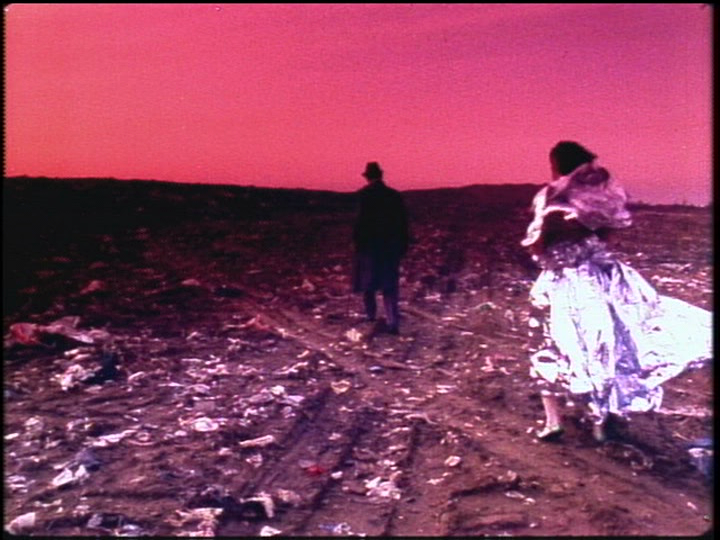
Showing posts with label 1980s. Show all posts

Thursday, 22 May 2014

City of Pirates (1984)


Dir. Raoul Ruiz

Nobody can say why you go chasing a pirate down
the street but such a state of affairs makes possible
a certain number of anxiety dreams. Was it the pirate,
you ask yourself, or was it the paranoia?
          
from 'When the privateers returned from their pillage' by Steve Spence

There is no Johnny Depp in eyeliner complaining about why the run's gone in City of Pirates, a film by the late Chilean director Raoul Ruiz, a film made to be intentionally difficult to gain cohesiveness over, nor are there galleons or people walking the plank. A pirate can denote something outside of law and order, and honestly, it's too literal and tedious to immediately go to Depp when the idea of a place suggesting pirates is far more mysterious and befitting this film's dreamlike structure.  Many viewers will complain that there are no actual pirates in the film, nor cities of any kind, dismissing the allegorical versions offered. Personally I wasn't disappointed, the lights that seasonally brighten up on a bush in a character's "Garden of Allegory" representing the ones readied for a war between pirates and the country of Spain, but some may be taken aback by the fact that this never becomes important for an overall narrative, merely detail in a world to add character, and that one should be concerned for the battle on this plant when its discovered Spain has lost.


I admit to finding the film a struggle to sit through in the beginning, but in dealing with the film, the issue of what I brought to it in terms of residue biases is part of the subject itself. Isidore (Anne Alvaro) comes into contact with Malo (Melvil Poupaud), a young boy who is in fact a killer, descending into a non linear trip that includes murder and an island where a man Toby (Hugues Quester), owner of the Garden of Allegories, has an entire family living in his head. It felt too close to the stereotype of pretentious art cinema originally. But befitting the film, either it was intentional, or that I fully absorbed the tone of it, and avoided forcing my own subconscious tagging by narrative cinema onto it.That Ruiz partially improvised the film, creating dialogue just before shooting scenes, was a dicey thing to do, in terms of how it would affect the tone of the work, and I'm still at the stage as a viewer, while falling in love with City of Pirates by the end, that the opening quarter of difficult films like this can frustrate me until I acclimatise to them. I've only seen four of Ruiz's films and one short, from a man who made over a hundred films, shorts and television work. As well as difficulty in actually seeing his films, including this one, sadly you can have critical writing be very vague when it comes to the maze-like nature of his work - like the key needed to unlock the mystery in the centre of his The Hypothesis of the Stolen Painting (1979), the description needed to entice you into Ruiz's world, rather than make it sound like obtuse navel gazing that'll put the casual viewer off being curious, is usually missing.

Yes, many viewers will find City of Pirates' completely disinterest with linear cohesiveness frustrating and dismiss it, but the film is far from obtuse. Again for a second review in a row I can reference Un Chien Andalou (1929), and how it was made with every rational idea purposely excised from the finished work. With City of Pirates, anything that connected together the content in terms of a narrative was removed during the editing process. Ruiz, and I dare stake this claim, in a film set by the ocean as depicted in lush almost candy-like colours - hazy burnt pinks, oceanic blues, blistering oranges - despite seeing little of his work, is an individual who suits the metaphor of the Chinese boxes well. Even if the conclusion is there by the end, the greater significance is that the route through the films seem to be continually expanding as you go along, and altering into more and more tangents as they go. Like the following too:


As a film, any plot for it boils down to the protagonist tagging along with the child as his "fiancée", after he (or likely she) has murdered her adopting father, only to be pushed into an increasing sense that she herself is hiding a more homicidal person within her. What the draw of the film is, the greater importance clearly, is how this is represented. It's worth remembering too that City of Pirates is a film that's playful in tone. A lot of my problems with the film disappear when the adoptive father leaves quite violently, in an unintentional shift in tone, or possibly on purpose. The beginning of the film is jarring against conventional norms of narrative cinema. A sentient white ball that bounces by itself, the mother talking to the dead, random appearance by policemen, and the one unfortunate aspect that was either Ruiz intentionally mocking pretence or something that flaws the film a little, the use of actors quoting very descriptive poetry. I'm not a fan of poetry where elaborate vocabulary for whole verses is common, rather than use of metaphors, grounded yet imaginative verse, or completely visionary or intentionally nonsensical wording choices. There is still the poetry in the rest of the film, usually in duelling voiceover, debating existence and life, but it's not as problematic. That the more irritating aspects of the dialogue were all quoted by the father, who is continually offering his adoptive daughter/live-in maid money as if soliciting sex behind his wife's back, it is the possibility that its intentional.

It becomes clearer than mood and fluxations of it drives City of Pirates, and what appears to be slight and close to pretentious drastically changes if one remembers what their dreams are like. Far from a cheap defence, it's a remainder to reconsider the context for viewing a film like this then the critical opinion. Dreams can have narratives, but they also dispense of any 'rationality' and inherently disregard notions of storytelling which required a 1-2-3 creation of characters and story. In this context, the film works perfectly. After a beginning stumble, it works as an increasingly darkening dream. One that is clearly humorous. One that has black humour and purely unconventional images. The most distinct, in the beginning, is the camera from inside the father's mouth, looking out between the teeth at his wife inspecting them.

City of Pirates

Instantly with this image, you should realise this is a deliberately absurd work. Especially if you use an example not from the film like this to emphasis the absurd camera shot -

Justin Quinnell's Smiley Cam Research Project
Large portions of the film are like this. The protagonist lost amongst a potential lover who offers her everything from radios to food, to Toby himself, where the mother of the family inside his head never heard from but only heard of from the other individuals juggled about from his consciousness. Surrounding this Ruiz is technically accomplished at making the shots seen have a distinction and a logical, tangible frame to house these illogical aspects. In dreams, the depth is gained from the resonance of the images and the events, not the background behind them. The meaning and emotions felt are already there for you beforehand as, in deep sleep or day dreaming, you are pulled away from the necessity of having a rationality to all that you encounter or sense. The difficultly one may have in trying to gauge with 'difficult' films, books and such materials could easily, possibly, maybe, be removed if you could go through them as one would encounter dreams in sleep. Maybe even the poetry I had a bugbear with may have made more sense in the film's place if I could have fully embraced the film in a resting state fully open to its content. The film's too deliberate in tone to be merely random, even if partially improvised, and the film's technical brilliance means that obvious motifs can exist which string together.

It's darker content reveals itself to be a fully darkened core to the work rather than mere shades to it. I can laugh and include the ridiculous juxtaposition of images just before, but parallel as well in City of Pirates is an incredibly uneasy film while still being tongue-in-cheek and playful. Nasty in its violence, the boy floating paper boats made of money in a river of a man's freshly split blood. Almost Italian giallo in its use of knives and blood spillage:

City of Pirates
Dario Argento's Deep Red (1975)

With Toby, despite a friendship taking place, his treatment of Isidore at first, locking her up in a prison cell, is immensely unsettling. When its changed into a friendly relationship, it's not a jarring and offensive shift. In dreams, opposites can sleep so much closer together while in the everyday the idea of them moving into being different and one-and-the-same equally is disturbing. The same applies to Malo, the killer boy, sarcastic but with the halo of a cherub. No wonder, when actor Poupaud grew up, you'd want to hug him in François Ozon's Time To Leave  (2005). But the boy is also a serial murderer and rapist. Later he takes on the status of a deity for murder, more of an entity. (Alarmingly Ruiz makes one of his names Peter Pan.) The childish innocence of the tone - pirates, bright colours - is hiding a tragic tale. A woman who lost romance, as she explains her backstory, and, in the symbolism, may be a killer as well. The film is open to interpretation. You can argue she's a mass murderer. Argue, with a shot of a man's face reflecting at her in a mirror, that it's the guilty of a man by proxy of his anima. That everyone's dead and this is purgatory as viewed as a coastal paradise of hazy, post-shooting highlighted, eighties colour coding. It's a not a cheat, a con, for Ruiz not to answer this, to be intentionally vague. His job here clearly was to make a waking dream. Dreams inherently have each viewer/listener of them making their own interpretations of what they mean.


There's always been a paradox in that, structurally, cinema is of audio and visual content. Even when either is removed, the lack of either and the sense of this takes up the gap left. However, the paradox, is that narrative is seen as more necessary within films. Narrative is not inherently of cinema, especially as editing, or lack thereof, is more of the connection of images in new meanings. Dreams are of the same idea. (So, fittingly, Sergei Eisenstein and Salvador Dali can exist in the same club house). Even if a narrative exists, like you wakes up naked in class on the day of an exam you haven't prepared for, my own experiences in dreaming have shown that the sensation of progression, through events, is more dictated by the effect of what happens than a story with a beginning, a middle and an end being shown. How narrative got to be the main priority in cinema is probably the result of theatre and novels influencing the material filmed, through either can remove it from themselves as well. Unfortunately, this means City of Pirates is seen as experimental because it negates the importance of narrative cohesion. My difficultly with the film at first is as much a subliminal printing of all the Hollywood films we see as children. This is important as I had difficulty writing this review - asking why I suddenly loved the film halfway through, when my mind originally was numb through the first quarter, and what I got from it when I loved viewing it. Sensations. The sense of dread, curiosity, wonder. The last image has stuck with me. Two women talking by a window. A man with a rotting face points a gun at the side of his skull. The women become skeletons even though without ligaments, muscle, a tongue or a vocal box they couldn't talk. Death. Unease.


A woman lost without love who'd likely slit her adopted father's throat for a lark and deep seated revenge against him. Her adopted mother doesn't care about the various murders, and still loves her. Death still existing from a child, completely against the notion of childhood innocence. Fittingly comparable to the last film I reviewed here - The Strange Colour of Your Body's Tears (2013). I know too Ruiz was an exile from Chile when it became a dictatorship. When Isidore is imprisoned, was that on his mind? Yet he's still playful. A white ball, clearly on a string above, being spun around the mother's head as if possessed by the dead feels too whimsical on purpose to be a fault tonally. There is no need for Ruiz to have to divide this from the serious side of the film, as the viewer should themselves and the film is structured so these abrupt parings make sense together. The conscious structure of these irrational pieces was ignored by me at first, which I regret when I finally noticed and understood them. Rather than hold one's hand, the film lets you feel when you react to individually in seeing said images. With this film in particular, it emphasises for me the absurdity of letting narrative being a driving force when images and sound are the more important factors for a film. That, and as taking its cues from dreams, it already possesses a cohesiveness, but that cohesive structure belongs from something, dreaming, where the rational to have something explain all of itself to you, rather than take from it what you can, is literally asleep and not allowed to be involved in experiencing the dreams. With City of Pirates the point is to experience the sense of dreaming it. The try and make a narrative out of it makes little sense to do and is patronising to it and yourself.

========
Images, in order, from the following sources:

1. http://1.bp.blogspot.com/_zlc81EWkeDU/TKedkC6nJdI/AAAAAAAABFU/jyKLN328ND0/s1600/vlcsnap-2010-10-02-15h55m18s148.png
2. http://img233.imageshack.us/img233/7813/ruiz5qu7.jpg
3. http://www.utopia-britannica.org.uk/Assets/maze.jpg
4.  http://dcairns.files.wordpress.com/2010/08/vlcsnap-197666.png
5. http://1.bp.blogspot.com/
-bbwrZ9IoKEA/TzLR1daBeII/AAAAAAAAAC0/wm_XH2UcfZU/s1600/Screen+shot+2012-02-08+at+11.08.56+AM.png
6. http://deeperintomovies.net/journal/image11/cityofpirates06.jpg
7. http://cdn.filmschoolrejects.com/images/deep-red.jpg
8. http://s3.amazonaws.com/auteurs_production/post_images/6403/city%20of%20pirates.png?1314026129
9. http://www.jonathanrosenbaum.net/wp-content/uploads/2011/08/cityofpirates-window-red2.jpg

Wednesday, 23 April 2014

Boardinghouse (1982)

From http://images.moviepostershop.com/boarding-house-movie-poster-1982-1020230391.jpg

Dir. John Wintergate

I have little in the way of life experience, but in terms of cinema, I can confidently say I've seen things that'll turn your hair grey. It doesn't matter if its art house or grind house. Body fluids. Sex. Gore. Random inclusions of clowns. A man turning into a bed sitting room. Exceptionally low budget films known for having an erratic tone have the aura for me of being exceptionally weird, particularly those shot on video, for the potential of odd circumstances, mismatched editing and rubber mask abuse. So it comes with a surprise that Boardinghouse to be pretty lacking in terms of an off-kilter air to it. I've wanted to see this film for years, since the bemused thoughts of the host of a bonus episode of the Mondo Movie podcast covering it. This is infamous for how strange a film it is. Enticed by the apparent madness its now that I reach this Boardinghouse, renting out a room for the night, and my expectations for what was going to happen were too high or not rewarded. In the tags section to the side of this page, you'll find one called "Cinema of the Abstract". It's used to compile together films that affect the viewer in distinct ways, throwing off one's perceptions of cinematic reality.  The other type of films placed under the tag are those so weird they have the same effect to, intentional or not. Boardinghouse was going to get the tag from what I imagined it to be, but seeing it, it won't now. What the film turns out to be is what happens when you pad a film out with many dialogue scenes with no connection to a plot. When the director plays the main male character who gets to be lusted over and have sex with the female characters. What happens when it's not the erratic editing you can say is why the film jumps tone and scenes as it does. That doesn't mean it's boring, but I'll get to the film as a whole for me as I go along...

In a text crawl and spoken narration that opens the film, on an early eighties computer, the viewer's told of a boarding house cursed with numerous unexplained deaths over the decades up to the then-current 1982. The nephew of the last owner to pass away in its corridors, played by the director Wintergate himself, the craggier faced cousin of Andrew Robinson, inherits the building. Immediately he decides to advertise for beautiful women between eighteen to twenty five to stay there for a rent, and rather than anyone being immensely hesitant to, many do indeed come, including a singer played by Kalassu, wife of the director who gets the most dialogue scenes along with him. The later point isn't a complaint, but this is definitely a film where those two get a lot of screen time. Wintergate's character gets to make love to many women, meditate in his underwear and develop his psychic powers, which he can use to make a bar of soap spin in the air above the bathwater he's in, while she develops her own psychic powers and hopes to succeed with her band. The other women get to muck about and longue by the pool in their bikinis all day. Unfortunately the gristly deaths are about to start again, clearly the work of a mysterious being who has escaped a mental hospital and can kill with psychokinetic powers. They're linked to an evil force in the boarding house, represented by a red haze generated by a computer effect from that decade, and odd and hazardous things start to happen. Hallucinations of having a pig mask for a head and pulling out bloody rat-tampon hybrids from the snout while taking a shower. Strange noises and maybe glowing eyes at the end of corridor. Guns randomly going off and objects harming people. Then people start dying, but only the viewer knows they are. Is one of the women to blame? Is it the gardener, also played by Wintergate as a shambling murmuring old man with all the costume department on, who was a Vietnam War vet and is far from normal? Or is it because of pure evil? Of course the lives of the characters are just as unexpected thanks to abrupt tonal shifts, a would-be suitor with dark intentions arriving to meet his estranged fiancée to a random pie fight breaking out.

From http://i1212.photobucket.com/albums/cc445/ObscureCinema101/vlcsnap-2012-07-07-23h02m28s206.png

It sounds truly bizarre from this synopsis, but while entertaining, the result feels too much like a desperate improvisation than something that sucked me into a strange dimension into itself like Canada's Things (1989) or an avant garde film that does it on purpose. The first horror film to be shot on video, it's of the lowest budget and barely attached to the plotline stated earlier, neither cohesively or consistently forwarding it, drifting in and out of random tangents. Attempts at humour next to serious horror. A random fight between two female characters at the pool.  Kalassu accidentally throwing yoghurt on herself when trying her psychic powers. The editing, for a film that was originally two and half hours long (!?), is haphazard and furthers the erratic tone by cutting away from plot moments and dialogue abruptly after they're stated. The tonal shift can be drastic, probably at its furthest being the flashback of the suitor raping his fiancée intercut with the women lingering around the pool, leaving a bad taste in the mouth despite the film around it. Around the psychic killer story thread you have the supernatural force in the house, Wintergate sleeping around, random conversations, jokes about a drunk man falling over trying to play golf and many other things. It also includes a gimmick where a specific sound and image, of a leather gloved hand on a psychedelic background, pop up occasionally to warn the viewer of the more prosthetics and fake blood heavy incidents that take place. Far from glorious it does feel disconnected. Moments stand out from what been said. Further points are added for the unexpected prescience of a magician during Kalassu's concert at the climax of the film. But I ended up watching a film which is a lot of dialogue, many scenes of strange circumstances, but never has a consistent, marked heightening of the bizarre.

Preference influences this review too, and I found Boardinghouse to be a mere diversion. I don't really gravitate to films that are held up for questionable acting and random shenanigans. I prefer those under the concept of "bad" filmmaking that end up creating a unique tone to them despite their technical problems, a consistency to their madness should I say. I've seen better examples created from the results of cheaper effects, abrupt editing and the unintentionally bonkers. I've found myself adoring these sorts of films within the last few years, technical incompetency be damned. Hell, Boardinghouse could grow on me. But at this moment its too obvious, and not strange enough to fully join any of the categories of these sort of films I like the most. It's not a film like The Nail Gun Massacre (1985), either, where reality inavertedly stumbled into a cheapie slasher film. Maybe the disappointment is distorting this first viewing too much, but I want to see films that break any perception of how a film should be put together. This just vaguely gets to an ending, and is a lot of poorly spoken dialogue and a few funny moments only.

From http://i1212.photobucket.com/albums/cc445/ObscureCinema101/vlcsnap-2012-07-07-23h03m57s59.png

Saturday, 29 March 2014

A VIdeotape Swapshop Triple Bill: Ninja The Protector (1986)/Robo Vampire (1988)/Beauty and Warrior (2002)

From http://i1.ytimg.com/vi/z0FOVncOdJs/hqdefault.jpg

Dirs. Godfrey Ho/Joe Livingstone/Sukma Romadhon


The following three have a connective tissue to each other. An infamous director and two producers from Hong Kong that have all contributed to taking old films, adding ninjas to them and selling them to Western viewers. The first film is such a work, from Godfrey Ho, who has been covered on this blog before. Here one can find out what happens when a melodrama is mixed with an improvised action film. The next is miscredited to Ho, but can be fully confirmed to have the influence of producer Tomas Tang somewhere within it, who would work with Joseph Lai and Ho at times or at least share a credit on their work. Robocop (1987) as envisioned as the Tin Man fighting hopping vampires used by a drug cartel's guard dogs. As you'd usually expect from cinema. The final review is for what Lai's been doing long past the cut-and-paste ninja films; whether its based on true mythology or not I cannot tell, but its an excursion in the obscurest areas of animation that you can find produced. All together they are a testament to how unpredictable films can be regardless if they were made merely as product.


From http://www.hairballmedia.com/robo_vampire_4.jpg

Ninja The Protector Review - http://www.videotapeswapshop.co.uk/19759/ninja-the-protector-1986-dir-godfrey-ho/

Robo Vampire Review - http://www.videotapeswapshop.co.uk/19816/robo-vampire-1988-directed-by-godfrey-ho/

Beauty and Warrior Review - http://www.videotapeswapshop.co.uk/19936/celluloid-wunderkammer-beauty-and-warrior-2002-director-sukma-romadhon/

From http://i1.ytimg.com/vi/2svdEDvyKOs/hqdefault.jpg

Sunday, 23 March 2014

In The Future There'll Be Plastic Domes On All The Cars: The New Barbarians (1982)

I had to use this instead of a film poster...
From http://www.post-apocalypse.co.uk/aus/NewBarbarians.jpg

Dir. Enzo G. Castellari

With The New Barbarians I realise why Italian genre cinema would sadly fritter away by the late eighties, because as the Hollywood blockbusters travelled around the world, you can see the difference between Star Wars and a film shot entirely in a rock quarry with buggies. Obviously, why would anyone only just like Star Wars when you can enjoy both equally I don't know, but unfortunately back when films like The New Barbarians were being made, the Italian public probably wanted to watch the American imports rather than the cheap rip-offs made by theirs. Yes, these films were being shown in theatres in the English speaking world, which would have been awesome to live through, but this wouldn't last. Unable to keep up with Hollywood, and their virtues ignored by the end, regardless if they were rip-offs in the first place, these entertaining and interesting films would dwindle out by the late eighties, which having seen a few from this period showed how bad it got. The less said about Cruel Jaws (1995) the better.  

But looking back, even if The New Barbarians wouldn't qualify as a great film in Enzo G. Castellari's filmography, its definitely not impoverished as its limited production design suggests. Set in 2019, after a nuclear apocalypse has passed, it means we've missed the worse, thus setting this in a fictitious reality, or that I really need to get a driver's license, learn how to use a laser gun, and arm a car with spikes and rockets for the impending doom befalling us soon. Within this scorched earth, an evil group known as the Templers exist led by One, played by Italian genre mainstay George Eastman; exceptionally tall physically, a giant decked in smart, menacing white uniform, bearded and with an evil smile on his face, the psychopathic leader of a group who desire, after the apocalypse, to eliminate all of mankind in a suicidal drive. The sight of an all-male group with perms, Mohawks and luscious locks, driving armed buggies, and dressed between white clad soldiers and Evel Knievel, would be frightening even before your head came off from the spinning blade extended out from one of their killing vehicles. They're definitely evil because One hates books, particularly ripping the New Jerusalem Bible in half. In their way is Scorpion (Giancarlo Prete), a Mad Max stand-in who seemed to borrow Robert Powell 's hair. Since Mad Max had a souped-up car, Scorpion has a similar looking one too but with a giant chrome skull on the bonnet. It does lose aesthetic points however for whoever in production design thought a giant bubble roof on the top which flows lime green in the dark was a good idea. Fred Williamson is Nadir , the former American football player and star/director of many exploitation films looking a considerable bad ass even if dressed up in sci-fi garb, the circlet not stopping the fact that his body armour was probably designed to be able to fit his machismo. It's strange though to see him soft spoken and without his trademark cigar. With him also to help Scorpion is child actor Giovanni Frezza as a child genius of car mechanics who is deadly with a slingshot; most will recognise him, blond haired and looking like a mischievous cherub, from Lucio Fulci's The House By The Cemetary (1981) as Bob, infamously given a less than desired English dubbing.

From http://monsterhuntermoviereviews.com/wp-content/uploads/2013/12/NewBarbarians2.jpg

I've fallen in love with the Italian genre movies of the seventies and early to mid-eighties. Before the seventies is a large wealth of potential gems, while for the criticisms I've made, my love for this area of cinema means I'll still be hopeful for late eighties and nineties work even despite the lessening quality from a lot I've seen. There is truly great craftsmanship and art in the best. But those which are more pulpy or less than perfect are irresistible to me still. Talented individuals of Italian art cinema worked on these films too, and their creation developed a unique tone and presentation to them that even makes a ridiculous film like this stand out. Strong colours. Post dubbed soundtracks. American stars. Lurid content. Memorable scores, with Claudio Simonetti of Goblin going mad with a synthesizer here. The New Barbarians is low budget schlock but I delight in the idea of these actors playing dress up in quarries. There would be a child-like innocence to this were it not for the gore and adult content. That with its few resources its had to try and weave a limited story from what's there, as Scorpion is pursued by the Templers, is more interesting and entertaining, with its grasps of high budget cinema, barely reaching the budget ceiling, and accidental absurdisms that add great layers to it. It helps to that the film cinematographically is still exceptional despite the nuclear apocalypse being camper vans and buggies decked out like Robot Wars/Battlebots contestants. The quarries, when space is shown, are brightly textured and expansive, and there is never a flabby camera shot or edit despite the narrative side being flimsy. Castellari stands out in Italian genre cinema, impressive considering the great directors within it from the era. He shows great love for all the films of his I've seen, regardless of them being b-movies, caring for the immensely invigorating action scenes but also capable of making films that go beyond this. Thus Street Law (1974) is a vigilante film that becomes a lyrical ode to the complications of taking justice into your own hands, while Keoma (1976) is a sombre, oneiric send off for the spaghetti western. The New Barbarians is slight as a story - cars driving around in circles at each other, conventional on-foot action - but its saved as much by the gifts of his and the crew he worked with as it is the infectious behind it. The quarries are allowed to feel expansive at times despite the limited locations and the touch of the film in editing and look are far removed from lacksidasical but solid. And that its ended up as it is anyway is much of a joy. From the Templers' costumes to a sex scene in a tent made of bubble plastic, the absurd decoration of lower budget films stand out positively for me because, contrary to what would be perceived as taking away the magic of cinema, knowing it can be made from stuff from your home but has become an object of a fantasy world is even more magical, as befitting a medium that started with trick films. For example, realising a communication van is covered in tinfoil isn't a failing, but instead that it is both this and a new thing in a future world, a strangeness that's rich. It's only when mere laziness exists where problems arise. The plot eventually becomes mere construct for this notion to play out, which doesn't dampen the textual pleasure from it. To grin. Admire the action, which is still there in spades. To look on in surprise, at the least expected way a villain 'tortures' a hero, both male, in a regular genre narrative, one that, were not for a single line of dialogue to have added an un-PC side to it, would have uprooted archetypes of masculinity and turned it upside down completely.

If you like your silly, post apocalypse cinema with a plot hanging on a thread bare, this one is worth seeing. Scorpion is a stock characters, but Williamson is simply cool and Eastman looks like he's lording it up as the bad guy, the only regret in the characters being that the women are just there to look pretty, when really this cinema should always make an excuse for a tough female as equal to the hero even if she's stereotypical. You'll find amusement in the laser sounds and the amount of exploding dummies is something, especially as Castellari likes using slow motion quite a bit. Seeing stunt men do their best front flips from explosions and cars flipping over is inherently fun when its shot as considered as here. I cannot dismiss its cheap look in terms of what is onscreen because how it's shot is still good, if you notice, and I cannot help but simple enjoy cars driving around each other in mock combat with bubble roofs on them. In seriousness again, even schlock can have the gift of enthusiastic craft to them, instantly as much cinema as a great film because, cobbled together, the obvious faults nonetheless add to the fantasy played onscreen.  If you admit the farce of this being a nuclear wasteland set in a rock quarry with a few cars lying baout, like the creators probably did before going on professionally regardless and doing your best, you don't worry about this and find virtue in this less-is-more style. The regret that films like this became of disinterest back when they were being made is that, yes, you should be able to enjoy your Star Wars films and these equally, one from the best money can buy in Hollywood, but the other being an enjoyment from what they were able to do with limited resources.

From http://monsterhuntermoviereviews.com/wp-content/uploads/2013/12/NewBarbarians1.jpg

Tuesday, 18 March 2014

Celluloid Wunderkammer: Call Me Tonight (1986)

From http://i1091.photobucket.com/albums/i386/jgespi/caratulas/CallMeTonightRedux-1.jpg
Dir. Tatsuya Okamoto


Contrary to the provocative image that I've included at the beginning, this short piece of obscure anime flips the expectations for hentai into how perverse the concept of tentacle erotica is. I've been lucky to discover these fascinating obscurities released straight to video, mainly thanks to the Anime News Network article series Buried Treasure - found here - and thankfully these works that have never been released on DVD even in their home country have been discovered by Western fans, subtitled by said fans, and made available online. I admit to haven't even see key anime works like Cowboy Bebop (1998) yet seen the likes of Call Me Tonight, my habit for digging deep into the depths of my favourite things sending me to material like this, made back when money was plenty enough for a subversion of anime sexuality, when anime hentai was only birthed within the same decade, to be made. If this material was made available on DVD, when pigs fly, they would be fascinating curiosities for anyone to see.


Review Link - http://www.videotapeswapshop.co.uk/19348/celluloid-wunderkammer-call-me-tonight-1986-director-tatsuya-okamoto/

From http://s3.amazonaws.com/auteurs_production/images/film/call-me-tonight/w448/call-me-tonight.jpg

Monday, 17 March 2014

Videotape Swapshop Review: A Chinese Ghost Story (1987)

From http://mutantville.com/blog/wp-content/uploads/2012/01/A-Chinese-Ghost-Story-1987.jpg

Dir. Siu-Tung Ching

I've probably been watching too many trashier martial arts movies throughout the last through months. I adore their questionable dubs and erratic tones, but its good to watch one which is crafted exceptionally. Seeing this film again, you can see how much the Hong Kong cinema of the eighties was liable to catch the eye of Western viewers like me. Its also good to go back to this film when the first Siu-Tung film I covered on here was Belly of the Beast (2003) with Steven Seagal. This is not a cheap shot at Seagal, but reading the review below, or actually seeing A Chinese Ghost Story, you can see why I say this.

Review Link - http://www.videotapeswapshop.co.uk/19608/a-chinese-ghost-story-1987-director-ching-siu-tung/

From http://img.photobucket.com/albums/v394/Manos99/GHOST_STORY1-1.jpg

Saturday, 4 January 2014

Celluloid Wunderkammer: A Broad Bellflower (1987)

From http://redkorea.files.wordpress.com/2012/01/e311.jpg

Dir. Kyun Soon Jo

I cannot wonder, thinking back on this review, what the original reactions to this film were in North Korea itself. What is the context of its existence? Frankly, considering the controversies surrounding the country, what did the normal public actually think of this film? In their own homes away from public officials? Without a lot of information on the country's cinema, its difficult to gauge these questions fully. The film itself in the context of the new Celluloid Wunderkammer series I started on Videotape Swapshop? The point of the series is that even if a film is forgettable, the context of its existence at least should leave a lasting impression, an opening one even, for a new area of cinema or at least more detail on it. Something interesting to look at if anything. It's almost cliche to say viewing this has made me want to see more of the cinema of the Great Leader's nation, but it wouldn't hurt to take advantage of the films you can find to see and learn from what the nation gives to its own people and to us. And I'm not even talking about Pulgasari (1985) yet.


From http://redkorea.files.wordpress.com/2012/01/df5607broad-bellflower.jpg

Tuesday, 10 December 2013

Clearing Through The To-Watch List #4: Journey To The Centre Of The Earth (1988)

From https://blogger.googleusercontent.com/img/b/R29vZ2xl/AVvXsEgnXC1wzRqMslXUzObBZVzagGdK8gbDZ9dj3oc2xwjIR5JbKMEGNR3aDw_en_vkB2VbTzZL_j6RL7mr-U1vsPMWNgjIU1V1uA0VPwpjdRixRkXh1PVA0pjjaKLHL1jqQOxHJNfln45-2vM/s1600/journey.jpg

Dirs. Rusty Lemorande and Albert Pyun

Journey To The Centre Of The Earth really takes the biscuit for how unfinished a film can actually be when its released. Like an unfinished building being opened up to the public, the complete lack of solid foundations despite the thing still being able to support itself tentatively is startling, and the holes are so obvious its more interesting to ask yourself what was supposed to be in the spaces missing. Rusty Lemorande has actually (presumably?) put up a brief piece of information on this film's IMDB page stating that only eight minutes of this film, at the beginning, are actually his own creation, the rest presumably that of b-film director Albert Pyun. Originally an update of the Jules Verne story, only for something significant issue to take place that, believing Lemorande's thoughts, caused the project to become a Frankenstein stitched-up creation, it's a case that, only seventy or so minutes long without the end credits, the whole piece is an utter mess.

A British nanny ends up travelling all the way to Hawaii for a job, only to end up having to look after a washed up rock star's dog rather than a child like her job suggests. In screwy, illogical circumstances she ends up in a cave, stuck, with two American brothers and said dog. The film is pretty dreadful in the beginning, to the point frankly that even if Rusty Lemorande got to make his film, it may have been a poorer film than what it is now. Completely leaden dialogue and character interaction that comes off as lame, with a broad performance style that is wooden. Abruptly, as the characters sleep, there are clips in dreams that feel like, in hindsight, scenes originally recorded for the original context of the film. If not, how do you explain an amusingly ghastly rescue sequence with a lazer gun, eighties hair, and troll men who are literally giant rubber ornaments you can also wear, who can only waddle around side-by-side and have no other form of movement let alone bendable limbs to do so? It's incredibly generic filmmaking through this beginning, everything that I really cannot enjoy despite there being a lot of people who delight in these sort of eighties and nineties films. I view this without the nostalgia of films like this being on video, because I grew up as an adolescent with DVDs, nor the real interest in this kind of filmmaking because it feels rudimentary than creative or insane like I prefer it to be. It's the churning of gristle into dust. Creation of film for product only.

Things get a little bit more interesting when, so far removed from an attempt at a Jules Verne story already, it completely abandons the notion of being such a thing and turns into something different. It's still set for the rest of the film in the middle of the Earth's core, so the title is still appropriate, but after that questions have to be asked about what "adaptation" actually means against this film's results. The perverse thing is that this is, technically, deep into the material Albert Pyun added, but I actually found it more interesting than what the film may have supposed to have been. Suddenly the centre of the world is Atlantis, (water, water not everywhere though, but let's not ask about that), a totalitarian city populated by punks, new wavers and proto-steam punk fetishes. It's still got a terrible broad sense of humour, especially when it comes to jokes about the dictatorship of the city, Judge Dread this isn't, but finally this gristle of movie has some layers on of some curiosity. Elaborate sets and costumes even if made on the cheap and baring in mind the possible production history of this whole work. Vaguely interesting characters. A legitimately interesting idea where, after encountering an "alien" from the surface world, a blonde female Californian, the Atlantis military squandered its resources to transform willing participants into exact duplicates of her, even in height and vernacular by rack and vocal couching respectively, to spy on the surface without actually thinking duplicates of a single person would immediately send off alarm bells above.

Then suddenly there's a freeze frame. Random moments of a post apocalypse motorised gang attacking ruined cityscape. Then we're back on the surface in front of a television screen, a peaceful truce between Earth's surface and Atlantis having taken place. An entire catalogue of possible events taking place in-between completely skipped. The film just ends. Its befuddling honestly. Right when a film got vaguely interesting, it suddenly ends because there wasn't enough material and/or time to finish it. It vanishes half way through a sketch you paid to see and no one knows what happened in the rest of the story to improvise, because it was already garbled in its storytelling before it legged it. It fosters the realisation you could release anything to cinemas even if its incomplete. It's actually a Cannon Pictures release, but their logo doesn't appear in the beginning. Only a few years later they would close down, making this film's creation an ill omen in many ways. Either way, even if it was finished properly, it would have either been vaguely interesting but average, or just awful. Frankly as the mess it is its probably memorable for a brief months, but would have disappeared in my mind immediately if it was properly completed. 

Friday, 6 December 2013

Frog Dreaming: Decoder (1984)

From http://theendofbeing.com/wp-content/uploads/2011/06/DecoderPosterNU.jpg

Dir. Muscha

Decoder avoids what happens to a lot of films based on the subcultures of their time, becoming badly dated, by taking the aesthetics so far it is completely in its own world. It is of the eighties and yet completely its own reality. The colours push out any sense of the real world. Blood reds. Blues. Greys. Sickening woodland greens. Scored with industrial music, this is a filmic manifesto for alternative culture, made in a collective independently with director Muscha. Amalgamating together beat culture, with a William S. Burroughs cameo, industrial music, punk aesthetic, anarchist politics and full out surrealism involving frogs. It still evokes a world of the Berlin Wall, European architecture and even the gothic together with computer technology and industry. It's what Claude Chabrol's Dr. M (1990) should have been, a multi-cultural melting pot of Europe, politics and dystopia, the past and the future melded together into one film.

From http://assets.motherboard.tv/post_images/assets/000/013/077/Screen_Shot_2012-07-11_at_4_18_51_PM_large.png

The movie is languid in its plotting. At first it's as if we'll follow a detective, Jaeger (artist and actor William "Bill" Rice), of a Big Brother law organisation, a weather beaten face of film noir still using computers and CCTV cameras, that can see everything, to his advantage. He is clearly tired of his existence, a ghost drifting along on the streets in his investigations. At a distance from his work colleagues as he says viewing clips of Metropolis (1927), the most famous German dystopia on film, is of use for his assignment. He wanders into the red light district as if for a case but becomes more curious about one of the women who works at a peep show, Christiane, played by Christiane Felscherinow. In a world where surgical footage of female circumcision and autopsy material is shown for a turn-on for patrons, evoking J.D. Ballard's The Atrocity Exhibition (1970), his interest in her is far more than mere sexuality but a strive for something out of place in the wreck of a society. But he is not the main character. Part of the way through we are introduced to him, a sound musician, and boyfriend to Christiane, called F.M. played by FM Einheit of the group Einstürzende Neubauten. He becomes intrigued with a fast-food burger food chain, believing that they use a special type of music to brainwash their patrons, working day and night on what he believes will be a noise that causes physical nauseousness. Spreading it to attack the food chain and every fast food restaurant possible, he hopes to cause a political upheaval, as Jaeger is assigned to track him down and finds that even he is more sympathetic to F.M. then his own employers.

Decoder is about mood. Intense, atmospheric music including compositions made by industrial artists who starred in the film. A world of human decay where arcade games blur with the sound of transport into a mass of violent noise. American war films play on the TVs, and even the people on F.M.'s side exist in a fiery underworld abyss led by Genesis P-Orridge of Throbbing Girstle as an anarchist keeper of knowledge. The only serenity for any character is for Christiane , literally in a world of frog dreaming, as the review's title suggests, at a point surrounded by the amphibians and books on frog anatomy, dreaming of a red desert wasteland monologue by a mix of the witches' chants from Macbeth and Burrough's work. It is ill advised to view the film as a vast narrative as that is clearly not what it wanted to do. It follows aspects of classic crime stories. The detective becoming enamoured with the subjects he is following and questioning his purpose. The attempt by an everyman to demolish a group that, in one scene in their absurd training of new employees just to work at a burger place, have no qualms in restricting "ugly" workers to the kitchens only and act with a belief that they are a titan of culinary skills, even if it means using noise weaponry when any of the customers get aggressive in their premises. (Although when one potential employee admits he'll be finally able to buy a specific brand of shoes with his wages, far from dismissing it as consumer gullibility, the film briefly steps back and admits that the people behind the counter are ordinary young adults like F.M., just happening to work for businessmen who view them as merely human resources). But the film drifts along as the world is turned upside down, real riot footage used to depict the city going up in flames. It's a grubby, beaten down reality distorted by the bright, bleeding colour saturation or dark shadows. It does feel like a feature length music video, but this is in Decoder's favour, as its visually depicted plot is driven by its musical content. The sounds of crashing metal. Synth. Only Soft Cell's Sleazy City, repeated every time the red light district is shown onscreen, doesn't quite work, but it's more of a personal taste issue for me, out of place against the more ominous, mostly instrumental compositions that even border on jazzy. What really sticks out with the film, as stated, is that it managed to be more faithful to older, even centuries older, influences like the gothic and noir while explicitly being new in its anti-authoritarian, industrial music driven world. It's not accidental that there's feelings of German Expressionism in the film because it itself has clips of Metropolis shown, fittingly squashed on a tiny CCTV screen next to surveillance footage, the metropolis here having pushed itself further into monitoring dissidents. Clearly Muscha and every contributor to this film wasn't aghast to the notion of referencing the past, still subversive and outside conventions, and in tipping their hats to the likes of Burroughs, seen in an electronics shop amongst cables and wires, the upmost respect and realisation that Decoder is as much a continuation of forefathers as well as its own work is alive in what's seen in the film, and is a great deal of the reason it works completely. While its future is of the eighties now, in the past, the mood and atmosphere, the ideas and how everything is depict, become a future in another reality, still potent even if the context of it feels more alien. Its newly gained alien nature replaces what is missing with the sense of intensity and rhythm of music that makes Decoder probably a greater film now it's been severed from its original time and place, allowed to be independent of its original purpose and able to become a subversive, abstract beat film completely in its own self-made context decades later.

From http://i155.photobucket.com/albums/s314/araknex777/DVD%
20SCANS%20AND%20SNAPSHOTS/vlcsnap-00015.png

Saturday, 30 November 2013

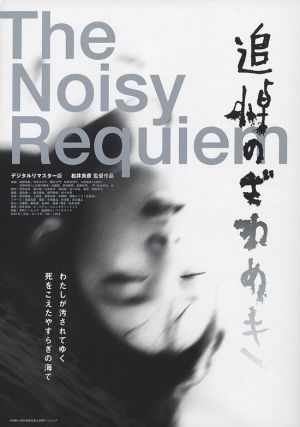
Nihilistic Love: Noisy Requiem (1988)

From http://i1253.photobucket.com/albums/hh590/thedarkpoet411/11158629_800_zps1bed6e82.jpg

Dir. Yoshihiko Matsui

Noisy Requiem is set in desolate places. Junk yards. Building rooftops. Red light districts and pachinko parlours. Obscure business offices. Backyard fields of weeds and industrial concrete. Any contact with the wider world, in this independently funded film, taking my steps into the rarely available jishu eiga underground films, is 'stolen' with documentarian capturing of the images without permits. Or distant like there are glass walls and ceilings baring the characters of the film to be noticed. In some cases the outside world runs away from them. It is mostly slum area. Shin Sekai, Osaka, a place of immense homelessness. The entire economic and social ups and downs visible on the locations onscreen like if you could film the council houses here in my own country. There is a violent young man whose only existing love for another, any love to anyone as he may even hate himself, is for a female mannequin, planning to raise a child with her. Going as far as giving her the organs needed from unwilling donors. A man and his very young sister, his care for her beyond convention. A homeless man who drags around a tree stump the shape of the lower half of a woman, perfectly so you wonder if a poor tree nymph was killed and cut up for firewood. A midget brother and sister, who run a sewer cleaning business, she feeling the immense distance from the world and progressing to random acts of destruction in a need she may not even know of. It sounds purposely transgressive. It is trangressive. It breaks so many taboos. It sounds absurd and the Japanese answer to Pink Flamingos (1972) before Takashi Miike's Visitor Q (2001) came to existence. People would dismiss it as another example of weird Japanese cinema, but with only the films to go by themselves, in their own worlds and contexts, many of them are more reflecting and artistically minded than you think.

Noisy Requiem is black and white. Beautiful in its ugliness and ugly in its beauty. Made independently, director Yoshihiko Matsui used the fact he was making a guerrilla movie to his advantage. Handheld cameras move with the dexterity I've only seen in the films of Akio Jissoji. Encapsulated, as the violent young man berates two disabled veterans of World War II, by the cameraman running around the water fountain behind them, on the other side secretly hearing on them and not getting involved, twirling around, thinking better of it, and running back to watch defencelessly as the violent man eventually gets a claw hammer out of his back pocket. Tinny synth doesn't detract from the film, and there is moments of tender piano music to counteract this music choice. To get high, almost eye-of-God shots, someone sat on a roof. Recording in one scene schoolgirls, like the pigeons the young man kills in the beginning, fleeing on  mass like running, liquid mercury. A rooftop was set on fire, and the person(s) who hid filming real fireman assess the damage never got caught and managed to get the footage into the film. Independent cinema here is suicidal in its bravery in getting the shots desired. In trying anything. Blurring the lines between fiction and real when it seems characters are hassling real people. It is not a static camera in a room filming dull conversation between the characters no one cares about like in other films.

You are forced to follow characters who have no moral grounding. There is incest. Blood. The desire for another literally consuming. But Matsui is on their side, having called this a film about true love. "True love", such an odd choice of words at first against such nihilistic, taboo breaking material where someone shows their love to another, a mannequin, by licking bird shit off their cheeks. But even if the characters could never be real, at least to a rational, "normal" society, the film is calm, lingeringly slow to the point you follow it carefully. Rationalising this behaviour from the characters' perspectives. Some of it is so twisted its sickly humorous, but you feel pity, then ask if they're the miscreants or if the ordinary public barely seen are worse. The only people from this part of the society, who are sympathetic and aren't faceless, are two schoolgirls in the beginning. One recounts the dream she had which is the central idea of the film, a white dove prevented from getting seeds by pigeons, and turning into a black crow who kills to survive. To live in this film's outskirts, you have to even harm other, and normality itself can be even more grotesque and sadistic, as takes place on a public bus full of bulling, sideshow caricatures. The main characters for all their crimes they commit are trying to rationalise their own existences let alone the one outside theirs.

At two hours, nearly forty minutes, Noisy Requiem becomes trance-like. You stop being offended by the content because you're living through the characters' eyes for so long, the daily rhythms, that you live in their place outside of perceived existence. Switching between characters, the film becomes confusing at times, what actually is happening in reality up for debate, but keeps a consistent and enticing tone. Fantasy eventually breaks through to sit alongside the disgusting, vomit and blood matched by rivers existing on rooftops and a split in time, a split of a body into two, long before Uncle Boonmie Who Can Recall His Past Lives (2010) did it too twenty two years later. If the film is depressing, it at least gives you characters to care about. If its vulgar and offensive, it at least lingers on the aftermaths with thought, that causes you to actually feel pain than let the incidents merely pass, as if they were acceptable, as in politer mainstream films. If it's rough, messy in presentation, maybe too long, it at least tried. And trying means more when you see a film like this that feels something. Characters searching for true love. All from an area completely isolated from the rest of the world. The homeless, the lost, the physically and mentally disabled (by birth, by accident or by war), those born with dwarfism, minorities or those to paraphrase Hunter S. Thompson are "too weird to live". Pity changes to showing your own hypocrisy. Even if these fictitious characters are miserable, at least they're trying to live. The last image of the film is an extreme close-up of a woman's face. You've seen her wander aimlessness. And the film actually makes you care for her when something else would make her a freak to gawk at or to only pity with a clear distance between you and her. There's no distance in Noisy Requiem.

From http://s3.amazonaws.com/auteurs_production/images/film/noisy-requiem/w448/noisy-requiem.jpg?1289474103

Thursday, 28 November 2013

Videotape Swapshop: The Falls (1980)

From http://petergreenaway.org.uk/fallc.jpg

Dir. Peter Greenaway


Birdmen. Human flying. Bird puns. Bird films. Avant-garde films. Twins. Faux twins. Typo errors. This and so much more exists in The Falls, a film that is both hilarious and profound. That's all I really need to say about it.


Review Link - http://www.videotapeswapshop.co.uk/18102/the-falls-1980-director-peter-greenaway/