|
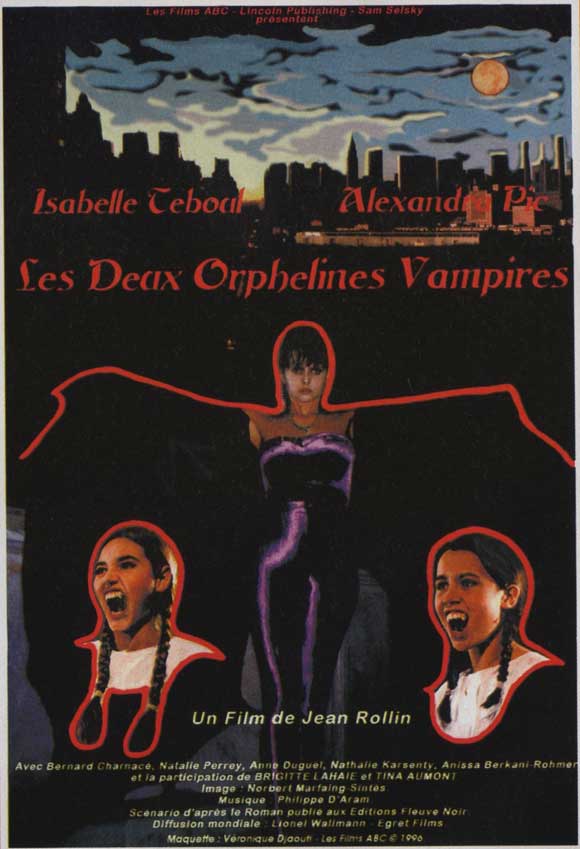
| From http://images.moviepostershop.com/two-orphan-vampires-movie-poster-1997-1020492359.jpg |
Dir. Jean Rollin
 It's a delightful surprise that
this film doesn't feel like a nineties horror movie at all. As much as I'm
obsessed with the nineties, one of the reasons I'm obsessed with it is the
tackiness of the era as well as the positives. Not a lot of horror films from
that decade are celebrated, as compared to other eras, for this reason. Jean
Rollin didn't make a tacky film in the autumn/winter of his career here,
thankfully making a very interesting one instead. It's very much an art film,
against other films of his I've seen, which must be beared in mind. It's
amazing too that I can compare this film to the work of fellow French director Eugène Green, of The Portuguese Nun (2009), with his long, almost Bressionian
moments of dialogue, dangerously near the precipice of pretentious but
ultimately charming and rewarding in being a bit more freer to let scenes play
out as far as needed for mood and effect. This is the same for Two Orphan Vampires. I will openly
admit it's going to be a difficult film for people to digest, including those
who like Rollin films. I will also
admit that I've developed a taste for films that could be seen as "difficult",
with small fan bases, but this one works completely for what it intended.
It's a delightful surprise that
this film doesn't feel like a nineties horror movie at all. As much as I'm
obsessed with the nineties, one of the reasons I'm obsessed with it is the
tackiness of the era as well as the positives. Not a lot of horror films from
that decade are celebrated, as compared to other eras, for this reason. Jean
Rollin didn't make a tacky film in the autumn/winter of his career here,
thankfully making a very interesting one instead. It's very much an art film,
against other films of his I've seen, which must be beared in mind. It's
amazing too that I can compare this film to the work of fellow French director Eugène Green, of The Portuguese Nun (2009), with his long, almost Bressionian
moments of dialogue, dangerously near the precipice of pretentious but
ultimately charming and rewarding in being a bit more freer to let scenes play
out as far as needed for mood and effect. This is the same for Two Orphan Vampires. I will openly
admit it's going to be a difficult film for people to digest, including those
who like Rollin films. I will also
admit that I've developed a taste for films that could be seen as "difficult",
with small fan bases, but this one works completely for what it intended. |
| From http://admin.highdefdigest.com/picture/original/32953 |
The titular vampires are two
girls, Louise (Alexandra Pic) and
Henriette (Isabelle Teboul), living
in an orphanage ran by nuns, blind in the day, but able to see at night when
they go out to feast. Immediately distinct in their identical clothes and white
canes, the two are sympathetic in that, while they need to feed on the living,
they are clearly close, engaging in their ponderings on existence, and obsessed
with books on Aztec culture and magic while they believe they are
reincarnations of the Aztec gods. The film is a series of events, ones from
their previous lives, able to come back to life after being killed, as well as
ones from their new life, as a doctor adopts them and they continue to explore
the world around them. They do encounter other supernatural entities - a ghoul,
a werewolf and so forth - but they are women too; in fact, baring the doctor,
there are no male characters in the film baring extras or minor, one scene
roles. (An interesting tone for the film in that it's a world framed entirely
around women who have the discussions on the meaning of life as well as the
small dramatic plots.) Its brief story is more of an engaging character piece,
of characters doomed to repeatedly die despite their happiness, both girls concerned
that they'll eventually never come back to life again at some point. Its
abstract in a way that could frustrate people, but baring in mind, digging
deeper with what Rollin was obsessed
by, this is a waking dream of a film crossed with the kind of aesthetics of book
illustrations that look exceptional when used in the opening and end credits of
the film
 |
| From http://2.bp.blogspot.com/_n35PfUpWyak/TPwPrOEv2mI/AAAAAAAAZVg/ MIh3GTMdpbg/s1600/Two%2BOrphan%2BVampires%2B11.JPG |
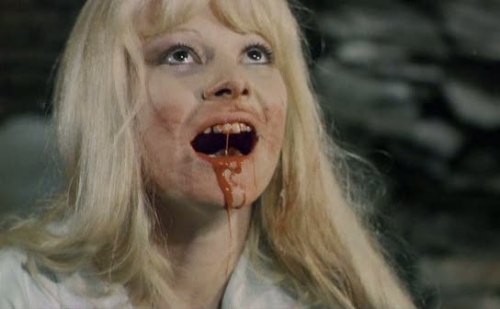
It doesn't look cheap either. I
suspect it was shot on celluloid. It has an atmosphere, like the best films
covered in this series of reviews, where from the first scenes it already sets
up the mood immediately with the look and use of the locations and the space in
them. The bright, vast locations of the day time to the blue lit environments
of the night time scenes. His obsession with sexuality and sensuality is still
there slightly in the vampires' relationship, including the sexual nature of
how vampires bite a victim's neck that has always existed in the mythology, but
barring two moments or so of nudity, this is quite a chaste film more concerned
with friendship, and the bonding of Louise and Henriette, at times like teenage
girls onscreen, other times very wise and adult in their reflections of the
world around them. The film's mind is more on magic and supernatural creatures than
carnality of other films of his I've seen. Probably the biggest reason why
people could be put off Two Orphan
Vampires if they're not prepared for it is because this strips away the
blood and nudity in Rollin's films
and leaves the unconventional plotting, where two vampires get bored of their predicament
and do whatever they desire to escape it, presented not as a conventional three
act narrative. For me it's nice to go through such an abstract, dreamlike film
that paces itself well. The dialogue is all of interest even if its
unconventional at times. It's an interesting take on vampires that doesn't
compromise the mythology while adds new things for its own depiction. The two lead
actresses are very charismatic as their characters, to the point that their
potential ego in believing themselves to be gods is actually sweet natured and understandable
pride in their existence than despairing their "curse". The distinct
age fluctuation in their appearance in fact adds a strange air to the
proceedings which makes their characters more interesting. The directions the
film takes make sense - a world of supernatural beings who are methodical and
languid, none of the hectic tone of, say, the Twilight films, and most horror films, where two vampires can kill
time as best friends for most of the running time. Nothing feels contrived in
the film in what happens, anything odd feeling appropriate for the dreamlike
tone. It feels like spending a week with these characters in their immortal
lives only with a few deaths at their hands taking place, and the danger they
will be discovered and killed themselves adding dramatic tension. It looks
good, and even if the score is dated synth, it feels like it's actually from
the eighties, the depth of that era's music here to and adding to the material.
There is nothing in Two Orphan Vampires
that feels amiss, and that Rollin
made a film completely against what is expected with these genre tropes is
admirable, more so in that he succeeded for me.
 |
| From http://3.bp.blogspot.com/_n35PfUpWyak/TPwPhQPz1ZI/AAAAAAAAZVY/ 1kZLEI5GMPc/s1600/Two%2BOrphan%2BVampires%2B12.JPG |