Showing posts with label Actor: Jean-Louis Trintignant. Show all posts

Tuesday, 10 September 2013

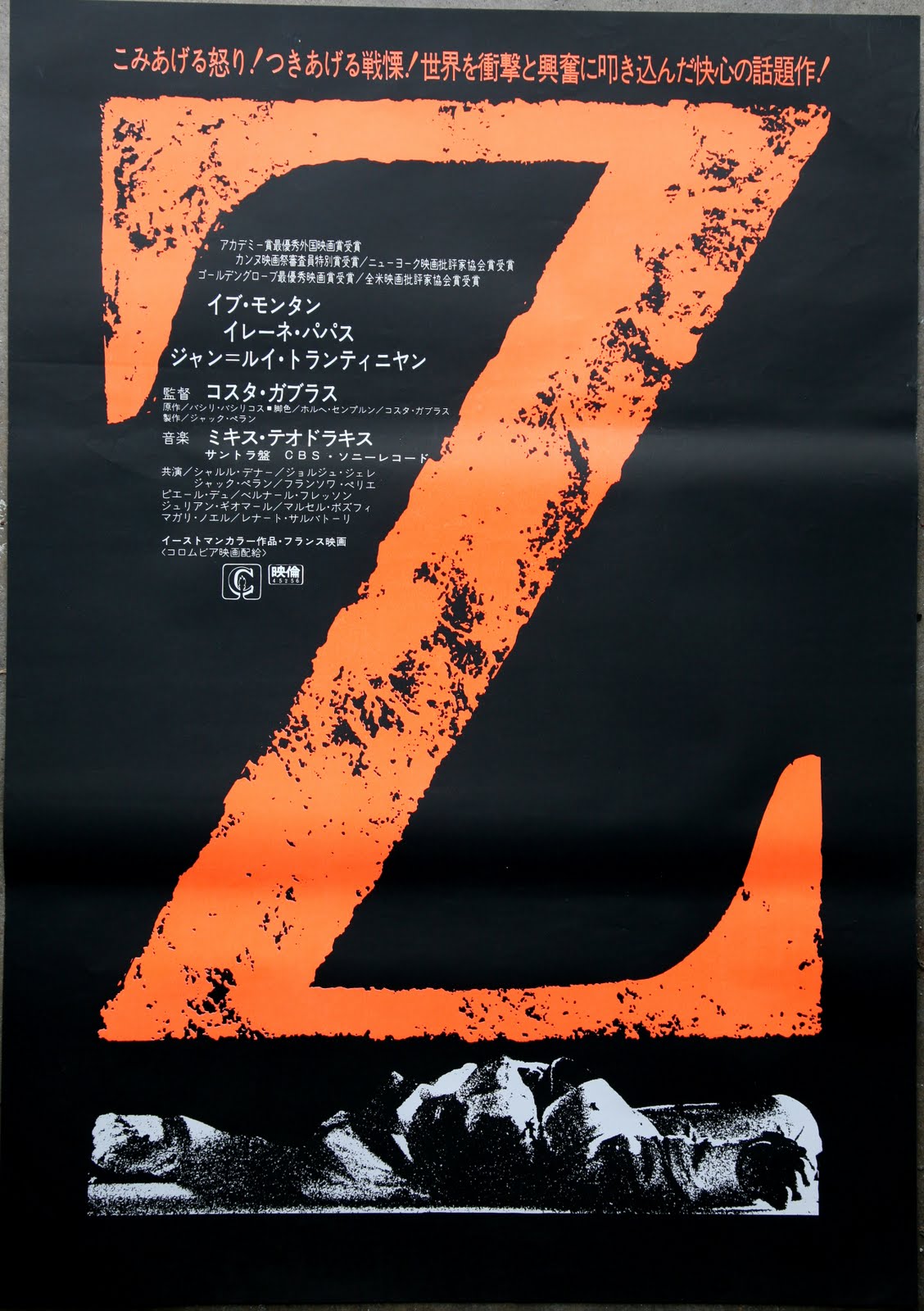
Z Is For...Z (1969)

From https://blogger.googleusercontent.com/img/b/R29vZ2xl/AVvXsEhfZHyaAqEiBaX8i9-JyFsQAp4biTlbELOSjwxb3jbE_6lkcjoizdecJrgLYKbB-IRS3SbLE9i4-iC71MSWpG_5fyXosgB1pJpTRWVRNZj9deyGEtVjX_-QNeM_gdXro_xWO7wk4cM2QaI/s1600/Z-poster-4.jpg

Dir. Costa-Gavras

The final film for this series. Hopefully you, the reader have gotten a lot from this. It has been a long, difficult project to complete; to write about these films required some thought and possibly more consideration than some that I have covered on my blog or Videotape Swapshop. The following choice befits the series, a reminder that this type of cinema also deals with the upfront, actual reality of the world it was made in and made to tackle. Its a reminder, as the film depicts the political turmoil of Greece in the early Sixties through hints, that the ability to have free speech is a tenuous one, that it can easily be lost. Art like the films I've covered could be lost. As much as I joked about this series being an antidote from Hollywood blockbusters at the introduction of the series, there are constant grim reminders that this kind of uncensored thoughts can be suffocated. It is not just war and political strife that can cause this, but also compliance and complicity, not just conservative but also liberal complicity, numbing of culture and a watering down of entertainment and art in favour of the insipid. The lack of courage, the lack of balls to be blunter, the lack of courage to be controversial, to take the easy way out. These films I have covered, even the ones made in the mainstream business of cinema, are not creations of pleasing the widest audience possible. They're not shrieking violets. They haven't been made to tick off checklists. They're not be made to please the troubling mindset of most cinema viewers now that it should be the equivalent of message porn, to make you concerned for the world only for a brief amount of time, like a perverse high from one's guilt, only to be able to push it to the side and not learn from it at all. Even something like The Holy Mountain (1974), embraced by cult audiences, is spiked with a mentality that, in the film, mocks the potential compliance of the supposed radicals, manufactured art, disco-shotguns and all. 

Films I considered rewatching for the series included Angel's Egg (1985), Begotten (1990), Un Chien Andalou (1929), Herostratus (1967), Neon Genesis Evangelion: The End of Evangelion (1997), and On the Silver Globe (1988). I recommend them all to you to see after those that were covered. I may review them all some day too. Films I wished to see for the first time for the series included Dandy Dust (1998), Mind Game (2004), Midori (1992), Pola X (1999) and X: The Man with the X-Ray Eyes (1963). I hope to still see them even if its not now.

Until then, I will be able to take a rest. Coming up in October is the next Halloween series. I will see you all then.


From http://magazine.ufmalmo.se/wp-content/uploads/2013/03/z21.jpg

Monday, 8 April 2013

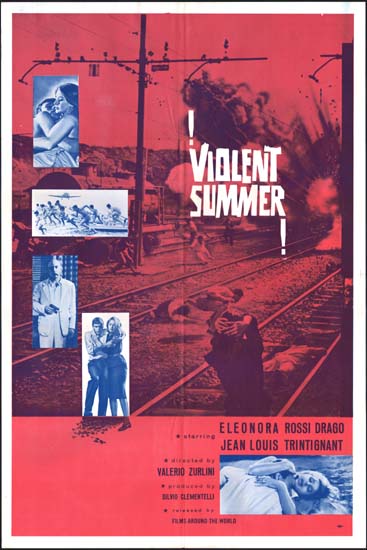
Mini-Review: Violent Summer (1959)

From http://www.movieposterstudio.com/pimg/ViolentSummer_US1.jpg


Dir. Valerio Zurlini
France-Italy

From http://wondersinthedark.files.wordpress.com/2011/03/violent-summer-2.jpg

Melodrama deserves to be reviewed on here as much as horror and action cinema is. To ignore the genres I’ve missed so far would be hypocritical as a film fan who claims to watch “everything”. It is a genre that amplifies real life situations in ways that seem over elaborate, in a reality when these problems are frequent for many people, but they have enough a semblance of real life that draws us to them. Set at the dawn of the end of World War II in Italy, Violent Summer pushes the melodrama into a more contemplative area. A young man (Jean-Louis Trintignant) and an older widow (Eleonora Rossi Drago), who’s lost her husband to the war, develop of a romantic relationship, divided by the hostility it creates from her family and his friends, and the falling apart of Fascist Italy, close to home as the man’s father is a high ranking member of the Fascist party as it is being decimated. It is fascinating to think, at least for two films including The Conformist (1970), that Trintignant has played two characters placed near the end, or aftermath, of Benito Mussolini’s rule of Italy and the end of the Fascist state, both of them – one a noble, charming man stuck in his fate, the other a void, both admitting to wanting to be part of the crowd despite being opposites – liable to encounter each other within the cinematic depiction of this era face-to-face. The use of the historical background clearly shows how the lives of the populous (the characters and their fellow ordinary people) were punctured by the chaos of the war, a fighter plane flying so low at a beach, lost, that it frightens the people on it, showing the lack of boundary between the war front and home.

From http://img1.bdbphotos.com/images/orig/i/3/i316ruepjwwgwwe.jpg

It is an elegantly made film, beautiful in cinematography with one sequence, of fireworks and a night of celebration set to an American song, which stands out as well as pushes a key emotional thrust forward. As a drama, it stands well, Trintignant and Drago making compelling leads, Trintignant’s distinct, handsome face, from another era of masculinity, and Drago’s natural and graceful beauty shining through. The divisive element of the film, which prevents it from being a great work, is whether it is actually satisfactory as a dramatic work by its end or not. As a melodrama with lush orchestra music and scenes of heightened emotion, you have to be able to suspend your disbelief to be emotionally connected to the characters, which applies here still despite the obvious political undertones. The divided and antagonised relationships between the lovers and everyone around them has a sense of the completely believable, the horrible awkwardness when a friend becomes hostile to someone they know having passions for someone they believe they shouldn’t. There is however an issue though to whether certain turns in the characters actions and story shifts, especially in the last scene, feel perfectly considered or too abrupt. That will be up to you to decide if you go and look for Violent Summer for yourself to see. 

From http://www.berkeleyside.com/wp-content/uploads/2013/03/VIOLENT-SUMMER-INTEXT702.jpg

Friday, 5 April 2013

Grilled Fried Proletariat (Death Laid An Egg (1968))

From https://blogger.googleusercontent.com/img/b/R29vZ2xl/AVvXsEhMKENcwmoTfZNYvJ-jk6ZvkZsce_3RyucXlS0XEoZiLzsq3i-NwXirOdrgpuAN5YSh9Xenm1cw9zWpJYXfViY5Ni3GQ3I0N9d6nN__3jJiRCMcJBHuu5aBAUPi_d5ndqgVP6ENrKFm937V/s1600/deathlaidanegg.jpg


Dir. Giulio Questi
France-Italy

From http://cdn103.iofferphoto.com/img/item/158/875/995/JwfxDJRzD6uG53n.jpg

The line between the lurid and avant-garde blurs with Italian genre films. Peter Strickland’s Berberian Sound Studio (2012) showed this, the film, for an improvised double bill, that I watched before Death Laid An Egg for a night’s viewing, a fitting signpost before the discordance of this one. Giulio Questi has an incredibly slight filmography, really only consisting of this, the infamous Django Kill! If You Live...Shoot! (1967) and experimental shorts that he has been making more recently at his own home, all of which I need to get around to. Death Laid An Egg however is a film that I have been wanting to see for years since I first heard about it from Mondo Movie, one of the first (and still one of the best) cult film podcasts in existence. The title sequence of Questi’s film, of chicken eggs being ovulated and chicken foetuses set to an abstract noise score, instantly sets up how confrontational and divisive it will be. Only a few will like it, but it lived up to its reputation for the bizarre fully.

From http://b.vimeocdn.com/ts/422/176/422176842_640.jpg

Death Laid An Egg is not what you would view as a typical giallo, which became more popular during the seventies, more closer to a politically layer story of greed and deceit...that just happens to be set in the poultry industry. Jean-Louis Trintignant, a face for cinema if any on the silver screen, is the husband of a rich woman (Gino Lollobrigida) who owns a chicken farm, a man with a peculiar sexual perversity. His wife Anna becomes suspicious of him while her cousin Gabrielle (the blonde, waif-like beauty Ewa Aulin) may be far less innocent then she acts to be. Eventually the strands connect together by the film’s end, but Questi’s film, edited and co-written by Franco Arcalli, is clearly designed to wrong foot the viewer from the beginning, to unsettle and attack them. I have heard it being compared to Jean-Luc Godard’s Week End (1967), and it is not close to that film in tone, but is just as abrasive. You are kept back from the characters, by their cold personalities or questionable attitudes, and the reality of the film is, a critique capitalist Italy of the time in an absurdist genre movie, is that literally, as some illustrations show, the chickens seen crammed in Anna’s mechanised battery farm are us. The human characters are victims of their vices or trapped in their repetitious lives. The constant clucking and shifting head movements of trapped chickens is no different from Trintignant’s awkward body language as he goes from place to place. That the film goes as far as having mutant chickens – a plot point I will not go any further with to not spoil – emphasises this idea in an intentionally ridiculous way. With the tone of an episode of the British series Brasseye (1997), which had a similar idea as a joke in one episode, the weirdness of this sequence adds to the coldness of the business, willing to break moral boundaries, as well as potentially showing what the people could become if they let themselves stay in their predicaments.

From http://gialloscore.com/img/films/43/grab1.jpg

With a cold, distant look, the film is not accessible, but is striking. Utterly strange, its political message seems more noticeable. The atonal noises of the score by Bruno Maderna, percussion going on its own new rhythms and trying to harm the listener on purpose, chips away at conventionality while the editing breaks time structure so that numerous periods and moments can exist within the same minute of each other. You will be baffled by it, maybe laugh at the mutant chickens, but you realise Death Laid An Egg is a genre film being intentionally strange for impact, its world of industry and the middle class extravagance completely peculiar and off to be trustable or to be populated by anyone vaguely human except the skittish Trintignant trying to understand what is going on around him. It is an art film with a capital A but its pretensions make it the stronger and more a true cult film than if you were expected the usual blood and nudity. It’s something the Surrealist movement would have praised if it wasn’t only made in the Sixties after them.

From http://1.bp.blogspot.com/__ZC6F3SCITU/TQvXSEJzbAI/
AAAAAAAAEW0/H8UAaZnyE6M/s1600/DLE%2BEwa%2B%2526%2BGina%2Bin
%2Bthe%2Bchicken%2Bfactory.bmp