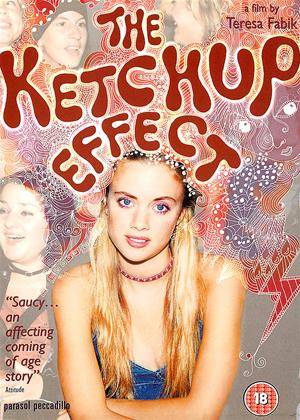
Dir. Teresa Fabik


 Coming up front with the main flaw of The Ketchup
Effect, it's that it never
ventures into braver territory. It's not a "safe" film by any
comparison to what an English language version may have been like. About a
thirteen year old girl Sofie (Amanda
Renberg) whose life spirals downwards when indecent photos of her, while
unconscious at a party, are passed around school, it is a lot more frank in its
depiction of adolescent sexuality and bullying than most films I've seen from
English language countries. In its playful, joyful moments it's just as blunt
and honest. The film had a little controversy in Britain in that, despite
clearly being for an audience the age of Sofie, with an important message to
give to them, it was given an 18 certificate for the image of a prosthetic penis
being exposed and slapped onscreen. One county, Stirling, went against this
ruling, possible to do legally if any non-British readers would like to know,
and gave it a rating that allowed twelve year olds to see it, but it still
shows a discrepancy in the British and Europe that still stick out like a sore
thumb.
The film has a lot to like. Its topic
of how someone can be badly treated by peer pressure needs to be brought up, especially
when it points out that teachers and even parents can so badly screw up and be
on the wrong moral side. In one sequence, if thought about, it presents a
disturbing idea that a woman can be complicit to behaviour that is inherently misogynistic.
The film perfectly depicts how awkward teenagers can be. On a serious
note, this is seen when Sofie's friends, fearing they will become unpopular and
as ostracised as Sofie when she gets mistreated, start to talk about her behind
her back and hang out with another girl. On a lighter note, especially with a
potential love interest for Sofie, this is seen in how difficult it is just to
express one's interests to another person. Scenes show that Renberg as Sofie does the perfect
performance for the role, completely sympathetic and charismatic in the lead.
Everyone playing the younger characters in general do their best, but she
especially stands out.
The
problem is that the film itself is the same as many others. It wraps its
conflict up in a neat package than explore the difficulty, and full triumph,
Sofie would have to have to overcome the situation she is in. It is very
generic in presentation - actor on the left of the screen asks something, cuts
to another actor on the right side replying, rather than have both in the same
frame; music on soundtrack, outside of scenes, to push you along into a certain
feeling than letting you get there yourself. And, as personal and potentially
petty this criticism could be, some of the music and visual choices are so
early 2000s, and don't age well already. Of course having never made a film
myself, there is a danger of writing such criticisms, but I bring up these
issues with films because, realising it with The Ketchup Effect, I've become concerned about the lack of variance
in cinema. In film, literature, any art form, I would be concerned if many
works looked exactly identical to each other, and the style this film
has is shared by countless others, more of a problem in that many of them,
including The Ketchup Effect, may
have been a lot more better if they tried something different in presentation
and narrative. If there was a ninety minute film that needed to be at least ten
or maybe even thirty minutes longer, it's this film. It's perfectly fine how
the film ends, but after the gruelling situation Sofie finds herself in, put
through in the film, its suddenly dealt with it abruptly and feels like she's
been cheated out something really triumphant. Its disappointing as there is
something great about a film that deals with the material it does, but it turns
out to be far less brave than one wishes it would be. It's much more honest in
its presentation than other film would dare to - the coarse language, its
adolescents drinking and using other substances until they go blotto - but it
eventually shies away from being something more tougher but far greater in its
reward. Films can be hesitant to tackle its subject fully even if the content
is not the kind dealt with in mainstream cinema, and unfortunately The Ketchup Effect is such a film.

 Falling in love and marrying, the
wife of a hunter enquires about a ritual to make him fall in love with her even
more, hesitant since he is continually out for long periods to hunt. The ritual
however leads to disastrous consequences of her continually turning into a
white reindeer, which entices hunters to try and catch her, only for her to
turn back with fangs and kill them. As people in her village die, slowly it
leads to tragedy. The film is not that long, brisk in its running time, and
tells this story with immense amount of engagement. The different environment,
of the snow covered Finnish lands, adds a freshness to this film, seeing the country's
traditional culture through this supernatural tragedy and being able to
appreciate it. Erik Blomberg uses the
environment to its full advantage too. The village community is very close
knit, small, where increasing amounts of death from sinister causes would bring
anxiety to them more so, and the vast white landscape is isolating, able to be
lost in it or pulled away from other people to die alone within it.
Falling in love and marrying, the
wife of a hunter enquires about a ritual to make him fall in love with her even
more, hesitant since he is continually out for long periods to hunt. The ritual
however leads to disastrous consequences of her continually turning into a
white reindeer, which entices hunters to try and catch her, only for her to
turn back with fangs and kill them. As people in her village die, slowly it
leads to tragedy. The film is not that long, brisk in its running time, and
tells this story with immense amount of engagement. The different environment,
of the snow covered Finnish lands, adds a freshness to this film, seeing the country's
traditional culture through this supernatural tragedy and being able to
appreciate it. Erik Blomberg uses the
environment to its full advantage too. The village community is very close
knit, small, where increasing amounts of death from sinister causes would bring
anxiety to them more so, and the vast white landscape is isolating, able to be
lost in it or pulled away from other people to die alone within it.