|
| From http://www.mondo-digital.com/prosperities.jpg |
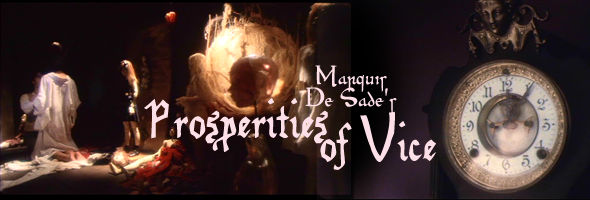
Dir. Akio Jissoji
 The film takes you to late 1920s,
early 1930s Japan. A group of upper class men and women are being served at a
long dining table by topless, submissive female maids, and they recount their
tales of sin and debauchery. One of them, a nobleman calling himself a Marquis,
runs a theatre and sets about adapting the novel Justine by his namesake the Marquis
de Sade using real criminals, murderers and prostitutes as the cast. His
wife, the beautiful Seiran Li, a
former prostitute herself bought by him and playing the titular character,
starts to fall in love with a thief in the lead male role, as the world outside
is drastically changing. Many distinct, eye catching images and sequences take
place, a real murder breaking the illusion of the theatre, but the film is very
subdued and is drawn back in its plotting. There's a lot to still take in that
would need a second viewing if it was possible, and much historical information
needed to get the most from it, but its elusive tone pulls the plot further
from being fully conveyed conventionally.
The film takes you to late 1920s,
early 1930s Japan. A group of upper class men and women are being served at a
long dining table by topless, submissive female maids, and they recount their
tales of sin and debauchery. One of them, a nobleman calling himself a Marquis,
runs a theatre and sets about adapting the novel Justine by his namesake the Marquis
de Sade using real criminals, murderers and prostitutes as the cast. His
wife, the beautiful Seiran Li, a
former prostitute herself bought by him and playing the titular character,
starts to fall in love with a thief in the lead male role, as the world outside
is drastically changing. Many distinct, eye catching images and sequences take
place, a real murder breaking the illusion of the theatre, but the film is very
subdued and is drawn back in its plotting. There's a lot to still take in that
would need a second viewing if it was possible, and much historical information
needed to get the most from it, but its elusive tone pulls the plot further
from being fully conveyed conventionally.  |
| From http://www.shockingimages.com/graphics/reviews/m/mdspov_3.jpg |
It looks like an eighties
Japanese film, a very glossy look that is unique to Japanese cinema compared to
other eighties glossy cinema. Akio
Jissoji's style however completely breaks the images up into uniquely new
ones. This Transient Life (1970),
his debut, had each image and scene play out with continual movement of the
camera or with something important and distinct in each shot. Prosperities of Vice is the same, with
everything from strong camera movements and distinct scene framings to make
every moment count. The film is more fantastical than This Transient Life, of dolls with pulsating open stomachs full of
strawberries, clocks and a small cramp hideaway full of life sized mannequins. The
meaning of the film still needs to be moulded for me but there are clear and
obvious conflicts shown - the end of an era before World War II, the nobles
very much being decadent and Western influenced but still human beings capable
of being phased, the concept of de Sade's
virtues of vice forced to be re-evaluated when a real death takes place, the
real world encroaches on your desires, and someone you control goes against
your wishes by falling in love. The film splits itself in the real and the
abstract. The machinations of real life, seeing actors getting into costumes
and rehearsing, contrasted against the actual theatre stage. The film cuts from
one time period to another, the play reflecting what is happening off the
stage, and when the otherworld is brought up by the end, the theatre becomes an
internal construct of the characters' minds as well.
 |
| From http://2.bp.blogspot.com/_E2uWeSxRO60/TBTzwk9dXqI /AAAAAAAAE4I/otzpIPM4WpI/s400/Akutoku7.jpg |
In terms of sexuality and
debauchery, it's as subdued. Baring a scene of said maids being forced to eat
sea cucumbers, it's as subtle as its tone and far from titillation through
perversity. It's not Salo, or the 120
Days of Sodom (1975) either. It's still a very erotic film, but it conveys
it through image and mood rather than actual sex, only one scene taking place
within the narrative. Unlike other depictions of Sade as well, it's about the ideas being conveyed through words and
thought rather than the whips and chains of, say, Jess Franco's adaptations. Like This Transient Life thought, it matches this with a visual texture
to make everything, the actors' naked bodies to the environments around them,
sensual.
 |
| From http://s3.amazonaws.com/auteurs_production/images/film/marquis-de-sades-prosperities-of-vice/w448/marquis-de-sades-prosperities-of-vice.jpg?1293019649 |
The result is very unconventional
and not the best place to start with less well known Japanese cinema like this.
There is little like this or in the films I've seen of Akio Jissoji though in existence. His work, heavy in subtext and
matching it with a rich visual style, is one I wish was more easily available. The
concepts of de Sade are placed
against reality itself, of political strife and emotional strife, the Marquis
and his friends as isolated in their perversions as the four leaders in Salo... while the world changes
completely for them outside the buildings they are housed in. The virtues and
vices cannot be easily separated as his wife proclaims at one point she is
neither Justine or the good Juliette, instead her own person with her own
thoughts, ideas and her own forms of virtue and perversion. The plan of the
Marquis to bring the joys of vice to people through the play doesn't bear in
mind that the people he is around already act out their own delights, and like
most people, he becomes hostile to it. Despite the heavy subtext this and This Transient Life have, they are all
about where people place themselves when they are separated from perceived
texts and concepts and have to think about their own existence. Like the
Japanese cinema and culture I have been able to view so far, it is very much an
existentialism that goes as far as the soul and doesn't shy away from the
perverted and vulgar in answering the questions, nor mixing it into vulgar
genres like pinku films. Nikkatsu,
who produced the film, abandoned the roman porno movies that kept them afloat
by the time this was made. Those films are still there for me to view, but
before I do so, its befitting before seeing very sexual and erotic films that I
have seen the one which breaks the ideas of sexuality and perverse delights
down and scrutinises them.
 |
| From http://www.1kult.com/wp-content/uploads/110615_marquisdesadeprosperitiesofvicephoto02-605x340.jpg |