Showing posts with label Genre: Fantasy. Show all posts

Monday, 17 March 2014

Videotape Swapshop Review: A Chinese Ghost Story (1987)

From http://mutantville.com/blog/wp-content/uploads/2012/01/A-Chinese-Ghost-Story-1987.jpg

Dir. Siu-Tung Ching

I've probably been watching too many trashier martial arts movies throughout the last through months. I adore their questionable dubs and erratic tones, but its good to watch one which is crafted exceptionally. Seeing this film again, you can see how much the Hong Kong cinema of the eighties was liable to catch the eye of Western viewers like me. Its also good to go back to this film when the first Siu-Tung film I covered on here was Belly of the Beast (2003) with Steven Seagal. This is not a cheap shot at Seagal, but reading the review below, or actually seeing A Chinese Ghost Story, you can see why I say this.

Review Link - http://www.videotapeswapshop.co.uk/19608/a-chinese-ghost-story-1987-director-ching-siu-tung/

From http://img.photobucket.com/albums/v394/Manos99/GHOST_STORY1-1.jpg

Saturday, 28 December 2013

A Videotape Swapshop Christmas #2: Santa Claus (1959)

From http://vciclassicfilms.files.wordpress.com/2011/11/poster-santaclausmurrayversion3.jpg

Dir. René Cardona

Christmas is slowly drawing to an end for this year. Someone reading this blog post has probably eaten their own weight in chocolate. Maybe two. To close it off, its befitting to choose a film that has been dismissed as garbage, but to my delight, actually has more enjoyable qualities than other Christmas films I've seen. Its better than the one with Dudley Moore at least.


From http://cdn.mos.totalfilm.com/images/s/santa-claus-1959-.jpg

Sunday, 20 October 2013

Representing Russia: Faust (2011)

From https://blogger.googleusercontent.com/img/b/R29vZ2xl/AVvXsEiN-0OtsMQEBcNHRzyHGNA3SWcCQxNEaesRc2xYLXWnYhCV8u4eOcltA2VUcGdCFDIUw2qnpmsmQKauwSbb94CyhzV64K9pfHja4mCkqTqH3-CVh7h0qZaypYlFUNJ49Z_cnnhQ6Dp0R7Y/s1600/faust-2011.jpg

Dir. Aleksandr Sokurov

Even for those who only know of the Faust story though the idea of it, a man who signs away his soul to the Devil, Sokurov's take on it, the final piece of the legendary director's tetralogy of films that concentrated on three real world figures (Hitler, Lenin and Hirohito) beforehand, is a bizarre, legitimately bonkers film which is yet an intellect crafted work about the placement of wisdom and trying to find meaning in existence that may have no God. The connection to those first three works immediately brings about issues - having seen two of the three, it's clear that the issue of power compounded against the ordinary, contradictory behaviour of human being is shared, with this story being the proto-diagram of the real life individuals. It still has to be digested how the Faust story, where the titular character (Johannes Zeiler) needs money and finds himself pulled into a series of strange events with a demonic moneylender (Anton Adasinsky), is turned into this mass of ideas from existential musings to full-on body horror played as a joke at points as well as being gross. It is almost, if not, a perverse buddy film where Faust is less of a friend of the moneylender than dragged behind him in a series of squabbles, pulled into his hands finally when a youthful beauty Margarete (Isolda Dychauk) becomes an obsession for Faust. But the moneylender, as the Devil exists less as an evil being here than a bulbous imp, a literal mass of fat flesh when you see him completely naked at one stage, acts in all his dealings with Faust as if it's a normal transaction or deal, or as a comedic buffoon who wrecks havoc with anything he touches.

From https://blogger.googleusercontent.com/img/b/R29vZ2xl/AVvXsEh5kLSl25j-QYFv8er0SBVyipeaVBZlL48Tlg8QEGDuHdvo77N_9bJXgEGLRHZOo3k8hqh9se6v8vehvm3o1Z4np5PQO7wCrbIzGHnj52aGViHsd-7iSrG3sqCBOsDR6taAhulXwydLKOBc/s1600/shot0013.png

Sokurov's film is dense. Long at two hours twenty minutes. A vast, distinct world of German origin,  interpreted through Russian production, depicted onscreen with a heavy, symbolic tone. But its dense not because it's a grand scale morality drama - F.W. Murnau did this with his silent adaptation in the twenties - but because for such a critically lauded auteur, as I slowly get into his work tiny piece by piece, Sokurov has such a peculiar film here in the final results. Grotesque definitely, the first interior image of the film a giant close-up of the penis of a male being cut open by Faust for research and long passed his mortal coil. That doesn't even begin to explain what the moneyleader actually looks like naked, or when Faust's assistant Wagner (Georg Friedrich) brings out a project he claims to be his to impress Margarete, suddenly evoking Frank Henenlotter in the middle of a serious, austere film. An austere Russian film which yet clearly plays for laughs the moneylender entering a church to empty his bowls blasphemously after drinking the hemlock solution Faust wanted to end his own life with. What Faust as a film means, there's a very obvious idea that, stripping the pretence, the titular protagonist here is no longer the Faust of Murnau who wanted to help people, but wants money, later wants a young, baby faced woman just for a night at least, having to deal with her mother's clear hatred of his presence, but despite coming off as a detestable man, eventually shows the human being who was a professor of great acclaim who finally gets his desire for knowledge back even if it's too late to save himself. The Sun (2005) and Moloch (1999), the two films of the tetralogy I've seen, made frank comments that the characters, Hirohito and Hitler respectively, were human beings, especially with the later despite his disgusting crimes against humanity. The later film needs a re-watching for me, but it at times was comedic, Hitler apathetic and only kept awake in life by his love Eva Braun, his minions like Joseph Goebbels bitchy and whiny, making Quentin Tarantino's Inglourious Basterds (2009) not that different to Sokurov's film in the mindset of depicting the real life individuals. The Sun, which had actual comedic scenes too, while not showing the atrocities Japan and America did in World War II, showed a man believed to be the human incarnation of God for the nation of Japan as a human being, wanting to know and learn of the world too in his interests, forced to show his nation he was only of mortal flesh. Faust had the potential to be a great person, but has yet signed his soul away by the end of this film for the mere ability to have sex which he later regrets, the most obvious of metaphors but perfect for being the central pieces of the other three films before it in this series. As the moneylender points out, a Devil who yet has moments where he is wiser than anyone else, if Faust cannot help heal people, considering he has medical knowledge, or console them, he is useless.

From http://lincolncen.3cdn.net/9e2f1d0fe667d09fc5_ccm6b3jid.png

The film is presented as something very different from most fantasy and art films. Alongside the many mentioned moments in the review, and ones unmentioned, the film presents itself in a very unconventional form. Murky while also visually splendorous, moments in the film are shown through a distorted, tilted camera lens, fitting something that is both sincere in its prestige seriousness but also close to wading through literal faecal matter with its fart jokes, pulsating flesh and extreme distortions of human body parts like genitals. Like Moloch and The Sun, the serious subject is nonetheless counterbalanced with a far more expansive view of humanity which can be bizarre and downright vulgar. Faust is extremer in tone and content than those films, but even with something like Russian Ark (2002), Sokurov combined very difficult content to digest with seemingly out-of-absurdities and humour that yet fits the material and deepens it. Faust is definitely a difficult film, at its length an immense amount to soak in, but it succeeds immensely. As much a very potent take on finding meaning in life through the "comedic" hijinks of Faust and the moneylender as they visit place to place bickering about each other's beliefs. Its swerve to the danger of desiring power, through Faust's gamble for love, shows that even in the simplest wishes, as Sokurov's depictions of Hitler etc. showed too, people can damn their souls through their moral failures. It's a weird film, a gruesome film, abstract when it ends, using Icelandic shooting locations, nearing Max Ernst's landscapes, but as a whole Faust manages to make all of itself work.

From https://blogger.googleusercontent.com/img/b/R29vZ2xl/AVvXsEiJLmxfK-QAg7m5RYewfdHvdBRoGtlx1XVxa__2k9dBKUhpxyaDj1yEI1Scw0GWpB_4kxVYUOlAFa9Y3IGbLXhs4whpn5vro7nPVNo6mYP3B1PFVSbonO80z-2FrIZ_ohgL1zt01uJ9cCE/s1600/Screen+Shot+2013-05-10+at+5.16.03+PM.png

Tuesday, 15 October 2013

(Unfortunately) Representing the Philippines: The Killing of Satan (1983)

From http://3.bp.blogspot.com/_BK-6fWMP6m4/S99R0GSdOOI/AAAAAAAAAIM/AOHAy7RDSyk/s1600/KILLINGOFSATAN-1.JPG

Dir. Efren C. Piñon

The Killing of Satan is awful. A candidate for one of the worst films for this year's series. I confess last year I controlled the choices for films to write about more strictly, hesistating to have to write negative reviews but going by nationality now I've decided to loosen it, and sadly for the Philippines, this was a poor film to represent them. A father of two, although his son is killed in opening establishing scenes and is never mentioned again, is called to replace his uncle in an isolated rural community. When his daughter is kidnapped by human mercenaries for Satan himself, wanting to make her his virginal bride, and his wife is harmed, he goes after them to rescue his surviving child, quickly discovering his capabilities for supernatural powers to help him in a war between literal good and evil. It's cheap, tacky, the version I saw had the type of English dub you get on these sorts of films which underwhelm your expectations further, and it's something like this which is a stronger candidate for the worst of cinema than Plan 9 From Outer Space (1959).

From https://blogger.googleusercontent.com/img/b/R29vZ2xl/AVvXsEgWrylCWrvlQcNWKBnH1dXPugJtt6bBQXuAVSwRkLLHltyiGDWo3_wj3yp4QGXTU9t8ARbE41g7ZRs5QZPWh9bzPSYV1ztD-NuQKIJ4kzwamqu0OzLGzc753nq4XBgixQa0oc2OKOB0W-RB/s1600/killingofsatan3.jpg

It's supposed to be a Christian battle of good and evil, with appropriate religious symbolism, but paradoxically it plays up to lurid content. The rudimentary gore is surprisingly violent and effects heavy, a poor man's Riki-Oh: The Story of Ricky (1991), and there's a magical cage of completely naked, brainwashed women which completely jars against the film having a religious message. It's an erratic film in presentation, and frankly despite the presence of things I've just mentioned, they have little effect on you when the movie in its whole is completely dull to sit through. It's also the poor man's z-movie, far worse than well known examples I've seen, on a completely different plane, in how horrifically sluggish it is. It's strange moments - snake fighting, a dog attack involving one poor man being tackled to the ground in a living room by a real canine with its jaw around his arm - are really not that rewarding for the slog you're putting yourself through watching the whole film. To enjoy this, The Killing of Satan can only have merit if you give up on any entertainment value, beyond laughing at how bad it is, a perverse mindset to end up in anyway, and not doing this will make it hell to sit through. No amount of ridiculous, added-onto-frames magical/psychic power effects can prevent this film from being atrocious even on the scale of z-movies. It's something that's only rewarding, if there's another way to find entertainment in it, if you watch the potentially funny clips, separate from the film, on YouTube. That is not a good place for any film to be in, as it effectively means that it has been scrapped and recycled into clips while the rest is eliminated from the minds of viewers.

Randy Savage would be proud of that elbow power
(From http://4.bp.blogspot.com/-wjtoZ_1jtxs/T423kxLZIYI/AAAAAAAAAYc/RRPJ7V5suTQ/s1600/killing%2Bof%2Bsatan-lando%2Bmagic%2Bdefense.jpg)

It's also a caution against the notion of any bad film being instantly enjoyable. Even if your soul has died and there is no such thing as a bad film to you now, you still would have a strict idea of what entertaining is, where the highest and lowest of cinema only is what interests you. The Killing of Satan is just boring, not rememberable at all. Even if it has ridiculous moments, and an impressive chest explosion, its only merit is if you watch the segments by themselves only, and never watch the whole film, because the journey of the hero against the forces of the Devil is completely worthless. Truly bad cinema is not rememberable. If you try to enjoy every "bad film", you are gullible to embrace something legitimately awful like The Killing of Satan; I have seen so much better for this kind of perverse kick of watching ramshackle movies, and this one provides me with nothing baring this review. 

From http://nekonekomovielitterbox.files.wordpress.com/2008/07/kos-052.jpg

Friday, 6 September 2013

U Is For...Underwater Love (2011)

From https://blogger.googleusercontent.com/img/b/R29vZ2xl/AVvXsEjgGOBQe-cOqUkxT1FKOnFtiAz8RrTMTqkXW8tHtELj7_3ExQ1K1xVZABPK5Km-8nTFkdBEfqbaA7lcIO7lbXqt80Y31wmN-KP1cKramnsTwdwOPYw2jc7vf-3tOBQ3SEaXqgD53u60Q5U/s1600/Undlo.jpg

Dir. Shinji Imaoka

Something a little pink, a little tasty, and fun. Erotica is worth covering and worth viewing in general, but its good to see one that was just fun and light. Admittedly its release in the UK from Third Window Pictures was a limited release of a certain amount of copies, but I'm grateful for it and the bonus soundtrack CD of Stereo Total's score in the same case. It will be interesting to see where this area of Japanese genre cinema goes when I dig deeper into it. Some of it I am hesitant about viewing. Some it will hopefully be great. Some of it will be incredibly well made and good looking. But I will gladly look into more of Shinji Imaoka's work at least.


Review Link - http://www.videotapeswapshop.co.uk/15609/u-is-for-underwater-love-%E2%80%93-2011-director-shinji-imaoka/

From http://fantasiafestival.com/transfert/2011films/Underwater%20Love%201.jpg

Thursday, 29 August 2013

O Is For...Orpheus (1950)

From http://images.moviepostershop.com/orphee-movie-poster-1949-1020143787.jpg
Dir. Jean Cocteau

Another classic film covered for this series. In digging through the canonised films for this topic, I've realised how a lot of them do stay distinct and legitimately subversive still all these decades. Orpheus is a dreamlike fantasy, but it still feels completely unique all these years later. It proves how talented Jean Cocteau was.


From http://24.media.tumblr.com/tumblr_mebpqo5S6D1rib0hxo1_400.jpg

Monday, 19 August 2013

A New [Linguistic] Adventure: Chompa Toung (1974)

From http://3.bp.blogspot.com/-53BOqh7KR2I/UCmscw1NGbI/
AAAAAAAAHFc/Ytov09xjLc8/s1600/CHT01.jpg
Dir. Lim Buh Lun [Or] Dy Saveth

Maybe I should have actually read the blog review that first introduced me to this film and the closest to a full version to view it. The blog, Die Danger Die Die Kill, is a recent discovery of mine, and now thanks to it my scale for world cinema has drastically increased more than before. So many films you'd probably be only able to find online in terrible rips. Ones that may perish forever one day because no one cares about anything without prestige even if they  could say a lot about a country as much as the art house films do. I want to see as many of them as I can before they do perish or if the interweb gets crabby about people uploading said films. But I should have read that he had to view a un-subtitled version to actually see it, and that it is ninety percent dialogue. The result of this is what would happen if someone who is monolinguist, me only able speak English in my cretinous mindset, trying to watch a dialogue heavy drama, with some fantastical elements, without any real idea what was going on except facial expressions and intonation. And this is the first film I've seen from Cambodia, introducing me to their culture and their language for the first time cinematically. I can register Japanese from all the films and animation I've seen. I'm able to distinguish German thanks to the East German dialects of the band Rammstein. But hearing Cambodian and how it sounds meant I had to adapt to it for the first time. Without subtitles it actually made the sense of listening to the language, rather than reading text at the bottom of the screen, and still watching the images above, more significant. I confess I blanked through many parts of the film, but it was quite an enlightening experience I should do more often. The results of having no subtitles is twofold. The first is that facial expressions became something I had to pay dividends to more so than usual, realising how far too dependable I am as a Western viewer to subtitles at times with my film viewing to explain everything. Even if I didn't get a lot of what the film was about, I no longer neglected the importance of facial expression in communication, even when it got very hammy even without the subtitles. Secondly, the language becomes a series of aural rhythms by itself, able to appreciate the sounds of the language and speech for once, backed up by a score that ping-ponged from traditional instruments to funk, psychedelic wah-wah guitar.

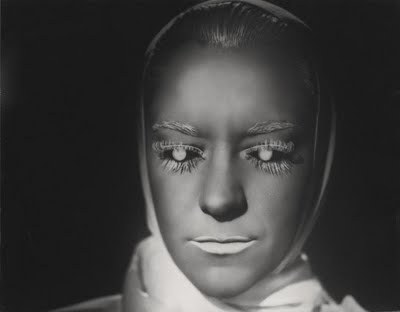
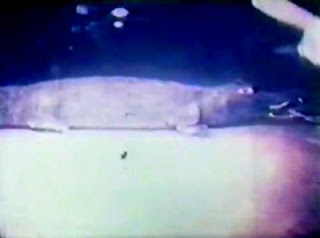
What I can gather, in terms of information on the plot, is that it's based on a Cambodian folk tale. A princess, Chompa Toung, played by Dy Saveth who may have been the director too explaining the confusion in the credit at the beginning of the review, is introduced. When she laughs, flower petals literally flow from out of her mouth. She is given a crocodile's egg as a gift, but when it's an adult the beast becomes a man-eater who ends up being let loose and attacks people in the village her family presides over. Taking the blame, she sacrifices herself to the crocodile, but a heavenly being literally stood on top of the clouds intervenes and saves her, his magic depicted as lines actually scratched into the celluloid itself. This is where the whole folk tale, having read it after viewing the film, ends, but the adaptation goes further.  It becomes much more difficult to follow but things can be established. With a pet kitten turning into a woman to be her aide, Toung ventures out into the world after being saved, finding a new place to be her home when the two are caught by a stream by a giant. Possibly a supernatural king, or just a regular one connected with the giant, rules the new home, and she now possesses a new place of luxury to live life in. A prince takes interest in her, siring a superhumanly strong son, but in I how I interpret what happens, a group of young women, four exactly, take immense displeasure in this relationship, and with some outsider help, cloud his mind and push Chompa Toung out of the way. With a bumbling potential lover from her old home, and a lot of scenes of people kowtowing in royal halls, and moments where the kings have contemplative or scrunched up faces like the famous statue of the Thinker, this mess is somehow resolved.

From https://blogger.googleusercontent.com/img/b/R29vZ2xl/AVvXsEj4WjQPGTg1VQd93GAdYzdD6H2GtkvNuZ0uxq7frraWftUwTE8642KUKfsJbnE_s2XzPD-U4eBF2l0UPR83hejXKlxv8uE10QmRAqbJbdW50MiIbEUackWC9SlBrzM2rlOJKBhrMujO4Qw/s320/CHT05.jpg

There is a strong possibility that the lack of subtitles actually makes this of any reward rather than the actual story. It could still be entertaining if I understood it all, but with the closest thing comparable to it being a melodrama crossed with fantasy, it has a lot of dialogue but not necessary any melodramatics or drama just from the visual content. It's not visually splendid either even considering the rough looking version I saw. Almost all the film for that ninety percent of time is actually people sat in lavish rooms talking. Sitting in front of important people, kowtowing, talking more, maybe offering a gift or an accusation, more kowtowing, rinse wash and repeat. Its great education for how to behave in front of Cambodian mythological royalty, but my lack of knowledge of the language scuppers me from trying to grasp the narrative after the first part based on the folk tale. There is as much a possibility that it's a terrible film for a native Cambodian film fan, believing dialogue is of importance but forgetting it needs to be cinematic and compelling. Without the language barrier, what could be a dull mess, although not a lot of people could watch any film in another language then theirs without subtitles, actually becomes engaging by being completely lost in it and having to notice how the actors speak. At points it's a fantasy film too, supernatural in the way I thought the whole film would be going into it. Honestly, a fantasy film which was continually set pieces after set pieces, with what practical effects were available to the production, can travel onto YouTube to many other countries without subtitles. It's not a case of it being a bad or a good film, or an insulting trivialisation of a country through its low budget genre filmmaking, but in preferable the best case examples, a sincere enjoyment in seeing a country rarely talked about in terms of cinema trying its hand at these existing genres and melding their own traditions and ideas to them. Viewing your cousins from the other side of the world and how they'd tackle anything from a fantasy melodrama like this or reinterpreting Star Wars. The deity in the clouds is a male actor superimposed on top of clouds. The giant is another male actor who, thanks to superimposition, is made gigantic compared to everyone else. A jump cut turns a cat into a human woman. The crocodile is a very fake one on the water, or is part of the many pieces of footage clearly borrowed from nature documentaries, dark blue on the battered and buggered VHS rip I viewed, spliced into the film. There was even an accidental effect in the version I viewed which actually added to it, an accident in the transfer of the film on tape where it blurs and, breaking the fourth wall, you see the literal celluloid film at a distance you are watching, adding to the off kilter tone.   

Whether one could find a lot truly entertaining or not is up to debate. But I must confess that, in an age where there are still so many films unavailable, and many without people to subtitle them yet, I've become more braver in trying to watch films which I have no understanding of the language at all. Chompa Toung was an extreme because most of it was just dialogue, but that made it an unique experience in its own right. I would be grateful as well to see a subtitled version too even if its the same jiggered looking version I've already seen. Its best for you the reader to try viewing it yourself. I will post the review from the blog Die Danger Die Die Kill here - http://diedangerdiediekill.blogspot.co.uk/2012/08/chompa-toung-cambodia-1974.html .

There is a link within it to the version of the film I viewed. After that it's up to your own opinion.

From https://blogger.googleusercontent.com/img/b/R29vZ2xl/AVvXsEi3qePwFcZzHDBZpOUyANqfPJfTilF3ddX7XC4Bm5ybsIQHEYEzLWOyrDm3fkQ_Wec50EvgilDPW7szcU-BTWLdMl9-uYPqjKfCceys9EeRoXVDSN0NcUI4szvytS6RJsFRF53DiNLjsZg/s320/CHT02.jpg

Saturday, 17 August 2013

H Is For... The Holy Mountain (1973)

From http://professormortis.files.wordpress.com/2012/03/holymountain.jpg

Dir. Alejandro Jodorowsky

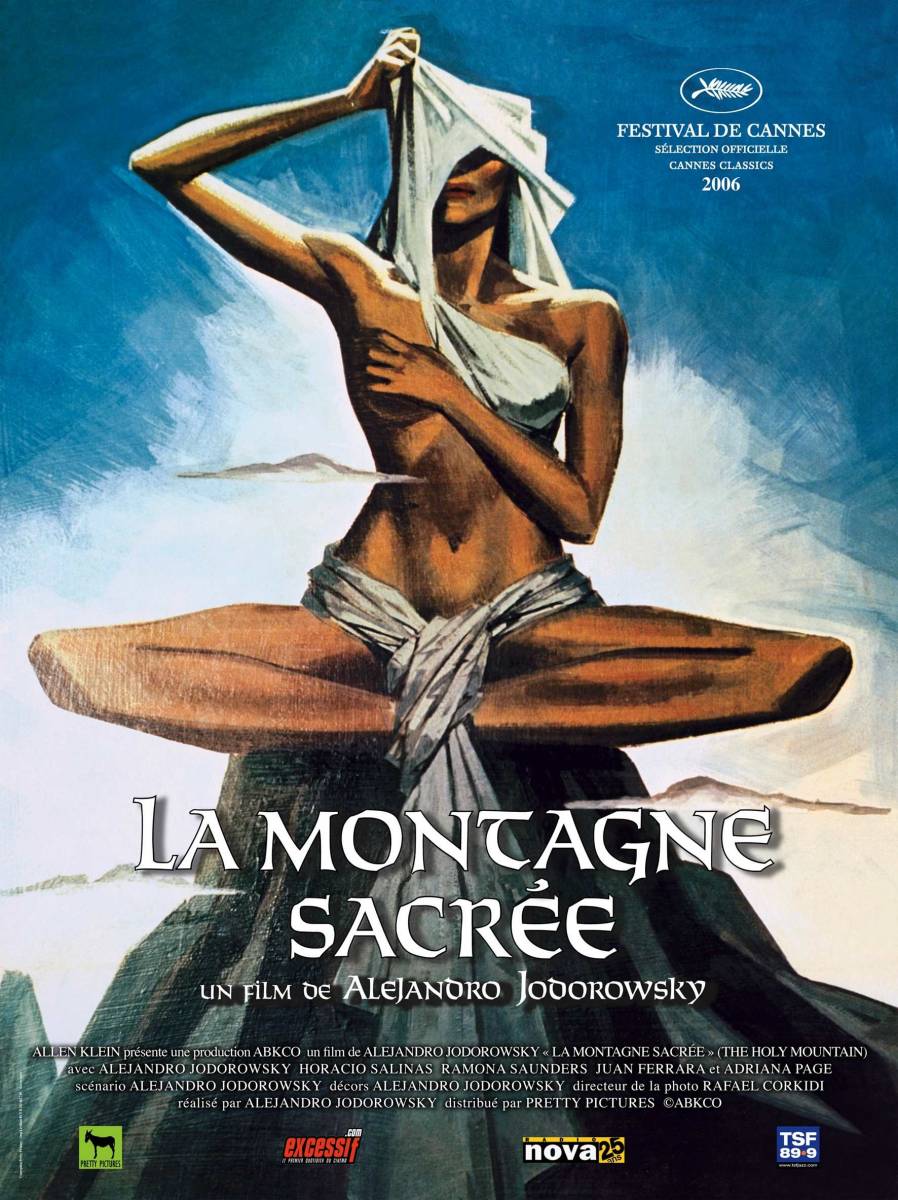
That Jodorowsky hasn't made that many films is both surprising and not. The former because he is the sort of person who could have channeled his ideas into countless films. The later because he's style of filmmaking would not be acceptable to a producer not wanting the director to take any of the risks or to make a film as far out as this. Tusk (1980), which I want to track down as a die hard fan of his, is said to be what happened when he was straightjacketed from making his own vision. A miserable failure. Thankfully this year, as a much older and wiser man, if his reflections on these older films are to go by, his newest one The Dance of Reality (2013) got a premiere at Cannes with very warm reception. I can only hope it does get released in Britain , preferably within the year but just to see it would be great.


As for his other films? After this review, don't be surprised if I try to tackle the others at some point.

Review Link - http://www.videotapeswapshop.co.uk/15056/h-is-for-the-holy-mountain-1973-director-alejandro-jodorowsky/

From http://schlockfootage.files.wordpress.com/2010/07/holy-mountain-la-montana-sagrada-0.jpg

Tuesday, 6 August 2013

B Is For... Black Moon (1975)

From http://24.media.tumblr.com/1b587ff0ad3f70034cd3b0fb590011d2
/tumblr_mpxzn6GahT1sn6jxco2_1280.jpg

Dir. Louis Malle

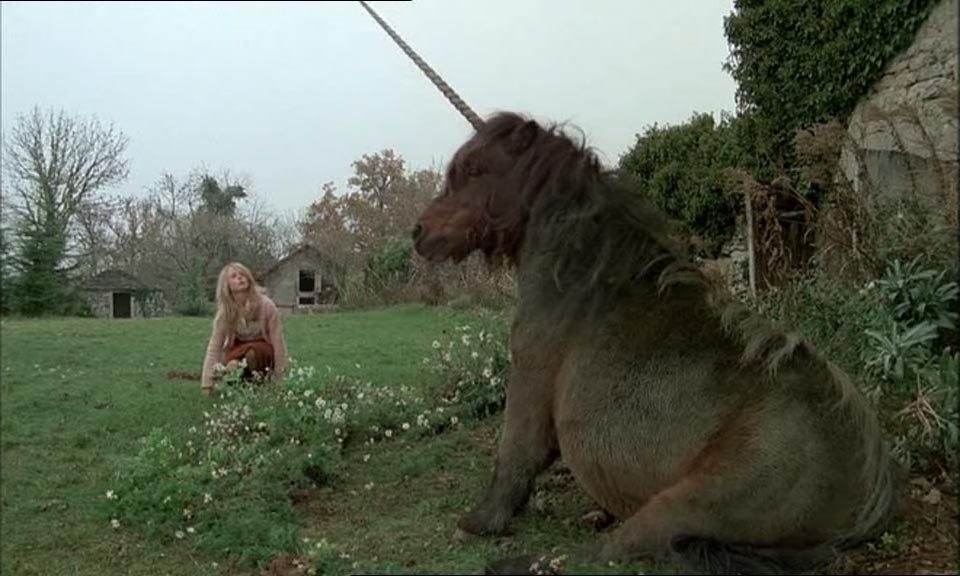
When I watched the whole of a Louis Malle boxset, it because obvious Black Moon was drastically different from any of his other films within it. It still feels like the other four films in that set, which does give a sense of a director who was able, for a movie or two, to shift style and still create something that fitting his filmography perfectly. It also feels like a Freudian romp through Alice In Wonderland with a Andy Warhol/Paulo Morrissey star and a shabby unicorn along for the trip, which is great too.

The only film of Malle's said to be close to this is Zazie dans le Metro (1960), which will be an interesting viewing experience.


Link - http://www.videotapeswapshop.co.uk/15585/b-is-for-black-moon-%E2%80%93-1975-director-louis-malle/

Sunday, 30 June 2013

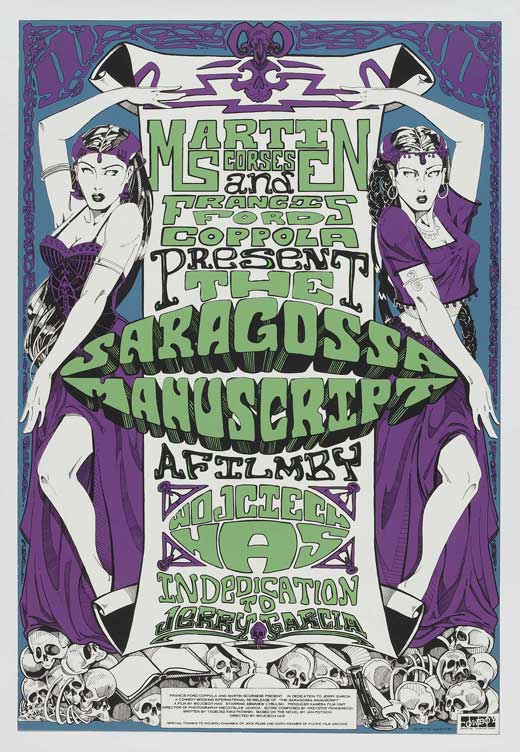
Wrapping Around Upon Itself By Its Tongue: The Saragossa Manuscript (1965)

From http://images.moviepostershop.com/the-saragossa-manuscript-movie-poster-1965-1020703017.jpg

We are like blind men lost in the streets of a big city.

Dir. Wojciech Has
Poland

From http://verdoux.files.wordpress.com/2011/05/the-sargossa-manuscript-still.jpg

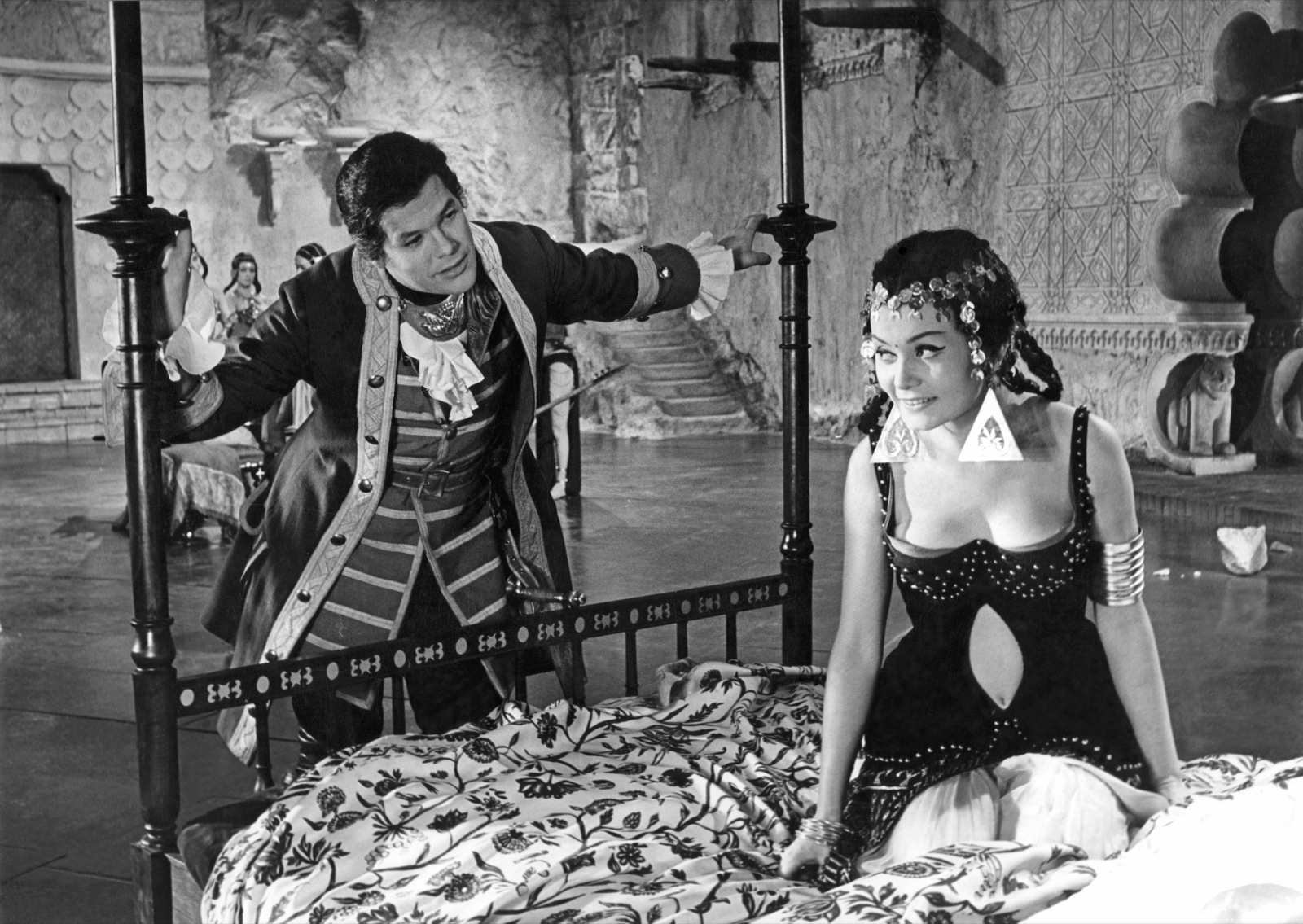
Storytelling itself is inherently beautiful even if the story being told has no end. My younger self, admittedly only five or so years ago but a vast jump to now, didn’t understand this and only got a lot from films which explained everything about themselves. With exceptions that would eventually chop away at this mentality, most films that rejected or subverted narrative fully were pretentious and dull in my eyes. I found The Saragossa Manuscript to be boring, and as the dinglebat I was, got rid of the DVD version I viewed. Like the ghosts that haunt Alfonse Van Worden (Zbigniew Cybulski), an officer for the Walloon guard who travels to Spain and finds himself unable to escape from a continuing loop, all the films (so far) I once dismissed are creeping out the grave I put them in as some of the films I praised the most turn rotten and feel pedestrian and lacking. The discarded films prove to be more potent now I realised the virtues of dreaming, plotting structure by itself and throwing yourself into something without any idea what is exactly going on. Films like American Beauty (1999) are vacuous and insignificant while The Saragossa Manuscript, seen again finally after all these years, runs rings around it in content and presentation.

From http://www.dvdbeaver.com/film/DVDReviews11/Saragossa%20Manuscript/Saragossa
%20Manuscript%20dvd%20reviewPDVD_007001.jpg

The film is a celebration of storytelling, starting off with a framing beginning of the protagonist’s future ancestor, and the members of the opposing army he’s fighting about to capture him, becoming transfixed with the titular manuscript, a beautiful, giant tone (presumed to be) written by Van Worden and with evocative illustrations. It goes into the tale of Van Worden, unable to leave an inn and the area around it, stuck in a labyrinth that circles back onto its beginning point, whether it is two Tunisian princesses who want to marry him or the Inquisition after his hide who drag him back to the starting point. He becomes a minor figure in his own tale as everyone else speaks of their lives. The film becomes a story-within-a story-within-a story as it juggles these characters’ tales of cuckooed husbands, demonic possession, pranksterish attempts to marry two people and duelling injuries with figures of the film interweaving and entering others’ stories. The film even becomes a story-within-a story-within-a story-within-a story-within a story, topping the one moment joke of Detention (2011), a film I covered on this blog, by making this an extended, multi-layered tales within tales narrative that humorously admits to the absurdity of this structure at one point. Like dreams-within-dreams-within-dreams, pockets open up in the film’s existence which develops pockets of their own.

From http://deeperintomovies.net/journal/image10/saragossa6.jpg

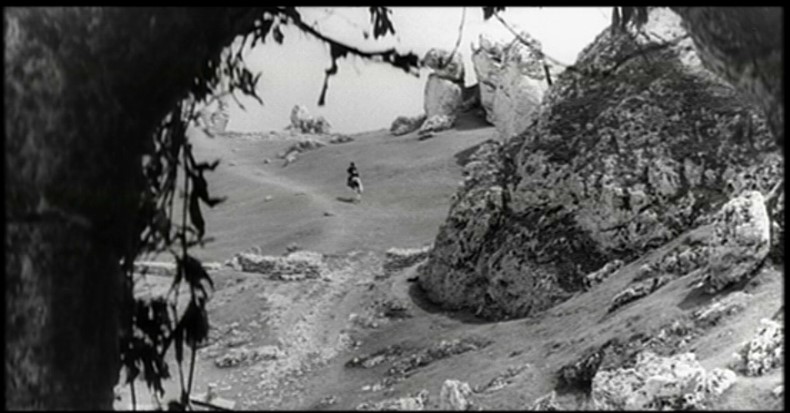
The film is elaborate in tone, with clear nods to Surrealist art but also with a dense visual look of extensive sets and moving camera shots. From a source material that, from what I’ve looked into, is even more dense and full of more pockets in its obsession with tangents – a book I’m adding to my To-Read list at the top now – this layered and vast film manages to breeze past despite being three hours long, but the sense of joy to it all is fully felt and intoxicating. Despite its obsession with death – piles of skulls, hanged men, fencing duel deaths, rotting flesh and demons – it’s on the side of the macabre that is playful. The score by Krzysztof Penderecki, electronic noises and layered demonic yabberings over the Napoleonic Era setting, is anachronistic but adds to the unearthly nature of what’s onscreen. As the film progresses, it’s clear Van Worden will never reach his destination, permanently in this loop that, unless he is only dreaming it, will continue timelessly. Far from a bleak end, it suggests the sense of the Ouroboros, the snake that eats its own tale and keeps existing, that reality has always repeated itself, and in a place of these stories-within-stories, of gypsies, princesses, pranksters and merchants, Van Worden at least is somewhere which is vivid in its life and populous despite the insanity that he may end up in. The story could have gone for six hours, spiralling into further tangents and areas, and felt succinct with its long length making sense to the material. Van Worden is a figure in the middle of a storyteller going through their tale, the onlooker as it continues as long as the narrator can muster it. This richness vastly outmatches other films I once praised for their lack of this depth, like films like it I unfair have given premature burials of. Such a controlled stream-of-consciousness, The Saragossa Manuscript is a welcomed self discovery for me. If my reviews of films like this dangerous veer towards being identical in their praises of the work, it is only because they end up intertwining together in one form showing how movies can be both entertainment but open up one’s perception of their creation and form. If there’s a virtue to my dismissive attitude I once had, it means that now I’m rewatching these films with a new perception it feels like each one is a first time viewing with new eyes. The revenge of The Saragossa Manuscript on me for wanting to fall asleep in the middle of it once was justified but was good for me too.

From http://deeperintomovies.net/journal/image10/saragossa2.jpg

Wednesday, 10 April 2013

The Nazarene Cross and the Wolf (1975)


Dir. Leonardo Favio
Argentina

From http://s3.amazonaws.com/auteurs_production/images/film/the-nazarene-cross-and-the-wolf/w448/the-nazarene-cross-and-the-wolf.jpg

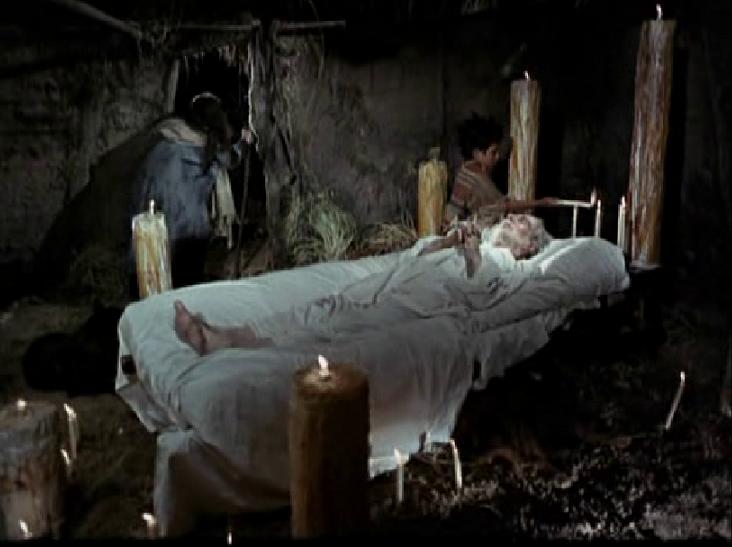
Based on folklore, The Nazarene Cross and the Wolf tells the story of the seventh son, the last surviving son, of a widowed mother who is said to be cursed by the Devil into becoming a werewolf. He is left to lead a happy life, viewing it as a joke, until his love for the maiden Griselda brings the Devil to him and begins the curse at the next full moon. It’s great to widen the palette and see these primordial and universal legends, of man becoming a beast, from numerous perspectives, as is the case for Argentina’s official entry for the Foreign Language Academy Award for its year. Its annoying films like this are difficult for English speaking viewers to see outside of nefarious means though. Nazarene Cross... is not pulpy enough for a traditional genre label, closer to drama even with its fantastical story and a soundtrack from Italian genre cinema, but even boutique releases of movies from countries beyond the likes of Japan and Italy are limited unfortunately, with only Mondo Macabro, to my knowledge, in the United States waving the flag for multiculturalism in this area of film.

From https://blogger.googleusercontent.com/img/b/R29vZ2xl/AVvXsEgU9OcriRSJvlK5O9krmg63ppfA75mIeN6xB5Ox4HQ8yAXPzO065D3TkXUidTZ0ZK0q2zx6B6lS_yw1S8I41-oskxpoUlvuASws0rM7ZtQb5cBdZdWgi0fy9Y_3k_eHNa2b-nLJN9z_nQ0I/s1600/nazarenocruz23.JPG

Nazarene Cross... is not perfect. It is very much a film of the Seventies, but unlike cult movies, it does not have necessarily a distinct visual look that stands out more, even if it is very well made, having a classical look, within a rural setting, that has moments that stand out, particularly a trip to Hell near the end, but is not constantly baroque or dreamlike in tone. It does avoid wearing out its premise, folktales better off as very short length works due to their concise natures unless a filmmaker can elaborate on it carefully, which is to its advantage. The only real flaw is that, while it starts to work as it goes on, the werewolf itself is botched in presentation, going for an actual wolf rather than a wolf-like humanoid, but not really working on a supernatural level compared to the emotional sadness added to the transformation later on. The emphasis on the culture, the more dryer, sparser landscapes shown in Latin American cinema frequently and the iconography, shows a clear grasp on a folklore that is lost in a lot of Northern American cinema unless it can escape internally or set itself in a minority community or the countryside, this film set in a part of some older period but timeless in appearance. These films from countries that don’t get the time or day they deserve as much seem to be more connected to their land and cultural heritage while others like Britain have seemed to forgotten theirs to their disadvantage. Even places that used their cultures to create great films in the past, like many European countries, have been lackadaisical in this in the last decade, with only Japan as a major cinematic country that has continually emphasised its traditions, taking their legends with them to current day. Far from suggesting a patronising tone to viewing something like Nazarene Cross..., it would be probably healthier if films like this, which has been forgotten about outside of Argentina, along with the celebrated works were more available and viewed. There is something very harmful about the consumption of only the new in cinema, even from film writing, for urban-set stories, technologically heavy works behind and in front of the camera, and aggressive post-music video style aesthetics, compacting human emotion and thoughts into cramp, claustrophobic mindsets that do not allow from breathing space or pause, and seem to abandon the useful tales and emotions from that country’s folklore, even in art cinema that is supposed to be the opposite of all of these aspects. The old chestnut of someone becoming so sick of the urban life that they desperately want to escape to the country applies to the viewing of cinema and storytelling in general, the cityscapes perfect for thrillers and Kafkaesque nightmares, fantasies that manipulated the buildings and streets or film noir, but not places connected to the basic human fears or desires personally through their appearance unless a protagonist has manipulated them to fit this. Within another werewolf film like An American Werewolf in London (1981), the city is a place that amplifies the darkest of the story, or contrasts absurdly with bestial nature, not remind one of old folktales and beliefs. When it does in a fantasy or horror film, it’s usually because the characters have gone to the magic store, a religious temple or library full of occult materials, and talk to people connected to old beliefs like a priest or the local gypsy fortune teller who speaks in ominous messages. If ideas generated from these folktales are brought up in environments separate from these, in shopping malls or from the mouth of a Mark Zuckerberg-like person, this discrepancy becomes part of the issue becoming tackled by the story even if it wasn’t an intentional one.  

From https://blogger.googleusercontent.com/img/b/R29vZ2xl/AVvXsEj48kFrfD4QvjbodhXWyweJ5bOrhMiRpy9L7D22fCsdhrzlbQts74LxkvRr7ffAJfjoTtOVOx8eybR0_gYudap7mIHhNHbqurLOpbEDhMC_yfRVO_YhPytEdoGfR2gEhvmeVTu44l9fjsWL/s1600/nazarenocruz3.JPG

This is significant with this film as, obscure or not, this one of the most successful, if not the most successful, box office hits in Argentina still. This is interesting as, in vast contrast to another box office smash like Titanic (1997), which takes traditions (historical/mythological/cultural) and pulls them into the context of the newest technology available and newest tastes, this feels like the cinematic and musical tropes that were new in 1975 were pulled back into the context for this folktale as mere tools for it. This is important as, for a purposely simple tale, Nazarene Cross... has aspects to it which really do not conform to the homogenised nature of what one thinks of a box office hit, particularly its more complicated take on the Devil within the religious strand of the film. In only a few pieces of dialogue, the film’s take on this figure is vastly different in a surprising way that is great. My knowledge of the late Leonardo Favio only extends to this film, but just from this, and the fact that he was a musician as well as a film director, suggests that in vast contrast to someone like James Cameron, mainstream or not, Favio wanted to be more honest and down-to-earth in his depiction of this folktale rather than rebuild it to fit the aesthetics available to him in the period. The Nazarene Cross and The Wolf would only work for a slighter amount of people – this kind of honesty and reverence for traditions does not extend well to a mainstream mindset that has to be assessable for everyone and has the current and the future in its mind only – but this honesty makes it rewarding even if its flawed and a bit dated now. It is a folktale that is told well over ninety minutes or so, and is better for it.

From https://blogger.googleusercontent.com/img/b/R29vZ2xl/AVvXsEj8a-s-E_DZ_0WDjOiIAAhGTb5Eu4aGbKGnvWvtUIbulxk4s6aUXUBynITU1qYhZdc39RDmMAeL2OMjPf5PSkS3PLE1Dye25EbKcBotOGZw4e4TbRKV3lKXrKVNaQWFmjphcIKtsXIidkQw/s1600/nazarenocruz10.JPG

Tuesday, 12 March 2013

Videotape Swapshop Review: Mortal Kombat (1995)

From http://www.dbcovers.com/imagenes/backdrops
/grandes/mortal_kombat_1995//mortal_kombat_1995_1.jpg


Dir. Paul W.S. Anderson
USA

Not much has to be said about this review, the second of mine for the March-ial Arts month on Videotape Swapshop, except that fatalities, as expected from the game, are involved.


From http://images2.wikia.nocookie.net/__cb20111107190920/
mk/images/3/3f/Mortal.Kombat.1995.720p.Bluray.X264-DIMENSION.mkv_snapshot_00.27.40_-2010.07.10_03.41.03-.jpg