Showing posts with label Country: West Germany. Show all posts

Friday, 4 April 2014

What? (1972)

From http://filmfanatic.org/reviews/wp-content/uploads/2007/05/What-Poster.jpg

Dir. Roman Polanski

I admit that rather than dig into an auteur's canon through the best work, as according to canon, I sometimes end up drifting to the lesser knowns of their careers or the oddities. Failures and miscreants. As much as F For Fake (1973) is a masterpiece from Orson Welles, usually its Touch of Evil (1958) after Citizen Kane (1941) in people's minds while I'm more inclined to dive for the former. My habit connected to how DVDs are released, snapping on the first time releases of an obscurity like a dog on fire. Or when rare screenings are shown on TV that are not easily available. But this habit, because of my peculiar "grab-the-film-in-proximity" mentality, has meant I've had a new side to the question of what auteurism means. Rewatching What?, how am I going to view this as a Roman Polanski film, as I've only seen a couple, and by itself? What exactly is What? By itself, and why has it got that title let alone is how it is? Along with Louis Malle's Black Moon (1975) and Claude Chabrol's Alice Or The Last Escapade (1977), this is another European auteur who decides to do something different by riffing on Lewis Carroll's Alice In Wonderland.

Nancy (Sydne Rome) escapes from a group of men in a taxi, a wide eyed naive American on vacation in Italy, only to end up at a holiday villa cut off in its own eccentric world. Legendary Italian actor Marcello Mastroianni is Alex, a former pimp turned masculine lizard with an eye on Nancy and many peculiar fetishes. There are a pair of British lads, the third friend Polanski himself as Mosquito, with his "Little Stinger", a harpoon in a dumb sex reference. The owner of the villa (Hugh Griffith) is near death and has the eye for Nancy, as does everyone else, such a shambolic man who can play Mozart despite arthritis in his hands. Add a priest, an older American couple, and two women, one usually completely naked, to the mix and a wacky sex comedy is the result. The villa itself is as much of a character. Full of art - Francis Bacon above the bed, Roy Lichtenstein printed on the carpet - and is placed next to an idyllic coast line. Nancy has to both deal with the people in the villa and the villa itself - déjà vu, objects breaking when she just touches them, and more and more of her clothes being stolen and torn. Honestly What? is a weird film. I've overused this word, something I've had to kerb, but it applies for this film. [My Collins Gem dictionary defines weird as "strange or bizarre; unearthly or eerie"] Films that I have praised have been defined as weird because they've broken away from convention; unfortunately I've over the years clouded the term with a vagueness, as someone whose only actually looked at its meaning in the dictionary. What? is weird, but unfortunately it's also slight.

It looks beautiful at least. Two cinematographers - Marcello Gatti and Giuseppe Ruzzolini - and the setting for the erotic farce is perfect for the cinema screen. Expansive ocean. Old Italian architecture.  A tower. Vast corridors. Passage ways and balconies. To reach a room just above you, where a ping pong ball has fallen from which Alex has an irresistible urge to crush to hear the crunching sound, you have to pass through a lengthy journey inside to reach it. Hidden away in obscurity until a few years back, the premise of What? would have worked beautifully, and it does stand out as an absurdist work. Alice In Wonderland but as conceived as more directly sexual and about cross cultural relations, the American in not only Europe but the cinema of Europe, a Polish director, Rome an Italian actress of American birth, Mastroianni and a cross pollination of actors including from Britain. The problems, on a second viewing, is the execution that is full of flabbiness and vagueness. Its tone is immediately off, with discomfort, as a comedy when it starts with Nancy escaping a gang rape in a taxi, which is immediately setting up the film as prickly in its content. The real life events of Polanski causes a problem when viewing this film because, as an erotic absurdist piece, the crime he committed in real life, whether you can separate this from his films or find him completely reprehensible, have a bitter taste to some of the content in What?. It's not that Nancy is continually naked or in a state of undress for most of the film. Nor the kinky and lurid tone. The problems are both how asinine, and merely crass, the sex jokes are and how insipid Nancy is as a main character. It's a problem that the opening involves a near-gang rape done in a jokey way, her backside is continually pinched and she's lusted over by all the men because she is such a blank individual who doesn't take consideration of what's fully going on, the only register that of a deer caught in the headlights. Her submissiveness to Alex is bad not because she's submissive to him but there's no sense of reasonable depth to it even for a sex farce. The tone that would try a gang rape as a joke makes this worse . (Such a tricky, discomforting concept like rape has only been justifiable as a joke, and a good one, from what I've seen in Pedro Almodóvar's Kika (1993) because the joke is on the patheticness of the rapist.)

From http://images10.knack.be/images/resized/119/469/558/521/0/
500_0_KEEP_RATIO_SHRINK_CENTER_FFFFFF/image/What-1972-.jpg

Rome is merely pulled along as Nancy, without any real interest for herself onscreen for us to care about her. The Alice In Wonderland scenario, depending on the version, is usually of an onlooker to the scenarios played out, but they can still interact with what happens with some spirit to them. Mentioning Black Moon, actress Cathryn Harrison's protagonist still interacts constantly to the events that take place, as does Sylvia Kristel's in ...the Last Escapade. Nancy could have worked as a character, a stereotype of the youth, the American, who believes in expanding her mind - bell bottom jeans,  yoga, travelling the world - yet has no idea what the old continent of Europe actually is, befitting a subject for the Polish Polanski if he was actually at his best. Her asking of someone's Zodiac abruptly to deaf ears or talking about a philosophy book she's read, she's a caricature of the middle class youth who believes in improving the world but is pretty useless in contributing anything of use, which unfortunately is not used enough. Most of the film is of Nancy in increasingly less interesting sexual scenarios. The character never progresses enough from her views being bashed by the lustings of mad perverts. Rome is just a pretty face, her voice is too thin when you need to depict an extremely naive woman who slowly realises the place she's in is alien to her.

It's a film made on a lark, which would have worked if it was actually daring and chaotic to befit a Wonderland scenario. It has its virtues indeed, but only really in style and Mastroianni. To see him, who dominated La Dolce Vita (1960)  and 8 1/2 (1963), in a tiger suit being whipped is on for the bucket list of viewing experiences, but even if it wasn't his voice heard in the English dub, he still brings a damn fine performance physically to the work. Moments where a better film exists are there. The curtain rail of Nancy's rail falling off and literally every object is almost against her.  A random moment where her left thigh is painted blue. All of this would as madness where nothing for her is going to assist her in the villa, as time repeats over and over again. But the film eventually peters out. After trying to admire it as a flawed gem, I eventually gave up from when Hugh Griffith is introduced. Eventually the most the other characters say to Nancy are directions around the villa or how they admire her breasts, something I found a mere flaw, without any real glee in the sexual humour like a good bawdy work, but just becomes irritating and questionable. It adds a creepiness in its lifelessness without even mentioning Polanski's real life events. The tone, after I stopped deluding myself, is just off, not working at all. The jokes are obvious or non-existent, the lost potential for this scenario felt, worse when its director knew how to do the abstract in his darker material. It's a film that's pleased with itself but fails miserably barring a few virtues.

It does beg the question of what an auteur means when this exists in the director's filmography. It's a fascinating and memorable work, but surely this upsets what Polanski's career means with its existence? And what does it mean if there are people like Jonathan Rosenbaum who put it amongst his essential films of cinema's existence? Am I blind? I fully endorse auteurism as a theory, worship at the shrine of it honestly, but my belief is counter balanced with the realisation that cinema is both the work of many people and that, no matter much I try, there'll always be the odd ones out that prevent the theory from being complete truth. What? eventually drags on, never progressing in tone like the other films referenced in this review. By the end it merely finishes. Leaving the film the viewer finally finds out what the title means, which is, an intended baffling of the audience. "It's the title of the movie!" Nancy shouts to Alex, leaving in the back of a truck, completely naked, full of pigs, suddenly breaking the forth wall. It lacks the subversive and abrupt undermining of it Jean-Luc Godard did very well in two of his late sixties films, Pierrot le Fou (1965) and Week End (1967). Instead it comes off as laboured and missing the point of what it should be doing with its ideas. What? sits at odds in a really tumultuous time in Polanski's life, and even without this in the back of my mind, the film comes off as a bad surreal film. I thought I could appreciate all 'weird' films, but this one is laboured by its end, proving there is a difference when one actually has the spontaneity and creativity that make them great. What? as a title perfectly sums it up, ill-advisedly, in that its title suggests befuddlement in the film because nothing of interest is explained. 

From http://366weirdmovies.com/wp-content/uploads/2010/03/what.jpg

Friday, 31 January 2014

Two Films From Jess Franco...

From http://media.screened.com/uploads/0/2709/264577-devilakasava_dvd_large.jpg

The Devil Came From Akasava (1971)
Dir. Jess Franco

Another Franco film. Different from the others yet very familiar like siblings. The same key is used with a different melody. There is a stone that is able to turn base metals into gold in ...Akasava. It also assaults the person who has contact with it without a protective suit on with radiation that kills you instantly. A paradoxical item of harm and lust, a Mcguffin if there ever was one which can yet effect the small narrative further because it can be implemented as a murder weapon too. Making it useful to use against people trying to claim it. Even then there are multiple groups who'll kill each other off the normal way, leading to secret agents and Scotland Yard having to get involved.

Small, limited sets are broken down into pieces of edited sequences. To Franco it's not the narrative that is of the most importance but the moments and the mood of them. The erotic dancing that a female secret agent (Soledad Miranda) does in a cover is of as much importance as a chase scene, lingered over for prolonged minutes until it's as much of the position of being there as well as the titillation that is of importance. It's too pronounced how Franco stretches out eroticism and violence in his films to say that they're just sluggish genre films, but a clearly disarming tone to them that encapsulates how much of this is very unreal cinema. The characters here are trapped in plot circumstance and twists that have taken place before, many times before, and the arbitrary nature of this actually makes the genre clichés fresh and entertaining. So close to being aesthetic messes, even though people may be divided with Franco's work, that they are completely unpredictable. Always abrupt when someone does turn the tables on another, but some moments, like the disposal of a body, actually show the director could as much make great scenes through conventional scene structure too. Suspicious people are actually working on the same side. Old women are not what you perceive them to be. The clichés of the sci-fi and thriller, despite the clear budget restrictions, stand out because the restricted tone prevents Franco from padding the twists out until they lose their effect. Although even then his cinematic style, mood before plot, meant that this is prevented in his films already.

http://i263.photobucket.com/albums/ii135/guessthefilm/devil.jpg

A lot of his great virtue is that, looked down on for his apparent sloppiness and disregard of structure, it's clear he was concerned for the structure of his films, but in terms of everything else but the plots. They are transitions. He cared about the sexuality of the human body. The sharp shock of a death. Films improvised on the huff. Contrivance like the reality has been drastically changed, even if this was not even considered by the director. ...Akasava doesn't really repeat any plotting from the films I have seen, and actually stands out as a unique film so far in viewing his work, somewhat fittingly ironic because in another person's hands this is insanely generic material. In his hands he was clearly obsessed with the cinematic image inherently as it was. Plot moments suddenly happen in his work, jarring you because the scenes before were so languidly paced. His obsession with the female body, possible contentious opinion on a male director's gaze on feminity notwithstanding, was as much about canvassing the screen in the female body (the breasts, lips, skin, pubic hair, all) in close-ups that at least showed the whole female body as part of real woman and belonging to her fully. Rather than parade a questionable attitude of putting women behind a glass screen and, while letting you look, seeing it as an abstraction of titillation. Instead of what Franco did and made it matter of fact even in a softcore tone. And he at least had women who were in control of their sexuality, in both films covered here in Soledad Miranda, than mere images, even if the characters were one dimensional pulp. Of course these films were exploitation. Of course Franco could show complete apathy with some of his films. Of course some of them fail miserably or purport tedious schlock. But with the ones I've tries to defend there is always a sense, even if it was sordid or made of tired conventions, that he impassioned and wanted to bring the viewers into them with his overload of incredibly long scene times, of characters wandering through rooms and corridors trapped in a haze, stuck in the environments on repeat by this point in his films, and sexuality less of a quick porno but a long, lingering sensation.

In having made as many films as Franco did, they start to meld together, not into pointlessness of their existence, but connecting and reflecting each other. They are very much genre films sold for their nudity and (hastily composed) action in closed hotel rooms and buildings, cut off from the rest of the world, but viewing as many of them as I have has introduced me to a slowly building universe. Happy to see Howard Vernon appear, a distinct face that, while he never got to work in Universal horror films from the thirties sadly, he did get his own world of horror films through Franco and to work with Jean-Luc Godard on Alphaville (1965). Introduced again to Franco's trademark of extreme zooms from afar. How isolated those interior locations actually are, and how even the exterior ones are cut off from all in their secret narrative. Films whose stories drift along. The fact that it's difficult for me not to repeat myself with these reviews is not a detriment to the late director but the sense of films which easily splice together into a single, self referential and formed entity. When you end one Franco film, you can transition into another and continue the atmosphere of the films in the next one....

http://classic-horror.com/files/images/shekilledin-poster.jpg

She Killed In Ecstasy (1971)
Dir. Jess Franco

Same year as the first film covered. Same universe. Maybe happening in the same time frame or another reality where these people lived completely different lives from the ones in the other film. A young doctor is barred from his career by four other doctors for an experimental that, despite intending to extend the lifespan of humanity, used human foetuses as guinea pigs. He loses his mind and eventually kills himself. His wife (Soledad Miranda again in a different personality) goes about taking revenge on the four doctors. It is a small film, only seventy or so minutes, and manages to be immensely economical in structure and yet retain the trademark prolonged, languid mood Franco made his trademark, abstracting scenes by their length and keeping the camera on moments longer than most directors. What makes this film stand out is that its brisk length allows the film to never sag, yet it's still intentionally slower paced, pulling you into the film fully if you can engage with Franco's (usually) erotic horror cinema.

As the gorgeous Miranda stalks the screen getting her revenge, the film like his best for me so far (eg. Succubus (1968)) is thick in mood and also with real visual richness. At his distinct, Franco could still make exploitation films, quickly, that stood out in a clear auteurist style, despite being a director-for-hire in his style and hundred plus filmography, and significantly different in their presentation and said style even if work was dismissed as rudimentary. The music, having seen a lot of films, and listened carefully to the soundtracks, in these films are memorable or legitimately great, especially jazz and world music used. The films, lurid horror and erotica, are constructed around simple plots but their concerns are the sense of everything but that plot except to get to the new twist, Franco more obsessed with the decor, the naked flesh, the sense of time passing. Even the compromised aspects of these films and his working habits, having to moved through numerous countries in co-productions and making countless ones within the same year, added special traits to them that are noticeable despite only seeing twenty or so films from a hundred film catalogue. The closed, limited interior sets, usually memorably well decorated, add a real sense of claustrophobia, tight reality for these characters, especially as Miranda's character becomes much more of a stalker in a prolonged sequence of her following a doctor she wants to take revenge on. Since Franco, in the sixties and seventies at least, had a tendency to cast the same actors, many recognisable to me now despite not remembering their names, it makes the films like a reoccurring dream. The same beings repeating cycles of revenge, erotic death and horror, especially as the films repeat plot points and narratives in different presentations. She Killed In Ecstasy is a reinterpretation of Venus In Furs (1969), of a woman using her sexual body to seduce people and kill them. Even if sadly her life was drastically cut short in real life, Miranda, as a woman who transforms into a being of sexual desire who can seduce both genders, was able to be a prescience onscreen immortalised in how Franco idolised her, the same with The Devil Came From Akasava where she is seen as an employee for a spy group who can switch between the alias of a prostitute and an erotic dancer and yet seem above them in her sexuality and beauty. Howard Vernon is able to become this recognisable face in the director's work, and since Franco cast himself in secondary roles countless times, he himself became a distinct face immortalised in these films too. It's also befitting he's in his own work, making himself as much a creation of his own films, while significantly, not using them as an excuse to be a lead, but always the interesting minor character in physical appearance and behaviour, and not afraid of killing himself off with his own stories.

Together with The Devil Came From Akasava, these films' minimalist attitude to plotting actually make plot swerves and twists, even ones usually cliché, become different because they are made into unexpected moments within the long sequences of the film. The plot in She Killed In Ecstasy is slight, but if you can gauge with the atmosphere led presentation, you'll engage fully with it. Both films co-exist within the same type of filmmaking context that is clearly distinct to Franco only. Even a director like Jean Rollin, who crossed paths with him in taking over Zombie Lake (1981), who also mixed the erotic with the languid, and are put together within the same part of Euro genre cinema, has a clear difference to Franco in presentation. Contrary to the appearance given to him even by cult viewers who see him as only a schlock filmmaker, Jess Franco if he is still to be a schlock filmmaker was yet clearly his own, distinct of a filmmaker in how he presented his material and in how many of films interlink very clearly together. At this point the films are now going to be intentionally melded together by myself because, despite the difficulties a hundred film or more career in terms of trying to find it all let alone complete, I cannot look at these films without them being part of one giant concept that connects fully in their mirroring of each other. The virtues I've stated for these films can be said for others I've seen, and they all befit each other if the director's work was treated like this fully. 

http://24.media.tumblr.com/332f1760d4d85b07cf722af739cf335d/tumblr_mk754t9DZU1qzrs0co1_1280.png

Monday, 21 October 2013

Representing Switzerland: Jack The Ripper (1976)

From http://upload.wikimedia.org/wikipedia/en/3/31/Jack_the_Ripper_FilmPoster.jpeg

Dir. Jesús Franco


The Ripper (Klaus Kinski), a doctor, is prowling the streets of fog covered London, a Euro-specific version where everyone is speaking German and the world shown is built from German-Swiss construct, killing prostitutes because of an internal psychosis. However the police are slowly closing in on him, with the love of one detective (Josephine Chaplin) willing to gamble with her life to drag out the killer. Even if it could be the influence of the producers and crew on this film, a higher budget film from the director, this is not the only film from Jess Franco this atmospheric and very well made. With a career that has travelled numerous countries co-producing the work, the late director was very talented at his best, and Jack The Ripper is reminiscent of the British co-productions in their lavish looks. Unlike the British co-productions, this German co-production feels far more lenient to allowing Franco to express his more lurid, trangressive side along with mood. Far from the most lurid of Franco's work, far from the most violent or sexually explicit film ever released on British DVD, and definitely not the most violent or sexually explicit take on Jack the Ripper with the original graphic novel of Alan Moore's From Hell (1999 collected) in existence. But there is still things in this that, even with obvious prophetic effects, still cause one to wince with what is shown or implied, while still not overdoing for the sake of shock. Mixed with the mood the film has, expansive sets and darkly lit streets, it works together very well.

From http://farm5.static.flickr.com/4037/4317835170_08ba0ec4d3.jpg

Some may have issue with how most of the film is slow paced and has quite a few dialogue scenes, but maybe it's my personal taste here, but even with the plot reaching its obvious conclusion with or without the scenes, the dramatic and police investigation sequences were immensely engaging. Probably because, unlike an awful Franco film Bloody Moon (1981), these sequences are actually of interest for characterisation, plot or just detail. It was great that there's a side character, a blind man, whose amplified sense of smell and sound would ultimately doom the killer, in the beginning, to at least escaping the police by the skin of his teeth. That from the beginning he's going to be found out quickly, Kinski's character more desperate than calculated. That he's shown to actually be a person as well as a killer as a doctor. That there's comedy with bickering amongst the police and witnesses, and the witnesses themselves. That the cliché reason behind the killer's psychosis gets distorted through two very distinct scenes, the first through visual manipulation, the second a two person dialogue sequence played out through extreme close-ups of Kinski's face, showing that even if off-screen he was a reprehensibly being, he was still compelling onscreen in genre films like this. That, even if she becomes the per usual potential victim, Chaplin's character has a more calmed relationship with her detective boyfriend and gets involved with tracking the killer down entirely on her own initiative. The film, while possible to dismiss as perverse gloss, has far more subtlety than most films in this genre. Altogether its one of the better of Jess Franco's films. Not one of his best, but at least rearing the silver tier. It proves the work of Franco has quality to it, its graphic content mixed with a tense sense of tone. 

From http://farm3.static.flickr.com/2436/4317100987_12a8d5bab3.jpg

Tuesday, 6 August 2013

B Is For... Black Moon (1975)

From http://24.media.tumblr.com/1b587ff0ad3f70034cd3b0fb590011d2
/tumblr_mpxzn6GahT1sn6jxco2_1280.jpg

Dir. Louis Malle

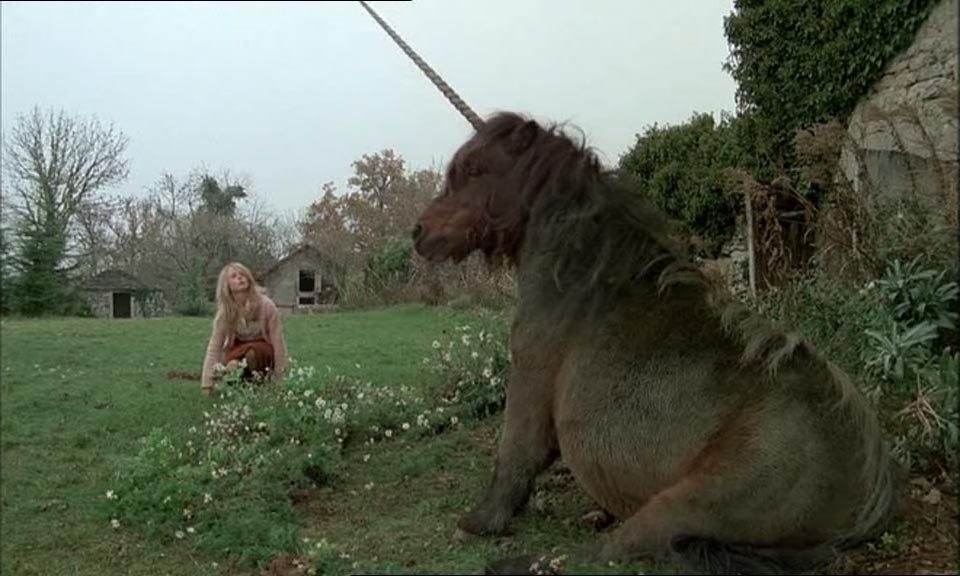
When I watched the whole of a Louis Malle boxset, it because obvious Black Moon was drastically different from any of his other films within it. It still feels like the other four films in that set, which does give a sense of a director who was able, for a movie or two, to shift style and still create something that fitting his filmography perfectly. It also feels like a Freudian romp through Alice In Wonderland with a Andy Warhol/Paulo Morrissey star and a shabby unicorn along for the trip, which is great too.

The only film of Malle's said to be close to this is Zazie dans le Metro (1960), which will be an interesting viewing experience.


Link - http://www.videotapeswapshop.co.uk/15585/b-is-for-black-moon-%E2%80%93-1975-director-louis-malle/

Monday, 4 March 2013

Sight and Sound of Atonal Textures (Behindert (1974))

From http://www.cinemaontheroad.com/screenshots/Behindert1.png


Dir. Stephen Dwoskin
West Germany – United Kingdom

From http://www.cinemaontheroad.com/screenshots/Behindert4.png

If there is an inherent abstraction in film and motion footage as a form, it’s that it cannot stimulate all five senses a human being has in reality. Baring failed attempts at one of them, taste, smell and touch have yet to be fully implemented into cinema. Some of behaviour people partake in when watching films, as simple as eating food like popcorn, could be seen as their attempt to compensate for this fact and to avoid having to only see and hear for two hours or so. Film is about sight and sound. The only point further from this is pure ‘visual’ cinema which has no sort of soundtrack whatsoever as practiced by the late Stan Brakhage in his short films; beyond this you are projecting light on a screen and sticking objects directly onto celluloid, the later actually practiced by Brakhage as well, or you’re going to just conjure up images in your mind like literature does when you read it or when you have flights of fancy. Sight and sound, fitting choices of words for the well regarded film magazine from Britain to choose as it title, are the prime aspects of cinema and how it is made, how they are used and juxtaposed with, experimental cinema usually playing with this for effect.

From http://www.cinemaontheroad.com/screenshots/Behindert6.png

Behindert is an abstraction of a relationship drama. After a prolonged scene at a friend’s home for dinner, a woman (Carola Regnier) meets a disabled man (the director Stephen Dwoskin himself) and embark on a relationship together that is soured by their waning passions and, using the director’s own disability after childhood polio ceased his ability to use his legs, her frustrations of how he has to function differently without the same functions physically another person would have. Musically the score, when not allowing us to hear the characters speak, is that of atonal noises and an occasional piano. Visually the film starts a technical style of prolonged close-ups that would be continued in Tod und Teufel (1974) from the same year. Mostly made of close-ups, extreme close-ups and abstracted images, we are forced to scrutinise the characters, especially the woman in prolonged minutes. We see the lines and pores on her cheeks and eyelids, flawed but beautiful face with combed back red-brown hair, the contours and dimples of her wide mouthed smiles and frowns of sadness, and with Regnier’s deep, fathomless brown eyes, her emotions in lingering detail not followed though with in more conventional cinema. It’s voyeuristic at first, but feels more like you, the viewer, having to actually look at the people you see, their expressions and what they are thinking, their bodies in abstract positions in the microscopic lense of the film camera, and what they are thinking as you have to look at the images and them, set to noise, longer than another film. If there is a major critical flaw in the late Stephen Dwoskin’sf film, it’s that in vast contrast to Tod und Teufel, which took the same style to two scenes out of a Ingmar Bergman drama and stretched them out to a whole feature length, forcing you to look at the same actress’s eyes in raw, agonising emotion, it’s that, while his obsession with the image is fascinating, as looking at anything for myself and absorbing it in is inherently going to have an effect, he pushes it too far into what I would call “arch” experimental cinema. This is what I am calling, in vast contrast to experimental work that I find powerful and potent, films that purposely push themselves teasingly as experimental and end up being vague even in the point of the experimentation, or as this film does, ignores how its conception inherently conveys the concepts and covers them up in unnecessary excess. We don’t need the other prolonged moments looking at someone which are not connected to the others. We certainly do not need the proto-shaky camera of still moments and faces that felt deliberate rather than by accident. It lacks the power of the other film because it forces itself to push its central idea far too hardly when the inherent concept of a prolonged view of a woman’s face, staring straight at the camera – Dwoskin the character, Dwoskin the director or us? – is enough to challenge and affect a viewer.

From http://www.cinemaontheroad.com/screenshots/Behindert9.png

Sadly Dwoskin’s films are difficult to find. I am only lucky to have seen quite a few now because I still have contact with my old university and can still borrow materials from their library. This makes this review instantly abstract as, unless you can find the French box set like I found in that library or a bit torrent link, you can only conjure up the film in your minds. My lack of knowledge of harvesting images from the film to have screenshots does not help either, but thankfully they were available online and replicated here. If you can find it, see it baring in mind the patience needed for it. Hopefully the review will suggest however that to have to stare at another person’s face, even if it’s a replication in a movie, for a period longer than we usually do in reality has an immense effect on your thoughts. Its considered impolite or discomforting, understandably, at times in real life but considering the lack of connection between human beings at points, something like this, despite not succeeding well, suggests that one having far more eye contact with your fellow man or woman could ease a lot of closed up feelings. Sight, as well as sound, can have such an effect on a moment depending on how long it is.

From http://www.cinemaontheroad.com/screenshots/Behindert2.png

Thursday, 10 January 2013

A Videotape Swapshop Review: Vampyros Lesbos (1971)

From https://blogger.googleusercontent.com/img/b/R29vZ2xl/AVvXsEjN5D8Pkq17NLJ71syeh3dn2cwRaadqLs1SGAQ68LspcbVxtct7rrGiADAoxYQHNves4ZR_RjgQ9Sc3vovk2Y-HezbDBTf4f0bx37sbS3CQBaNc3Heukq0SWfSKuTVYdH8BYVlVUkFyMx8/s1600/Vampyros_Lesbos_017.jpg


Dir. Jesús Franco
Spain-West Germany


The following is one of two reviews of mine for an month’s worth of Jesus Franco and Jean Rollin reviews on Videotape Swapshop this January. Some decadence and sex is a nice palate cleanser from the bad films you’ve all been reading reviews of this week.

Thursday, 6 December 2012

An Aesthetic of Violence and Hunger [Antonio Das Mortes (1969)]

4.bp.blogspot.com/-s9o3YLgHKU4/
TnCSnrJ3YDI/AAAAAAAAAcM/z_6QV8TNM2c/
s1600/Drag%25C3%25A3o%2Bda%2BMaldade%2BContra%
2Bo%2BSanto%2BGuerreiro%252C%2BO%2B---%2B1969.jpg

Dir. Glauber Rocha
Brazil-France-West Germany
Aka. O Dragão da Maldade contra o Santo Guerreiro

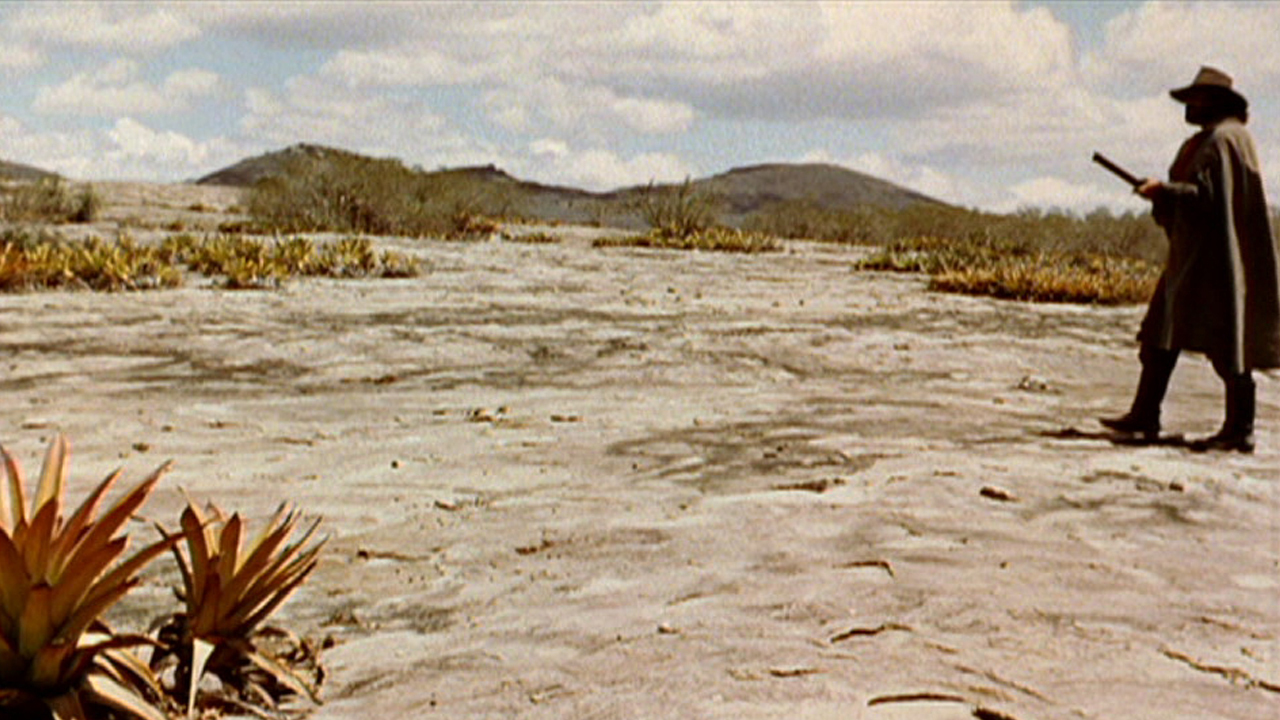
The disparity between a nation’s cinema and the amounts of films that are available outside the country is significant with the Brazilian director Glauber Rocha, whose filmography on purchasable disc is only three films available from the company Mr. Bongo; this is problematic in that, despite my little knowledge of Rocha, what knowledge of him I know of is that of a very important director in Brazilian cinema and Latin American cinema in general. Founder of the Cinema Novo movement in the continent, Rocha also wrote a very important manifesto on the Aesthetics of Hunger, calling on film directors in third world countries to draw from their plight – poverty, government corruption etc. – and channel it into left wing political cinema that could spark revolutions. In the vast numbers of Latin American cinema of the 1960s and 1970s that is waiting for me to see then, within a period of political strife during these decades for countries like Chile and Brazil, Rocha looks to be one of the most important directors of the continent, making the lack of access to his films even more disparaging. Antonio Das Mortes can be said to be a sequel to Black God White Devil (1964), in which the titular Das Mortes was introduced as a secondary character, a bounty hunter who targets Cangaceiros, ‘mythical’ bandits who fought for the people. Played by the same actor Mauricio do Valle, the film gains a lot from being a continuation but can be viewed by itself, and it takes the character on a very different path to before.


From http://s3.amazonaws.com/auteurs_production/images/film/antonio-das-mortes/w448/antonio-das-mortes.jpg?1309012930

Set decades after Das Mortes has killed the last Cangaceiro, he is an older, less confident man, filled with regret and yet also left without a purpose. When he is called upon to deal with a leader claiming to be a Cangaceiro, it gives Das Mortes new purpose, but it leads to him taking a drastic turn in his life from what he has done before. The film sounds like a Brazilian western in plot, which it pretty much is, but it is something far more drastic in tone from genre. Not only is the film set in a more modern day environment, the older myths being crushed under modernisation and completely losing the battle long before the film’s narrative, but the film is definitely a political manifesto onscreen. It is very unconventional in tone, willing for three quarters of its length to have prolonged scenes of characters talking to each other and straight to the camera directly, interlaced with overlapping dialogue over visuals and folk music, the Western driven plot dissected for the purposes of Rocha’s ideas as Das Mortes’ alliances drastically change. It is very much its own film and completely unique to itself, its dialogue and literary subtext combining the fantastical with politics and reminding me of William Blake’s more political and visionary writings. The growing intensity of the film, intercut with scenes of violence, eventually grows into a finale that is a barrage of merciless death, the only way tyranny can be overruled, genre and political revolution as a cacophony of gun fire and blood that is brief and startling, with a humorous and lyrical guitar song played over the screams that makes it an event already immortalised during its length. The use of music is exceptionally important for Antonio Das Mortes, the sense of ordinary people within the narrative being able to speak through songs, emphasised by the continuous singing that commands the soundtrack at one point and drowns out the voice and gunfire of the capitalist landowner and his henchmen. The music breaths life through the film while giving it an even more mythical tone alongside its symbolism.

From http://www.theoneonefour.com/wp-content/uploads/2010/05/Antonio-das-Mortes_still1.jpg

The final film needs to be adapted to, but by its end it is startling in its effect, the violence and rage of the content emphased by its messy yet very considered structure, its deep 1960s colours almost making it look like the paintings that bookend the entire film. The use of mythology with political fury is clearly biased, with no regard for balance, but made in a period that could only get worse when a dictatorship took over Brazil, forcing Rocha to leave the country in exile, it is a creation of strife and the desire to change the world when it was drastically needed. As the man who wrote a manifesto of channelling one’s anger into one’s cinema, Rocha made a furious film that is effecting even if it loses you at first with its unconventional tone. Pretty much like most world cinema once you start to dig deeper into it, it will break down your views on what ‘cinema’ should feel and be like, and the lack of Rocha’s films in terms of availability is even worse when I consider that Antonio Das Mortes, with its desolate ending, encourages one to continue through the director’s filmography, a vast one even if he tragically passed in his forties that is out of hand’s reach.

From http://cf2.imgobject.com/t/p/original/voOUcsIgQQYPlLvIDPKeSJ0CT3h.jpg

Monday, 12 September 2011

Alice (1988)


Dir. Jan Svankmajer
Czechoslovakia-Switzerland-West Germany-UK


Note: At least with the UK DVD release, the original language version of the film is available, so don’t be put off if the English dub shown in this clip is off-putting.

What Is It?
A pretty faithful adaptation of the Lewis Carroll story Alice in Wonderland viewed through the eyes of surrealist animator Jan Svankmajer, who made his feature film debut after a few decades of acclaimed shorts.


And?
Alice is almost a continuation from Jabberwocky (1971), which combined another Lewis Carroll work of the same name with Svankmajer’s perception of childhood, existing in the same universe as each other. Immediately from the start of the film, it is less a children’s film and more of a surrealist fantasy art film, where Wonderland is interpreted through corridors of a home and its habitants are stop motion creations made from bone, fur, thread etc. It also separates itself from many children’s films in that its child protagonist is not an idolised version of a child, innocent and yet aware of their surroundings, doing what they can to be kind to others. The Alice in this is a more accurate portrait of a young child, very naive and learning about the fantasy environment very slowly, more slowly than the viewer. Also in one scene, at least for myself, where she is trapped in the White Rabbit’s house made of toy bricks, she shows a selfish spitefulness without any malice where she does not follow the requests of others for the sake of it, a rarity in child characters in mainstream cinema.

For those who have not encountered Svankmajer’s work – and you really should, as they are not just for animation fans, but for any film viewer - his work is distinctive in that the man-made aspect of his animation (and even the positioning of real people as actors) and their textures are upfront and as much part of the films as everything else in them. His stop-motion, and surrealistic flourishes, are usually created using everyday objects both man-made (paper, tools and utensils etc.) and natural objects that are manipulated by human beings (stones, taxidermy animals and bones); he has worked with paper animation and puppetry as well amongst other things, but the emphasis on the materials, and their textures and appearances, is still apparent. (Both these styles appear in Alice as well, and are completely inseparable from everything else). Every scene feels like it has by crafted by someone’s own hands, with the flaws of manipulating and moulding everything into place as much part of generating the atmosphere of his work, be it a short or feature film work.

In the context of other adaptations of Carroll’s story, Svankmajer’s style looks far more ‘creepy’ and ‘unsettling’ compared to something like Disney's, an aspect which is purposely emphasised by having such images as loaves of bread suddenly spurting nails from inside them or the White Rabbit continually losing sawdust from the gaping tear in his chest. However the style is able to go from this to charming and humorous as well, the later a definite part of many of the director’s other work even if its black humour. For its source material it is perfect, adding to the adult sense of whimsy which appears in the original story (which, as well as being a surreal fantasy, satirised attitudes of the British culture of that period, as seen when Alice is put on trial by the King and Queen of Hearts). As an interpretation of childhood, it is just as good, enforced by the use of old style toys that look Victorian at times in appearances. A universal nature in Jan Svankmajer’s work can be seen in the fact that these everyday items are ones that viewers probably possessed or know of greatly – owned by themselves or relatives, found in their attics, or even found on car boot sales and in antique stores – regardless of their country of origin. Svankmajer is also an imaginative filmmaker who, as a practicing Surrealist who works in other mediums as well as cinema, has a keen eye for inspired contrasts and juxtapositions. How fitting is it that the portals to Wonderland and between each part are desk’s drawers, part of a piece of furniture stories like this would be planned and written upon?

Sadly Svankmajer’s other feature work after Alice have been hard to find in the United Kingdom, but having seen Conspirators of Pleasure (1996) and Little Otik (2000) he has affectively taken all of his obsessions from his short work and combined them into longer form narratives that show the craft of a talented veteran filmmaker. Also worthy of praise, especially with Alice, is Welsh film producer Keith Griffiths who helped this film, and other Svankmajer works, to be made. I ask of you the reader to look at his IMDB page, which I will provide in this post, and look at his producer credits. Even though I have disliked or hated some of the films he has produced, Griffiths has contributed to cinema in general immensely, helping such filmmakers aside from Svankmajer like Chris Petit, Apichatpong Weerasethakul and the Quay Brothers (who are huge admirers of Svankmajer and made a short work in tribute to him) to make interesting and unique works. Having Alice and Conspirators of Pleasure in one’s producer credits is worth applauding, but Griffiths’ is even more incredible than this.

Alice is not my favourite Svankmajer feature (that would be Conspirators of Pleasure) let alone out of all of his filmography, but it is a great achievement, a fantastical and surreal work which matches its subject material like a hand to a glove. The film was finally released on UK DVD this year thanks to the British Film Institution, part of a sudden surge of interest in Alice in Wonderland in cinema that started in 2010. Hopefully his other feature films will be made available, but this by itself was worth the wait for me.

Keith Griffiths’ IMDB Page - http://www.imdb.com/name/nm0341702/