Showing posts with label Genre: Slasher. Show all posts

Wednesday, 23 April 2014

Boardinghouse (1982)

From http://images.moviepostershop.com/boarding-house-movie-poster-1982-1020230391.jpg

Dir. John Wintergate

I have little in the way of life experience, but in terms of cinema, I can confidently say I've seen things that'll turn your hair grey. It doesn't matter if its art house or grind house. Body fluids. Sex. Gore. Random inclusions of clowns. A man turning into a bed sitting room. Exceptionally low budget films known for having an erratic tone have the aura for me of being exceptionally weird, particularly those shot on video, for the potential of odd circumstances, mismatched editing and rubber mask abuse. So it comes with a surprise that Boardinghouse to be pretty lacking in terms of an off-kilter air to it. I've wanted to see this film for years, since the bemused thoughts of the host of a bonus episode of the Mondo Movie podcast covering it. This is infamous for how strange a film it is. Enticed by the apparent madness its now that I reach this Boardinghouse, renting out a room for the night, and my expectations for what was going to happen were too high or not rewarded. In the tags section to the side of this page, you'll find one called "Cinema of the Abstract". It's used to compile together films that affect the viewer in distinct ways, throwing off one's perceptions of cinematic reality.  The other type of films placed under the tag are those so weird they have the same effect to, intentional or not. Boardinghouse was going to get the tag from what I imagined it to be, but seeing it, it won't now. What the film turns out to be is what happens when you pad a film out with many dialogue scenes with no connection to a plot. When the director plays the main male character who gets to be lusted over and have sex with the female characters. What happens when it's not the erratic editing you can say is why the film jumps tone and scenes as it does. That doesn't mean it's boring, but I'll get to the film as a whole for me as I go along...

In a text crawl and spoken narration that opens the film, on an early eighties computer, the viewer's told of a boarding house cursed with numerous unexplained deaths over the decades up to the then-current 1982. The nephew of the last owner to pass away in its corridors, played by the director Wintergate himself, the craggier faced cousin of Andrew Robinson, inherits the building. Immediately he decides to advertise for beautiful women between eighteen to twenty five to stay there for a rent, and rather than anyone being immensely hesitant to, many do indeed come, including a singer played by Kalassu, wife of the director who gets the most dialogue scenes along with him. The later point isn't a complaint, but this is definitely a film where those two get a lot of screen time. Wintergate's character gets to make love to many women, meditate in his underwear and develop his psychic powers, which he can use to make a bar of soap spin in the air above the bathwater he's in, while she develops her own psychic powers and hopes to succeed with her band. The other women get to muck about and longue by the pool in their bikinis all day. Unfortunately the gristly deaths are about to start again, clearly the work of a mysterious being who has escaped a mental hospital and can kill with psychokinetic powers. They're linked to an evil force in the boarding house, represented by a red haze generated by a computer effect from that decade, and odd and hazardous things start to happen. Hallucinations of having a pig mask for a head and pulling out bloody rat-tampon hybrids from the snout while taking a shower. Strange noises and maybe glowing eyes at the end of corridor. Guns randomly going off and objects harming people. Then people start dying, but only the viewer knows they are. Is one of the women to blame? Is it the gardener, also played by Wintergate as a shambling murmuring old man with all the costume department on, who was a Vietnam War vet and is far from normal? Or is it because of pure evil? Of course the lives of the characters are just as unexpected thanks to abrupt tonal shifts, a would-be suitor with dark intentions arriving to meet his estranged fiancée to a random pie fight breaking out.

From http://i1212.photobucket.com/albums/cc445/ObscureCinema101/vlcsnap-2012-07-07-23h02m28s206.png

It sounds truly bizarre from this synopsis, but while entertaining, the result feels too much like a desperate improvisation than something that sucked me into a strange dimension into itself like Canada's Things (1989) or an avant garde film that does it on purpose. The first horror film to be shot on video, it's of the lowest budget and barely attached to the plotline stated earlier, neither cohesively or consistently forwarding it, drifting in and out of random tangents. Attempts at humour next to serious horror. A random fight between two female characters at the pool.  Kalassu accidentally throwing yoghurt on herself when trying her psychic powers. The editing, for a film that was originally two and half hours long (!?), is haphazard and furthers the erratic tone by cutting away from plot moments and dialogue abruptly after they're stated. The tonal shift can be drastic, probably at its furthest being the flashback of the suitor raping his fiancée intercut with the women lingering around the pool, leaving a bad taste in the mouth despite the film around it. Around the psychic killer story thread you have the supernatural force in the house, Wintergate sleeping around, random conversations, jokes about a drunk man falling over trying to play golf and many other things. It also includes a gimmick where a specific sound and image, of a leather gloved hand on a psychedelic background, pop up occasionally to warn the viewer of the more prosthetics and fake blood heavy incidents that take place. Far from glorious it does feel disconnected. Moments stand out from what been said. Further points are added for the unexpected prescience of a magician during Kalassu's concert at the climax of the film. But I ended up watching a film which is a lot of dialogue, many scenes of strange circumstances, but never has a consistent, marked heightening of the bizarre.

Preference influences this review too, and I found Boardinghouse to be a mere diversion. I don't really gravitate to films that are held up for questionable acting and random shenanigans. I prefer those under the concept of "bad" filmmaking that end up creating a unique tone to them despite their technical problems, a consistency to their madness should I say. I've seen better examples created from the results of cheaper effects, abrupt editing and the unintentionally bonkers. I've found myself adoring these sorts of films within the last few years, technical incompetency be damned. Hell, Boardinghouse could grow on me. But at this moment its too obvious, and not strange enough to fully join any of the categories of these sort of films I like the most. It's not a film like The Nail Gun Massacre (1985), either, where reality inavertedly stumbled into a cheapie slasher film. Maybe the disappointment is distorting this first viewing too much, but I want to see films that break any perception of how a film should be put together. This just vaguely gets to an ending, and is a lot of poorly spoken dialogue and a few funny moments only.

From http://i1212.photobucket.com/albums/cc445/ObscureCinema101/vlcsnap-2012-07-07-23h03m57s59.png

Thursday, 21 November 2013

Videotape Swapshop Review: Leatherface: The Texas Chainsaw Massacre III (1990)

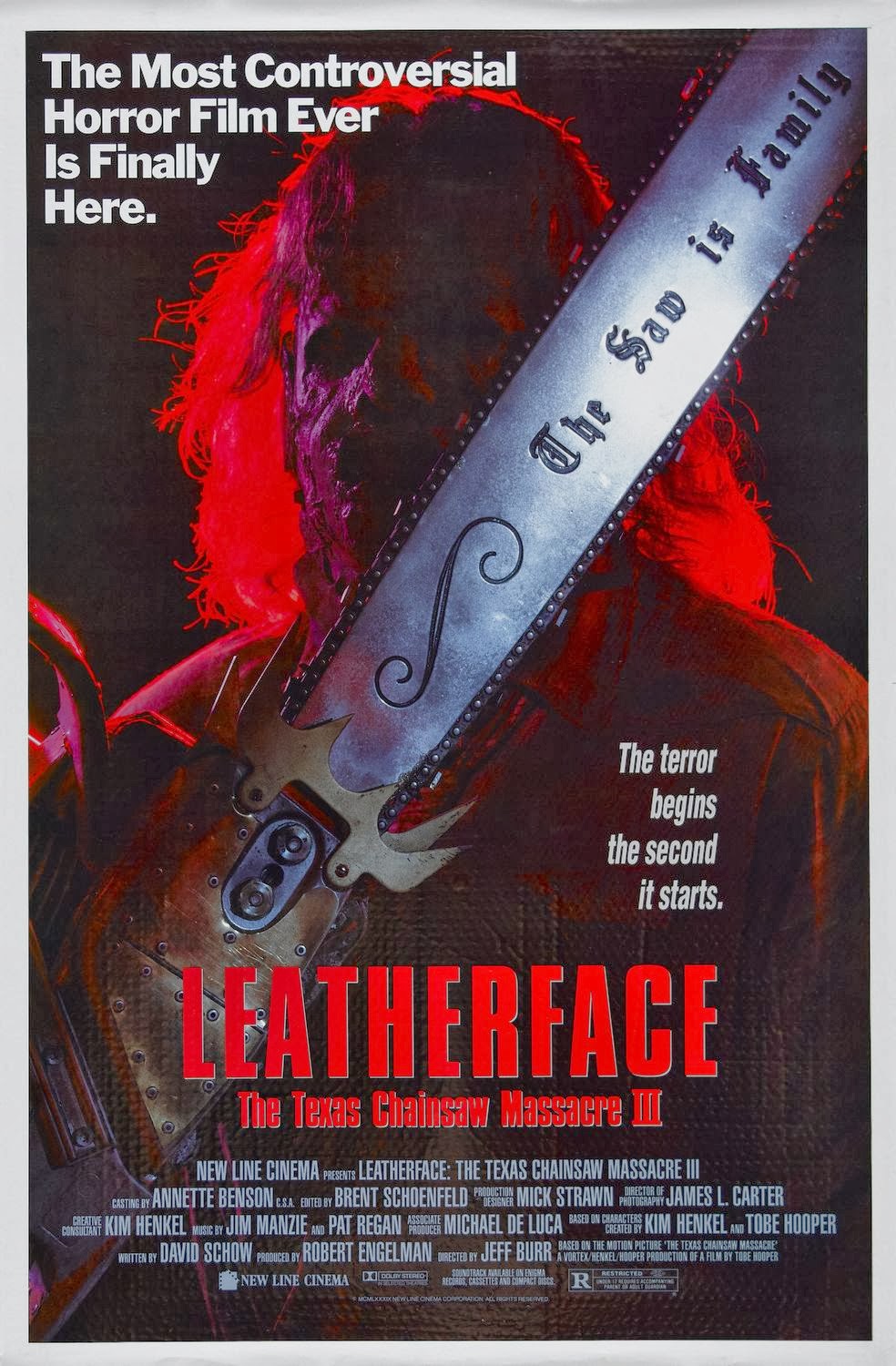
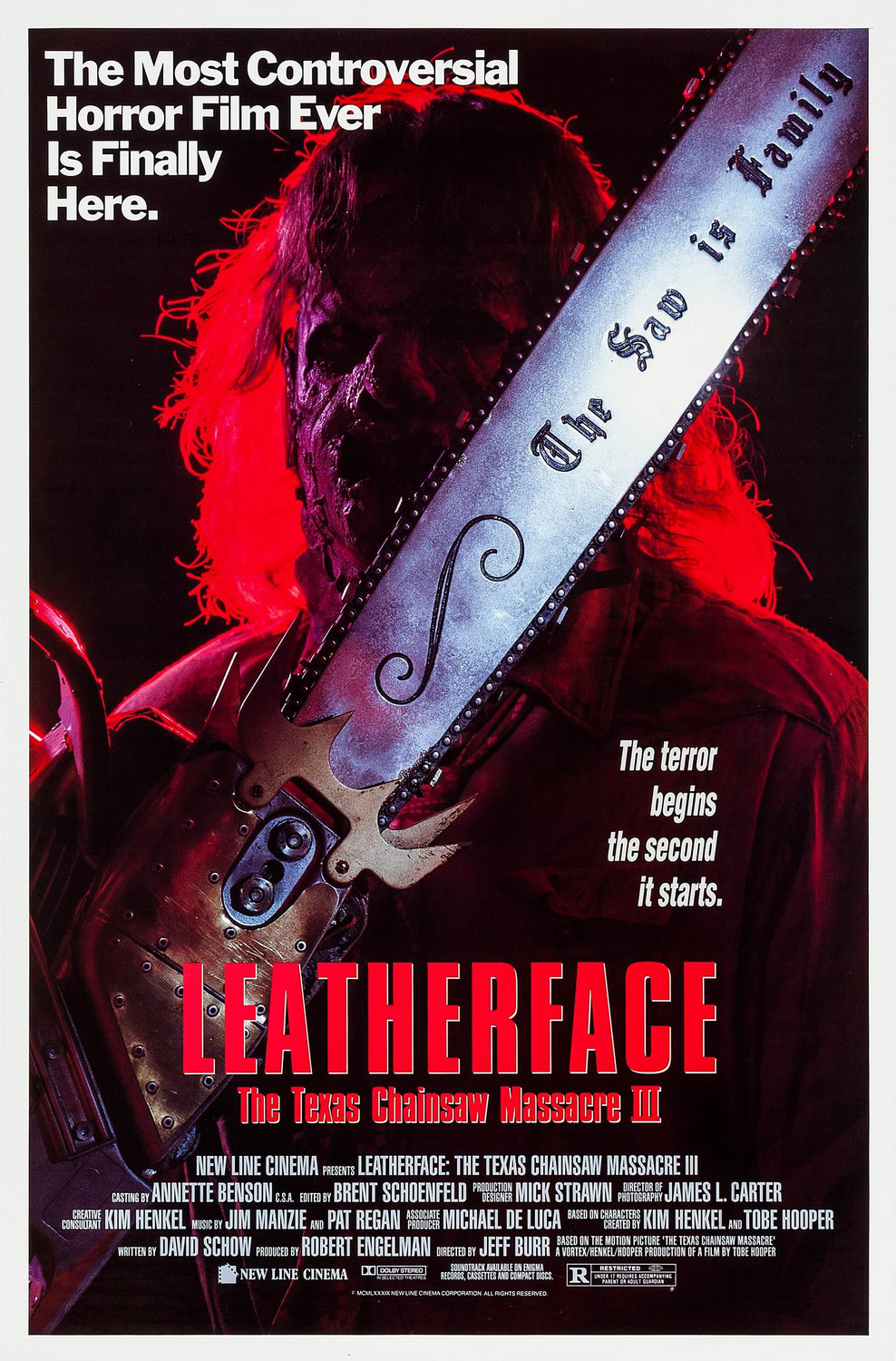
From http://www.impawards.com/1990/posters/leatherface_texas_chainsaw_massacre_iii_xlg.jpg

Dir. Jeff Burr

Another Videotape Swapshop review, and the other threequel I covered. Sequels are always a fickle concept. Any premise could lead to a justifiable sequel unless it closed the book on its content completely in a single film. Even then, its possible for some to become a franchise if good filmmaking was involved. The problem is whether there's actual 'good filmmaking' involved because sequels are usually made only for economic purposes and not with the optimism for making something interesting. In this franchise's advantage, there was a good first sequel in The Texas Chainsaw Massacre II (1986). I reviewed that film months ago, so covering this second sequel is a nice follow-on. Would I cover The Texas Chainsaw Massacre: The Next Generation (1994)? Yeah I definately will one day, here on Swapshop. This franchise has a better track record than others I've seen, baring the terrible Texas Chainsaw 3D (2013), and while I've not seen all the films, I've seen a fascianting spectrum of differnt attitudes through all the films. From the original's raw tone, to number 2's greater emphasis on blackest of black humour, to this one's grimy nineties tone, they all have something of interesting in them from the original four of the franchise. Yes, even The Next Generation when I get around to it.

Review Link - http://www.videotapeswapshop.co.uk/17034/leatherface-the-texas-chainsaw-massacre-iii-1990-director-jeff-burr/

From http://www.ionlywatch18s.com/wp-content/uploads/2011/11/Leatherface-2.jpg

Friday, 8 November 2013

Somewhere, In Australia... [Houseboat Horror (1989)]

From https://blogger.googleusercontent.com/img/b/R29vZ2xl/AVvXsEj78wUXT68VkunyVy6_t3S5qK94NVvwuoSbGPIrxVyliMcQwI9Czi3yB5eCzLu317KTtThNZU-ineD34M0KRcNx4PyXSd1CmrvfuwM8-j1GkfqHyQ31unhbfhW2nCYzEItFEz6Ixp5FAhYN/s1600/Houseboat_Horror.jpg

Dirs. Kendal Flanagan and Ollie Martin

I went into Houseboat Horror knowing how bad it was likely to be. Scraping the bucket of Australian exploitation films, it's also a while past the golden age of American slasher films its transposing to the outback. I really don't like the slasher subgenre. I'm willing to watch them still, to be a completist, in hope of finding one or a few I would like, always willing to give something another chance. To maybe be converted into a slasher film fan who can get past the flaws and love the films with enthusiasm. This subgenre can be great, technically starting with Halloween (1978), a damn good film let alone a great one in the subgenre. Even if Houseboat Horror was ridiculous, it may have still been entertaining, to a lesser extent The Nail Gun Massacre (1985), more obviously the jaw dropping Pieces (1982). But the concept of the slasher film could be seen as easy to dismiss, workmanlike in creation, with no atmosphere, teenagers being picked off repetitiously whose only characterisation is the bland dialogue that fails to give them character and their dated fashion. Going through the z-grade slashers would make these factors worse. But I wanted to enjoy Houseboat Horror even as bad trash.

From http://i1.ytimg.com/vi/JGlHJNwSwY8/hqdefault.jpg

Dear Lord, it was worse than I presumed it to be!

From https://blogger.googleusercontent.com/img/b/R29vZ2xl/AVvXsEgsrUJ48dI8DOcJvYCvvcpdJYYXg70rlHliwYGPs1_AwI0aVwrG_V7-NzL74hk82xYfYCd77Uqdu4v-ZgFec6_tj5XFrRgya6A6i3SwSZuZ_NQ4kJrxd-2iDCt4tMFILJJcY-SccjnUlJGA/s1600/Houseboat_Horror_1.jpg

A rock band, subjective because their music is diabolically bad, dated pop with tinny synth, go to record a music promo, renting a houseboat or two and travelling up the river of the Australian woodland. Unfortunately a killer with clear burn marks on their flesh is stalking around the isolated location picking off unwelcomed visitors. After that, if you've seen at least one, imagine the bog standard slasher plotline. And if you watch Houseboat Horror, prepare for the worst. I didn't expect it to be this cheap looking. Shot on a low price video camera from near the turn of the early nineties. Awful music that evokes the low rent cousin of a Casio keyboard. The title is shown as a cheap text made on a computer of the time. It could be seen as cruel to dismiss this from the beginning, but my heart sank when it came obvious that the creators weren't trying at all here. Even if passion was here, it was for such low aspirations. They merely wanted to make an average slasher film with no creativity, and the realisation of how painful the film would be grew when a main character was introduced and spoke. I wanted to avoid evoking the word "Neighbours", as in the Australian soap opera shown on the BBC and the show my parents once watched all the time, even though it was in my head, because I feared it could be seem as racist, by accident, to immediately evoke this for an Australian film. Then I discovered one of the directors of this made episodes of Neighbours. That series was at least a soap opera with some ridiculous drama. This is that soap opera stiltedness through the lowest budget possible and as horrible as it sounds.

From https://blogger.googleusercontent.com/img/b/R29vZ2xl/AVvXsEgsrUJ48dI8DOcJvYCvvcpdJYYXg70rlHliwYGPs1_AwI0aVwrG_V7-NzL74hk82xYfYCd77Uqdu4v-ZgFec6_tj5XFrRgya6A6i3SwSZuZ_NQ4kJrxd-2iDCt4tMFILJJcY-SccjnUlJGA/s1600/Houseboat_Horror_1.jpg

In another context, stuff in the film would be entertaining even if it was technically bad. There is one laugh that I had surrounding a running motif of a jet ski. As the band make the promo and cavort, sleep around and drink, they brought a jet ski with them since, hey, maybe they could use it in the promo since it was still the eighties but only just. Maybe they wanted to create a Duran Duran video even on a shoestring and Russell Mulcahy was unavailable since he was riding high on Highlander (1986). Its naturally used in a death scene in the only amusing moment of the film. But the rest is lifeless. Actors left stranded with insipid dialogue. I tried to engage with the film, but eventually gave up mentally halfway through. Apathy met the film as it went through the motions, as the killer does their thing and cheap prophetic gore effects are thrown about. Something this low budget could have been charming. The Nail Gun Massacre, for how bad technically it was, felt like the locals of a middle American town bringing their idiosyncratic personalities to a mess of a film that yet let them breath through its gaping structure holes. Houseboat Horror is just shockingly low rent. So tedious that it's been difficult to actually write about. Paper-thin characters died with no sadness or tension released, any visual flair or any engaging luridness stayed away from the film, and the gore and nudity is here but missing any jolt to it. Its defiantly an Australian film, but blasphemously it lacks the insane energy of an Australian exploitation film, more when in the nineties a similarly very low budget film, Body Melt (1993), was everything you wanted from such a movie. It's one of the worst films I've seen in a long while. Probably the worst covered on this blog so far. It's not worth the viewing. It's pointless to view it.

From http://www.wirelessfodder.com/wp-content/uploads/2011/01/HBH05-300x224.jpg

Sunday, 6 October 2013

Representing Iceland: Reykjavik Whale Watching Massacre (2009)


As much as mankind can be populated by completely reprehensible beings, can anything succeed if the ending just confirms this in a nihilistic conclusion and nothing more? Maybe, and virtues can be found in the film I'm covering here, but ultimately the concept won't succeed if said film is not as well made as it should and comes off as just a nasty, cynical take on The Texas Chainsaw Massacre (1974). This is a film that will put in one a sense of anger against it with its foreign tourists, going on a whale watch trip, and the Icelandic family about to pick them off being all reprehensible or gullibly naive. Sexism, attempted rape, bigotry, homophobia, racism, a callous disinterest in one's other man, the film is intentionally trying to get a reaction with its dog-eat-dog depiction of survival where the last one standing is the only "good" person. It's a viewpoint that is black hearted even in horror. You finally realise that this is the point of the film after a while - for the occasionally good person, everyone else is a deplorable human being or a coward, that no one, not even the hippy-dippy save-the-whales liberals, escapes from the director's blunderbuss tone of satire. The film actually succeeds with one character, an assistant for a Japanese couple (Nae Yuuki) who adopts to the growing body count quite quickly, the truly sick satire actually legitimate with her character in how no one wins except the bad person. It's a difficult film because of this, leaving a bad taste in the mouth, but it's very significant for a horror film to be going for such a trangressive mindset rather than merely be content with mediocrity. Even torture porn horror doesn't truly go this far with having no one to truly sympathise with or having the good characters being easy targets to pick off. For one, if not the only, Icelantic horror film, such a cynical, vindictive little movie like this is quite a shock to the system with its anti-humanitarian tone, and I'm amazed no one on the Icelandic film board didn't look at the script with horror.
But is being so anti-humanitarian really a virtue? The blackest of satire still needs to connect to you to the characters vaguely, like with Dr. Strangelove or: How I Learned to Stop Worrying (1964). You need to connect to the characters even if they're reprehensible mass murderers - something which could be learnt with an anime television series actually, Baccano! (2007), which juggled that dangerous issue with the characterisation very well. Reykjavik Whale Watching Massacre (2009) is still stuck in its structure, and unfortunately it belongs to these last few decades' obsession with pointless vindictiveness. Contempt for the world that, even if this film tries harder, still belongs to a juvenile point of view, one which dismisses any hope for life instantly than think about it thoughtfully. Pier Paolo Pasolini this isn't, and even as a horror film with its own criteria, this childish view of human relations gets oppressive. It's also another film for this season, unfortunately and more so this early into it, that invokes rape, and again it's a tastelessly put together scene that just shows up the failings of tact of the whole film. It's supposed to be a comedy horror film in fact, but that's almost impossible to put next to the actual results. Worse, it's a pitch black comedy which shows gaping contradictions in itself. Where the murderous family are clearly Christian, religious psychopaths, something which comes off as an incredibly cheap anti-religious attack next to everything else. That the film has no problems with racial epilates, sexism and near rape, but even in a charismatic, legitimately brave and good character, dances around homosexuality like one of the dippy liberals it mocks and comes off as patronising liberals being vaguely politically correct. It still cannot get past the generic inbred-family-as-killers plotline despite its tone. The Bjork cover - fitting, since its Iceland, and a potentially amusing idea - at the end credits is childishly unfunny and fucking atrocious.

From http://metropolis.co.jp/movies/files/2011/06/897-M-RWWM.jpg

At least I did not just feel numbed disinterest for the film like in the first half, but by the end credits it was still a disappointing failure made worse by the few virtues it briefly showed. It may seem absurd, but viewing this idea for this year's blogathon over, I have effectively created an absurd film contest for countries around the globe, boiled down to a country, one after another, standing in the spotlight, making an attempt at a horror or month appropriate film, and living or dying after the fact. Regardless of era, type of film, culture or nationality, regardless of whether there are other films that are better from each choice, the films chosen are either good or bad. When Reykjavik Whale Watching Massacre leaves the stage, the bad taste just leaves you in a fouler mood because you're not laughing at the worst of the world or learning from it. It's a miserable, nihilistic work that doesn't connect with my worldview, and it's still a poorly put together film.

From http://www.ionlywatch18s.com/wp-content/uploads/2012/04/0000221693-e1334605822793.jpg

Tuesday, 3 September 2013

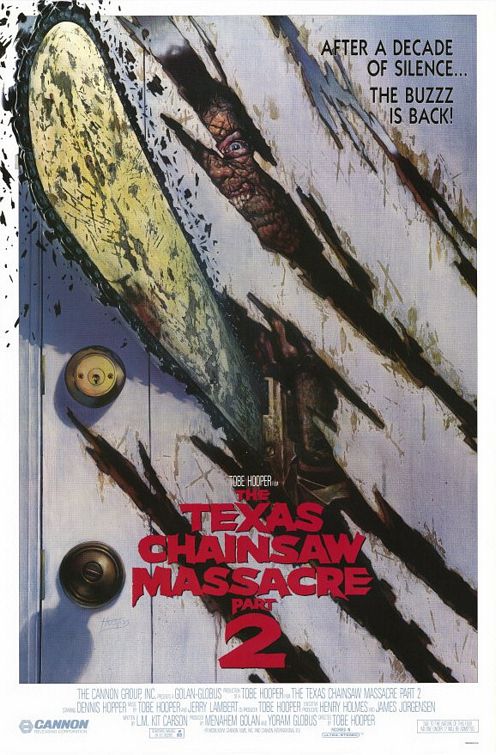
T Is For...The Texas Chainsaw Massacre 2 (1986)

From http://dailygrindhouse.com/wp-content/uploads/2013/01/The-Texas-Chainsaw-Massacre-2-1986.jpg

Dir. Tobe Hooper

More pulpier and ridiculous than previous entries, this nonetheless shows that any film can be potentially subversive, even one made by Cannon Group. Also there's the likelihood that I'll cover most, if not all, the films in the Texas Chainsaw Massacre series over the following years. At least one will be painful to sit through again, two I've never seen, and yet it won't be as bad as you think, and I will even defend one of them if any.

Review Link - http://www.videotapeswapshop.co.uk/15420/t-is-for-the-texas-chainsaw-massacre-2-1986-director-tobe-hooper/

From http://static.comicvine.com/uploads/original/10/108875/3034689-0938893114-tcm2b.jpg

Saturday, 13 July 2013

When There's Nothing Left In The Tool Shed... The Nail Gun Massacre (1985)

From http://www.critcononline.com/images/nail%20gun%20massacre%20vhs%20front3.jpg

Do you remember when you could sit outside and not worry about the mosquitoes and the killers?

Dirs. Bill Leslie and Terry Lofton
USA

From https://blogger.googleusercontent.com/img/b/R29vZ2xl/AVvXsEi_SZgVTrF74IWm5LwZfWE4z1WfnMlOSWkR6oAHgnok11DILxVZXn2G5zrc6TdeagaE1fNtGfXtCwdbhGmrT79Syf9GzWdeiD0enTvUV9eml1xllP1A7JdBN3CVxEty0licYXIeYvxQouTz/s400/Nail+Gun+Massacre+12.jpg

The story for a film like this is not the real interest, nor the kills themselves as a slasher movie as well. It's seeing everything of a rural middle America in the mid eighties that's somehow got captured on film, beneath a (frankly) rambling and (more frankly) bad movie, and how it is also reinterpreted on screen. That one actress is wearing a skinny sky blue neck scarf and that baseball caps with the words "T.A.M.E.D." existed for purchase. That grilled cheese and a drink costs $1.19 in this world or that the emergency services won't pick up the body of a murder victim at night in the woods because it's too dark to see. The film around it adds to this even if you cannot deny how ludicrous the whole thing is. One expects, even if its chaste and cheesy, a film which opens with a gang rape to actually go forward as a consistently toned and serious story. Instead you get electronically aided, two-for-the-price-of-one puns from the killer, nail gun duels, and gratuitous nudity that with the opening scene makes this very exploitative. The result is worthless if you cannot extract anything from this sort of cinema, but the sense of ordinary people trying to make a film, and the environment recorded onscreen and the stumbling, tasteless tone does come off as compelling if you can just sit back and imagine the background of making it. The opening incident leads to a mysterious individual, clad in camouflage and a black motorcycle helmet, driving a gold hearse (?!) and armed with an industrial strength nail gun, killing both the men involved in the incident and just about anyone else that stands in eyesight to them.

From http://www.horrordvds.com/reviews/n-z/nailgun/nailgun_shot3l.jpg


The film thankfully avoids, aside from one or two moments, the habit that makes a lot of this sort of "so-bad-its-good" cinema just bad, of being scenes and dialogue that drag you along so predictably regardless of how funny the film may be to some. With The Nail Gun Massacre, the closet thing to protagonists, the town sheriff and doctor, are completely useless and leave dead bodies around the town because, from the film's perspective, they're the only people there to take the murder cases and people are dying nonstop and preventing them from dealing with the previous ones before. Instead it feels like viewing a series of vignettes about ordinary lives that just happen to end with the person recreating makeshift version of Pinhead from the Hellraiser series with their own bodies. We see that even when he takes her to the cheapest place for a "fancy" meal like a skinflint, and has to contend with an old girlfriend working there, a scuzzy guy can still seduce a very busty girl only to have a nail gun wielding onlooker watching them, like a pervert, on the bonnet of his  car. That it's possible to be floating at the side of a swimming pool in front of someone and still be completely invisible to them. That the scene of two male workers firing nail guns at each other in a mock gun fight may have been on a real life incident which inspired the film and would have raised health and safety issues even back then. Everyone on screen, even if they are bad actors, are clearly normal everyday people who would be viewing these sorts of films after they were made - homely girls with hairstyles from a different dimension, everyday Joes and one of the directors' grandmother, nervous onscreen and clearly reading her script in front of the camera, captured on film through a schlocky American horror movie. It's far from great even in terms of this sort of cinema; the best have some virtues to them, no matter how small, and squash any sense of predictability to them. The Nail Gun Massacre is merely a rambling take on the slasher film, amusing for those with the right mindset (and willingness to pass its amateur moments of sleaze) for this type of cinema, but far from its heights. Its more fascinating to view films like this one from the perspective that the man who, in woodland sex scene, has his bared, hairy arse in front on camera, was and may still be someone's next door neighbour somewhere in Texas where the film was made. Far from someone we should ridicule, even if we laugh at the film, we should be proud of him, the actresses, the grandmother, everyone onscreen, for being immortalised in a film that, even if it's not for the original intended reasons, is still encouraging people like me from another country to track the thing down to view it. Praise that naked man and everything else here.

From http://www.horrordvds.com/reviews/n-z/nailgun/nailgun_shot6l.jpg

Monday, 18 February 2013

The ‘Lower Rung Video Nasty’ of Cinema [Don’t Go Into The Woods Alone (1981)]

From http://c3.cduniverse.ws/resized/250x500/movie/399/6994399.jpg


Dir. James Bryan
USA
Film #3 of The ‘Worst’ of Cinema

The following review is another addition to my growing amount of reviews of Video Nasty films. They are a divisive group of films.

Monday, 7 January 2013

The ‘Underrated’ of Cinema [Halloween II (2009)]

From http://www.film1.nl/images/portrait/original/56435.jpg


Dir. Rob Zombie
USA
Film #7 of The ‘Worst’ of Cinema

From http://www.gorestruly.com/wp-content/uploads/2010/09/halloween2.jpg

At what point do I veer towards being a mere contrarian or are critically lambasted films like Halloween II far more subjective in your reaction to them than what a critical consensus says overall? A single phrase – ‘personal opinion’ – colours any judgement of a film, and the only reason it wouldn’t, even if you agree with the generally held opinion of most film critics on it, is because you’ve yet to see the film. I had no interest in Rob Zombie’s Halloween (2007) – having not liked House of 1000 Corpses (2003) or The Devil’s Rejects (2003) at all – but Halloween II sounded like something much more interesting. Stuck with a sequel he did not want to do, Zombie rebelled and also, despite his love for John Carpenter’s original film, purposely made a sequel that did not stick to the conventions of the series and slasher films, thus enraging horror fans. My love and admiration for Carpenter’s Halloween (1978) has been documented in a review on this blog – [HERE] – but I find the slasher sub-genre that grew out of its influence to be one of the most tedious. I will watch ones I have not seen in hope of finding good films, but my hostility is not a unwillingness to see them but disappointment in how almost most of them are vapid even as genre films. Good ones exist, and even the repetition of plot structures and characters could be used to the sub-genre’s advantage, but most of the time they are the worst offenders of reducing a film into bland dialogue and scenes that merely pulls you along arbitrarily, with only gore and maybe a naked breast or two as a reward rather than anything else, to an ending you (ie. I) don’t care about. They are the colouring book to the blank page of an Italian giallo; the latter, because they are usually murder mysteries, are allow to go in any direction they desire, depending on the quality of each film itself, while slashers, unless they break the conventions or are very well made, are suffocated by the plot structures and rules of the sub-genre, like lines in a colouring book you are forced to stay in. Rob Zombie’s Halloween II while flawed changes this, by being everything that is the opposite of what is loved about slasher films, managing to escape from the sub-genre and making itself something worthwhile.

From https://blogger.googleusercontent.com/img/b/R29vZ2xl/AVvXsEjeySSyjX1w7HLEchkoscNTABjy_lb9QaF8Zaz9tMxb5kY_UirFyBZS9RXNiAXt01zDknqSUwYPIPu-7FIWa7SUz_NheuzUirro5858RKgiO9GsONxIDtSR2UaORuuuZUKOO2rxx_7jM3h1/s1600/Halloween+II+2009+9.jpg

Viewing it without seeing Zombie’s first Halloween film, it can be seen as an alternative reality of Carpenter’s original, drastically changed by time period and Americana used but,  within a film series which became convoluted and has the awful Halloween 4 (1988), Halloween 5 (1989) and Halloween: The Curse of Michael Myers (1995) within it, almost comes off as an attempt to bury it all and convey a far more interesting portrait of the characters. Laurie Strode (Scout Taylor-Compton) in Halloween II is far from the version Jamie Lee Curtis played, but could be seen as a logical conclusion of the potential psychological damage caused by Michael Myers’ attempt to kill her, leaving her a psychologically damage person suffering from constant nightmares and on medication. It surprises me – having grown up with girls who acted like this even if they weren’t this extreme – that many critics and viewers find this Laurie Strode obnoxious and completely unlikable. Despite her continuous swearing and hostile persona, there are plenty of times, especially around the characters Annie Brackett (Danielle Harris) and Sheriff Lee Brackett (Brad Dourif) where she is clearly a lovable, kind person whose outgoing attitude and persona – the swearing, the Alice Cooper posters etc. – are both the combination of how any of us as young adults sometimes rebel against authority figures through this kind of behaviour, and Zombie, sparing us another slasher sequel, bravely tackling post trauma damage on a person’s mind in a genre film’s tone. The only time where Laurie becomes obnoxious in how I perceive that attitude to be is after a major plot twist that leaves her in even more despair and believing that only drinking herself mindless at a Halloween party is the way to drown the pain away. It is probably a generational gap issue, as a much younger person, but I wonder, even if there is no sexism or misogyny involved, whether male fans are afraid of women, through this female character, who have human flaws and act in ways unexpected and confrontation to them. Fans are accepting of a virginal, mousy girl like Jamie Lee Curtis’s Laurie, whose portrayal is a great one nonetheless, but are taken aback by one who is angry, is psychologically troubled and dressed and acts as she does in Halloween II. Even if a male viewer does not like the final girl stereotype of slasher films, there is a potential danger for any of us men to still have a biased portrait of these types of young women – that they are only obnoxious and have no further levels in personality to them, that they are only empty headed and are not merely naive, or that, to use a horrible word I apologise for writing, they are merely sluts with piercings and ‘tramp stamp’ tattoos. Laurie and her friends, at moments in this film, come off as misguided, unbearable, annoying and childish, but not only are they young adults that, like all of us at some time, have still a lot to learn about the worlds and ourselves, but that, even in a genre film like this, Rob Zombie is willing to write characters, of any gender, who are as complicated and as flawed as people are in real life.

From http://www.doblu.com/wp-content/uploads/2010/01/hallo2ween14433.jpg

The desire to preserve the original Carpenter film from this ‘imitation’ or ‘betrayal’ is pointless; the immortality of Halloween (1978) is cemented as is its great influence, while this film should be allowed to break from the rules and do what it desires with the material if it works. The portrayal of Dr. Samuel Loomis (Malcolm McDowell) in this should not be viewed as blasphemous and it would show shallowness in a person if they said this for not being able to distance themselves from an reinterpretation they don’t like; in fact the Loomis shown in this could be seen as an alternative version of him if the events of the first Halloween night had destroyed the morals that were strengthened in Donald Pleasance’s interpretation. It is arguable that the character isn’t given a lot to do, part of the film’s issue of needing to have been a lot longer and fleshed out, but the drastic change in him adds a new perspective that would be a godsend in any slasher than the usual dirge. The same applies with the interpretation of Michael Myers; I find the original ‘shape’, which appears from the shadows, to be a frightening creation, but to repeat it with the mentality of a photocopy of a photocopy, until the quality becomes less and less good, is destructive to the original material. Why should this version wear the mask all the time? Why can’t he talk? Why does he have to use the same knife all the time? Why do these differences not make him a version of Michael Myers? This pedantic tone, while sometimes justifiable, feels childish against a film which is purposely breaking the series’ conventions on purpose rather than as a result of bad executive decisions.  Quite frankly this pedantic nature of horror fan culture is also probably why most of the films made now are unbearable or tedious for me, the colouring book mentality causing mistakes and bad ideas to slip into films and ruing their virtues. Something like Halloween II, while immensely flawed, is far more interesting and better for relinquishing itself from this mentality.

From http://lookpic.com/i/284/mqCBn0RV.png

The film is erratic in structure, needing the added time to pace itself I mentioned earlier. Only the dream sequences don’t work within the film as a specific flaw; some are striking, but they feel like the ‘prettified’ nightmares usually depicted in mainstream cinema and feel disconnected from the rest of the film and its subject. The violence also veers dangerously close to being sadism for the sake of sadism, like I felt with The Devil’s Rejects, but it thankfully avoids this, as horrifying and appropriately upsetting for a film with this dark of tone. The only concern I have is that, while it was clearly on purpose by Zombie and succeeds, the film is violently depressing by its ending, making it unadvisable to view as a visceral horror film but something you need to be in the mood for. It does give hope however that Rob Zombie could be on the way to being a great director and reminded me that good horror films of worth are still being made. That this one was merely dismissed in some circles is disappointing, yet may prove to be a virtue in its favour. The most memorable films in horror are usually hated on their release – and Halloween II has its supporters – and for the genre, the films should confuse, upset and anger people. Horror cinema should not be a mass act of self congratulation for a fan community, but to make films that are divisive and undermine the conventions from before even if enrages someone. It should not be safe, something a ‘subversive’ slasher film like Scream (1996) is actually not, its smugness worsened by it still perpetrating the same clichés it is mocking. Halloween II, an uncomfortable, messy creation feels far more honest and alive in its divisive nature and is something I can keep closer to heart than an ironic horror film.

From http://justinsmithonmovies.files.wordpress.com/2010/02/halloween-2-2009.jpg

Thursday, 1 November 2012

The End of the Witching Hour [Halloween (1978)]

From http://breathingdead.files.wordpress.com/2010/10/1191857431-halloween.jpeg

Dir. John Carpenter
USA
Film #31, for Wednesday 31st October, of Halloween 31 For 31

Written and completed in November, this review is a fitting way to end October of writing with the next month enclosing over the other. Plenty of films were missed or were not available to cover as I desired, while others were spotted and hastily added, turning out to be fitting for the occasion and worth their weight in being written about. Despite my desire to not let this get in the way of ordinary life, my original rules for the project failed to realise how much enjoyment and pride I would get from the whole work even if it was hard. To end the project with a fitting film, I had to go back to something as iconic as Halloween, a horror film talked about by everyone, praised by many, and the original bloodline for a whole sub-genre without taking into consideration its influence on other genre films. There is of course the fear that with a film as written about like Halloween there will be difficulty adding anything new to it, but that seems a pointless argument. Also I can claim to a different perspective where, first viewing it in my later teenage years, I thought it was a good film and respected its legacy, but far from the best of its genre in my view. Rewatching it this year changed my mind to this, and this repeat viewing to end the October season has confirmed that.

And to think there are so many terrible horror films that lay claim to being tributes to it. Just before watching Halloween last night I decided to clear through a shot-on-digital work called Maniacal (2003, director Joe Castro) that I knew going to be bad, only to realise the comparisons between it and a  good film like Halloween were fitting. Even if it is a lowest of low budget films, Maniacal in its worst virtues ended being a perfect template for all the horror films in the last decade that I could live without, shot on video or the type of cult and mainstream releases of a far higher budget you usually think of, the padded out and forced regurgitation of previous ideas with a self deluding habit of referencing the films of yesteryear like a lame attempt at starting a conversation at a social gathering. Quentin Tarantino could be blamed for this, but I would rather point the finger at a film like Scream (1996) whose self-referential comments, that never broke down the clichés it was pointing out and making it seem half hearted, mixed with the to-be-expected habits of lazy filmmaking in later films and their mentality and lead to mere name-checking without attempting to break down the references and breaking into anything new. Maniacal, about a mentally challenged young man who escapes from an asylum - actually a room or two with a few people dressed in white frocks but I’m not going to scorn the film for its cheapness when its actual sins are redundancy – is as much part of the brethren of film fan cinema of my generation, with films like Scream or most of the neo-Grindhouse movement,  which references and uses the tropes of the past on purpose, but merely feel like copies that only illicit thrills for the references or tropes themselves. (Kind of like Family Guy, to kick it on the ground again on this blog to be honest.) Maniacal’s actresses clearly evoked the female protagonists of Halloween (Jamie Lee Curtis, Nancy Kyes and P.J. Soles) but transmogrifying the friends of the main character from high school girls to women with clearly silicon pumped breasts, like two miniature footballs stuffed in a flesh suit or when Andy Sidaris unfortunately went to the fake breasts over the beautiful real ones immediately in his action-softcore films, as much an act of more mainstream films when young actresses are sculpted into plastic instead of flesh and bone and human souls. Final Cut Pro edited scenes and software font text onscreen in Maniacal becomes use of CGI without any sense of creativity. Poor technical composition becomes hackneyed ‘music video’ editing. Crow barred references to slasher films become rehashes of older generations of films without striving to be something new. A shot-on-budget piece of forgettable waste becomes a overhyped and creatively sparse piece of waste, low or high budget alike eating its own innards without realising the consequences or ignorant to them. When claiming to be tributes to the past, they merely descend into the tedious equivalent of an mind numbing  trivia contest rather than a excavation of what frightens the viewer and raises the hairs on the back of their head. Horror has had its crud since its origins, but with this generation there is a sense that they mis-viewed films like Halloween and, bar the few gems that cause my heart to backflip in exhilaration, a lot of them missed why these classics deserve that moniker.

It is Halloween at Haddonfield, with Michael Myers returning back, after a fifteen year stint in an institution for killing his older sister at six years old, with designs to kill more people for the sake of killing. His psychiatrist Dr. Loomis (Donald Pleasence) is in pursuit, by for three young women (Curtis, Kyes and Soles) they are inadvertent casualties when the day is taken over by night and a holiday that is supposed to be trick ‘n’ treating and joy is disrupted by a tall shaped man in a pale white mask with a knife.

Most people have seen Halloween, seen it a few or many times, and even dared wander through the fourth to sixth parts of the franchise with a curiosity that kills cats, but it amazes me to think, as fans of the film may attest to as well, how few lessons were learnt from it about how a film should be made even if its intentions is a visceral horror movie. John Carpenter is not the worst stereotype of a ‘film fan’ director, his obsessions outside of cinema as well as enamoured by the cinema too, as shown interviews with him, and his influences go outside of horror films as well. When he does tip his hat to genre film – showings of the original The Thing From Another World (1951) or Forbidden Planet (1956) on the televisions the characters watch – it is not bashed over your head but neatly threaded into the whole work. He also riffs on them, as when the primal electronic noises of Forbidden Planet, as it is being played on a TV within a film, suddenly is layered over an image of Myers’ sinister machinations outside in the supposedly safe suburbia. Even though the film is primarily a simplistic horror film by design, set on Halloween because the producer wanted to try a film set at that time, it was made with thought, love for the work, and to make something to pin the viewer to their seat. That does not stop it being more than this, and that makes it a far greater piece of entertainment too as a result. I will openly lift comment from an audio review I listened to, by the podcast The Gentlemen’s Guide To Midnight Cinema and pointed out by one of their guest reviewers (Link To Podcast Episode Here), that the single class we see onscreen has Curtis’ character listening to a discussion on fate and its inevitability, how Laurie Strode the main protagonist will inevitably meet Michael Myers face-to-face. Adding my own two cents to this idea, the fact that in a scene not so long afterwards the Blue Oyster Cult song (Don’t Fear) The Reaper is heard diegetically on a car radio, even if it was a coincidence, cements the sense that as well as being a killer-on-the-loose film, existing before slasher films came to be, Halloween plays into the season’s background by having a bogeyman who at one point literally forms tangentially from the complete darkness of a shadowed doorway.

Cinematography – even over Carpenter’s legendary score and the good performances – is Halloween’s greatest virtue as provided by director of photography Dean Cundey. Again as I have stressed in an earlier review, one does not need to have taken a Film Studies class to see why a film like this is a great for its cinematography, but merely to notice where the camera moves, or is placed, and why. The greatly canonised metaphor of a film camera being a mechanical version of the human eye is one that could help anyone, if they think of it, see the best techniques for how great they are even if the terminology is completely lost to them. In a single camera movement – such as a swing across from one side of a telephone booth, where Dr. Loomis is trying to warn the sheriff of Haddonfield, to the open door he is stood in-between – this film shows its technical prowess, and the whole movie is full of panning, gliding and moving cameras that all evoke the growing tensions that can make the hairs on the back of your neck rise even on the hundredth viewing. That is not taking into consideration the opening sequence from the first person perspective of a six year old Michael Myers, a prolonged take from outside the house, to the top rooms, and out again.

When the film moves into its main night time setting, Halloween fully becomes the masterpiece I realised it was, the absence of light creating shadows and darkness that add to the fear of Myers and exemplifies the scares further. Drenched in shadows, the film started reminding me of Film Noir, German Expressionism, and in the effect of light on window blinds that produces lines on scenery and people’s faces, even Bernardo Bertolucci’s The Conformist (1970), Carpenter’s film in company with these films where the use of manipulation of light and darkness adds so much to their moods and emotional impact. It also helps Halloween in its supernatural element, the everyday aspects of life – babysitting, watching horror films on Halloween night, having sex with your boyfriend – punctured by a figure that materialises out of the pure blackness with a real sharpened blade. That the characters are modest and charmingly real - Laurie the primordial ‘Final Girl’ of slasher films yet able to enjoy a toke on a joint that thus pisses all over the ‘rules’ of innocent heroine in this subgenre before they were set - emphasises a humanity to the film while causing the stunning use of shadows, filtered through the ominous electronic score, to feel even more frightening in how it devours a normal environment and twists it inside-out.

So much is written about Halloween, but it has to be emphasised what its virtues are just in hope that one day the tributes made to it by new films will be honourable rather than a disgrace. If this season has proved anything, bar my new found torture technique of writing thousand word reviews for almost 31 days straight, it is that for me genre cinema needs to be championed for its least formulaic entries and surge of risk taking and consideration of quality. Even the hilariously ridiculous horror films needs to be better in their (accidental) field better than any other. Great films are still being made, but the realisation just how many pointless films are made wants a process of energy efficiency and a more methodical recycling of previous films to be put in place, horror films that are full bursts of passion and creativity rather than rehashing Halloween for the umpteenth time. It took me a while to realise the virtue of the film, but as part of it was the result of so many others I’ve seen failing the moment they started, it was also the result of slowly appreciating how spine tingling the film was. As the final credits ended just before the 1st November at 12 o’clock in the morning, the Jack O’Lantern I carved smiling its burning grin in the darkness of the hall outside the living room and October a whole year away again, Halloween proved to be the obvious way to end the whole project because, and I apologise for my language to you the reader, it’s that damn fucking good a film to have the final word in on the entirety of the month. 

From http://bandbent.files.wordpress.com/2011/10/jamieleecurtis3.jpg

Tuesday, 23 October 2012

More Slasher Than Slasher [StageFright: Aquarius (1987)]

From http://retroslashers.net/wp-content/uploads/2010/09/stagefright.jpg

Dir. Michele Soavi
Italy
Film #22, of Monday 22nd October, for Halloween 31 For 31

When Italian genre cinema is at its best, they are rich in style and distinct in their filmic textures. Even at their most minimal in plot or narrative, the Italians were able to still succeed because the emphasis on the visuals was pushed to the point that it conveys all the emotion and effect needed. Michele Soavi’s StageFright can be summarised in a single sentence – a psychopath in an owl mask picks off a theatrical troupe in a locked theatre. The film comes closer to an American slasher movie than the ones traditional in Italy, following an elaborately dressed killer murdering a group of people one-by-one. The plot is very slight, the kind that would get immensely criticised for its lack of depth; the slight nature of it does affect the quality of the overall film, but for pace reasons. The rest of StageFright avoids this by Soavi turning the overall work into a kinetic, immensely lurid hybrid that is far better than it could have turned into.

Owl Mask considers some practical DIY.
From http://cdn.chud.com/9/9e/9edfe47c_Stagefright1.jpeg
Drenched in late 1980s style, the film is a basis for Soavi to push camera movement and use of images as far as he could go. The premise of a slasher film can easily become redundant in its inanity if not done well; the stripped down nature of the genre however can allow emphasis on the tenseness of the situation to be taken to its fullest. An understudy of Dario Argento, his influence on Soavi is obvious, using the focus on moving camera shots, and the use of colour and light, to take StageFright’s minimal premise and push it into a far more quality work. The characters are surface-level, the violence is over violent, and the owl mask the killer wears is impractical in reality, but playing in a clearly artificial world, Soavi allows these aspect to still work. For example, the owl mask, a giant owl’s head from the stage play the theatre cast are practicing, is a striking presence in the film and stands out in genre cinema despite its ridiculous size. Soavi even uses the feathers from it brilliantly as a frequent motif in the narrative. Like Argento, the style of the film is excessive on purpose to emphasis the intensity of the horror onscreen.

The style of the film and your reaction to it is the same as to the music within it. If it is off-putting, the excess is too much, full of saxophone flourishes and synth, but if you can engage with it or love its excess, especially for me as I used to play the saxophone until college, then it adds to the lurid nature of the film, and as a score adds to the effect of the dramatic scenes. Italian genre films and their stylism is at its best when the directors also use it carefully even when it is intentionally saturated in tone. With the score for example, Soavi brilliantly contrasts it with use of silence for certain sequences, especially the highlight near the end involving a key, which adds to their intensity, and classical music. The same logic is used by Soavi for composing the visuals, excessive in style – extreme close-ups, a breathtaking 360 degree pan of the theatre soundstage, first person prowling cameras – but put together with immense consideration. Regardless of the content, the editing of the scenes together is probably StageFright’s greatest virtue aside from its style.

As his debut, Michele Soavi started off especially well. It is what it is, but while Italian genre cinema had plenty of highs, just from seeing a few films from my perspective, there are plenty of terrible ones too. Since the Italian industry would soon after this film die off, this can be seen as one of the last hurrahs before the dearth of the 1990s would take place. Only possible to make as it was in the 1980s, StageFright is a film which takes such a replicated and grinded-out concept and breathe life into it, an act which is refreshing. I did suggest I would do a slasher film for this season; it’s an Italian one, and probably doesn’t legally count, but this is my slasher choice, far more its sub-genre emphasised tenfold than some of the American ones and much better for it.

Owl Mask resting after a night's worth of killing.
From https://blogger.googleusercontent.com/img/b/R29vZ2xl/AVvXsEg7dZ373M3zQWtU5FjYt78IAynMP_rVAzQscf46rflkfWcZYTJZ6ilKxRB3l25ZKT-eBf01GLjkBJGA9rO2coZ7-ws6k9wNCVO6bq3pMjL6ypeTfJmjpEhB4F-TcoXMFyfbYaQWqgz5hrg/s1600/owl-head-deadly-movies.jpg