|
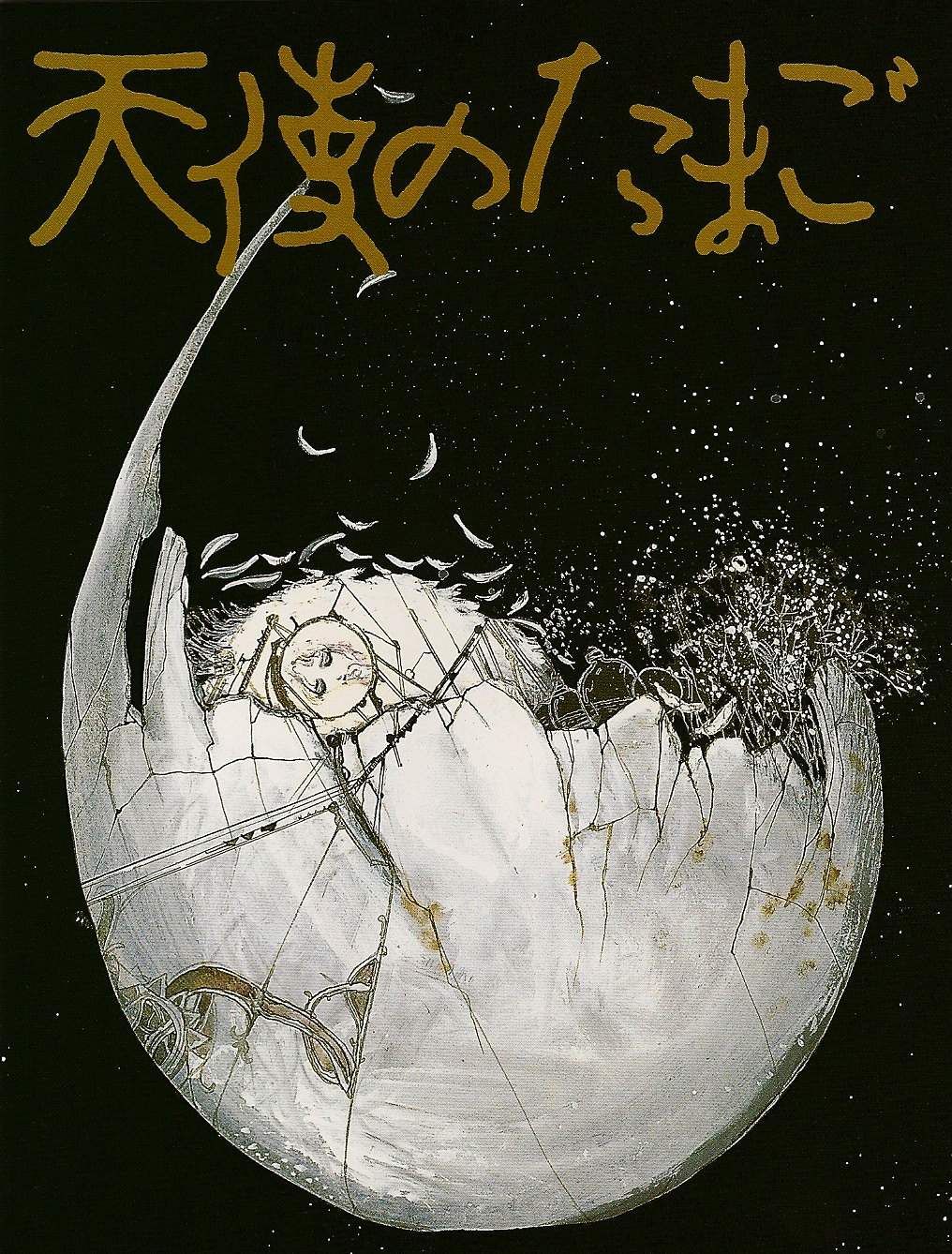
| From http://guriguriblog.files.wordpress.com/2009/03/untitled-1.jpg |
Dir. Mamoru Oshii
[Note = This was originally an introduction for a project I'm part of on the forums for MUBI, which is why its tone may be a bit different. I hope you all can get something of interest from it though.]
 Angel's Egg is now an even rare type of creation in the Japanese
animation industry. Experimental anime still exists, even in pulpier areas, but
with the economic issues taking place globally many industries are playing it
safe and drawing back away from areas of bolder creation. Hollywood even went
away from the mid-budget hard boiled action and crime films that were part of
its bread-and-butter at one point, so how could another Angel's Egg be made in anime now unless it was a suicidal risk? In
the eighties, with an economic boom, so many anime works were commissioned even
though they were just made to let someone experiment or to try any idea out. Mostly
these works were made for the new, and at times higher budgeted,
straight-to-video market, with creations like California Crisis: Gun Salvo (1986) and Cosmos Pink Shock (1986) examples of the most obscure of the
obscure I've at least seen myself, usually up to a mere forty minutes or so
long, one off pieces with no original source material or follow-on, and only
available now thanks to Western anime fans who have acquired Japanese VHS tapes
and put up digital copies online. Angel's
Egg is more significant in this area because it's a completely abstract
film that was made to be shown in Japanese cinemas. It didn't do well,
understandably despite wishing for a perfect world of the opposite, but it has
built up a reputation. A lot of it is to do with two key men who created it.
Director Mamoru Oshii, who would go
on to make entries for the Patlabor
franchise, the two Ghost in The Shell
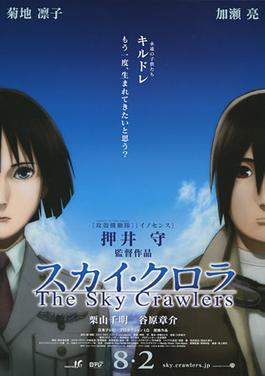
films, Avalon (2001) and The Sky Crawlers (2008), a chequered
career in cerebral, acclaimed animation and live action experiments. The other
is artist Yashitaka Amano, known most
for his illustrations for the Vampire
Hunter D novels and his work for the
Final Fantasy videogame series. But
the film has gained a lot of status by itself for a lot of good reasons.
Angel's Egg is now an even rare type of creation in the Japanese
animation industry. Experimental anime still exists, even in pulpier areas, but
with the economic issues taking place globally many industries are playing it
safe and drawing back away from areas of bolder creation. Hollywood even went
away from the mid-budget hard boiled action and crime films that were part of
its bread-and-butter at one point, so how could another Angel's Egg be made in anime now unless it was a suicidal risk? In
the eighties, with an economic boom, so many anime works were commissioned even
though they were just made to let someone experiment or to try any idea out. Mostly
these works were made for the new, and at times higher budgeted,
straight-to-video market, with creations like California Crisis: Gun Salvo (1986) and Cosmos Pink Shock (1986) examples of the most obscure of the
obscure I've at least seen myself, usually up to a mere forty minutes or so
long, one off pieces with no original source material or follow-on, and only
available now thanks to Western anime fans who have acquired Japanese VHS tapes
and put up digital copies online. Angel's
Egg is more significant in this area because it's a completely abstract
film that was made to be shown in Japanese cinemas. It didn't do well,
understandably despite wishing for a perfect world of the opposite, but it has
built up a reputation. A lot of it is to do with two key men who created it.
Director Mamoru Oshii, who would go
on to make entries for the Patlabor
franchise, the two Ghost in The Shell
films, Avalon (2001) and The Sky Crawlers (2008), a chequered
career in cerebral, acclaimed animation and live action experiments. The other
is artist Yashitaka Amano, known most
for his illustrations for the Vampire
Hunter D novels and his work for the
Final Fantasy videogame series. But
the film has gained a lot of status by itself for a lot of good reasons. |
| From http://johnnywestmusic.files.wordpress.com/2011/04/angels-egg.png |
It's an incredibly surreal film.
Even on this viewing, things in it do not make rational sense for me, more
dreamlike and felt than connected together into a full conventional tale. But
there is a clear through line within it. The world depicted is a dying one,
desolate, destroyed, with remnants of a war still going on. A young girl
wanders through an empty town keeping herself alive and carrying a giant egg,
the egg incredibly precious to her that she guards it all the time. (The odd,
accidental or purposeful, pregnancy motif when she carries it under her dress
is either saying a lot about my own though process, or something to dig into
another time with another person). A soldier encounters her, adamant to find
out what's in the egg, following her with the possible intent of breaking it
just to answer his questions. It's here that a very important piece of
information about Oshii has to be
taken into account. Oshii has been
documented as being a Christian at some point, whether he is still or not
unknown, to the point of considering entering a seminary. The drastic change,
in the path of his life, that would lead him to instead become a celebrated
auteur of anime cannot be ignored when viewing a film like this with its choice
of Christian symbolism. Anime is notorious for its vague uses of this type of Christian-Judean
religious symbolism, especially since the TV series Neon Genesis Evangelion (1995) became a leviathan of a work that
brought more people to anime but made a hodgepodge said symbolism haphazardly
with its real intellectual meat. But Oshii's use of any symbolism, quotation
or reference, even if you have difficulty with it, has always been done with
some clear purpose, even in a film like this that is also clearly abstract.
 |
| From http://img.photobucket.com/albums/v178/brngrofdeth/tnt1.png |
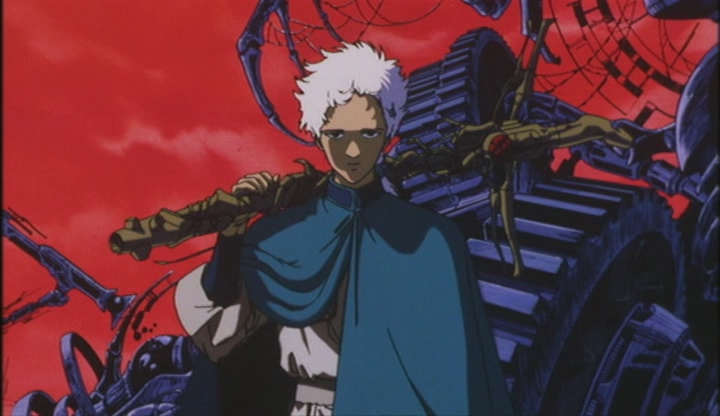
The soldier, with bandages on his
hands and carrying a staff/weapon shaped like a cross, doubts his existence and
the meaning of it. His interpretation of the story of Noah and the Ark, in a
key monologue in a film mostly without dialogue, is a very disillusioned one.
He even questions whether he actually exists. The girl believes devoutly in her
egg being something of importance, maybe even an egg of an actual angel, but he
wants to break it open to see if this is true or prove his disillusionment
forcibly on another person. There is also a group of fishermen in the town, but
their prey are giant shadows of fish, which their spears merely pass through
and damage their surroundings. It is missing the point to say the film is about
blind faith in a "fictitious" God. Atheism is a religious belief in
itself, just one where there is no God and the Holy Book is of natural science
with no suggestion of it coexisting with a spiritual entity, and disillusionment
with one's beliefs can be encountered in any person like it did for Mamoru Oshii. The soldier is trying to
find himself, while at the same time he is just as questionable in letting his
nihilism cloud his judgement and bully a young girl. In a destroyed world, one
would ask if God actually exists. Even in our own world, November 2013 as I
write this, the situation of the world with its centuries of war, religious
conflict and disillusionment, and the wider realisation of the atrocities committed
globally has made the issue of the existence of a God (or Gods), and the question
of the existence of evil, more pertinent. Even whether one truly exists could
be up to debate, as the soldier suggests to the girl they are being dreamt by
another, such an ironic idea when said by a character hand drawn and made to
breath and be alive through another person's hands. Even those who stayed
faithful to the belief in a Christian God can suffer as well; a term, "the
dark night of the soul", was coined in the sixteenth century to describe a
rare sensation where certain Christians felt they were completely alone, that
God was completely absent in existence and their beliefs may have been wrong.
In the New Testament itself, Jesus Christ, said to be part of God Himself as
well as His Son, screamed while on the Cross why he has been forsaken for a
brief moment. The crisis Angel's Egg
depicts is that of the loss of a surface to even place one's foundations, one's
feet, on. Oshii in his career would
explore these themes in different areas, asking what makes us human, with the
"soul" against technology in the Ghost
In The Shell films, and in the plot events of The Sky Crawlers.
 |
| From http://1.bp.blogspot.com/_hLY9DmXXlH4/S76jjGnwoHI/AAAAAAAABu8/ DQYIuf9ZNao/s1600/vlcsnap-2010-04-09-04h13m34s50.png |
The film looks beautiful.
Painstakingly animated in ways rarely done now if ever. It looks legitimately ethereal
in tone and look through Amano's
character designs. It sounds beautiful and mysterious in its score by Yoshihiro Kanno. Its paced slowly, so
slowly time seems to abruptly holt at one point with a character just sitting
there in the dark. Unfortunately this kind of anime is not being made
available. This film is not available commercially in the West, and other
inventive works like Belladonna of
Sadness (1973) aren't either. As much as anime at its best, in its pulpiest
genre based material, can be so brave and creative in its aesthetics and ideas,
films like Angel's Egg have been
left stranded. The key target audiences of anime are young teenagers who
haven't been given an opportunity to grasp slow paced, cerebral work that is
not punctuated by Facebook links. Or
adult geeks of both genders that, stereotypically but honestly at times, are
more interested in alarming sexual fetishes involving fictional school girls or
boys, or want to stay in their adolescences permanently, considering what is
mostly being made now in anime, not something like this film about the
existence of God. An audience needs to be built for Angel's Egg so it can be finally released. It's the strongest piece
so far for me in Mamoru Oshii's
filmography, and one of the most potent works made in this medium.