Tuesday, 9 October 2012

Separating My Diddy From My Gaga [Detention (2011)]

From http://www.brutalashell.com/wp-content/uploads/2012/06/detention-movie-poster.jpg

Dir. Joseph Kahn
USA
Film #8, of Monday 8th October, for Halloween 31 For 31
                                                                                                                                                               
In yesterday’s review, I felt the disheartened but still optimistic hope that the director would make a film that will improve on the mistakes of the one I covered. Made in the same year, also shown at the same Frightfest in London with it as a midnight screening, was another film that, upon viewing it now, showed a director improving on the mistakes of his first film and throwing his cards on the table impressively for his second. From the first scene of a high school girl talking to the viewer in very reference heavy, but bluntly vapid, dialogue with masses of text and on-screen graphics morphing on the foreground, the film immediately stands out as something very different that manages to be both purposely irrelevant and bouncing off the rubber walls, taking an entire generation of young adult culture, and the one before it, and transforming it into an abrupt, multi-text mirror back at it.

Back in 2004, the year before a point within the film that gets poked with a bloodied cultural feather at one stage in Detention’s narrative, its director Joseph Kahn made a debut film called Torque. A music film director whose work goes from Britney Spears to U2, his debut suffered from being another Hollywood action film with a generic, go-by-numbers dot-to-dot plot and a cast in danger of being remoulded into bland plastic figures, without any sense of self mocking intention, by the film’s presentation. What salvaged the film from the flotsam-and-jetsam of forgotten blockbusters from the early 2000s and makes it worth seeing at least once by anyone was that Kahn stood out as a potentially great director, his playful pop art sensibilities lifting the materials higher than it is.  Irrelevant sight gags, bright imaginative use of colour and space, and even uses of screen covering CGI that poked fun at itself for being fake but pushed it to imaginative and ridiculous ways that made the scenes memorable, all of which showing a director who had the talent to go onto great work. Torque’s tedious emptiness against this creativity undermined these qualities sadly, leaving me in hope that if Kahn ever made another film that he would remove all the problems that plagued the first. I don’t know if I knew about Detention before seeing Torque, I may have seen his debut before knowing about the other film, thanks to Armond White’s one man matching band praising the film in his other reviews, but the anticipation for it was high for me regardless. It’s too early to judge Detention fully, but at the moment Greg Araki’s Kaboom (2010), a film in a similar vein despite deeply different mentalities and thoughts to each other, feels far superior as the work of a veteran director at his best with his mischievous narrative and achingly good use of primary colour and images, but regardless of Detention possibly losing some of its magic on a rewatch, it’s a doozy that throws its satirical swipes with force.

Going about with the logic of a game of Exquisite Corpse, only using pop culture of the 2000s and 1990s instead of linking together random words and pieces of drawing for its material, the film centres around the lone, alienated female student Riley Jones (Shanly Caswell) who has nothing to live for to the point her fellow high school students gladly walk over her prone body on the hallway floor without realising her presence. Around her however is every stereotype of high school culture, including herself, from the jock to the nerd, melded with vast areas of filmic culture, from high school dramas to, of all things, Cronenberg body horror, pulled together by Riley’s relationship with failing outsider Clapton Jones (Josh Hutcherson) and a serial killer who has literally jumped out from a slasher film series in the story’s world called Cinderhella. From there, stereotypes are bent plastically into shapes unexpected, and referencing multiple pop items at the same time, bears suddenly learn how to time travel, and through the countless sub-chapters on even minor characters, it becomes apparent that, while there is a clear plot line with an ending, Detention is as much a purposely abstract movie, and gleefully so, whose tangents are meaningful in how out-of-place and silly they can get.

The film will put people off. Immediately it’s clear this is a film with heavy, Family Guy levels of referencing that could possibly date it and cause the film to feel pretentious and obnoxious to others in conjunction with its tone and visual barrages. However unlike Family Guy, which had its great high points but seemed like cheap references with thin bare stories wrapped around them most of the time, Detention still has a core that is both cute with its referential jokes but have a clear, razored tongue in them, the erratic bombardment of music references, film homages and quips reflective of the age we live in and how it is the ordinary lives of the high schoolers depicted. The film has a lot of visual gags, but especially with the many passages of text on screen that may be there just to be another gag or reference; in an age of Wikepedia, Facebook, Twitter, iPhones, fifteen or more (?) years worth of the internet, and countless forms of media on many tiny or large screens, the rapid fire nature of Detention visually is a picture of what all this would look like if it was fully part of our lives as breathing is. Some suggest this may already be the case strengthening the ADD tone as a chameleon-like recreation of this sort of world that kicks it in the nuts repeatedly at the same time.

The fact that I am a Brit does not detract from the issue, as the overriding nature of pop and geek culture both good and bad – hipsterism, retro fads, cult films etc. – has reached almost everywhere in Western society. My year-ago, three years of life as a university student would have made it still relevant in one of the film’s subconscious ideas – the borderline of young adults growing up and enjoying culture of all kinds, to become pretentious and shallow catchphrases that distorts them into stereotypes that have to redeem themselves, like characters in this film, into charming, charismatic people, or fodder for a slasher killer massacre no one will mind being bumped off in a bloody way. And even then the film still allows the paper-thinest of the characters to have more to them, from the sub-chapters that detail some individual’s lives, but its filtered through the idea that pop culture has to be adapted to a person’s personality, not the other way around as the 2000s onward dangerously furthered. The film avoids making itself merely a parade of references by showing how pop culture can fade and become old quickly, even for the next people a few years later, if it doesn’t have a meaning or given one by its admirers to keep it in memory. (Just think of all those long-forgotten nu-metal and mainstream punk bands, who I heard on Kerrang TV over here in Britain growing up, which flood the second hand stores with their albums.) An inspired highlight is a reverse timeline from the film’s main setting to 1992, depicting the music and fads from 50 Cent to Hole along the way, a 360 degree, repeating camera spin, helped by simple optical effects, that depicts the ‘survival of the fittest’ existence of youth culture, as likely to perish, like species in Darwin’s theory of evolution, into the obscurity of ‘Why I Love The 1990s’ countdown shows unless it gains mainstream significance or is held aloft by Rolling Stone or Mojo magazine readers beyond their twenties.

It helps that the film is so amused in its oddness despite being a conventionally made film when stripped of its flourishes.The time travel, cultural references from both decades the film is set in, and the collage created plot threads lead to some bizarre and absurd ideas made more prominent by how they can be casually done with when they could have made whole movies or subplots. (The Cronenberg references, a subplot that includes the strangest use of a television since David’s own Videodrome (1983), never even connects to the main plot). The result did lag in the middle when I feared the film would lose momentum. Then a sequence involving a film-within-a-film-within-a-film-within-the-film-I-watched, work prints-within-work prints downloaded off the internet involved adding to the complete disregard for solid dimensional reality to the film, made me realise the film, despite its plot, should be embraced as a non-narrative blitz on its material references as well, Airplane! (1980), with its amount and frequency of jokes on-screen, pushed to the stage of anti-narrative cinema with its silly walks and bloody pie shots to the viewer’s face. That Kahn’s director credit looks like alphabet spaghetti that is puked out into a urinal bowl by a character in the elaborate opening credit sequence may be a simple self-mocking gag, but unintentionally it fits the mess of two entire decades of mass media being churned up in the narrative’s stomach and vomited up. Hell, I can argue even the 1980s isn’t safe when Patrick Swayze and Steven Seagal have a metaphorical fist fight in a film that has broken so many rules of logic it clearly doesn’t care as long as it entertains and still pokes itself savagely in recognition of the silliness of it all.

As someone who grew up in the early 2000s as a teenager, the dark days of bad rap metal on Kerrang, the seeds of hipsterism and the shiny little monoliths known as the iPods about to invade music culture, all jostling in my mind as I write this and in said mind as countless other memories from the period, this is a film that speaks to my generation as well as the young audience of 2011 it was intended for, tricking them into laughing at their choice of rebellion or the MP3 player they have on all the time. And the less said about the 1990s, which I grew up in as a child, with its pre-Millennial panic and post-modernism Ouroburos eating its own tail, the better until another review one day where it needs the time to surgically dissect it.

From http://thefilmstage.com/wp-content/uploads/2011/03/detention.jpg

====================

Additional Note - I refuse to use the images on the UK DVD front and back covers. They are the worst and blandest examples of advertising design I have seen in a while and are insulting to anyone who picks the DVD up and to the film itself. Its a shame a film this unconventional gets the kind of design it could have mercilessly parodied within its own narrative.

Monday, 8 October 2012

It may not seen so long ago... [Kill List (2011)]

From http://horrornews.net/wp-content/uploads/2011/12/Kill-List-373x500.jpg


Dir. Ben Wheatley
UK
Film #7, of Sunday 7th October, for Halloween 31 For 31

[Note – This review does have a spoiler for one major plot aspect to the film. It does not spoil the whole film and its ending, but if you want to go into it without any prior knowledge except the basics, be wary.]

Writing a review only a few hours, or the next morning,  after seeing a film is something I hesitate on. Before this project, I would gestate opinions and reviews over a few days, maybe even a week after with one of them posted onto this blog. I feel to grasp even schlock you need time to ponder, especially if it troubles you in what you thought of it. In the last week this rule has had to dropped to keep up with this monthly project. Bear in mind that with this review especially that the films for this monthly special were gestated from a very short time span, reflected as true first viewings being recorded down unless the film was a rewatch I included in. I may rewatch this subject of this review one day, which may lead to the same opinion, or a different one in either direction of critique.Also bear in mind though that I have also taken procrastination to an Olympic level sport. Keeping on my toes helps keep the mind active and avoid complacency...


Crossing together different genres of film, Wheatley’s acclaimed film follows an ex-soldier Jay (Neil Maskell) who works as a paid hitman with his partner Gal (Michael Smiley). His marriage with his wife (MyAnna Buring) is in a difficult, down-spiral of arguments, and when he is encouraged by Gal to work on his first assignment in a long period, they find that the targets are not what they seem.

In the beginning Kill List sticks out for how unconventional it is to the horror genre it is inextricably attached to but eventually becomes as it goes along. With the constant arguments between Jay and his wife, their son overhearing them in his own little world, the film sets off well as a fascinating character drama, based on real life scenes of horror of a breaking relationship, that made me hope that it would continue this thread onwards directly into the horror film I heard about in reviews in a unique way. That it takes the concept of the hitman in such an innocuous place at first - fitting into my comments in the Bad Taste review of all things about how we the British use the innocuousness of our culture to portray such unconventional things, in this case stock characters from a crime thriller – and is filtered through scenes of character dialogue that was improvised by the case as well as part of the script, catches you off-guard. I have to credit Ben Wheatley and co-writer Amy Jump for this attempt to meld the ordinary with the fantastic in such a broth of ideas. As it moves onwards into its main plot thread, it gives a lot of promise too. Knowing about the drastic shift in the final quarter, the referencing of religion in the first half, starting at a dinner party with Gal and his female lover when Gal suggests saying Grace at the dinner table and prompts a discussion about it, suggested a different take on morality similar to how the film Kill List directly references in the final scenes took the idea of religion and it’s struggles in a real world further than even most ‘serious’ dramas. (I won’t reveal that older film’s name – it’ll spoil Kill List by evoking intentionally similar images.)

Unfortunately the film started to lose interest for me in the middle. First, despite my admiration with Wheatley for the unconventional plotting, he does run through so many clichés of how films are put together, in the editing, putting together of audio and the visuals, the use of the camera, and the structure of the film. The obvious example of this is the amount of montages of short second transitions, set to sombre music, to represent the passing time or the emotional state of the characters; this technique can be used perfectly, but it has been used in so many other films I have seen without real success that it needs to be retired for a long time unless someone can use it in a way that is incredibly effective. At the first the ‘realistic’ style of scenes, common in both a lot of films now and television, works for the character dialogue in the first quarter, but eventually I kept thinking about how much I have seen similar cinematic techniques, even if I cannot give concrete descriptions of them, in so many other things, including British cinema, that it deals Kill List a disfavour by sucking it into a cloned cinematic style ill-befitting it. The repetitiveness is matched by the fact, and sadly with the case with Kill List too, that even though these constantly replicated and modified styles of cinema common nowadays – a digital camera replicated realism heavy on moderate paced, non-abstract editing to convey emotions and a lot of close-up, back-and-forth editing of dialogue scenes – can create striking moments that you can take out of context as screenshots, they aren’t actually that good cinematically for me either, the oversaturation of familiar flourishes from watching films constantly causing me, just by instinct without fully being able to articulate it, to find them off-putting and not able to visually and audibly draw emotion from me or immerse you into the ideas, emotions or plot of the films.  For the few moments that stand out visually, or to drive the story, they seem suffocated in a style of filmmaking limiting for a filmmaker who could bring as much experimentation with it if his blending of genres in the script, at first, with his co-writer is as interesting as it is.

Then, secondly, and bear in mind my words about how this is a very fresh viewing of the film, the script does falters in the middle and is never able to pick itself up again close to the well created beginning. The problems start when the hitmen discover their second target, a librarian, is helping in the distribution of child pornography, an uncomfortable concept, another, worse real world horror if you strip away how tabloid newspapers and the media have distorted the idea away from the sickening reality, but one that ends up being used in a cheap way to push the film into a blackened mood and the character dynamics rather than tackle actually serious ideas of morality the film promised in the beginning. I was reminded of the 2008 Australian film The Horseman which had a loaded concept as its whole plot – a father taking revenge on pornographers who took advantage of his drugged addicted daughter, by filming her in a porn video in a state unable to agree with the participation, and letting her die of the consequences of narcotics – which causes you to want to (out of primal and moral rage) be on his side but, when faced with scenes of horrible torture as bad as the actions of the villains and with the aesthetic of a Saw franchise sequence, within a film that tries to be a serious drama but clearly is a genre film with actors acting out a horrible real life concept, trivialises the concept worse than a lurid rape-revenge film like Savage Streets (1984) tenfold. Kill List makes a worst mistake with its plot point in that, through the same mistakes, it trivialises paedophilia in a way that is unsettling. Even if all of us, including myself, would desire, and find difficulty to hold back, the punishing actions to main and maybe kill someone dealing with child pornography or a child molester, a serious minded film like this that portrays such a concept in an arbitrary way with graphic justice involving a hammer, in full view, just comes off as incredibly dubious, especially when before this the film had a perfect balance in the genre film it was leading into and its drama. After this point the script started to unravel quickly for me out of frustration, becoming a mixed bag of scenes disrupted by this massive mistake in plotting and the lack of tight construction compared to the first half. The abrupt transition in the last parts does make sense on paper and would have been inspired, set up multiple times in the first half and, if it had been done well, would have be a provocative swerve in which the whole film is a full circle surrounding Jay and his morality being punched further and further into oblivion by the chapters, tangential at first, that set the end up. Because the film collapses in the middle and cannot recover itself though, this set-up is undermined, making the sudden change in genre feel out-of-place despite the subtle establishments beforehand.

It is almost physically painful to write this critical review, disappointed something that, unless my views drastically change in a few years if I ever rewatch Kill List, started off promisingly sabotaged itself, and it’s impossible to find fun in writing the first bad review for these 31 days. Considering the reviews praising this out there, I may be in the minority, but it feels more saddening than the words of a simple contrarian. As said in the first review of the October project, I want to support my country of Britain’s cinema, but for every good or great one, there are many poor ones, and to my sadness many disappointments and failed potentials. Wheatley has the potential to get much better, leaving this review with a sliver of hope, considering his brave attempt to mesh so many different ideas into this film as he and his co-writer did. He needs to now however, taking into consideration that this is the first film of his I have seen, iron out the clichés and pitfalls in the script and direction in his films or, for me as an ordinary horror fan who just happens to use big words and phrases in his reviews, he is going to keep disappointing me with the same sorts of problems. His new film Sightseers (2012), a horror comedy drama, is about to be released and I wait with trepidation but also with a freshly wounded, but still hopeful optimism that he can improve immensely from the film I reviewed here.


===============

Additional Note – Aside from the DVD cover, the other screenshots for this review are my first, crude attempts at capturing screenshots. I’m not completely confident with the technique yet, and need to find better software and/or learn a lot more about it, especially with the tricky problems it would have involving multi-region DVDs I would want to review but having to put up with my laptop DVD-drive being region-locked. Any comments on the quality of the image or advice, which I have thankfully had already as well at the weekend, would be received with delight.

Saturday, 6 October 2012

Heroic Bravery, Opening a tin of beans [Bad Taste (1987)]

From http://www.viewclips.net/wp-content/uploads/2009/09/Bad-Taste-1987.jpg

Dir. Peter Jackson
New Zealand
Film #5, for Friday 5th October, of Hallowen 31 for 31

Spare a thought for the poor bastards who don’t work with large, well established groups who deal with extraterrestrial activity like the Men in Black or those who work out of Area 51. The middle America, full of UFO sightings, where either a police force who are not taught to deal with such cases, or a small group of amateur or professional (but unfunded) specialists, have to contact with alien life but get all their credit stolen by FBI agents called Mulder and Sculley when they’ve done all the legwork. Even the most well known version of these tales from Britain, H.G. Welles’s War of the Worlds, inextricably tied to London and the devastation of the nerve centre of South England, has to exist in a British landscape, even then, full of rural countryside populated by farmers and tourists on walking holidays, villages with only one (about to close) post office and little else, and seasides. Martian tripods could easily rise out of the waters of Blackpool beach, or closer to home, Mablethrope seaside, crushing sweet shop stands that sell lollipops in the shape of breasts and penises as well as candy floss and ginger snaps, and disintegrating whole donkey rides and miniature golf players with their heat rays. Who’s going to be there first, before the Army comes in, to deal with the mess?

Spare a thought for Bad Taste’s The Astro Investigation and Defence Service, a New Zealand group who even have to put up with a name so politically incorrect even in 1987 when written as an acronym. Either they have no time to discuss changing it, although one member at a brief point wishes they could, or, dealing with malevolent aliens rampaging around their beautiful but quaint countryside, the sick humour of the name is something to take their minds off said nasties terrifying the sheep and making whole towns of people disappear. Unfortunately, finding the entirety of the population of Kaihoro missing, they have to deal with aliens who want to use human beings as the main food supply for an intergalactic fast food franchise. Never has the terms ‘Heavy Users’ and ‘Super Heavy Users’, from the Morgan Spurlock documentary Super Size Me (2004), been as macabre as when you link them to the activities of the aliens in Bad Taste...

The innocuous nature of Peter Jackson’s first three films – this, Meet The Feebles (1989), and Brain Dead [Dead Alive] (1992) – is a huge factor in why they are as memorable as they are as well as other factors. Even horror-comedy can feel completely disconnected from reality, not a gritty fake world depicted in most realistic dramas, but one full of non-sequiturs, odd tangents and accidental slip-ups that happen in real life. Everyone looks like a model or a plastic composition of what a normal person is, the settings glamorous metropolises (New York, Los Angeles) or cleaned up versions of places, and never would it be conceived that one of the main heroes, with an uzi in hand to take out the mindless hordes, would step in a patch of cow dung and slip like in this film. Bad Taste still has a final chapter that is an extended gun battle, but because of its low budget, its setting, and its jokey and naive tone, such images are pulled up into being inherently silly as well as gripping. That the film is as much a comedy as well as horror, keeping in the boom of ‘splatterstick’ and horror-comedies made in the 1980s, enforces this as it never takes itself seriously. Sight gags, jokes against places within New Zealand, and aliens giving the heroes the middle finger during combat all pile up together in their frivolousness to create something inanely charming. The first three films of Jackson’s, even in the perversity of Meet The Feebles, were able to take such juvenile humour and ideas, and makes them into imaginative, amusingly inane but compelling areas. Brain Dead [Dead Alive] would succeed the most as its 1950s setting and the era’s stereotypical stiltedness already brought a sense of naivety and innocence to the characters and interactions that were invaded by the bloodiest and graphically imaginative gore and zombie attack scenes you could see. That they are New Zealand films, part of the British Commonwealth, does have a lot to say; connections with the British and our use of our own inanity within our most surreal and disgusting jokes is matched by the utter amusement of how Jackson runs with the connections with the British Royalty and our culture within his country, just by the amount of times our current Queen or Prince Charles’ faces appear in such a gory film.

The gore is the most distinctive aspects of Bad Taste, but the virtue of it and Brain Dead is that they are more just decapitations and blood effects continually repeated, but delve into a Carnivalesque mentality where the rules of human anatomy are destroyed, as well as any vindictiveness and cruelty in the violence, and creativity is allowed to sculpt organs, bloods and the body into whatever shape the creators thought would stand out and was possible with the materials they had. Brain Dead stands over some of the best and most regarded horror films for me because it pushes the ghoulishness of gore and anatomy into surrealistic levels – where any body part or organ could move sentiently, or be put together or re-sculpted into any shape – but Bad Taste still shows the same flourishes that would been seen in that film. Case in point would be the predicament that main character Derek (Jackson in one of two roles) has when his skull is broken and he is in constant danger of his brains falling out. The anatomy of the grey matter is slightly suspect even for me and my lack of medical knowledge, but the complete lack of rules is what makes the gorier sequences stand out. And it is not just these scenes to as, despite the low budgeted nature of the film, shades of the camera techniques Jackson would have in his later career and the Lord of the Rings trilogy can be seen in these origins, the elaborate movements at certain moments striking considering how difficult or time consuming some might have been to pull off. They are not up there with where Sam Raimi and his friends went to with The Evil Dead (1981), but the attempts to play with the form of cinema in one’s debut, made over four years, can be seen and are the best virtues of the film. Jackson even has his Derek character and another played by himself who is one of the aliens, fight on top of a cliff, whether out of practicability or to see if he and the rest of the film production team could pull it off, the mirrored doppelganger effect a memorable and applaudable attempt even if it’s obvious how they set the individual shots together to make it work.

My interactions with Jackson’s more acclaimed, later period is cut short. I have not really caught up with them from Heavenly Creatures (1994) onwards, and when I revisited the first of the Lord of the Rings films last year, it was a tedious three hours that put me off the rest of the trilogy. I even fear that Jackson may have lost something that made him distinct in his early splatter period, a potential reason I never caught up with the later films. And yet, aside from the fact that I can still catch up with his work and could end up changing my mind, I can still look at something like Bad Taste with immense satisfaction. Sadly most genre films, regardless of budget, and frankly most films, are lazy and passionless creations, or worse, presume to be creative but end up being pretentious in their mindset. That is a dangerous thing to suggest, especially as judging films is at the end of the day a personal opinion distinct to each viewer, but laziness masquerading as passion is a problem even if its disagreed upon. The sense that the digital camera revolution, while allowing people with creativity to actually have access to making a film, has caused most low budget genre cinema to sink into a hack mentality further than before, as long as nudity and violence is on screen, feels more apparent, even if it’s a distorted bias of mine that hasn’t been fully shown the Video Rental Store of the Damned where films as far back as the 1910s were capable of being half-hearted hackwork. It still cannot hide though those films like Bad Taste which exist and radiate with a clear pride of the filmmakers trying their hardest, something which even outside of filmmaking is worth taking away from. As a person wanting to write and be a writer, whether I can end up writing published novels or am content to post on my blog like this, I want to push myself so the best and most creative work is made. This is why this Halloween project, subconsciously, was started as well as, when I considered it, improving my writing and creative skills outside of hobbies for real world employment. Peter Jackson with Bad Taste clearly wanted to push himself with this film, and like the most well regarded genre films, the large flaws cannot undermine this fact, especially when he went on to make Meet The Feebles and the masterpiece Brain Dead, and successfully raised the bar and made better films. And this is not a hollow mentality that you see in Bad Taste either - the kind that film fans making their own work accidentally channel or celebrate that does not capture a sense of life of what is outside of the cinema - but something that is as much a creation made with life, which factors into its innocuous charm, while still is a genre film for the diehard film fanatics. This sort of filmmaking leads to great reward for the makers and the viewers, and now 26 years old or so, Bad Taste has probably made double the reward for itself.

From http://horrornews.net/wp-content/uploads/2010/08/Bad-Taste-photo-3.jpg

Friday, 5 October 2012

Eyes flew open, pulled back – [The Fall of the House of Usher (1960)]

From http://www.toplessrobot.com/2-house%20of%20usher.jpg


Dir. Roger Corman
USA
Film #4, for Thursday 4th October, of Halloween 31 for 31

Allas, I have only gotten through a few of Edgar Allen Poe’s short stories in the short space of my life, but I can still attest to the fact that fear and horror, in his eyes, was a lingering spectre that drifts like mist into a person’s mind and draws away their breath. Adapted from one of his most well known stories, made into numerous films (from avant garde director Jean Epstein to a version by the late, great Ken Russell literally filmed in his garage), a would be suitor (Philip Winthrop) travels to the manor of the Usher family in hope to see his would-be fiancée Madeline Usher (Myrna Fahey), only to encounter an ominous environment. Pushing him to leave immediately, her brother Roderick Usher (Vincent Price) is a man on the tip of disintegration, believing his family to be doomed, as the centuries year old home is literally falling to pieces and the land around it is a bare carcass of poisoned ground. The rest of the 80 or so minute film is lurid, sinister melodrama, Roger Corman enforcing that as well as being a seminal producer whose influence is vast in American cinema, he could direct as well.

The word ‘Technicolour’ immediately stands out from the film, the darkness of Poe depicted in a way so unexpected from the images you would normally picture in your mind....by portraying it through colours so bright they become as on edge as Price himself. The paintings his character creates, beautiful but frenzied collages of colour, are a perfect mirror of the film around them, even before a flat-out sequence of psychological breakdown depicted with Vaseline smeared camera lenses and full bleeding coloured lights. The classic score from Les Baxter, achingly romantic in style, contributes to this unsettled jitteriness, as the madness builds and the at-first stately and tense film suddenly starts galloping into gruesome lunacy.

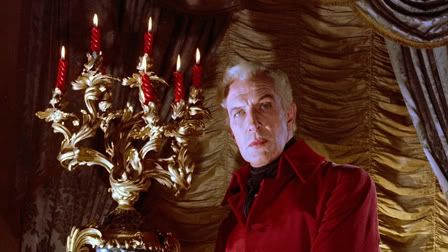
That it feels like a chamber piece as well, the rest of the small cast (including Harry Ellerbe as the servant Bristol) matching the tone as well as Price in his quiet but blatant unravelling performance, helps amplify its story. I will not spoil anything – compared to the DVD box itself on both sides – but despite the falling interest in these types of horror films near the end of the 1960s, The Fall of the House of Usher is still ghoulish and twisted even now, the overwhelming colours and tone, matching the symptoms of sensory saturation the Ushers suffer from, adding to the perverse nature of the story. It may be a lot more blatant in its presentation of what Poe would write in his stories, but the sense of the horror and madness, as vivid and upfront in his literature, is still there and done with great respect.

From http://i14.photobucket.com/albums/a301/deadmissbates/usher.jpg

Thursday, 4 October 2012

It Came From Within... [The Guyver: Dark Hero (1994)]

From http://www.assaultonplaneta.com/wp-content/uploads/2012/08/guyver.jpg


Dir. Steve Wang
USA
Film #3, for Wednesday 3rd October, of Halloween 31 for 31

Practical and computer effects have been a major sticking point for anyone who caught the bug of genre cinema. CGI, after replacing almost all practical effects in mainstream and genre cinema after 2000, has been kicked to pieces by fan communities for years and I myself have contributed a few punts into the ribs while it was down. However it is not the fault of CGI itself – it is a tool that needs good craftsmanship to use. Even bad computer effects, or dated effects, can have a beauty (intentional or not) if it matches the context. If used subtly, it works greatly, or if used as an intentionally artificial or cartoonish flourish, it adds to the mood. The problem is that, as a tool for art, it is used because it seems to be what should be used rather than the right tool, probably more the case than for budgetary reasons, overused and without artistic consideration in most films. It either is a hollow mess with no emotional or primal effect to it, or if done in a way that is ‘supposed’ to be bad (rather than using ‘bad’ techniques purposely, or admitting its artificiality, to disrupt the sense of verisimilitude or adding an unrealism to proceedings), comes off as lazy, as with most intentionally ‘bad’ films in general let alone their production ideology. Practical effects can be just as badly used though, and like CGI, it needs the right craftman (and in all respect an artist like a film director) to use it properly. Why practical effects are so loved however, aside from the obvious nostalgia of the previous eras of genre cinema, especially the 1980s where it had it glory days, is that as physical material or a trick involving existing objects it also evokes the feelings of texture and material, flesh and bodily fluids, metals and mechanics, physical presence to the space away from the effects, and so forth. Practical can go from a simple blood effect to reaching into other artforms such as illusion and puppetry. CGI is closer to animation, and its unlimited possibilities, and even as far as illustration and painting. Practical effects go into sculpture, performance art and tangible creation. Bar the few examples that blur the lines, and the times when CGI and special effects are used together and cross each other lines separately, CGI is more of an art of the eyes and subconscious thought if viewed away from the obvious exceptions, unbounded by physical restrictions, while practical effects are a conscious art that evokes one’s ability to ‘hold’ something, or feel the space of a body or entity distorted or be abstracted under the contradictions of the creator’s imagination against the limits of the optical illusions or materials in their access. And when you have trained stuntmen and martial artists, in practiced fight sequences, in rubber monster suits combating each other the physical aspect of practical effects is taken to a literal idea.

From http://s3.amazonaws.com/auteurs_production/images/film/guyver-2-dark-hero/w448/guyver-2-dark-hero.jpg?1289461430
Adapted from a manga by Yoshiki Takaya, and made after two animated adaptations in its original home of Japan, The Guyver: Dark Hero is a sequel to a previous American adaptation called The Guyver (1991) which had Mark Hamill in its cast, and watched by itself there is the obvious issue of the introductory set-up being missing. I have not seen the first film yet, although in my favour I have seen the 2005 animated TV series and padded out the missing information, despite the localisation differences, from there. Past the missing set-up though for the whole concept, the story is rudimentary so that this does not become a problem when you have the gist of what is going on. Sean Barker (David Hayter, later screenwriter for comic book adaptations such as X-Men (2000) and Watchmen (2008), and voice actor for Solid Snake in the Metal Gear Solid videogame series) became fused with an alien symbiote/weapon known as the Guyver, able to cover the host with an alien bio-armour with provides him superhuman abilities and an arsenal of weaponry. Driven by its infection of him, Sean follows a lead at an archaeological dig to try and discover the origins of it. Unfortunately, member of the Cronos Corporation, the villains of the original Japanese work and the first film, are prowling around the site, made of beings known as Zoanoids, men who can turn into beast humanoids of immense power. Power Rangers, Japanese pop culture entertainment involving its heroes fighting Kaiju and monsters, and considering its origins as a manga and its anime adaptation, the influence of them, all are mixed into this. Then of course is the specific melding of animalism, body horror and biomechanics that has permeated Japanese culture, and is distinctly their own compared to Western examples of the same concepts, that director Steve Wang and the production team perfectly recreate in an American context.

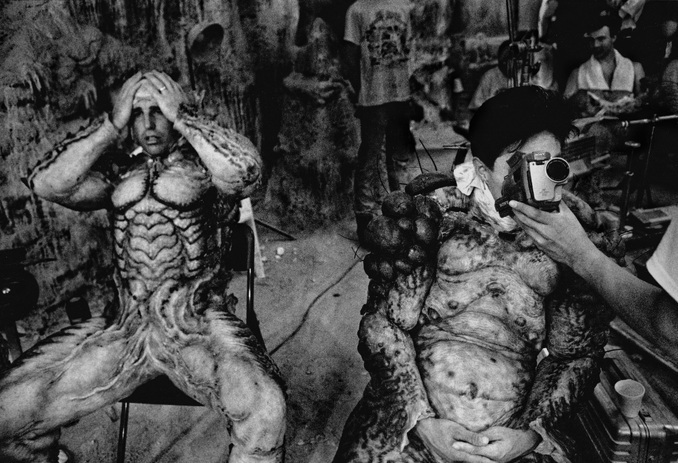
I will be honest, as a narrative film it really is not that much to praise, as if the putting together of scenes and the whole film, but it survives these glaring flaws as a worth viewing movie because the practical effects and the fight choreography is so imaginative and well done. Yes, aspects are dated and the film is not for everyone, the concept of men in rubber monster suits fighting each other a base thrill, but the vivid melding of the physically startling (beast men, bio armours, the flesh and viscera construction of an alien spaceship discovered early in the plot) with solid stunt and combat work is a pleasure in its own right. Base thrills can be more powerful and inspiring than ‘deep’ thoughts, especially when you can see the love poured into this film just in the beast man designs. If more straight-to-video films, especially now in a perfect world, were like this fan culture would be one closer to genre heaven. And this film fits the mood for Halloween. If the concept didn’t slide into horror tropes already, the franchise is known as an ‘ultraviolent’ work, the American adaptation surprisingly bloody; that most of the victims are in non-human forms is probably why this had a 15 certificate for its (long out-of-print) UK DVD. Gore and the joy of its spilling in a fictional context is a fickly and controversial subject in any entertainment, which we can enjoy but even in this film needs to be paused on for a second by me considering how surprisingly gruesome this can get for its age certificate. It does add a necessary sense of brutality to the combat considering the science-fiction and body horror tropes pull in weaponry and inhuman abilities into the basic premise, probably faithful to the original vision from I can pull together about it. It also avoids becoming vindictive and callous in its violence, despite at least one moment of ocular trauma that generated a cringe from me amongst examples, in that the sense of bodily manipulation is combined with a thread of gleeful Grand Guignol mentality to create something that sticks in the mind but never becomes numbing or alienating to a premise which is driven to entertain a viewer. The fights themselves regardless are impressive, considering the restrictions the costumes would cause in your mobility, even without the gore. Power Rangers was perfect to evoke as the stunt coordinator Koichi Sakamoto worked on many adaptations of that series (including the first one which I grew up with), the style of fighting exactly the same style but with concreteness absent from many films. The fights and stunts have a physical force to them, the contact with each other and scenery probably painful for the stuntmen even when wearing the suits. Any potential issues with it were obliterated with Wang’s 1997 film Drive with Mark Dacascos, one of the best American martial arts films ever made just in terms of the quality (and insanity) of the fight sequences and stuntwork, and the creativity behind it.

Aside from that this is a film which stands by its technical qualities in these areas, but stands so well with them that the foundations are prevented from collapsing like so many examples in the same areas do so easily. Again, if more films were like this in genre cinema, despite its major flaws in story and composition, the ideas and their recreation are beautiful to see by themselves, their macabre physicality evoking far more than a rush job, either with practical or CGI effects, would. That Drive (1997) vaulted this film in terms of quality confirmed that Steve Wang and his collaborators were sorely missed after the American release of Drive was botched miserably and shot the team’s kneecaps out from under them. Adaptations of other sources can be a miserable experience to sit through, its cemetery pilled with corpses of so many forgettable, lazy additions that the ones like The Guyver: Dark Hero which can climb out the pit of bodies, with its head held high and a severed spinal column of a weaker film like Green Lantern (2011) in its bloodied claws, even in 2012 is impressive to me. 

When the Zoanoids are on their breaks from their plans on world domination.
From http://www.automation-drive.com/EX/05-13-11/Guyver_2_suits-Edit-large.jpg

Wednesday, 3 October 2012

An Inch Above Sand [Them (1954)]

From http://imagecache6.allposters.com/LRG/40/4058/AMKLF00Z.jpg

Dir. Gordon Douglas
USA
Film #2, for Tuesday 2nd October, of Halloween 31 for 31

While we may laugh at the saucer-tin saucers and the effects, modern film viewers forget that the American science fiction B-movies of the 1950s are all inextricably connected to the culture they came from. Following an outbreak of giant ants that have grown because of nuclear radiation and may become a threat to human life, this is completely threaded into fears of the nuke and nuclear fallout  of the period, after the atomic bombings of Japan and the after-effects, and in the middle of the Cold War and the fears around it. The film also admits that for most human beings, insects are disgusting creatures to them. Completely different to mammals with their exoskeletons and their mandibles, insects along with other invertebrate species are unsettling in their differences to us.

Considering all the other giant/killer/mutated animal films throughout cinema, from giant shrews to sharktopuses, rabid dogs who were once loving companions to our (potential) evolutionary ancestors the ape, humanity fears even its own fellow mammals, and all other species, subconsciously. Despite our apparent higher consciousness, and souls depending on your spiritual beliefs, we still cannot stand that the ‘mindless’ animals may survival long after our species perishes or that, if the favour was tipped to the other’s side, the chances of staying in the top rungs of the ‘survival of the fittest’ would be 50/50. As one of the characters points out directly, ants have intelligence and are a species with a concept of war and hierarchy, and if they developed higher intelligence, or grew to the size of the ones in Them, it would make them difficult competitors in a conflict with us. All genre films, even if it involves accepting many are made for money only and having to either improvise or pull ideas out of your backside, show metaphors and fears of humanity within them regardless of the quality of the product itself, or at least show a perspective on social anxieties and thoughts. And it doesn’t have to descend into pretentiousness either as many can be read immediately and sometimes just before watching the film, only adapting it afterwards and the actual material redevelops the establishing thoughts. The films so far for my Halloween viewing all have layers even if one was paper thin. Vampyrs (1974), the aborted first film for my work which is still useful to pull from and as a scapegoat until I get over it, continues vampirism as a metaphor for libertine, alternative sexuality viewed as evil and degenerate by stereotypical Western, heterosexual, Christian society, and yet secretly is titillating and tempting, keeping with Christian issues of temptation and sin, especially if it involves nubile lesbianism. Even with the open minded liberals, including myself at my dumbest, they can see alternative sexuality as merely exotic titillation and nothing else, especially if it involves nubile lesbianism. Footprints On The Moon (1975) depicts a metaphor of how psychological breakdown can be viewed as completely alien, sending sufferers into places of their mind different from the world around them, and something that merely exists on another planet to certain members of society who wish to ignore it. Them shows how, despite our apparent love for animals (usually the cute ones), most of us subconsciously hate the fact that we’re animals like the untamed ‘them’, part of the food chain, and would want them removed, or eliminated with fire, from our human society. Also the fact that, if one grew to the size of a small skyscraper, we would fall to the bottom of the food chain immediately. That Godzilla has ‘God’ in his name may have more metaphorical significance then we all thought...that and the fact that, considering their history of Kaiju films I’ve still to dive into, the Japanese still show utter respect and understanding to nature and animalism even if its rampaging through Tokyo nearly every week and scaring the tourists.

Them does suffer when the ants are finally seen. It is solid, nuts and bolts filmmaking which does suffer from its constant expeditionary dialogue, and desire just to show mechanically created ants menace the cast and not go further with it, far from the opening segment where there is quite a menace that the preconceived notions of this film did not inform me of. Destroyed, isolated areas, bizarre noises in the vast emptiness of the desert setting where it starts in, traumatised children, all established by considerably striking black and white cinematography. As invisible menaces, even if you know what to expect and what they look like, they are sinister, hidden in the outdoor landscape despite their size and yet able to create vast amounts of casualties and damage. When the awkwardly moving, but visibly impressive ants do appear, the film sits a little on its laurels onward afterwards around them. That said it was still solid, good entertainment that gets over this problem, one of the few films in a while that was able to find humour in itself and yet, impossible to do now unless someone was brave enough, taking itself seriously and was matter-of-fact within its world. Almost every character accepts the concept of giant, radiated ants as true and get on with their work, while most genre films in the sixty or so decades afterwards would have the protagonists spending whole chapters of a film convincing people they are not crazy and this is actually happening. It’s refreshing when most of us horror and sci-fi fans are probably excruciatingly sick of the cliché, and I am surprised by a more ‘naive’ film from a ‘naive’ era cutting through the cop-out pretences and getting on with things. Also despite its flaws, Them still has the advantage in that, combining its premise with practical effects, it has the sense of the icky fantastic; the scenes likely to stick in my mind are within the ant’s nest in the desert near the beginning, vast isolated tunnels in the earth full of giant ants and egg sacks. I can’t help but reference videogames with one of the few I’ve played in years, and the rare one I actually loved, called Earth Defense Force 2017 (2006), whose primary enemies were huge swarms of giant ants and had countless levels in repetitive, claustrophobic mound tunnels; the game has probably made the already great Starship Troopers (1997) more entertaining as well as a satirical gem, and as a B-movie game probably influenced by this and Japanese cinema, it has made films like this for more joyfully engaging in their imaginative pulpiness. That it has the seriousness too and explicitly weaves ideas of the Cold War, atomic power and our fear of primitive animalism within its B-movie story adds to its charm. Eventually I may encounter a ‘bad’ film and have to review it, unlike Vampyrs, but two days in there is this great optimism that even the films like this - which despite its classic status and Oscar nomination for effects is a true B-movie at heart and is unapologetic about it like true art - will stick out and not waste time with laziness. It helps that, in reference to the introductory post I wrote before the reviews that, when talking about films you find in your local library that give you something different, this was a DVD I kept seeing in my local city library and was not disappointed by when I finally rented it. While most of the films the library stocks are new releases, regardless of the few eclectic choices, it’s nice to see a fifties film, an old timer, snuggled just above the children’s section and near films like Who’s Your Caddy? (2007) waiting for someone to catch it out of their eye out of intrigue. 

From http://s3.amazonaws.com/auteurs_production/images/film/them--2/w448/them--2.jpg?1289438382

Tuesday, 2 October 2012

...live well for less than you can remember. [Footprints On The Moon (1975)]


Immediately in the gate, and there was a hiccup. Originally the opening film for this Halloween project was the 1974 erotic vampire movie Vampyres (directed by Jose Ramon Larraz), but the film turned out to be a middling chore to sit through not worth a full review. Like many genre films from the United Kingdom, (even as a Brit who wants to love the concept of them as a fan and in a patriotic way), they, the older ones especially, can be immensely disappointing and tediously made – dull story, pedestrian cinematography and editing, strung together by dull exposition dialogue and, with Vampyres’ case, a stilted take on sexuality and the erotic (bar the humbly beautiful Sally Faulkner who is far more interesting and physically attractive in her ordinariness on screen than the generic, forced beauty of the lead actresses Marianne Morris and Anulka who get top billing above everyone else in the cast). There are of course exceptions which are great British genre films, but consistency has probably been the problem that has prevented us from having a continuous flow of films being made until the 2000s onward. British cinema can fall into an inadvertent awkwardness with the quality of the films which causes many to be poor as a result...which digging through the barrel of 1970s films especially means that, for every fascinating one (such as the famous cinematographer Jack Cardiff’s bizarre Freaks remake The Freakmaker (1974)), there’s many more bad ones.

I had a replacement thankfully at hand, the original choice for the Tuesday 2nd film, not a horror film in the conventional sense but something worth its weight amongst the potential inclusions later down the line. With its cold, strange air it was the perfect choice to start off the monthly series...

From http://i19.fastpic.ru/big/2011/0413/e5/c81fadd174dec2dba7fb0501120160e5.jpeg


Footprints On The Moon (1975)
Dir. Luigi Bazzoni
Italy
Film #1, for Monday 1st October, of Halloween 31 for 31

From http://s3.amazonaws.com/auteurs_production/images/film/footprints-on-the-moon/w448/footprints-on-the-moon.jpg?1336315890
Fittingly the debacle with Vampyres perfectly sets up the virtues of the curious Footprints On The Moon. Everything Vampyres does so flatly, the Italian mystery drama did right and feverishly. Following the confusion of a woman Alice Cespi (Florinda Bolkan) as she suffers from three days of her life missing from her memory, the film is an immensely slow-burner, one which requires great patience but rewards in the end.

The Italian genre films especially in their boom in the 1970s seem far more consistent than their British equivalents from what I’ve seen. Of course, there are plenty of terrible films but probably one of the biggest advantages they had was that the quota of talented individuals in directing, scriptwriting, composing, cinematography and many of other areas of film production was far more noticeable on surface level. Even figures like Lucio Fulci, who are as well known for the varying quality of his work as well as his best amongst his fans, backed up his reputation with the creativity (and a nihilistic personal voice) to craft together even the lowest of budgeted material into something memorable or legitimately great. As the first film I’ve seen from director-writer Luigi Bazzoni, co-written with the author of the original novel (and possible co-director of it) Mario Fanelli, he is a capable director worth looking into. Their script is the best of the work. Delving into the well worn clichés of a main character potentially having a double, or is losing her sanity, bluntly, they yet avoid a laboured work by shaping it into a quietly moody, unbelievably quiet and gentle paced, potboiler  which is immediately unconventional from the first few minutes on. The considered but cold air of the film, in pace and story threading, is matched by an ever growing string of threads. Alice goes to the island of Garma for most of the film, a place she hasn’t been to but may have had, time wounded by holes within its linear line in which either duplicates exist or even a timeloop in the reality exists, and even if the film stays grounded within a realist logic to its tale, following Alice’s perspective and the mood of the film leaves us in a mindframe where anything could happen – reality doubling over itself, replicate itself, remove parts of Alice’s actions from existence, or putting it in random order – and time’s sense of cohesion is smashed to pieces, like the rhythms of music are broken and rearranged into new orders by an experimental rock band of the period, while still remaining in its original shape behind the elusive veils that throw us off. Footsteps... pushes itself into further reaches of the peculiar writing choices by Alice’s constant dreams of an astronaut being left stranded on the Moon as a guinea pig for a survival experiment. Said to be memories of a film she found too distressing to see all the way through, the film splits its own skull, its brain, in a meta-textual way with the fictitious movie, moving between On The Silver Globe-era Andrzej Żuławski images on the Moon itself and scratchy, black and white scenes of scientists watching the proceedings on TVs and controlling them. Is Klaus Kinski, playing the corrupt scientist Blackmann who orders the proceedings, actually playing himself within-a-genre-film-within-a-genre-film, his dubbed-in English voice played on by the presence of non-English subtitles translating his words, or is it merely a twisted fever dream of Alice’s mind in celluloid form, the best kind of material form even above television to have nightmares through? Kinski was already in many genre films by 1975, including Italian spaghetti westerns, so the inspired tangents Bazzoni and Fanelli created for the film possess an ability to self-reflect on themselves - as merely cinematic tropes - as well as pull the rug out from under the viewer continually without fail. That the UK DVD, the only release, to my knowledge, that is available globally, is a hybrid of the best surviving materials of a sadly neglected film adds to the intangibility of the final product. Picture quality can suddenly shift, and for certain scenes that may have been removed to trim the running time down, the English dub is suddenly dropped for Italian dialogue with subtitles for characters who were speaking English seconds before, an accidental flourish of inspiration when the protagonist translates speeches from one language to another, into text form, as a profession. If a better print could be salvaged, it would be for the better, but Footprints... continual sidesteps, until its neither showing its hand or being elusive about its plot, a half space inbetween where the oppressive but mysteriously compelling atmosphere pulls you further onwards, allows technical issues with the source prints and their availability to increase its abstractness.

To Italian genre cinema’s help as well was that the best in its country’s cinematic talent truly did work on the films and put their best work out within it as well as in prestige films. Ennio Morricone’s genre compositions are as well loved and praised as his work for his later compositions for prestige films or for the legendary Sergio Leone westerns. For Footprints..., not only is the editor Roberto Perpignani, who has worked with Bernardo Bertolucci to Miklós Jancsó, and contributes a lot to the film, but for cinematography Bazzoni had the legendary Vittorio Storaro. Within the same year of 1970 Storaro contributed vital work in crafting the masterpiece that would be Bertolucci’s The Conformist and worked on Dario Argento’s debut The Bird With The Crystal Plummage, a strong contender for Argento’s best film, showing the flexibility and craftsmanship the Italians had to switch from varying types of cinema, within bias, and create pieces of art. Vampyrs suffered from the same problem many films from around the world, ever area of cinema, every era include the current one, have in that it defensively goes with a ‘safe’ conventional style of scene capturing, the handheld of now or the static camera work of the 1970s that it is made of, consisting almost always of mid-to-close up shots of the actors and the actions taking place without real purpose, no sense of playing or tampering with the form to create effects, and more problematically, never letting the viewer sink into the environments and ‘feel’ the space of the locations and sets the plot is set in. You don’t have to have a Film Studies knowledge of types of camera shots like I had at college to notice this problem in many films – think how very little you actually ‘see’ in most films on screen, even those that claim to be expansive epics, and how repetitious it is (action film fans already know of this through the almost complete hatred of shaky cam fight scenes after an entire 1980s full of fights shown in their fullest on screen) and how a film like Footprints... thanks to  Storaro lets the buildings and architecture tower Alice from the distance and in close-up. Even with the jungle sets of Apocalypse Now (1979) and the comic book adapatation Dick Tracey (1990) and its primary colour, cartoon noir, Storaro is obsessed with space on screen as much as he is with colour and light, and within Footprint...’s abstract story the sense of space adds to the tensions Alice feels as conspiracy, doubles and a monochrome Kinski tormenting astronauts meld together. It also adds a romantic but elegantly distant framing to the events that pulls it away from its bizarre roots but makes it far more unsettlingly weird in its almost sweet and beautiful cinematography. This, combined with a score from Nicola Piovani, heightens the quality of the film, the music just as vital in taking you by the hand along in the disrupted threads of the story but also in its beauty causing the whole film (intentionally) to feel more alien in tone. One of the most potent examples of ‘odd’ cinema, as someone who was compiling a list of the ‘Cinema of the Abstract’ on this blog before this project, and will add this film to it, are those which match their unconventionality to a serenity and beauty in the quality of the work. From David Lynch’s Blue Velvet (1986) to even Pier Paolo Pasolini’s Salò, or the 120 Days of Sodom (1975),  when the truly stunning contributions to image, sound and music are added to material that is surreal, disturbing, and in the case of Salo, the utterly vile and horrifying, the mix of the different sides of the coin are strange bedfellows who are yet inseparable and may be twins and the same. Alice’s journey by the end of the film is both deeply unsettling but – from the first images of a space shuttle spinning closer to the Moon, the dated effects adding to the off kilter nature of it – gorgeous to view. That even a Frankenstein print, toiled on with clearly great strain and love from Shameless Screen Entertainment, clearly as well film fans who desperately wanted to pluck this obscure gem from the mire because they loved it and pass it onto other film fans like me, actually adds to its beauty as well as abstractions makes it a rare film. Whether you can get with its slow pace, almost complete lack of blood and sex compared to other genre films from the country (the 18 certificate for the UK DVD is for the trailers for all of Shameless’ back catalogue they put on all their discs), and its desire with mood than rationality is up to you, but these divisive factors also can be said to be virtues as well. That Shameless released this as a ‘giallo’ on its back cover blurb is an understandable attempt to fit in into an established frame to entice the curious when the film itself is on its own existence. I thought it would be a giallo going into it but, despite my slim knowledge of the sub-genre, this is far from what I was expecting. Even compared to Argento’s least conventional contributions, Footprints On The Moon is either the most elegant and elusive siren within the Italian murder mystery fold I’ve seen, sat on a mass of intangibility in the clouds alongside the classical The Bird With The Crystal Plumage to the crassness of Umberto Lenzi’s Eyeball (1975), or in keeping with the astronautical theme, is on a completely different satellite in space to the entire sub-genre.