Sunday, 1 December 2013

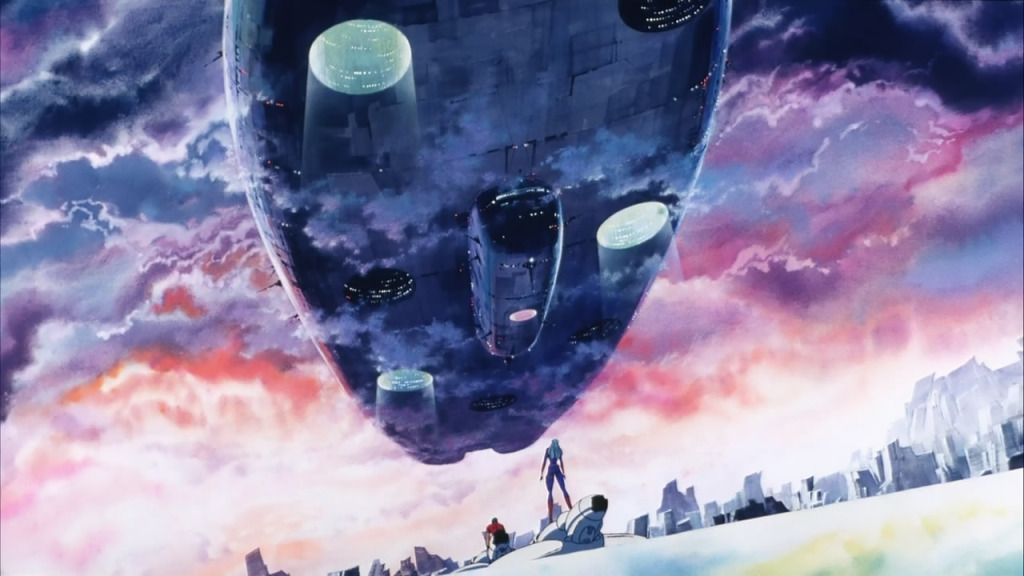
Clearing Through The To-Watch List #3 - Jinki: Extend (2005)

From http://upload.wikimedia.org/wikipedia/en/6/64/Jinki_Extend.jpg

Dir. Masahiko Murata

"Do I have to write about this? " "Yes, because you're a crazy completist!" "I'm wasting my time." "But you're a cine-masochist..." "But-" "-and will write about any anime you-" "But I didn't write about Cospley Complex (2004) and that was atrocious..." "Ignore that one." "Fine," I think to myself having this internal debate, "But I'm going to strop about it while the series is still warm in my mind." I found a science fiction anime series for cheap. Giant robots. Front cover of the first volume is two girls, one with black hair, the other blonde hair. First scene of the first episode is them, older, fighting each other in "Jinki" war robots in the centre of Tokyo. The blonde girl, drawn like a very cutesy, moe character, is the villain. Even in bad anime, how characters, especially female ones, have their eyes depicted when they've lost their sanity or moral compass is always artistically effecting. The stereotype of female character with eyes bigger than their heads has use when you can exaggerate emotions for potent effect. The other girl is the heroine completely outmatched. Clearly the series is going to skip back to when they were younger, together in the same training camp as friends, maybe as close as sisters, maybe a tragic back-story. It's obvious but you can get good powerful drama from the idea. This is not what you get.

The series is actually a mashing together of two separate manga into one narrative. It tries to be clever by juggling two different time periods but with a lacksidasical tone. The first is in 1988. The black haired girl, Aoba, is shipped off to a Jinki defence base against her will in Venezuela by her evil mother. Nonetheless she shows a superhuman ability, and enthusiasm, to pilot one of the Jinki that needs to be honed out of the unatheletic girl who was more interested in plastic model kits before. The time period is never told to us, and with any reason for why this alternative dimension is as it is for this advanced robot technology to exist in the eighties. The blonde haired girl, Akao, appears in this segment, but she exists more so for the part set three years later in Japan. A more advanced version of the Jinki defence force exists, with a whole group of girls and women piloting multiple Jinki. With no memories from before those three years previous, Akao also has superhuman powers of her own which are of interest to a dark group. Completely off topic for a moment, the main villain is a rather bland, height stunted masked man who is so much of a void I wished one of his barely seen minions stabbed him, Julius Caesar style, and taken over the world domination plan for themselves. But he exists and he's interested in Akao, with plans to pervert a girl who refused to fight into evil. A girl so much of an innocent that, unfortunately, to depict it there's one of her flashback memories, of how happy she's been with the Jinki pilots, of her being completely unable to open a packet of crisps without someone's help. Yes, some packets of food are a bugger to open but as characterisation of a female character I wouldn't be surprised if anime was dismissed as misogynistic for this sort of thing and an insult to crisp packet manufacturers. This moment happens long after it becomes clear that Akao, along with all the other characters, even the more sparky Aoba, are pretty one dimensional. In the first few episodes the white elephant already went to sitting on top of me refusing to be ignored. The young, innocent Akao, turned into a killing machine, piloting a leviathan sized red robot, with dead eyes is a starring character of a badly put together, cheap looking series.

At thirteen episodes, there's far too many characters and plot points to cram into them, especially as this is two manga set in the same world being combined together. The story actually had to be finished on the twelfth episode, the final one an epilogue as a DVD extra. It is a complete mess. It might have worked regardless of the squashed length. Hades Project Zeorymer (1988-1990), giant robot sci-fi too, was four episodes with far too much plot to cram into them, but not only was it good hand drawn animation, with great robot designs, but the plot was an amazing dramatic sucker punch regardless. Jinki:Extend is bland. Generic plot. Paper-thin characters. Beyond Aoba, the female characters, who dominate the show, are less like real female characters then strange perceptions of femininity written by isolated males. The girls are submissive, despite being pilots of city destroying war machines, easily breakable or/and mentally nonexistent. It comes apparent too this series is trying to rift on Neon Genesis Evangelion (1995) in being dark, but never succeeding. I'm flabbergasted, despite having legitimate problems with it, that I could have hated that acclaimed series  at the same level as something like this. "Why?" I ask myself, "Because I'm an idiot."

Fan service creeps in slowly. Aoba is caught with her pants down a couple of times. Eyes roll. There's a clear attempt at potential underage Sapphic passion that's not edgy, in this TV friendly work, not character building or romantic, but a lame attempt to keep the male otaku happy. Indeed, when they meet again, discrete under the sheets, two characters fondle each other admiring how much they've "changed" everywhere on themselves, not with an (admittedly) perverse take on horseplay between two girls, but because, hey, let's drool over underage animated girls groping each other. With an innocent casualness that's more disturbing than being explicit about it. A female character is from Nottingham, England, raising a brief smile cause it's not that far from where I actually live, but she's abruptly introduced late in the series, uselessly characterless, and is there only to have a character who wear shades, to be an adult with big breasts, and wear clothes to show said assets off without any sense of a person oozing sexuality and charisma. Then there's the creepy aspects which scuttle in through the later episodes in the Japan arc. Anime can be dubious, which I admit as a fan of it, completely offensive, but even something like The Legend of the Overfiend (1989) forced you to see the things it showed and the full horror being shown. Jinki: Extend is the first thing in a while that's made me sit up in some of the stuff it was showing, legitimately creeped out by its slapdash and casual use of some of the perverse material is references. It's even beyond having a female villain, randomly introduced later on, be represented as being evil by having her snog any girl in her vicinity, as if being attracted to the same gender is a villainous character trait on her bio. A female Jinki pilot, whose already depicted as a asinine, weak and frail archetype, is kidnapped by a man disguised as her older brother, who plans to pilot his Jinki in a later fight with one hand while the other "plays" with her. It's not played as a sickening gut punch or a trangressively potent comment, just an offhand remark that is flippantly suggested and never mentioned again along with his whole character. One girl is dunked into strange liquid which partially dissolves her pilot's suit, skin-tight as designed for male viewers, yet doesn't dissolve the ropes she's tied in, by another male pervert on the villains' side who, along with the scene, is never mentioned again too. The lack of actual explicit content and the rushed nature of the plotting makes this stuff pointless disturbing than important for the plot, which is worse than something that was being offensive on purpose. A key part of a relationship, barely sketched out anyway, is that one of the people within it was raped and she still gave birth to the child conceived. The discrete, flippant tone of the off-screen rape, and the plot reveal, barely mentioned again too like the other examples, is in all serious far and away more objectionable, when such material can be written in half heartedly because it seemed "normal" to have it done in the narrative.

Its despairing to defecate verbally on something other people worked hard on, but this is terrible. Characters look the same, confusingly, but on purpose for the plot. Some look the same but it wasn't on purpose. Major plot points and events are skimmed over, for being able to get the entire narrative gone in such a small space of time, but also for squandering it on the wrong things. The thirteenth, final episode is the one that actually has some virtue. It's nice that a character has some back-story from photos and unprocessed photo film found in her old home, memories once lost rediscovered. Its legitimately funny when one girl, too young to drink, still pretends to be drunk for fun, as every girl is firing off twenty year old fireworks that still work in a back garden, to the bafflement of others. But it's too late. It cannot save a bland, forgettable anime. And it can't save it when the characters had no personalities before and when some were pointless molested in an occasional, out-of-place sequence in a previous episode. A paradox is created. Why review something no one would want to watch?  Catharsis. To get something of worth from my wasted English pounds. To warn people off it. To cause people to remember this series, blocked in amnesia by its blandness, reading this and remember how bad it was to share the pian. If a fan of Jinki:Extend, if one actually finds this, gets annoyed, and tries to convince me to try it again, or read the mangas, although it would have to be a bulletproof argument to even consider doing so. Because I'm a masochist who will cover any anime I watch. Admittedly I did skip over reviewing one as stated in the beginning, but that might be the exception. I may stupidly rewatch it just to review it. But in this case, Jinki:Extend is just horrible even for someone fond of collecting bad anime along with the good anime.

Saturday, 30 November 2013

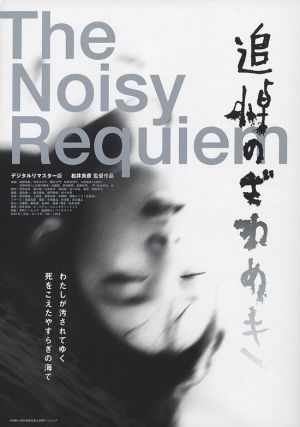
Nihilistic Love: Noisy Requiem (1988)

From http://i1253.photobucket.com/albums/hh590/thedarkpoet411/11158629_800_zps1bed6e82.jpg

Dir. Yoshihiko Matsui

Noisy Requiem is set in desolate places. Junk yards. Building rooftops. Red light districts and pachinko parlours. Obscure business offices. Backyard fields of weeds and industrial concrete. Any contact with the wider world, in this independently funded film, taking my steps into the rarely available jishu eiga underground films, is 'stolen' with documentarian capturing of the images without permits. Or distant like there are glass walls and ceilings baring the characters of the film to be noticed. In some cases the outside world runs away from them. It is mostly slum area. Shin Sekai, Osaka, a place of immense homelessness. The entire economic and social ups and downs visible on the locations onscreen like if you could film the council houses here in my own country. There is a violent young man whose only existing love for another, any love to anyone as he may even hate himself, is for a female mannequin, planning to raise a child with her. Going as far as giving her the organs needed from unwilling donors. A man and his very young sister, his care for her beyond convention. A homeless man who drags around a tree stump the shape of the lower half of a woman, perfectly so you wonder if a poor tree nymph was killed and cut up for firewood. A midget brother and sister, who run a sewer cleaning business, she feeling the immense distance from the world and progressing to random acts of destruction in a need she may not even know of. It sounds purposely transgressive. It is trangressive. It breaks so many taboos. It sounds absurd and the Japanese answer to Pink Flamingos (1972) before Takashi Miike's Visitor Q (2001) came to existence. People would dismiss it as another example of weird Japanese cinema, but with only the films to go by themselves, in their own worlds and contexts, many of them are more reflecting and artistically minded than you think.

Noisy Requiem is black and white. Beautiful in its ugliness and ugly in its beauty. Made independently, director Yoshihiko Matsui used the fact he was making a guerrilla movie to his advantage. Handheld cameras move with the dexterity I've only seen in the films of Akio Jissoji. Encapsulated, as the violent young man berates two disabled veterans of World War II, by the cameraman running around the water fountain behind them, on the other side secretly hearing on them and not getting involved, twirling around, thinking better of it, and running back to watch defencelessly as the violent man eventually gets a claw hammer out of his back pocket. Tinny synth doesn't detract from the film, and there is moments of tender piano music to counteract this music choice. To get high, almost eye-of-God shots, someone sat on a roof. Recording in one scene schoolgirls, like the pigeons the young man kills in the beginning, fleeing on  mass like running, liquid mercury. A rooftop was set on fire, and the person(s) who hid filming real fireman assess the damage never got caught and managed to get the footage into the film. Independent cinema here is suicidal in its bravery in getting the shots desired. In trying anything. Blurring the lines between fiction and real when it seems characters are hassling real people. It is not a static camera in a room filming dull conversation between the characters no one cares about like in other films.

You are forced to follow characters who have no moral grounding. There is incest. Blood. The desire for another literally consuming. But Matsui is on their side, having called this a film about true love. "True love", such an odd choice of words at first against such nihilistic, taboo breaking material where someone shows their love to another, a mannequin, by licking bird shit off their cheeks. But even if the characters could never be real, at least to a rational, "normal" society, the film is calm, lingeringly slow to the point you follow it carefully. Rationalising this behaviour from the characters' perspectives. Some of it is so twisted its sickly humorous, but you feel pity, then ask if they're the miscreants or if the ordinary public barely seen are worse. The only people from this part of the society, who are sympathetic and aren't faceless, are two schoolgirls in the beginning. One recounts the dream she had which is the central idea of the film, a white dove prevented from getting seeds by pigeons, and turning into a black crow who kills to survive. To live in this film's outskirts, you have to even harm other, and normality itself can be even more grotesque and sadistic, as takes place on a public bus full of bulling, sideshow caricatures. The main characters for all their crimes they commit are trying to rationalise their own existences let alone the one outside theirs.

At two hours, nearly forty minutes, Noisy Requiem becomes trance-like. You stop being offended by the content because you're living through the characters' eyes for so long, the daily rhythms, that you live in their place outside of perceived existence. Switching between characters, the film becomes confusing at times, what actually is happening in reality up for debate, but keeps a consistent and enticing tone. Fantasy eventually breaks through to sit alongside the disgusting, vomit and blood matched by rivers existing on rooftops and a split in time, a split of a body into two, long before Uncle Boonmie Who Can Recall His Past Lives (2010) did it too twenty two years later. If the film is depressing, it at least gives you characters to care about. If its vulgar and offensive, it at least lingers on the aftermaths with thought, that causes you to actually feel pain than let the incidents merely pass, as if they were acceptable, as in politer mainstream films. If it's rough, messy in presentation, maybe too long, it at least tried. And trying means more when you see a film like this that feels something. Characters searching for true love. All from an area completely isolated from the rest of the world. The homeless, the lost, the physically and mentally disabled (by birth, by accident or by war), those born with dwarfism, minorities or those to paraphrase Hunter S. Thompson are "too weird to live". Pity changes to showing your own hypocrisy. Even if these fictitious characters are miserable, at least they're trying to live. The last image of the film is an extreme close-up of a woman's face. You've seen her wander aimlessness. And the film actually makes you care for her when something else would make her a freak to gawk at or to only pity with a clear distance between you and her. There's no distance in Noisy Requiem.

From http://s3.amazonaws.com/auteurs_production/images/film/noisy-requiem/w448/noisy-requiem.jpg?1289474103

Thursday, 28 November 2013

Videotape Swapshop: The Falls (1980)

From http://petergreenaway.org.uk/fallc.jpg

Dir. Peter Greenaway


Birdmen. Human flying. Bird puns. Bird films. Avant-garde films. Twins. Faux twins. Typo errors. This and so much more exists in The Falls, a film that is both hilarious and profound. That's all I really need to say about it.


Review Link - http://www.videotapeswapshop.co.uk/18102/the-falls-1980-director-peter-greenaway/

Tuesday, 26 November 2013

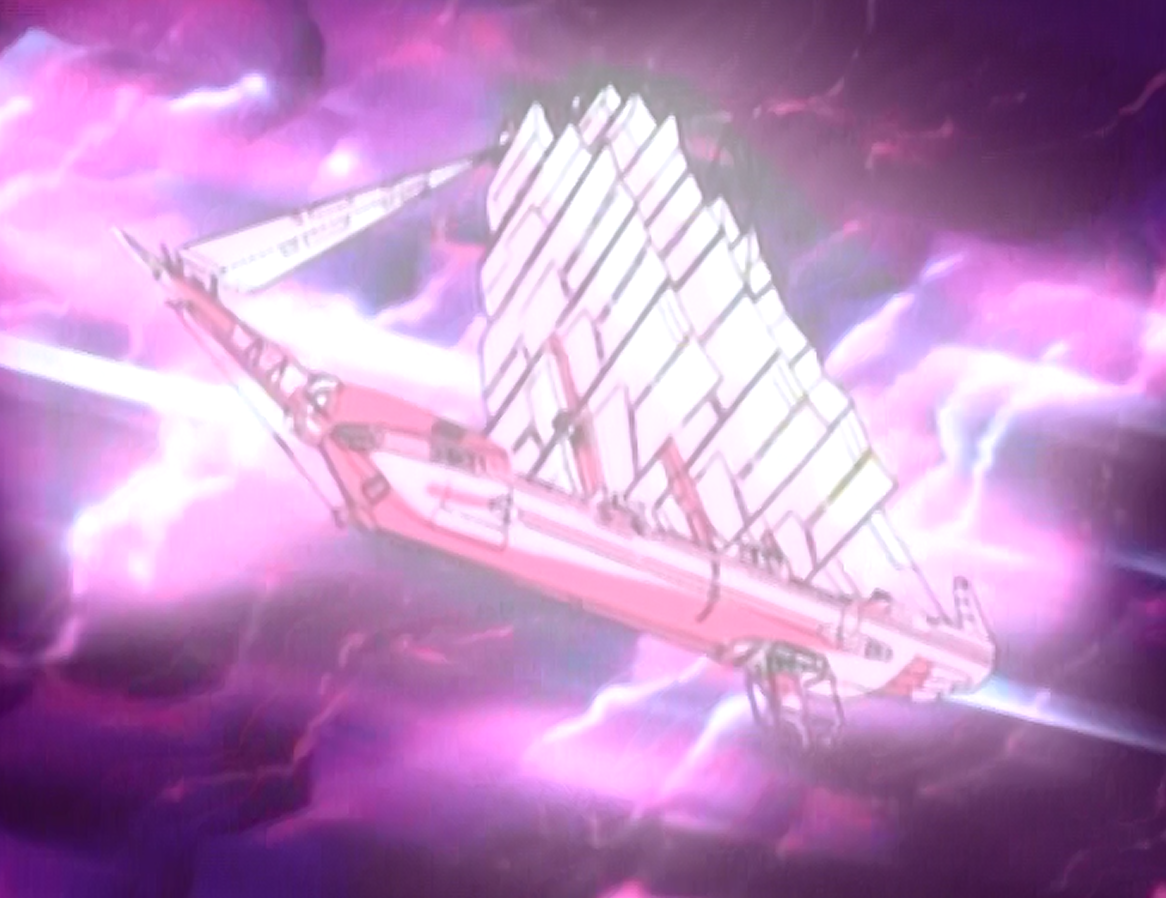
Going Through The To-Watch List #2: Odin - Photon Space Sailer Starlight (1985)

From http://merryfrolics.files.wordpress.com/2006/04/odin12.jpg

Dirs. Eiichi Yamamoto, Takeshi Shirato, Toshio Masuda and Yoshinobu Nishioka

Odin... is a folly. Its negative legacy is understandable. It has so many problems. Tonal ones. Length related ones. Consistency ones. But I cannot hate it. I'm drawn to films this sincere in their failure. Plus there is much worse in existence. Really much worse in existence in animation and live action. This was a cakewalk for me for a film infamous for its length. When you get into world cinema through Satantango (1994), that's nearly eight hours long, you've jumped into the deep end of the cinematic swimming pool rather than start with the arm floats in the kiddy one. I can think of ninety minute films that have felt like dental operations compared to this one's lengthy stroll. The film, past this, is a mega budget folly in the truest sense. In anime there is a series called Space Battleship Yamato (1974-1975). One of the most well regarded anime ever made. One of the most loved. Ordinary people on the street in Japan, even if they are older now, know of the show not just a small club of otaku. One of the creators, Leiji Matsumoto, became incredibly famous. The other creator, the late Noboru Ishiguro, has contributed a great deal to the industry but he was also notorious with stories under his belt. One of which involved live howitzer shells. Odin... was supposed to be a landmark. One of the highest budgets for Japanese animation. It shows. The first part of a planned franchise. It failed miserably and the result is usually scorned.

A test flight of a new experimental spacecraft, designed to look like a sailboat but laser and gravity-based energy to propel its sails. The test is interrupted when the new crew get a distress signal on the other side of our galaxy. Finding only a female survivor, they are led on to a journey to a planet called Odin. The possibilities to travel light years ahead to a new civilisation are too tempting to the crew as they mutiny against their officers. Once on their way, they discover a threat to them and their own world. Pretty simple plot. The mentality of Star Trek for global exploration. Grandiose and for all mankind. The prologue is an elaborate story of the history of sailing on Earth. Vikings. Christopher Columbus. An ode to sea travel and discovering new land expanded to outer space for new cosmic sailors, with the mechanics for space travel in their world explained. All shown with a sombre narration and classical orchestration. Then suddenly the film proper starts. A space station where the test ship, the Starlight, will set off from. Someone suddenly appears on camera, pointing to the side and shouts "Go!". The young crew start running around like idiots on the ship for what feels like a whole music video. It is a music video. A cheesy and ridiculous glam metal job by Japanese band Loudness blares out over the images. Immediately there's a discrepancy. The orchestra has wandered off. Christopher Columbus's future generation are being propelled by eighties cock rock.

The schizoid tonal shifts stay. Serious melodrama at one moment, silly the next. It wants to be profound, fed by its high budget and wide eyed in its view of cosmic travel. But the music by Loudness  is there. And the rest of the score, while catnip for me, is still eighties dated synth. You immediately get the logic jumps in the script as it goes along. One key protagonist failed to get on the ship, punching his trainer in the final exam. Yet illegally commandeers  a personal spacecraft, gets on board the Starlight, and is not put in an improvised prison hold but allowed to help through the lark of the boatswain. The film cannot keep its point together. Its charmingly naive for me. So earnest and goofy at the same time. But you will laugh if the film doesn't drain you. Countless mentions of the "mizzenmast" will come as an improvised drinking game you will lose. The countless galactic navel laws broken in the name of exploring the universes have to be ignored completely. What's with the Norwegian references, alongside the ones of Viking mythology, and considering the sole female character is supposed to be Norwegian herself, Sarah Cyanbaker doesn't exactly sound Scandinavian either. When she screams she cannot take it, because it's too much, the film's fed a line into the hands of people whose brains were scrambled by the film and want to get revenge on it.

The film would have been good nonetheless for many, even unintentionally, if it kept itself focused. It has to be enforced how good it looks. When someone would be suicidal enough to do so much detail on each animation cel. The galaxies depicted are like that of acid rock music and someone staring at a lava lamp for too long. Pink nebulas. Strange machine men. Eighties hair. A random inclusion of blue, space snake-dragons made from blue fire passing through the stars that just looks awesome regardless. The ship's graveyard that exists out of time and dimension completely and looks likes the contents of a spinning colour wheel or of a Skittles bag. Action wise, the animation allows for dense, exhilarating combat sequences by themselves especially by the end. Yet the film is incredibly dumb alongside being this cool. It will have characters suddenly turned a function in the ship into, say, an improvised wave cannon just because. "Just because" is Odin's modus operandi. Usually it's a loved aspect of anime but here it's a complete jump required for some of the moments when whole plot trajectories are based around them. Then there is the bigger problem. The film is two hours, nineteen minutes long. I've said already that I have seen far longer work and that I resisted Odin...'s length and pace issues. I even like it's this long, when most anime is under ninety minutes feature length. But even I admit it feels too long, or actually, not put together well enough to justify the length. The film's not a piece of garbage as its reputation says it is, but for all its virtues, it's a structural mess. Four directors. Three screenwriters. I was grinning when the warp speed sequence for the Starlight was shown, golden orange glow blurring the entire screen, and still was each time, but having said that having this sequence five times at least in the film is overkill. It's not spectacular when the mutiny feels like when the crew ran around the ship like idiots in the beginning, with the same Loudness song, but funny. It's not a good idea to intercut the serious dramatics with unintentional humour. By its end its stating the obvious, naive views of human kindness and the coldness of machinery, while yet being about how great the robots look animated. And as archetypes the characters are barely detailed. Someone has a grandmother back on Earth, but he even calls her "Granny" and that's all we get of her or any person close to the characters. And at over two hours, it's going to feel long even for someone like me resistant to it, still able to feel the time pass despite being resistant to the brunt of the sensation. Even I confess to looking at the running time left at points and being amazed about how much more left there was of it.

The film is a folly of excess. It shines with beauty in its production. Its good intentions are nice. It's not a piece of excessive capitalist rubbish, wasting money for the sake of it, but a folly of someone wanting to make a work that moves metaphorical mountains. True mega budget films are like this. The virtues and the terrible mistakes both have to be admired to appreciate the whole film. When money was like tap water in the eighties, you got weird, obscure straight-to-video anime, it was possible for a film like Mamoru Oshii's Angel's Egg (1985) to be made and put in a cinema, and an attempt like Odin... at a spectacle wouldn't be seen as a really bad idea. But while I wish, too young and born in the wrong country to appreciate it from an eye witness's place, for this era to return, a large chunk of the remembered anime from that era, barring the few mainstream successes, weren't big hits. Even the big hits were hits for a cult fanbase of anime otaku. Its not dissimilar to live action cinema in the West at the same time. When Blade Runner (1982) was a film unsuccessful at the box office than a cult masterpiece.  Odin... tries to be something which makes it more rewarding. It's not merely being as average as possible. I can think of anime which is far more pointless in its existence than this one. I would rather have the majestic folly of this film, which tried its damned hardest but only failed. I can only enjoy its failure because it feels more genuine as well as being thick headed. The ending credits is live action footage of the band Loudness playing another song. Tight leather pants. Poodle hair. Fog machines turned up to eleven. A rudimental placement of the animated Starlight going over them. This is not how you're supposed to end a film trying to be serious, but what the hell? I have the song now on my iPod, knowing how ridiculous it is. The opening guitar riff is irresistible. It fits the amusing bombast of a film completely. The bombast of the film, no matter how misguided it was, was worth the spectacle. 

From http://operationrainfall.com/wp-content/uploads/2013/01/Odin-Screen-2.png

Monday, 25 November 2013

Videotape Swapshop: Space Adventure Cobra (1982)

Dir. Osamu Dezaki

This film has grown on me. The imagery. The sensuality. How damn cool it is while still being humourous in the same way the Lupin The Third anime I have seen is. Its sad that something this playful, that's not the ultraviolent anime of the nineties for men only, but more larkish while techincally beautiful and experimental, is missing now. It proves you can have a romp while pushing the boundaries of how animation can look. Without being silly because its able to be silly itself and completely sincere in its too. I can hope one day that this changes, when everyone gets bored with anime high school, or the industry collapses and the crazed offspring of the most die hard animators, who wanted to cut their teeth on their own work, get the chance to try something. I'm hoping for something ludicrous, but something this awesome and fun is something I'm begging more for.

Review Link - http://www.videotapeswapshop.co.uk/18173/space-adventure-cobra-1982-director-osamu-dezaki/

From http://i835.photobucket.com/albums/zz278/Jexhius/CobraTheMovie.jpg

Saturday, 23 November 2013

Videotape Swapshop Review: The Awful Dr. Orlof (1962)

From http://wrongsideoftheart.com/wp-content/gallery/posters-a/awful_dr_orlof_poster_07.jpg

Dir. Jesús Franco

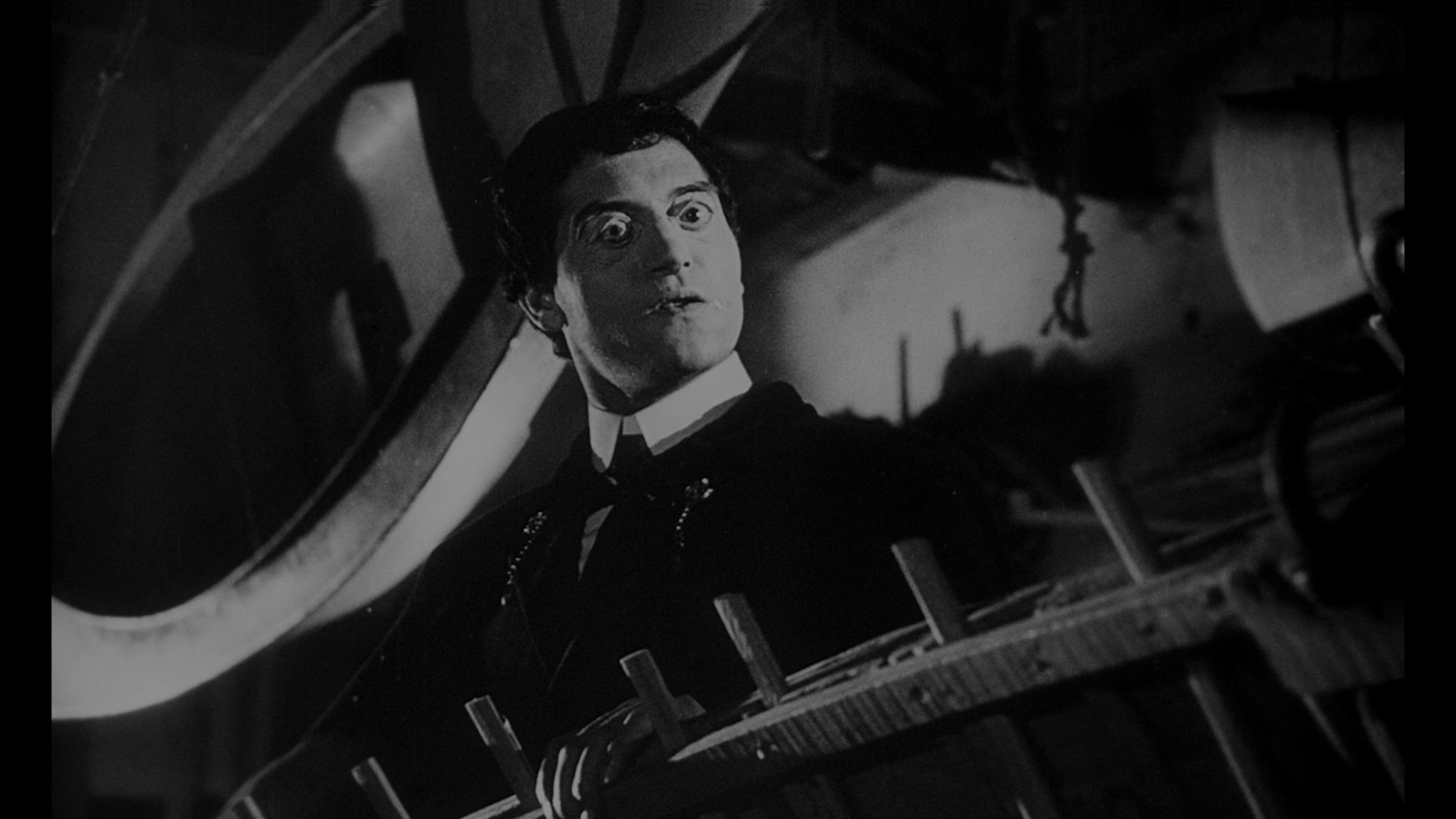
Another Videotape Swapshop review, and more Franco. Like a reliving high, I can jump back to reviewing another of his films and always find something of interest. Only my own inconsistency with using Jesús and Jess for his first name is going to give me grief one day if I don't get a consistence first name moniker for him in my writing, especially when I'm LONG before ever getting through a quarter of his work. I was thinking about starting on another director, next year, that I felt I had barely seen work from and wanted to compensate for the embarrassment, but I had to choose a director whose filmography is over the hundreds as the first, meaning I'll be with Franco for a while at the same time. Its damn great to be watching his works which is the thing I'll be going to in my mind every time I think this, and I only wish I started becoming a fan of his while he was still alive. But as I watched this early work of his, I can say fully that he left a vast library of work that expands when you think you've pinned the late Spaniard down fully in tropes.

Review Link - http://www.videotapeswapshop.co.uk/18154/the-awful-dr-orloff-1962-director-jesus-franco/

From http://www.mondo-digital.com/awfulorlof4big.jpg

Thursday, 21 November 2013

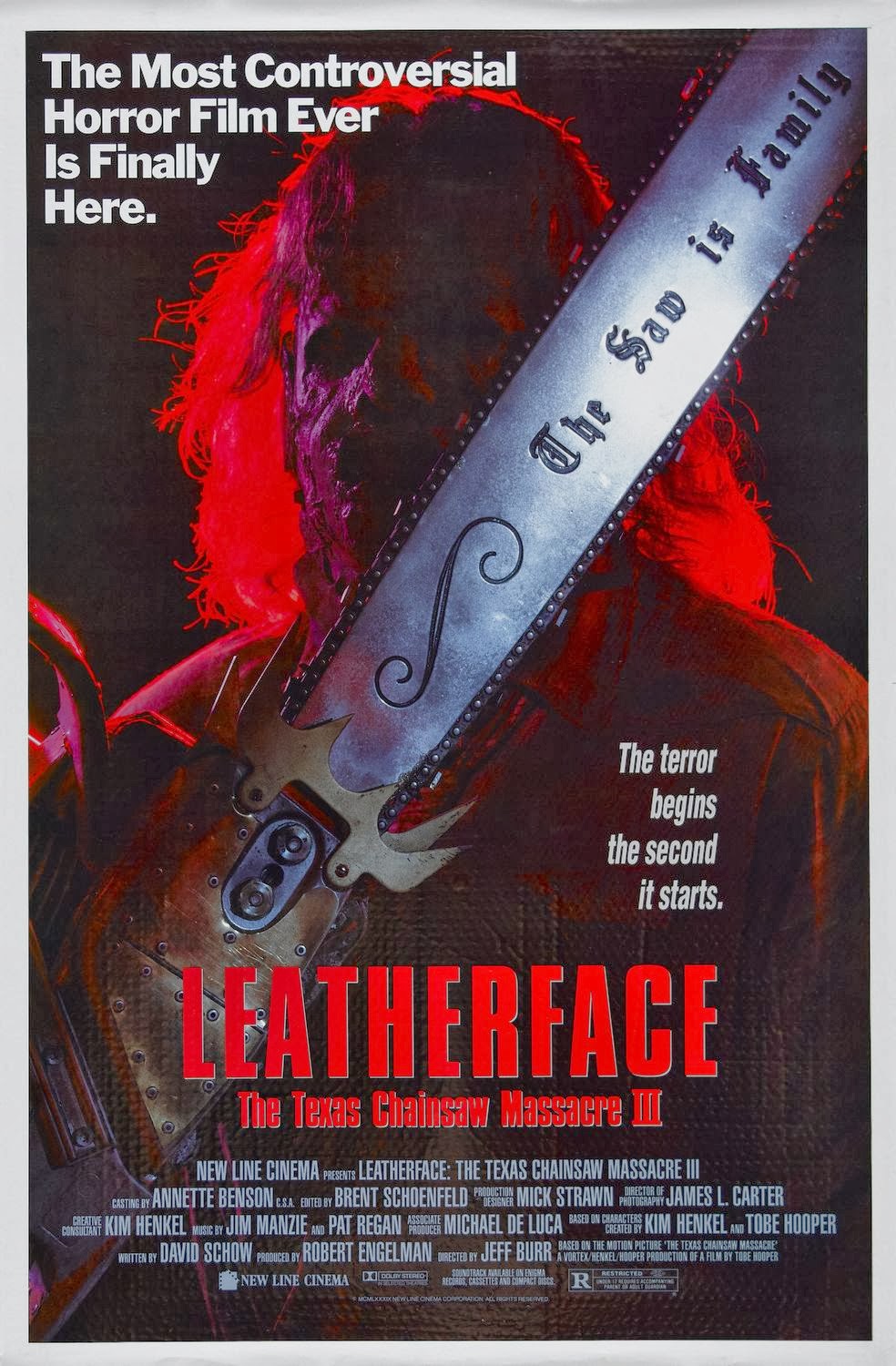
Videotape Swapshop Review: Leatherface: The Texas Chainsaw Massacre III (1990)

From http://www.impawards.com/1990/posters/leatherface_texas_chainsaw_massacre_iii_xlg.jpg

Dir. Jeff Burr

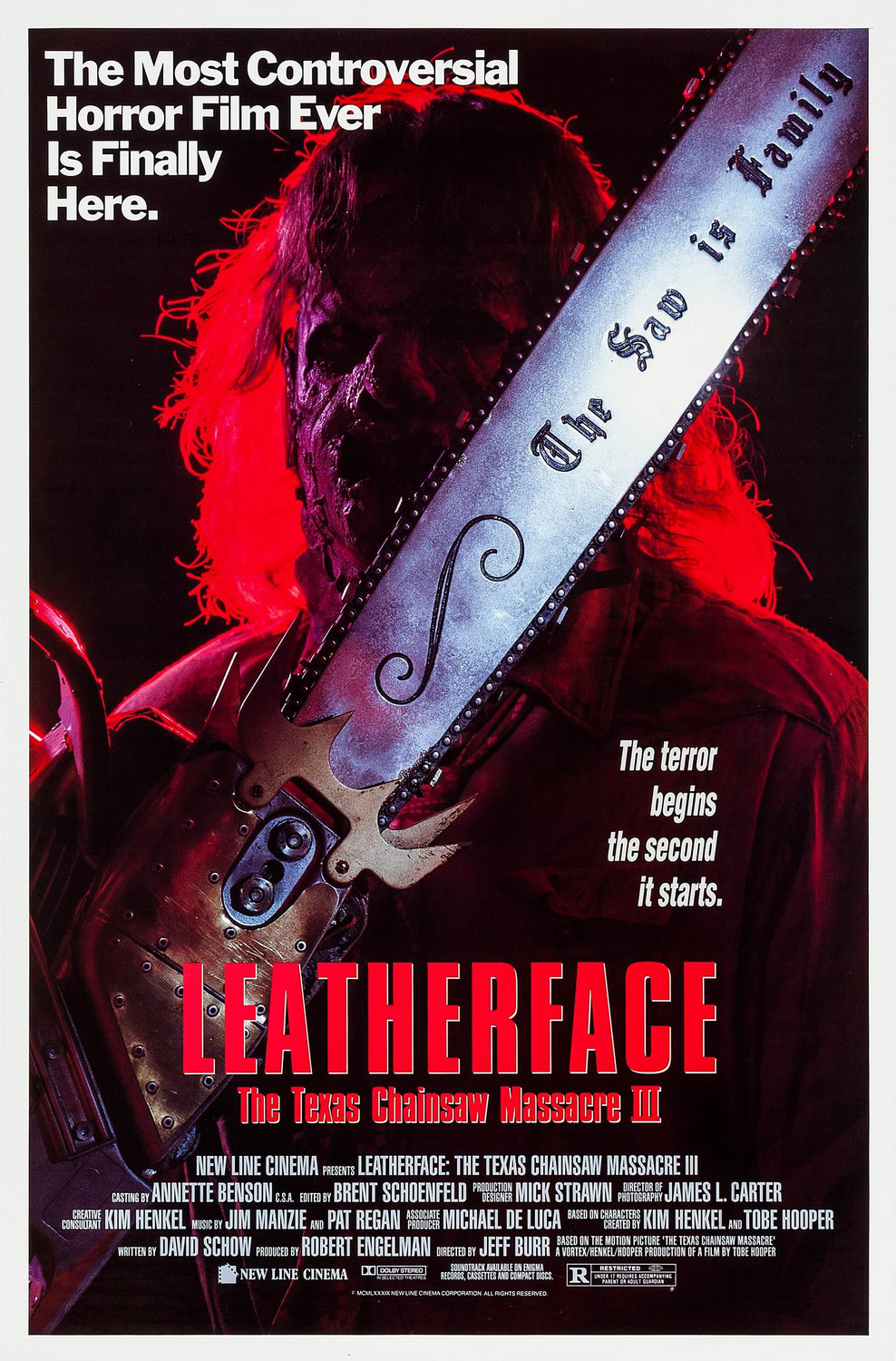
Another Videotape Swapshop review, and the other threequel I covered. Sequels are always a fickle concept. Any premise could lead to a justifiable sequel unless it closed the book on its content completely in a single film. Even then, its possible for some to become a franchise if good filmmaking was involved. The problem is whether there's actual 'good filmmaking' involved because sequels are usually made only for economic purposes and not with the optimism for making something interesting. In this franchise's advantage, there was a good first sequel in The Texas Chainsaw Massacre II (1986). I reviewed that film months ago, so covering this second sequel is a nice follow-on. Would I cover The Texas Chainsaw Massacre: The Next Generation (1994)? Yeah I definately will one day, here on Swapshop. This franchise has a better track record than others I've seen, baring the terrible Texas Chainsaw 3D (2013), and while I've not seen all the films, I've seen a fascianting spectrum of differnt attitudes through all the films. From the original's raw tone, to number 2's greater emphasis on blackest of black humour, to this one's grimy nineties tone, they all have something of interesting in them from the original four of the franchise. Yes, even The Next Generation when I get around to it.

Review Link - http://www.videotapeswapshop.co.uk/17034/leatherface-the-texas-chainsaw-massacre-iii-1990-director-jeff-burr/

From http://www.ionlywatch18s.com/wp-content/uploads/2011/11/Leatherface-2.jpg