Showing posts with label Genre: Vampires. Show all posts

Sunday, 3 November 2013

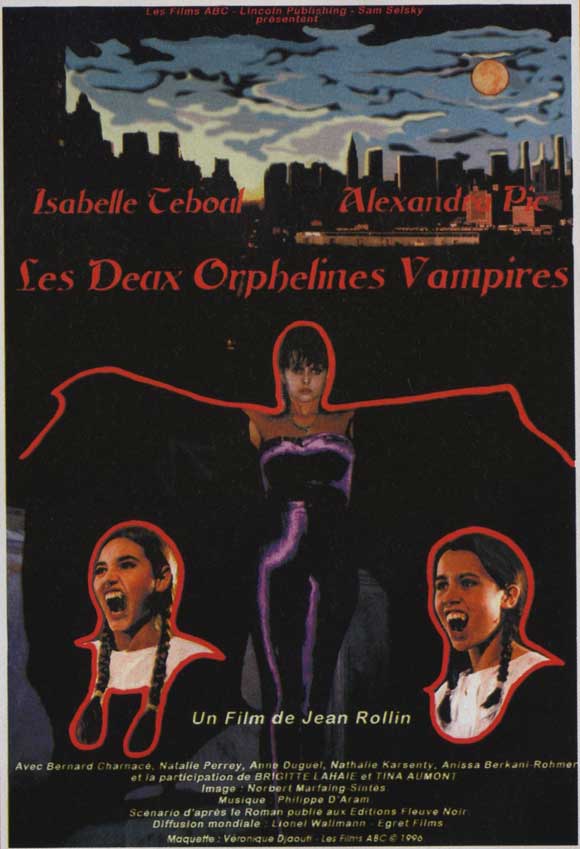
Representing France: Two Orphan Vampires (1997)

From http://images.moviepostershop.com/two-orphan-vampires-movie-poster-1997-1020492359.jpg

Dir. Jean Rollin

It's a delightful surprise that this film doesn't feel like a nineties horror movie at all. As much as I'm obsessed with the nineties, one of the reasons I'm obsessed with it is the tackiness of the era as well as the positives. Not a lot of horror films from that decade are celebrated, as compared to other eras, for this reason.  Jean Rollin didn't make a tacky film in the autumn/winter of his career here, thankfully making a very interesting one instead. It's very much an art film, against other films of his I've seen, which must be beared in mind. It's amazing too that I can compare this film to the work of fellow French director Eugène Green, of The Portuguese Nun (2009), with his long, almost Bressionian moments of dialogue, dangerously near the precipice of pretentious but ultimately charming and rewarding in being a bit more freer to let scenes play out as far as needed for mood and effect. This is the same for Two Orphan Vampires. I will openly admit it's going to be a difficult film for people to digest, including those who like Rollin films. I will also admit that I've developed a taste for films that could be seen as "difficult", with small fan bases, but this one works completely for what it intended.

From http://admin.highdefdigest.com/picture/original/32953

The titular vampires are two girls, Louise (Alexandra Pic) and Henriette (Isabelle Teboul), living in an orphanage ran by nuns, blind in the day, but able to see at night when they go out to feast. Immediately distinct in their identical clothes and white canes, the two are sympathetic in that, while they need to feed on the living, they are clearly close, engaging in their ponderings on existence, and obsessed with books on Aztec culture and magic while they believe they are reincarnations of the Aztec gods. The film is a series of events, ones from their previous lives, able to come back to life after being killed, as well as ones from their new life, as a doctor adopts them and they continue to explore the world around them. They do encounter other supernatural entities - a ghoul, a werewolf and so forth - but they are women too; in fact, baring the doctor, there are no male characters in the film baring extras or minor, one scene roles. (An interesting tone for the film in that it's a world framed entirely around women who have the discussions on the meaning of life as well as the small dramatic plots.) Its brief story is more of an engaging character piece, of characters doomed to repeatedly die despite their happiness, both girls concerned that they'll eventually never come back to life again at some point. Its abstract in a way that could frustrate people, but baring in mind, digging deeper with what Rollin was obsessed by, this is a waking dream of a film crossed with the kind of aesthetics of book illustrations that look exceptional when used in the opening and end credits of the film

From http://2.bp.blogspot.com/_n35PfUpWyak/TPwPrOEv2mI/AAAAAAAAZVg/
MIh3GTMdpbg/s1600/Two%2BOrphan%2BVampires%2B11.JPG

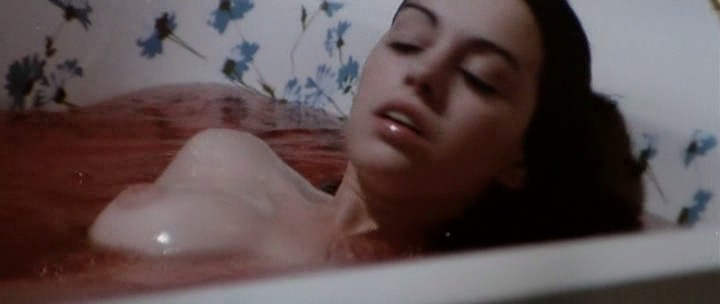
It doesn't look cheap either. I suspect it was shot on celluloid. It has an atmosphere, like the best films covered in this series of reviews, where from the first scenes it already sets up the mood immediately with the look and use of the locations and the space in them. The bright, vast locations of the day time to the blue lit environments of the night time scenes. His obsession with sexuality and sensuality is still there slightly in the vampires' relationship, including the sexual nature of how vampires bite a victim's neck that has always existed in the mythology, but barring two moments or so of nudity, this is quite a chaste film more concerned with friendship, and the bonding of Louise and Henriette, at times like teenage girls onscreen, other times very wise and adult in their reflections of the world around them. The film's mind is more on magic and supernatural creatures than carnality of other films of his I've seen. Probably the biggest reason why people could be put off Two Orphan Vampires if they're not prepared for it is because this strips away the blood and nudity in Rollin's films and leaves the unconventional plotting, where two vampires get bored of their predicament and do whatever they desire to escape it, presented not as a conventional three act narrative. For me it's nice to go through such an abstract, dreamlike film that paces itself well. The dialogue is all of interest even if its unconventional at times. It's an interesting take on vampires that doesn't compromise the mythology while adds new things for its own depiction. The two lead actresses are very charismatic as their characters, to the point that their potential ego in believing themselves to be gods is actually sweet natured and understandable pride in their existence than despairing their "curse". The distinct age fluctuation in their appearance in fact adds a strange air to the proceedings which makes their characters more interesting. The directions the film takes make sense - a world of supernatural beings who are methodical and languid, none of the hectic tone of, say, the Twilight films, and most horror films, where two vampires can kill time as best friends for most of the running time. Nothing feels contrived in the film in what happens, anything odd feeling appropriate for the dreamlike tone. It feels like spending a week with these characters in their immortal lives only with a few deaths at their hands taking place, and the danger they will be discovered and killed themselves adding dramatic tension. It looks good, and even if the score is dated synth, it feels like it's actually from the eighties, the depth of that era's music here to and adding to the material. There is nothing in Two Orphan Vampires that feels amiss, and that Rollin made a film completely against what is expected with these genre tropes is admirable, more so in that he succeeded for me.

From http://3.bp.blogspot.com/_n35PfUpWyak/TPwPhQPz1ZI/AAAAAAAAZVY/
1kZLEI5GMPc/s1600/Two%2BOrphan%2BVampires%2B12.JPG

Monday, 28 October 2013

Representing Belgium and The French Language: Female Vampire (1973)

From http://upload.wikimedia.org/wikipedia/en/d/d5/Female_Vampire.jpg

Dir. Jesús Franco

First of all, hopefully I'll be able to pick up from the few days I missed. The least expected thing - technical malfunction out of my hands and nothing to do with my computer - delayed the final stage of the season. It will have to run into November to make up for thirty one films I wanted to write reviews of. A conclusion for the series will have to be written in November or part of the next Month In Review too. To compensate today, I present a review of another Jess (Jesús) Franco film and the first in a group of reviews I wrote for Videotape Swapshop  to tie both places I write for together into this blogathon. 

It made sense, since I was diving into the director at the beginning of the year, going through his filmography slowly, to cover a film or two for this season. Considering how many co-productions he made, including for countries with no other horror films expect his to truly represent them, its befitting and also says a lot about how diverse his career was. And I have barely scrapped a body of work that's over a hundred films not including the re-edited versions. There could have been three of his films covered already, but Bloody Moon (1981), his West German slasher film, is one of the few legitimately awful films of his I've encountered. I rather champion Female Vampire. Merely poking the air next to the catalog of the late man, deciding to view his work when he sadly passed away this year, I can be thankful that its quite a solid series of films I've seen baring those couple of bad ones. Even something like Oasis of the Zombies (1982), which I reviewed on this blog, is no way near as bad as some of the films I've seen. I'm late to the party with reviewing Franco's films, with other blogs devoting themselves to his, but as a person who only saw a handful of his films before and barely had any primary knowledge of what his films were like, there's a potential for a really interesting chronology in these reviews, as the director gets the most tags to his name so far in the labels section for filmmakers, where I slowly get to know more and more about his style as I watch more films. I could be digging at his work for years, which means I may have to use other director seasons as mini-diversions, their thirty or so films a puddle next to the ocean of Franco's, and there's stuff by Franco, like his porn films, that are going to be difficult to find. Here at least I got to one of the first of his films I heard of, and I'm glad for what I saw. I only wish an available DVD wasn't very out-of-print in Region 1 or 2 as of yet. 

Also of importance, looking back on this film, is that Lina Romay deserves her own label in the Actors section of my site. Even if a lot of Female Vampire is near-explicit titillation, she was clearly more than mere window dressing in this film, turning the movie into something more sensual and interesting with her clear interest in how she presented herself. Its worth making this review link a moment of my own applause for both her and her husband Franco together. 


From http://images.dead-donkey.com/images/bscap1924wl3.jpg

Wednesday, 16 October 2013

Also Representing the US of A: The Entire Twilight Saga (2008-2012)

From http://moviefarm.co.uk/image/2010/04/twilight.jpg

Dirs. Catherine Hardwicke (Twilight), Chris Weitz (New Moon), David Slade (Eclipse), and Bill Condon (Breaking Dawn Part 1 & 2)


To ignore films that are marketed for a female audience would be a hypocritical stance for me. I want to cover anything of interest, and regardless of the gender of the target audience, if its interesting on first glance, I will look into it. And I'm not reviewing this series as a joke entry for this blogathon either, but completely seriously as someone who actually wanted to see this entire series for myself all the way through, revisiting the first three parts, and considering how significant these films are in pop culture. There's more chance of hell freezing than me rewatching Peter Jackson's Lord of the Rings films after nearly falling asleep in the first one on a repeat viewing a while back, but this series I had no issues with whatsoever. The results, in one of the longest reviews I've posted for Videotape Swapshop, of watching all five films and developing my thoughts on them were more complicated and interesting than I may have suspected beforehand. Aside from that, said review should speak for itself. Just bear in mind, said review will contain gratuitous references to sparkling vampires.

Review Link - http://www.videotapeswapshop.co.uk/17311/technically-a-twilight-eclipse-2010-review-but-more-about-the-whole-twisted-series/

Tuesday, 3 September 2013

The Curse of Kazuo Umezu (1990)

From http://i1.ytimg.com/vi/K8LOCE1mMko/hqdefault.jpg

Dir. Naoko Omi

There's a surprising lack of horror anime in existence. Even in the golden era of straight-to-video anime in the eighties and nineties, where in most cases it was of higher production quality than TV series and could get away with more adult content, there was a rare amount of them only. Now, with these straight-to-video works, OVAs, sorely missed and needed to be brought back, there's a gap left what can be released. Films are rarely made already, let alone horror ones. TV series have restrictions in content, and even those which have shocked Western viewers like Elfen Lied (2004) were probably censored on broadcast or showed past midnight. Only hentai could get away with more horror related content; its already porn, so aside from certain Japanese laws, you could probably get away with more. Manga is usually where horror thrives, slowly being dripped into the West in bookstores. As for those rare horror anime that do exist, The Curse of Kazuo Umezu is a truly rare one, which I only discovered the existence of within a few weeks. It's not even included in the version I've read of The Anime Encyclopedia by Helen McCarthy and Jonathan Clements, which catalogues every anime ever made from 1917 including all the hentai tapes. Its existence, once released on video in its home country in 1990, meeting it myself in a VHS rip probably taken from a Japanese VHS a Western otaku has acquired and made available, shows how deep the well anime is outside from what its usually labelled as.

From http://24.media.tumblr.com/tumblr_lq3fz7Ko1H1qc1tyfo1_500.png

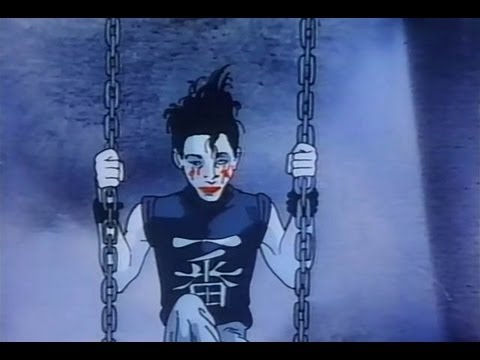
Kazuo Umezu is a well regarded horror manga author. He's apparently obsessed with red and white stripes, which would make passing a barber's shop and a candy cane stand bliss for him, and I confess to having yet to read his work, as most or nearly all of his work is not available in the West at all. This anime consists of two stories over forty five minutes. The first, a schoolgirl suspects that the new transfer student is a female vampire, but thanks to videotape the truth is more horrifying. The second is of a group of schoolgirls going into a haunted house to their peril. The most distinct aspect of the anime, bookended by a mysterious thin narrator/crypt keeper who entices us with morality tales, is the visual look of the anime. Clearly there was an attempt to replicate the style of Umezu's manga, black lines heavily used and very grotesque imagery. It shows in the female characters, if just their eye lashes and eyes, who dominate the entire anime. I cannot help but think of Western influences such as gothic art to maybe even dolls with the look of the anime, more so when showing moments of terror for the characters through excessive use of said black lines. It looks good in terms of design, and the format allows for more nastier material. The first story brings in a freakish level of body horror that the cutesy break between two stories cannot make into a complete joke - think of very, very big teeth. The second story, lots of raspberry jam smeared everywhere.

From http://i4.minus.com/jblxSZqXNvhyss.jpg

In terms of quality in other areas, it's not a great work if I'm completely honest. It's grown on me, but this must be stated. The visual look is distinct, but the actual animation is rudimentary. The obsession with moments where the characters freeze in terror do go on a bit, and the stories are very predictable. In terms of entertainment value, it's about the presentation of what's on screen, not originality, that will be whether you like this anime or not. Interestingly, the stories do occupy themselves with the ideas of seeing something only to live to regret it, curiosity killing the cat literally. The first centres around how a video camera can reveal the truth, pre-empting the obsession with technology's tangibility in Japanese horror, only for it to reveal too much. The second, cut into by the narrator, becomes purposely abstract, reality cut to pieces by going to the wrong place. It even gets a bit dreamlike and also reflective of itself, the main two characters watching horror movies, including one called the Curse of Kazuo Umezu, before they end up investigating the haunted house.

From http://zapodaj.net/images/7c2f99d4811ee.jpg

It's a completely minor work. The technical and plotting failings do undermine it. But it's still fascinating, immensely fascinating. Beginners to anime shouldn't view this first - this is for those looking for the deepest, obscurest cuts of anime or horror, forgotten in history and made unique for this and its appearance. Done in the era of hand drawn animation, it still has a textual quality, despite rudimentary animation, that stands out far more than the plastic sheen of post-2000s work made on computers. Almost carnivalesque in its horror - the subversion of body parts and the body, obsessions with toys - it's encouraging to investigate the author's original work, and despite the failings of it, it has stayed on my mind since seeing it. The rarity of horror anime helps it, but it's a strange beast by itself, its forty five minutes memorable. A layer of eeriness trickles throughout it, emphasised by the likelihood the version I saw was an original Japanese videotape release from 1990, having survived to reappear in some form for someone from a different country, me, to find. Myths, legends, eroticism, body horror, historical and cultural information, even Western and Eastern pop culture seeps throughout a great deal of anime and its animation plates alongside the genres within it. They feel far more rooted in deeper and more interesting influences than a lot of Western animation, where even a minor work like The Curse of Kazuo Umezu has something incredibly distinct despite its predictabilities. And since horror anime is rare, its great to see one that brings something interesting with it instead of fail miserably. 

From http://i1.ytimg.com/vi/xnB1Q8adRa4/hqdefault.jpg

Thursday, 22 November 2012

Reader’s Choice: Salem’s Lot (1979)

From http://fwooshflix.com/files/2012/10/salems-lot-wallpaper-1024x768.jpg


Dir. Tobe Hooper
USA
[Selected by the Gentlemen’s Guide To Midnight Cinema forum. Check out the main website here - http://ggtmc.com/]

I was somewhat hesitant to view Salem’s Lot because it was a TV film. While television can be a great sequential art, the stereotype of typical television, especially the ‘TV movie’, can be such an uninteresting creation with its limited palette copied over countless creations and grinded out. Salem’s Lot in comparison to Tobe Hooper’s theatrical films is clearly a television work, but far from grinded out material it proved to be something a lot more hopeful immediately as it started. Adapted from a Stephen King novel, it follows a writer (David Soul) who goes to his hometown of Salem’s Lot for his vocation. Something is amiss with the Lot as disappearances and deaths by unknown circumstances become more apparent, while a man named Richard K. Straker (James Mason) now occupies the main house of the town, the Marsten House, which has a bloody history and for the writer is a construct of pure evil. Paradoxically a single three hour film and two feature length parts that create one single work, Salem’s Lot has to operate within the structure of television, such as the many fades-to-black that would be where the ad breaks would be, but unlike something like The Stand (1994) adaptation, which after its brilliant opening credits is all the worst aspects of a ‘TV movie’ for five hours, Salem’s Lot feels more carefully made and with a richly simplistic story. Length is not necessarily a good thing, but three hours allows the characters to be fleshed out and the sense of overwhelming tension grows as the threat to the town starts to take over. In terms of actors the general level of the cast is excellent and helps the material perfectly, not taking into account the prescience of James Mason and his distinctly gentle yet sinister vocal intonations. There’s even a small role from Elisha Cook Jr., who is synonymous with pulpy black-and-white cinema for me.

Despite its structure, and being part of Stephen King’s created world, the work still exhibits a great deal that is distinct to Tobe Hooper as well. Not only is he a criminally underrated film director, usually dismissed for only contributing The Texas Chainsaw Massacre (1974) to genre cinema, but the most intrinsic aspect of his films is a heightened intensity that is entirely his. The Texas Chainsaw Massacre is legendary for this virtue but it continues on in other films in Hooper’s filmography, from the artificial sets and bleeding colours of Eaten Alive (1977) to the terrorisation of a peaceful family within Poltergeist (1982). When it builds up, Salem’s Lot shows the same intensity, not straying too far from the conventions of its main concept, but playing it up for maximum creepy effect and throwing some effective jump scenes at me without reducing itself to just repeating them. The length, put together so every scene provides something to the story and mood, allows it to grow in its horror content far more greatly than most ninety minute films, while also having a fantastical edge that is refreshing when this sort of television work, especially now, can be creatively rudimentary. It doesn’t feel like a typical ‘TV movie’ either, made with elegance in terms of look and slowed pace, richness to the look of the film even before the supernatural aspects intervene into the narrative. I was absolutely happy when Salem’s Lot was not only good but exceeded my expectations further. The hesitance with television work for me feels justified as, with the exception of televised animation from Japan, the medium is usually an excuse for copying the same lifeless creation and look ad nauseum. A work like Salem’s Lot, even if it had to still concern itself with its origins despite the advertisements that cut between it no longer existing, proves otherwise to this. Stephen King only really succeeds if the director or a key creative voice in the adaptation brings their distinct mindset to the material too. Someone like Mick Garris, who directed that adaptation of The Stand and a few others is the wrong sort of person even if he is more faithful to the source books; Brian De Palma and Stanley Kubrick are the people needed and Tobe Hooper succeeds with his adaptation too. 

From http://s4.hubimg.com/u/6342519_f520.jpg