Showing posts with label 1950s. Show all posts

Sunday, 19 January 2014

Clearing Through The To-Watch List #5: The Lone Ranger (1956)/The Lone Ranger and the Lost City of Gold (1958)


Images from http://www.cowboysindians.com/Blog/June-2013/
Weekend-Western-The-Lone-Ranger/LoneRanger56.jpg
/http://www.cowboysindians.com/Blog/June-2013/
Weekend-Western-The-Lone-Ranger-And-The-Lost-City-Of-Gold/
lone_ranger_lost_city_of_gold.jpg

Dirs. Stuart Heisler/Lesley Selander


The Lone Ranger (played by Clayton Moore). When his brother was killed, he donned a mask and became a masked avenger in the American west to fight wrongdoing. The man who found him after the shooting, Native American Tonto (Jay Silverheels), decided to join him in his goal. There's no denying this character, adapted once again in a Disney blockbuster last year, feels like he's from another era now, where despite the earnest nature of the character and the potential for more works to be made, people will have political correctness issues with them even though the new film does exist. And if this wasn't a problem, the western has lost its interest for many unfortunately, and even if it was revamped for this generation, it'll be a fifty-fifty chance if there'll be a sequel to the new one. There's no denying these two films, released on DVD in the UK, one disc, to tie in with the new Disney film, are from a different era where it wouldn't be a commercial risk and b-movie features were much more prominent. And that they were for children rather than sold to the widest audience possible. There's a lightness in tone and a lot of humour. The bright colours. The Lone Ranger's clean-cut image, which Moore carries on in his stoic behaviour and moments of comedy, and the bombastic use of the 1812 Overture by Pyotr Ilyich Tchaikovsky. The Overture, starting with a horn, clearly begins as a Calvary charge, befitting horse races or charging horsemen. But there's always been a jaunty, playful side to it befitting comedy and for a character like the Lone Ranger charging over the plains.

The first film, the first time the character had a feature film, has him and Tonto sent into a community to investigate tensions between Native Americans and the (mostly) white populous, only to find the indiscriminate attacks presumed to be by the Natives are up to question. The second concerns Indians being killed for unknown reasons, possibly for very specific items, while a subplot follows a town doctor who is hiding his true Native American heritage. The films as entertainment are average. Their flaws equate to not being good enough westerns, for children not meaning that they should not try to be as good as they can. They're not as memorable as they should be, only alright. But there is a virtue to them that I will keep even if I forget them, and connects to the sense of having lost something now without films like these in existence. The films, for their flaws, do have the virtue that their rudimentary meat-and-potatoes filmmaking has the desire to have spectacle, showcasing talent and just having fun with their material that is drastically missed from a lot of films now, especially when CGI became a convenience for everything. They do show signs of limited budgets. Rear projection including, bizarrely, on characters on horses stood still talking. The only real technical flaw is with the first film but this could have nothing to take the creators to task for. If it was, it's an abomination of a production choice, cuts to black that suddenly kill the mood and energy of scenes, but I suspect the version Classic Media have acquired for the 2013 DVD release is one designed for television, the cuts designed for ad breaks. Commercials undermining a film's tone is bad enough, but non-existing ones doing so is just ridiculous.

The films have a solid quality to them outside of this, conventional westerns but with the playfulness and the willingness just to do something so a person can steal the scene for a trick or stunt. Moore and Silverheels have a charisma on a team. Moore also has a character who uses disguises to help him get information, including a Southern dandy in the second film, which with both cases showed he was able to be varied in both speech and body language with them, an impressive feat considering they skirt the line of being too broad in the tone of the films. This extends to the horses of the protagonists, especially the Ranger's trusted Silver, as much a person as the human characters in the mannerisms the animal can act out. Moments like this can be cheesy in a cute way, but the films show a sense of wanting to entertain the viewer that is rewarding. That they had two lead actors from the television series who were clearly so used to their roles but enjoyed them still. That they would get trained horses who would act out mock moments of gesture and humorous gags. That, especially, they would have the stunt work as they have in this; it's not imaginative, but including a brief fire stunt, you cannot help but appreciate real people doing real falls and other such sequences. This willingness to make something of interest in these films, even if the structures of the plots are what fail them, is of great appreciation.

It's also surprising, for such friendly films in tone, that they have incredibly dark and serious subject matter in them. People are still killed, and a key set piece in the first film is about Tonto being a potential victim of a lynching in the middle of a town. As the plot details for both films point out too, they are also both dealing with racism against Native Americans. It's not perfect. The Natives are treated as superstitious, played by white actors in dark body paint, and to quote Jean-Luc Godard, speak in "Navajo English" that you probably only get in films. The Lone Ranger ends up at times like a teacher lecturing children when talking to them. And while Silverheels has moments for his character Tonto to stand out, for the most part he is a dogsbody to the Ranger. If this was even a D-grade martial arts film from Asia, the Lone Ranger and Tonto would be an equal ground if just in having enough time in the spotlight as a team with the Ranger still the protagonist. Despite this though the clear messages of unity and honour for Native Americans, from matinee films like this, is still praisable and something immensely interesting about them. They suffer from not quite getting to the idealised place but this willingness to go close to these ideas, especially the second film with the doctor character who has a big character arc for himself, shows an attempt at progression.

In the end, what should be taken from films like this, for myself and anyone who viewed them, is that while it was disappointing that they weren't as good as they should have been, there was however a clear line of quality that was being kept up to. Admittedly what a large piece of their virtue is is defined by them being films from another era, where westerns like this were popular and that they weren't being made to be "adult" in a way a teenager boy would view that term. In fact these films, while still children's films in their playfulness, are far more adult in what they cover than a gritty, teenager's film (in most cases) now. It emphasises that I would rather watch films like this than many of now. Although I have optimism for the new one...but that's an entirely different subject of topic in my mind to deal with.

Saturday, 28 December 2013

A Videotape Swapshop Christmas #2: Santa Claus (1959)

From http://vciclassicfilms.files.wordpress.com/2011/11/poster-santaclausmurrayversion3.jpg

Dir. René Cardona

Christmas is slowly drawing to an end for this year. Someone reading this blog post has probably eaten their own weight in chocolate. Maybe two. To close it off, its befitting to choose a film that has been dismissed as garbage, but to my delight, actually has more enjoyable qualities than other Christmas films I've seen. Its better than the one with Dudley Moore at least.


From http://cdn.mos.totalfilm.com/images/s/santa-claus-1959-.jpg

Friday, 18 October 2013

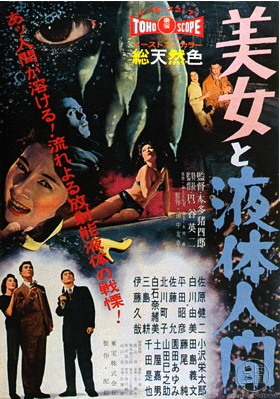
Representing Japan: The H-Man aka. Beauty and the Liquidman (1958)

From http://skreeonk.files.wordpress.com/2011/10/the_h-man_poster.jpg

Dir. Ishirô Honda

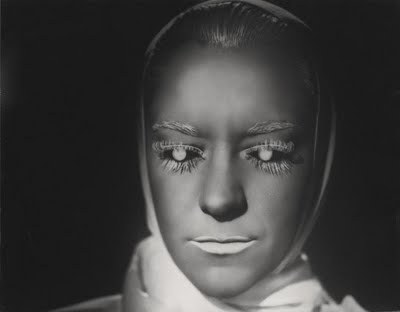
It would have been amiss not to include fifties, nuclear paranoia era sci-fi, having covered one last year, and it's one of the many choices I could have chosen from the boutique of genre films made throughout the decades in Japan. So many are there to choose; even if horror cinema only really came to be around the time of Jigoku (1960) and the influence of its director Nobuo Nakagawa, there are ghost stories and sci-fi monster films from before than I could have used. The same fears of nuclear fallout he tackled through Godzilla (1954) is yet taken to a different tone with The H-Man by director Honda. Godzilla was the ruminations of Hiroshima and Nagasaki through the wholesale destruction of Tokyo, potentially  symbolic of all the earthquakes that have beset the nation too, but with this film, it feels more concerned with the effect of nuclear aftermath, nuclear waste and radiation, the fear that a substance could get into the water. The film at first evokes acid rain in the first scene, but it gets more complicated than that.

From https://blogger.googleusercontent.com/img/b/R29vZ2xl/AVvXsEgav9iwKDDTF1fh4GPr0RNExpL-0xcwNQRdCNbvmZOTX6cy1Ujw2u9RVOd1emBOfGOHTLY5gOL4Ej48_ZVRWdddrCwwecKZdBVhoLr2UQxbCvVYDVCH62TFjzpXM188ACHu9nrHxHvjb9wI/s400/H-Man+%25286%2529.jpg

A drug runner suddenly vanishes one night when trying to transport a large package of narcotics. In the middle of a street, in heavy torrential rain, all that is left of him is a pile of clothes dumped on the road. It's presumed, logically, by the police that it's just a bizarre coincidence surrounding the per usual yakuza infighting, where the gangs are going after each other and the drug runner has ran for his safety, leaving his girlfriend, a club singer, to fend for herself. But said to be hopelessly in love with her, to being the kind of person to still try and see her even at his own risk, his complete absence is a mystery, and while there is still an issue with the drug related crime, another person vanishes leaving only their clothes. Only a scientist who studies nuclear radiation, who to the bafflement of the top police detective takes interest in the case, could have the answer, and it may show a horrifying threat for the entire Tokyo population. Very much sci-fi at its most fantastical. Horror as well, especially with an extended flashback including a "ghost" ship. Pretty gruesome when it shows what actually happens to the victims in sloppy, wet detail. Even if they're replaced with fake ones, toads get the worst of it in the name of figuring out what the protagonists are dealing with.

From https://blogger.googleusercontent.com/img/b/R29vZ2xl/AVvXsEi6tT0e7uDIJpdj2HZRGs6BaXUxCUOW9TUJpYN04ogYuFPRZN-zqYnclHNxc-bD1TbFD16N71kJv-bx0heh4GYEfPXzNeA1zhOIDby0EXn2hxz15tOwJrqqS3BafvA9nNtzR79joH16ocT9/s1600/AIP-2012-05-14-14h25m32s51.jpg

The Japanese sci-fi/kaiju/monster genre is barely tapped into in my viewing of Japanese films as a whole, but it's such a distinct genre in what I've seen while also having pieces of it that bleeds into other areas like anime. The bright colours to the images, glossy and rich, its foot between reality with the films between the fifties and seventies, but also close to both illustration and manga. A big thing about these sci-fi films, alongside yakuza films, is the amount of Western influences and how they almost drown out the Japanese origins of something like in The H-Man. Jazz instead of traditional instruments. (Great jazz pieces at that). The female heroine sings longue songs in English. Proto Pop Art deco for swanky, alcohol soaked nightclubs, one a prominent location in this film with local girls doing showgirl performance numbers in spangled bikinis. The gangsters here are in suits, slicked back hair and only carry guns, inching the film closer to the area of mukokuseki, cross-cultural works on film, that Seijun Suzuki went to with a film like Branded To Kill (1967). Post Second World War, when Western culture entered Japan in vast amounts, this is not a film that questions and or scrutinises this, like a Shohei Imamura film would, and even Godzilla had the first quarter of it set in rural Japan with its traditions clearly visible. No one raises a question about it, and baring certain things like the housing with interior paper walls, nothing pronounces it as "Japanese", more concerned with the story of people randomly disappearing. But it still manages to feel very Japanese paradoxically. The methodical pace. The willingness to depict such a premise completely seriously. The take on the fears of nuclear destruction spoken from experience. Even in being completely nationless in look, it's still very much a creation of Japan only.

From http://skreeonk.files.wordpress.com/2011/10/hman5.jpg

The H-Man is a b-movie. Pulp. The first viewing I found it dull and disappointing. This time I liked it. Opinions change in hindsight sometimes. It still drags by the end, probably because the cause of the incidents is not something like a kaiju that is visually frightening unless the icky practical effects are used, having to rely on the crime subplot for enough menace. But for a b-movie it was made with consideration. It has a grace to it, and at moments it becomes both freakish, and at least once or so far more sexual and edgy than anything that could have been dared done in an American film at this time. There's another example of the bravery in Japanese pop culture here which is willing to show with more vividness fears and anxieties, desires and fantasies even in something like this with its premise. Even in the simplest terms with The H-Man, just making something entertaining its creators went further and made this bright, gangster sci-fi hybrid film which mixes sultry, elaborate jazz orchestration with ominous fears of every drain pipe housing a dangerous entity based on real national scars. With an ending, without spoiling most of it for you the readers to watch it fresh, where you see the bay of Tokyo on fire, the water itself an inferno of flame, with a warning of the events possibly happening again, it neither comforts the viewer into believing it could never happen again, or that such an event couldn't happen in reality in terms of what is scientifically possible, not wrapping itself up in a quickie, happy package. It's still a happy ending, but unlike an American film of this genre, its Japanese counterpart, after seeing the brunt of war and the nuke, still desires to tell its viewers of the era, even if they're entertained in their cinema seats, not to be complacent about the dangers that a nuclear weapon or radiation, or a natural disaster or chemical fallout, could have when it's not a H-Man or a giant, god-like lizard destroying Tokyo. In the American sci-fi film I watched last year, while superior and still creepy, it was about the norm triumphing over an alien outsider. With The H-Man, it's not an issue of the norm being even in the centre of the threat, but that the folly of mankind, regardless of norm, can doom itself, and that even if the threat was an alien, mankind is responsible to keep on their guard rather than take their lives after for granted in a gee-whizz, apple pie mentality. 

From https://blogger.googleusercontent.com/img/b/R29vZ2xl/AVvXsEjCHFDge1ZJ6HTwI3tb9-70QxNVtuktY1CGjv0rPF4IlSfNKTilGOMr6vGB9w68Cc1Lh-3IZT6iOn8q363DOUg1QFapWMwg3wNpD6WX98bw6rTZVGROfCVnY49t7qbZW44j93bAN3UfVBVH/s320/hman22.JPG

Friday, 11 October 2013

Representing Finland: The White Reindeer (1952)

From http://i27.photobucket.com/albums/c187/TStatic/polish_white_reindeer_linen.jpg

Dir. Erik Blomberg

Falling in love and marrying, the wife of a hunter enquires about a ritual to make him fall in love with her even more, hesitant since he is continually out for long periods to hunt. The ritual however leads to disastrous consequences of her continually turning into a white reindeer, which entices hunters to try and catch her, only for her to turn back with fangs and kill them. As people in her village die, slowly it leads to tragedy. The film is not that long, brisk in its running time, and tells this story with immense amount of engagement. The different environment, of the snow covered Finnish lands, adds a freshness to this film, seeing the country's traditional culture through this supernatural tragedy and being able to appreciate it. Erik Blomberg uses the environment to its full advantage too. The village community is very close knit, small, where increasing amounts of death from sinister causes would bring anxiety to them more so, and the vast white landscape is isolating, able to be lost in it or pulled away from other people to die alone within it.

From http://b.vimeocdn.com/ts/206/247/206247843_640.jpg

Aside from this, it's just an alright film. It's no way near the best take on this idea, of love broken by the curse of bestial transformation, but The White Reindeer is still good. This does actually make it difficult to write a lot about the film because of how small it is, so rigidly concentrated it is on just depicting its story. It could be a flaw of the film that it leaves little space for tangents that stand out, or a flaw in me for being unable to go into more detail about the virtues that are there. Probably the biggest flaw with the film is that it does so well in merely telling the story that it loses out on the potential elaborate artistry that could have made it a great film too. But as the Finnish entry for this series, the obsession with using supernatural and horror cinema to look back on traditional culture and folk law has always revealed itself in films defined by various countries, including my own, and it's very interesting and distinct with the better examples like this. The ominous aspects, the bestial aspects having a physical affect on the heroine's appearance, the shrine she conducted the ritual at littered around with reindeer skulls and bones, mix with the basic aesthetics of the period of the clothes, the everyday activities of the people and the relationships with fascinating effect. You can probably learn more about a country through films like this than other mainstream entertainment or news documentary. The White Reindeer, melancholic and ultimately sad by its end credits, shows a great deal of Finland, even if the film's short and to the point, and makes you wish you could see more.

From http://s3.amazonaws.com/auteurs_production/images/film/the-white-reindeer/w448/the-white-reindeer.jpg?1301729719

Thursday, 29 August 2013

O Is For...Orpheus (1950)

From http://images.moviepostershop.com/orphee-movie-poster-1949-1020143787.jpg
Dir. Jean Cocteau

Another classic film covered for this series. In digging through the canonised films for this topic, I've realised how a lot of them do stay distinct and legitimately subversive still all these decades. Orpheus is a dreamlike fantasy, but it still feels completely unique all these years later. It proves how talented Jean Cocteau was.


From http://24.media.tumblr.com/tumblr_mebpqo5S6D1rib0hxo1_400.jpg

Tuesday, 20 August 2013

J Is For Johnny Guitar (1954)

From http://softmorningcity.files.wordpress.com/2011/04/johnny_guitar.jpg
Dir. Nicholas Ray

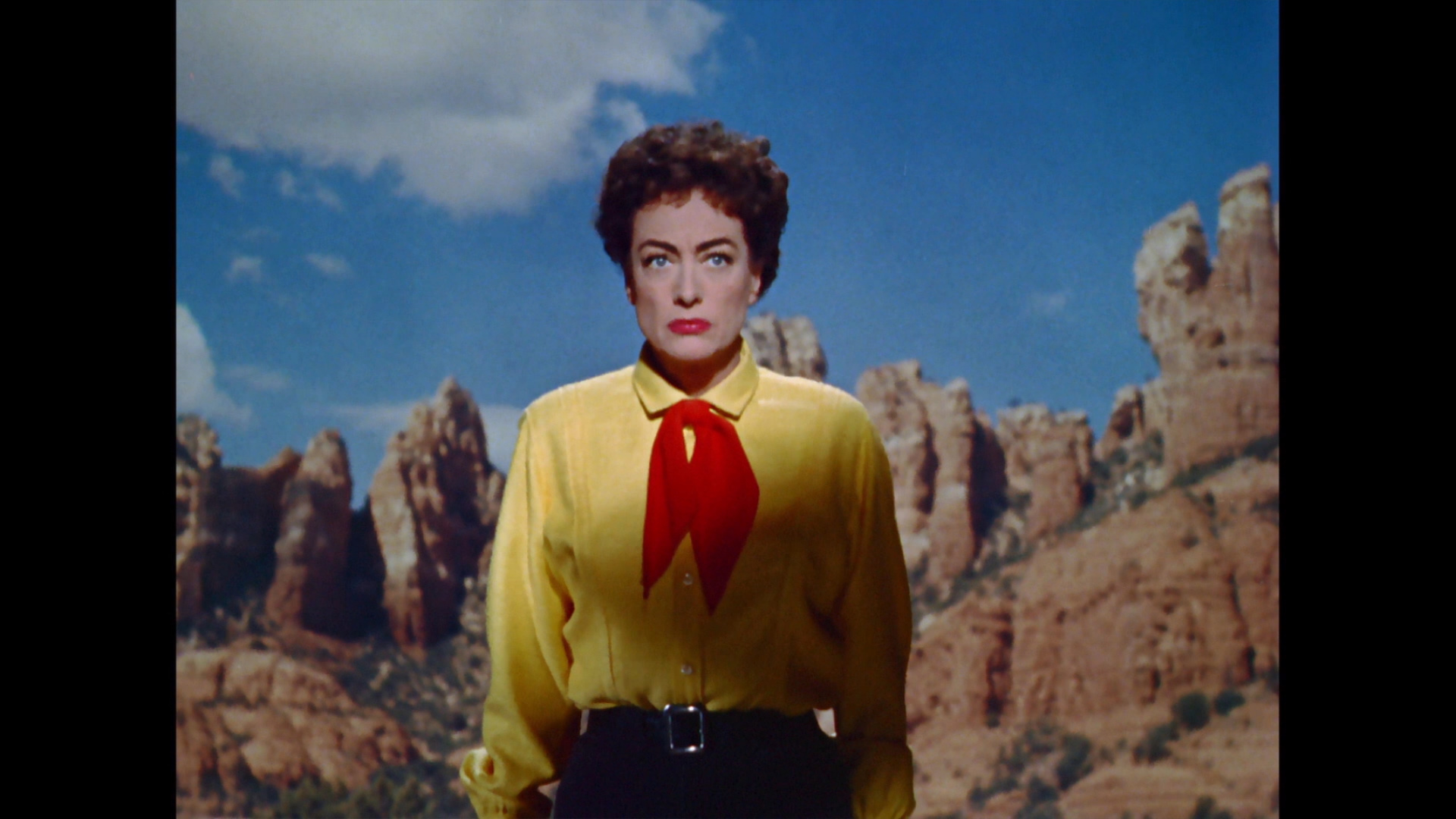
There is a lot of classic American westerns I want to watch, more so now that I have an appreciation for them. I admit I've been more positive about the later revisionist and lurid films, from The Wild Bunch (1969) and spaghetti westerns, but that was because they all had a distinct personality, even as part of a collective sub-genre, that made them all unique and have something to make them stand out. Johnny Guitar, revisiting it, is the sort of film that exemplified this. My first viewing of it years ago I thought there was nothing special about it, but with a lot of time to see more films, including westerns, that opinion is baffling now considering how unconventional it truly is. Its drastically different from the classical American Western of the fifties and before admittedly, but it showed me there are probably a lot of distinct and interesting films in its golden period I once dismissed as potentially dull.


From http://www.dvdbeaver.com/film4/blu-ray_reviews57/johnny_guitar_blu-ray_/large/large_johnny_guitar_blu-ray_x08.jpg

Monday, 22 July 2013

Mini-Review: The Halliday Brand (1957)

From http://fiftieswesterns.files.wordpress.com/2011/05/the-halliday-brand-movie-poster-1020533660.jpg

Dir. Joseph H. Lewis

Regardless of my thoughts, The Halliday Brand looks exceptional. Joseph H. Lewis, in just a few films, has shown a tremendous visual eye, encapsulated by the dark smoke covered alleys of The Big Combo (1955) and the gangsters standing in the middle of it blurred, and with The Halliday Brand, cinematographer Ray Rennahan adds to this with his talents. The black-and-white images, of closed rooms, cramp and shadow covered, to wide open plains, sprawling and at points baroque in look, are sumptuous with a rich use of lighting. At points it fells naturalistic, at others stylised and artificial, like a summary of the western genre in terms of images. After his sheriff father (Ward Bond) may have deliberately allowed a half American Indian employee to be lynched, because of his racism and hatred of the idea of his daughter being in love with him, one of the sons (Joseph Cotton) decides to act in a way to make his proud, egotistical father crawl on his belly to apologise for his nature. Using the dissolve flashback to enter its back-story for most of the film, the old, no longer used editing effect causing a complete fraction of time as an entire chapter in a person's life goes for just a minute in the present for them, the relationship between the father and son is problematic even on the father's deathbed.

As a technical piece of visual art, it's great, but the narrative is minor. It is enough when supported by the film's visual splendour and the prescience of the actors, especially Cotton and Bond, but by itself it doesn't match up to something like Lewis' own Terror In A Texas Town (1958). It feels lacking in story, which even in such a short length could have juggled this parental divide alongside the romance with the lynched man's sister (Viveca Lindfors), the son's brother and Cotton's character, but as is the case with such a continually churned out genre, it fells underwritten, with the ending feeling like a big anticlimax. It's more of a personal taste as times, but which such a visual eye to it, this isn't the film that's going to push Joseph H. Lewis (yet) from being a fascinating director to a great one. I'm going to have to see more of his films to see if this can happen.

From http://cf2.imgobject.com/t/p/original/cBx0lwUKtyAvLyo0QmrsIFDZpnT.jpg

Sunday, 21 July 2013

Souls In The Moonlight Trilogy (1957/1958/1959)

From http://www.wildgrounds.com/img/jap/soulsinthemoonlight/1.jpg


Dir. Tomu Uchida


Before I start this review, I confess the period between viewing the first part of this adaptation of The Great Bodhissatva Pass, a legendary and incredibly long Japanese novel most well known cinematically as interpreted as The Sword of Doom (1966) (on the To-Watch list), and the other two parts was a short while, which will affect the review a little. Thankfully I viewed part two and three one after another over two days. I also confess that this another (three part) film that is impossible to find by conventional means. Even my resource to view this trilogy could dissipate like a puddle on a hot summer's day, but if you can find it hopefully you can see why I'm covering it. Souls In The Moonlight is a very elaborate, character and plot driven samurai film based around Tsukue Ryunosuke (Kataoka Chiezo), a cold blooded ronin with no qualms with killing anyone who yet has a contradictory morality that is entirely alien to the society surrounding him. Two individuals band together to get revenge on him for his actions, a young woman for the pointless murder of her grandfather, the younger brother of a samurai who was killed in a duel and who wants to avenge this by the sword. The story, however, over three films, around 100 minutes each, spins the tale out further. Film #1 sets up the story, with a dynamic narrative by itself, and Film #2 brings in more characters and plotting as Ryunosuke is also mortally wounded. Film #3, the finale, brings an ominous supernatural edge that slowly creeps in, through misty, dark streets and night scenes that feel like the film is about to turn into Kwaidan (1964). Then it does.

From http://i840.photobucket.com/albums/zz328/noereversing/Shot3B.png

Even when more characters are added in Film #3, and the film takes massive tangents to follow secondary characters in Film #2, Souls In The Moonlight is very well planned out and methodical with its plotting. Again, another film whose material I have yet to read, if I can, but if the novel is as lengthy as I have read it is, originally a newspaper serial, director Tomu Uchida and the screenwriters needed to have been coordinated and at Uchida's best for this to avoid failing miserably with so much to juggle. Trilogies of now, whether the sequels were actually needed or not, need to look back at a trilogy like this to see how structuring is actually done. Uchida is also very subtle in his directing, a dialogue heavy film whose sword battles are more like theatrical performances in the many times they happen, the moments he changes tact leading to exquisite camera moves or eye popping moments of imagery rising up on you as you engage with the plot. Even when you get a little lost with who's who, and why certain characters are being followed for such a long length of time, everyone has a meaning and depth to their presentation, with a moment to stand out, and how the trilogy ties everything up works perfectly. Far from long films each, the three parts manage to convey so much without going anywhere near the two hour mark each as films now have started to get to for very thin bare plots.

From http://4.bp.blogspot.com/_15XHh2WrHl8/TNpOM7OgNZI/
AAAAAAAAA_U/z81F_dCNdbI/s1600/Souls2.jpg

The film has a pulpy edge, of drama and of sword battles that, while heavily choreographed, still have a visceral edge, but the real virtue of the film is the level of characterisation. Kataoka Chiezo and his main character could dangerously steal the film from everyone else, which would be sad considering everyone is good and is needed to make the trilogy work, but Ryunosuke is a fascinating creation, able to have moments of nobleness but completely amoral at other times. They are films where everyone has more complexity to them, or are allowed to be in the centre for enough time to stick out, and grow over the length of three films. And its encapsulated by the ending which robs the viewer of what they wanted to happen. That ending would have been good, but the actual closure of Souls In The Moonlight is brilliant, the complex morality of the story moving upfront. Ryunosuke is a curious figure; even how he lays on his side to relax asks questions, reminding one of a reclining Buddha. How the film ends brings a moral judgement to play but never damns a person even for their bloodthirsty violence, instead viewing their behaviour as a state of hellish torment. The trilogy is merely good by the end of Film #1, but the two parts needed to make a whole film literally play off as the middle and final acts of a larger work, increasing the character dynamics and adding more emotional investment, and becoming even better as it goes on.

From http://s3.amazonaws.com/auteurs_production/images/film/souls-in-the-moonlight-iii/w448/souls-in-the-moonlight-iii.jpg

Saturday, 15 June 2013

Gun Battle At Monterey (1957)

From http://www.westernmovies.fr/image/is0/9/7404/gunbattleatmonterey1957.jpg

Dirs. Sidney Franklin Jr. and Carl K. Hittleton
USA

You will have noticed that alongside continental curiosities, anime and abstract cinema, I have a taste for covering certain well trodden genres like martial arts films and westerns. Above other genres that have more mainstream currency, above most if not all other genre types, I am more willing to watch all of the films in these two genres because I am becoming enamoured by the mythologies and legends interconnected into their cores above any other pulp cinema. Other genre cinema is only interesting when it’s good, spectacularly ridiculous or is inherently cultural. The western and the martial arts genre are entirely based on social, mythological and cultural content by their natures. Others could become more interesting for me – I will watch almost anything from Japan and Italy – but especially with the western I’m seeing the real and fictional stories of an untamed country, America’s or set in another land, being repeated over and over again like the repeating ghosts of the past. Gun Battle At Monterey is unfortunately not a good film, but I’m still grateful for watching it and I will be willing to watch more westerns like it in promise of good qualities and with the devotion I share with anything from anime to avant-garde cinema.

Also anything with Sterling Hayden in it has now grabbed my attention. The one-two of Terror In A Texas Town (1958) and revisiting Johnny Guitar (1954) has made the man a badass who I admire for his screen presence, charm and how he clearly looks like a real life tough guy onscreen. Carrying a fuck-off huge whaling harpoon nearly twice his size in the former Joseph H. Lewis film helps just as much solidify his image. He is a robber who is shot in the back by his partner Max Reno (Ted de Corsia). Going to return the favour and get his promised share of their stolen wealth back, he finds that Reno has taken over a small town like the corrupt man he is. Things pick up from here. The unexpected sight of Lee Van Cleef, as Reno’s right hand man Kirby, in the opening credits was an additional enticement, already promising with Hayden but just as it starts topping the cake with a giant cherry while you’re in front of the TV watching it. He is young, angry and playing the stereotypical evil hothead with aplomb. Hayden even if he’s coasting is still Sterling Hayden. The addition of Cleo the card dealer at Reno’s gambling joint (Mary Beth Hughes) improves things further. Charismatic and likable – far more so than Hayden’s good girlfriend and moral compass (Pamela Salvador) problematically for the plot; Duncan feels like a loose end when, despite being the girlfriend of Van Cleef’s character, Hughes’ Cleo and Hayden work well with what they had, so far that she manages to rip off his shirt in their first encounter in his rented room in a way incredibly gratuitous and pornographic for a family friendly, fifties western. Like film noir, it’s the femme fatales who are more charismatic, beautiful and thoughtful when depicted onscreen, although here I think that’s a botched failing than an intentional thing done, sad since both actresses could have been equals in these qualities in their characterisations.


The film around them is the problem that doesn’t make it good. Shabby, rushed, even when the plot in this very short western starts to get interesting in the ending, killing its potential. The actors are shot in mid-to-torso distance images that look like they’re trapped in that camera space, and the black-and-white cinematography does not show the scope of the land or the bustle of the gambling den and confined sheriff’s jail cell. As some of the westerns I’ve seen, not a lot but enough to prove this point, have shown, low budgets don’t stop a film looking exceptional and being resourceful. The actors in this film, going for their best, make the film rewarding to view once, but the cinema around them lets the side down. But this is the reality of being enamoured with watching a certain type of cinema on mass. It means wading through bad ones, or imperfect ones like this, in the desire to still see them and that there’s always the hope of uncovering one that you’ve never heard of and love, even if you’re its only defender. And it proves Hayden and Van Cleef, even in something like Gun Battle At Monterey, are able to shrug off cinematic limitations around them and stride on the screen. It’s like two kaiju standing in a model western town, the cardboard buildings completely unable to hinder them as they squabble onscreen and show, regardless of who wins, that neither is truly a loser. 

From http://www.moviegoods.com/Assets/product_images/1020/319759.1020.A.jpg

Monday, 8 April 2013

Mini-Review: Violent Summer (1959)

From http://www.movieposterstudio.com/pimg/ViolentSummer_US1.jpg


Dir. Valerio Zurlini
France-Italy

From http://wondersinthedark.files.wordpress.com/2011/03/violent-summer-2.jpg

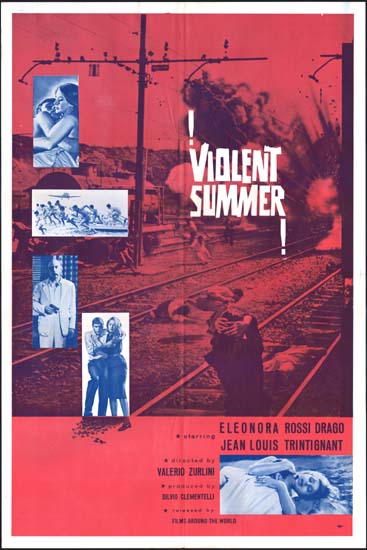
Melodrama deserves to be reviewed on here as much as horror and action cinema is. To ignore the genres I’ve missed so far would be hypocritical as a film fan who claims to watch “everything”. It is a genre that amplifies real life situations in ways that seem over elaborate, in a reality when these problems are frequent for many people, but they have enough a semblance of real life that draws us to them. Set at the dawn of the end of World War II in Italy, Violent Summer pushes the melodrama into a more contemplative area. A young man (Jean-Louis Trintignant) and an older widow (Eleonora Rossi Drago), who’s lost her husband to the war, develop of a romantic relationship, divided by the hostility it creates from her family and his friends, and the falling apart of Fascist Italy, close to home as the man’s father is a high ranking member of the Fascist party as it is being decimated. It is fascinating to think, at least for two films including The Conformist (1970), that Trintignant has played two characters placed near the end, or aftermath, of Benito Mussolini’s rule of Italy and the end of the Fascist state, both of them – one a noble, charming man stuck in his fate, the other a void, both admitting to wanting to be part of the crowd despite being opposites – liable to encounter each other within the cinematic depiction of this era face-to-face. The use of the historical background clearly shows how the lives of the populous (the characters and their fellow ordinary people) were punctured by the chaos of the war, a fighter plane flying so low at a beach, lost, that it frightens the people on it, showing the lack of boundary between the war front and home.

From http://img1.bdbphotos.com/images/orig/i/3/i316ruepjwwgwwe.jpg

It is an elegantly made film, beautiful in cinematography with one sequence, of fireworks and a night of celebration set to an American song, which stands out as well as pushes a key emotional thrust forward. As a drama, it stands well, Trintignant and Drago making compelling leads, Trintignant’s distinct, handsome face, from another era of masculinity, and Drago’s natural and graceful beauty shining through. The divisive element of the film, which prevents it from being a great work, is whether it is actually satisfactory as a dramatic work by its end or not. As a melodrama with lush orchestra music and scenes of heightened emotion, you have to be able to suspend your disbelief to be emotionally connected to the characters, which applies here still despite the obvious political undertones. The divided and antagonised relationships between the lovers and everyone around them has a sense of the completely believable, the horrible awkwardness when a friend becomes hostile to someone they know having passions for someone they believe they shouldn’t. There is however an issue though to whether certain turns in the characters actions and story shifts, especially in the last scene, feel perfectly considered or too abrupt. That will be up to you to decide if you go and look for Violent Summer for yourself to see. 

From http://www.berkeleyside.com/wp-content/uploads/2013/03/VIOLENT-SUMMER-INTEXT702.jpg

Wednesday, 27 February 2013

Mini-Review: Terror In A Texas Town (1958)

From http://4.bp.blogspot.com/-9QcjIpxfKYU/T9IHqmf1rdI/AAAAAAAADlw
/6rJSRxVsTuM/s1600/Terror%2Bin%2Ba%2BTexas%2BTown.jpg


Dir. Joseph H. Lewis
USA

The old motto is to never bring a knife to a gunfight. At the beginning of this western from the director of The Big Combo (1955), a man brings a harpoon to a duel, so large that it makes the one from Strike of Thunderkick Tiger (1982), the film I reviewed a month ago, look like a toothpick. Said man is George Hansen (Sterling Hayden), who comes to a tiny town only to discover his father was killed. As he investigates the cause of this, he begins to be wary of an enforcer (Sebastian Cabot) for a rich tycoon who has no qualms about using force. The film is only seventy seven minutes long, a lean, solid tale. Unlike The Big Combo, which undermined its point as film noir by having its protagonist get on his soapbox and rant for no justifiable reason when the plot laid it out for him, this is too short to allow itself to be bogged down by bloat in the dialogue and events, and in the character of Hansen has a man with a likeable personality who just wants to claim his father’s farm and nothing else.

Hayden is good in his main role, passing off, and I am serious with this comment, as a lovable bear of a man who yet has the curved-from-cliff face of a Lee Marvin who will snap when his immense patience is broken.  Cabot is just as good thought, his villainous character allowed to have time to flesh him out alongside his love interest Molly (Carol Kelly), showing him as a heartless villain who yet is vulnerable and could have been a great man if he tried. As I watch more westerns, I am finally getting more enamoured by them, not just the later ones post-Serios Leone and Sam Peckinpah, as the good ones like this show both good genre storytelling and exhibit American culture and moral tales through a genre that has been repeated hundreds of times and yet still be watchable. Terror In A Texas Town does not attempt to be more than a short length western, and succeeds incredibly well.

From https://blogger.googleusercontent.com/img/b/R29vZ2xl/AVvXsEh76pzL11mstgy17hI3Lf8NFDLtwmqhyphenhyphenRr-GmuVMxeIsfUKcOFRMlnNba3mzNKecwWYzFEz0Xm3rVYKgw5BzCr0vMNvIyDgA9F4dCcvsM0qf_2jOFx87qQFZxGddI3T-mKJKw17Ua2KM37m/s1600/ttt4.jpg

Tuesday, 12 February 2013

The ‘Older, Eccentric Statesman’ of Cinema (Plan 9 from Outer Space (1959))

From http://1.bp.blogspot.com/_lKibK3oDtTk/S6uob2PsxII/AAAAAAAAABg/
doUnSx2Dqw4/s1600/plan_9_from_outer_space_poster_01.jpg


Dir. Edward D. Wood Jr.
USA
Film #11 of The ‘Worst’ of Cinema

The following is the start of the missing reviews for this season being made available on the Videotape Swapshop site. This film’s reputation is very well known, but what did I think of it?

Monday, 11 February 2013

The ‘Z-Movie Which May Be Smarter Than It Is Said To Be...’ [Robot Monster (1953)]

From http://3.bp.blogspot.com/_aoZjamlF5VE/S_iwdNVQYYI/AAAAAAAAAYw/
GXsovXTiA5Q/s1600/robot_monster.jpg


Dir. Phil Tucker
USA
Film #28 of The ‘Worst’ of Cinema

From http://2.bp.blogspot.com/_s_30zQFJp4g/SCdGyxnticI
/AAAAAAAAEEM/cpFJb70Ka68/s320/RobotMon.jpg

"The trouble with modern day films is that the actors and actresses seem to be showing off rather than acting...don't you think."
- YouTube Comment -

From http://i.imgur.com/jjRn1.jpg

I will argue that American genre cinema is not as unbridled and uninhibited as one wishes it could be. Japan sits on top of both categories as the unchallenged king, able to have deep questions on the human condition alongside two androids melding together into a phallic-headed man. After that every country has vast quantities of these ideals, especially in Europe and Eastern Europe. American cinema has its fair share of imaginary phantasmagoria, but there is also many ‘should-have-beens’, films which could have been more artistically creative, more pulpy, more crazier, despite the great ideas they had to start with. Fifties science fiction is becoming for me a vast area of all these virtues in American cinema even if the films are bad. The obsession with nuclear annihilation and the Cold War, mixed with an innocent sincerity, despite the darker aspects of the era, and the development of technology like 3D, creates a distinct tone to these films where everyone I’ve seen is difficult to forget, even if I am bored by them, because of their moods created from all this. Robot Monster, dubbed one of the worst films of the genre, is a lot more potent in its tone and creation than a great deal of bad films, as has been brought up with other films reviewed in this season, made decades later.

From http://24.media.tumblr.com/tumblr_m9vatnb3Ti1ra8pzzo1_500.png

When the entire human race, in a quite gruesomely nihilistic fashion, is destroyed, except for eight people, by cosmic death rays by the alien species the Ro-mans, the survivors have to content with the Ro-man charged by his grand leader to eliminate the last survivors. It is impossible to take Robot Monster seriously, but considering how legendary this film is for its titular monster, a man in a gorilla suit with a diver’s helmet for a head, this should vetoed from being a justifiable criticism. A real criticism is that, while this could have worked fully with such a low budget and small cast, a great deal of its sixty or so minutes is of the Ro-man wandering around the countryside and cave hideout. There is a fine line between moments of introspection and just having actors waddling about the shooting location, and just like being too reliant on exposition dialogue, it has undermined a terrible amount of B- and C-level films and quite a few blockbusters too. The sense of the gap in ‘bad’ cinema, the pregnant pauses and long, awkward passages of dialogue and action that catches itself out in comparison to ‘good’ dialogue and acting, which blends into the cinematic world seamlessly, is an obsession for connoisseurs of these sorts of films. There is a concern however that the border between the profoundly languid and comedic, and the utterly tedious, is up for debate. In the case of Robot Monster, for its benefit, it blurs, but other times you wonder why anyone would find any worth in a long drawn out of scene. Perversely this is the same concern that exists in areas of art cinema, the difference between Michelangelo Antonioni and Bela Tarr, in their use of slow, methodical camera takes, to a hack who leaves the camera on not knowing what to do. The difference is the latter isn’t discussing the awkward transitions in Plan 9 From Outer Space (1956) where actors move across screen to the next plot point or their next line.

From http://i851.photobucket.com/albums/ab75/paul_ayche/robotMonster33-03.jpg

Robot Monster is also peculiar – not weird, but peculiar in how goes with the concept of the end of humanity by an extraterrestrial force through a young boy’s mindset. This may spoil this film, or the one I am about to evoke if you’ve seen Robot Monster, but this film has the same narrative structure of The 5,000 Fingers of Dr. T (1953), the only film Dr. Seuss worked on, and one has to wonder, even if the film has glaring flaws, whether the writer of this film’s plot was purposely playing off the story as the sort of thing a younger boy would conjure up. With an opening title with sci-fi comic books and paperbacks in the background on top of each other, and the boy character wandering around in the first scenes with a toy space helmet on, with a toy ray gun pretending to disintegrate his little sister, is this film purposely playing itself off as, without revealing too much, a child’s flight of fancy? Considering the structure of the film, where an older archaeologist he meets becomes his father, his real one dead, and his assistant becomes the love interest for his older sister, and somehow this film that is dismissed as garbage manages to be actually interesting as cheapy sci-fi pulp that was shot in four days in 3D. This is not to defend Robot Monster as a great film, but like a lot of these films, it was an attempt at sincere filmmaking, and in this one, that sincerity shines through. The peculiarities of the film, of what Ro-man looks like and, more oddly, of there being scenes of stop motion dinosaurs or actual lizards fighting on tiny, model jungle opening sets, whether for the film or pre-existing footage, used numerous times including to depict mankind’s end, makes the film stranger. Why dinosaurs and overlarge iguanas? It is better not to ask and go with the surrealness of it. The Ro-man himself falls in love, or has inklings of physical passions for the older sister, and has an existential crisis about his function in life. The sister herself, an independent and technologically gifted genius, is literally tied up by her father and lover who refuse to let her act by herself by meeting the Ro-Man and having a negotiation of their lives with him in favour of a relationship. This sort of thing is far more interesting than what usually counts as entertainment in ‘so-bad-its-good’ films. Boom mikes popping up in the corner onscreen are amusing, but they don’t hold a candle to a creature, made from a gorilla suit and a diver’s helmet, being given a personality and a conflicting crisis about his existence of a drone.

From http://horrornews.net/wp-content/uploads/2010/08/Robot-Monster-photo-5-400x300.jpg

This nature of what Robot Monster is – of what could have been a legitimately great film but is still memorable to see – is far more worth its weight in gold for me after a season of films like this than something ‘so bad’ you laugh at it. It’s a compelling failure rather than an excuse in film making product – like Sunday School Musical (2008) – that is completely worthless. I didn’t find Robot Monster to be the most rewarding of films of this ilk I’ve seen, but playing out as an adolescent’s imagination in cheap location scouting and costuming, it proves to be more than its reputation as a golden turkey suggests even if it’s just to illicit surprise and little else.

From http://wrongsideoftheart.com/wp-content/gallery/stills/robot_monster_02.jpg

Thursday, 18 October 2012

Pop Songs For A Rapture [Inauguration of the Pleasure Dome (1954)]

From http://www.journeybyframe.com/wp-content/uploads/2011/01/Inauguration-of-the-Pleasure-Dome.png

Dir. Kenneth Anger
USA
Film #17, of Wednesday 17th October, for Halloween 31 For 31

The films ‘made by Anger’ are both maximalist but were made as underground and independent works, an economy of means required for the bloody red images of Inauguration of the Pleasure Dome to exist at all. As Leo Janacek’s majestic Glagolithic Mass plays over said colours however, we can be glad Kenneth Anger exists in the first place.

I was originally going to review James Whale’s The Invisible Man (1933) but I couldn’t connect with it. I am both a coward to not give a bad review to a film probably liked by many, but reviewing films just after watching them that same night was bound to dumbfound my mind at some point. I will say that on the first viewing I was disappointed, reading the original H.G. Welles story in anticipation of a rollicking write-up. Reading the original story, and finishing it the same day you watch the film adaptation does not help, and the amused tone James Whale gave the film felt like a half hearted attempt to improve a weak entry in the Universal horror catalogue. First viewings are fickle, but who puts a romantic interest in the adaptation, none existent in the original story, and writes it like an afterthought? Only a sentient pair of policeman’s trousers skipping along a countryside road feels appropriately ‘magikal’ for this Halloween for me – the rest feels too garbled in my mind right now to process out on a keyboard.

From http://bombsite.powweb.com/wp-content/uploads/2009/04/pleasureklein.jpg
Kenneth Anger as a myth is more appropriate for the witching season, his biography so intangible in what the facts are, of his life and the works that may have been lost or not, that it dwarfs Perfect Blue (1997), the film I reviewed in the last post, in terms of the multiple realities and versions of Anger even before you get to his films. Yes I am cheating at this point with the rules of writing 31 reviews for horror films or anything close to the genre, but unlike the hundreds to the dozen films I could have chosen, I am choosing a film from a worthy candidate, who will be remembered after his death and dealt in making his films into magical incantations, far more profoundly absorbing and exhilarating than a camcorder shot Dawn of the Dead (1978) rip-off or something similar.

Inauguration... is the LSD awakening I will probably never experience outside this film, a drug even championed by actor Cary Grant but illegalised in the US of A and obsolete in its concepts of psychic awakening in the Millennia except from musicians who evoke the psychedelia of the period. With its images of naked bodies, swarming in mass, on a cliff in Hell superimposed between the celebration of pure ecstasy however, this is not the LSD evolution Timothy Leary envisioned – his name always evoking the girl who suggested we research him for a group project at university, who was so achingly beautiful to me, and the only person yet I’ve openly flirted with, that I cannot mention one without the other now, beauty and acid trips as inseparate as in this film – his belief in the narcotic expanding the mind rejected by Inauguration... in favour of a complete separation from the confines of the human body and reality.

Halloween III: Season of the Witch (1982) evoked how commercialism of the legacy of Halloween was a destructive force, perfectly followed in this season by a short film filtered with magical occultism, desiring to evoke a subconscious effect on the viewer. Some may view that as a crass comparison, but if the neglected sequel of mainstream horror franchise can open the doors to this idea, an older gem of American experimental filmmaking is able to develop it further. It took a few viewings to be fully impressed by Inauguration..., maybe needing another or more beyond this review to fully embrace, but on a large blank screen, a canvas, the 1950s melodrama of colours and a purple and/or lime green skinned Osiris presiding over a Californian mass of unadulterated joy seeps into your eyes and fills them fully. Is not Halloween a celebration of the supernatural, dressing up in elaborate costumes – from a creature with long fingernails to Marilyn Monroe as a Greek Aphrodite – and channelling the mysterious? That the film was inspired by a Halloween party at which guests were invited to ‘Come As Your Madness’ cements the connection. As a suburban English boy near the countryside, this grand spectacle is becoming more enticing as art, maybe rising in me the dulled blood of my mystical fathers on this pagan land and believers of the supernatural, while showing how exceptionally well made it all is.

I cannot read into the influence of Aleister Crowley in this film, but with its flamingo pinks and crimson reds, yellows and greens, golds and shadows, the film creates magical effects just through its elaborate colour palette. Led by the hand into the film by the likes of the Scarlet Woman and Cesare the Somnambulist, portrayed by filmmaker Curtis Harrington, bleeded from the black and The Cabinet of Dr. Caligari (1920), the overblown theatrics even before Anger’s seminal Scorpio Rising (1963) created the closest to what eventually became the music video but fully using the collaboration of images and music to have a deeper gut and mind reaction. Montage, straight from the books of director Sergei Eisenstein, cut-up and arrange the orange-red images in a way to allow Anger to make the personal cinema he desired. Like the gems that are eaten in the party guests, it is a collage of imagery and textures, filmed in the house of Hollywood outsider Samson De Bier, as rich as the home shown on screen with its Japanese rugs to paintings of big eyed black cats against the sliding door that leads to the Pleasure Dome. It is sensual at its maximum, and with Janacek’s score allowed to be heard properly for the first time for me on a decent sound system, my middle class surroundings felt at odds with such a film, the doubling faces of the beings within the film’s world far too intense for the restrained living room with its modest brown red motif. Drawing from occultism, the supernatural and Hollywood – read Anger’s Hollywood Babylon books if you can – it still stands out in whatever setting you view it, but you also realise how forcibly normal your surroundings can be if viewed against the work of a director trying to evoke other spiritual plains. I do not want to image this playing at a modern cinema regardless if it caters to art films – something like Inauguration of the Pleasure Dome needs a ‘Dream Palace’ of early American cinema with its vast decoration and rows of theatre seats like at an opera to feel at home in it, not the Bauhaus-esque designs of modern buildings, without the elegant German stylisation, or fast-food coloured multiplexes.

I’m glad this is available for me to watch over and over again regardless. As my appreciation for experimentation grows despite my pickiness with it, my admiration for Kenneth Anger that already existed is probably going to grow immensely. And this sort of film feels so more right for a Halloween season to write about. Films dealing with supernatural entities of mythology make sense for Halloween, continuing the legends even in modern settings. Something like dead teenager films or slashers don’t the more you think about it outside of the Halloween series, more appropriate for any other time outside of All Hallows Eve, except Christmas when homicidal Santa Claus films would be more fitting. An incantation of pure adulterated pleasure within a full spectrum of colours and occult symbolism feels far more of a celebration of the month and fits with the pagan imagery that scares the conservative Christians away.

From http://s3.amazonaws.com/auteurs_production/images/film/inauguration-of-the-pleasure-dome/w448/inauguration-of-the-pleasure-dome.jpg?1289442710