Showing posts with label Genre: Comic/Manga Adaptation. Show all posts

Sunday, 26 January 2014

You're Under Arrest Specials (1999)

http://ecx.images-amazon.com/images/I/51AK9PM9B2L._SY300_.jpg

Dir. Junji Nishimusa

Probably one of the least thought about difficulties with being an anime fan is that franchises, even small ones, can be split up into multiple works - sequels, prequels, spin-offs, comedy specials etc. - from the successful (or well loved) original. We don't get most the merchandising or tie-in material to the original anime. In some cases we don't get the original source material said anime is based on. Franchises which have multiple continuations, if they're released separately, or only a piece is released, can lead to some problems with context missing. Or you can find a piece second hand in the store and are left to work with it only, like is the issue here for me writing this review. One result of this is that, if you continue with the franchise or not, you'll end up with an inherently different perspective on it from others because the fragments are connected together uniquely to you and/or the context was different in registering it. Or you could just evaluate the one piece by itself and see if it is followed to in the other parts if you look for them. One of the most peculiar examples of this is Sailor Victory (1995), which is the last two episodes of four, the first two a high school comedy drama, the last two a Sailor Moon/robot series parody with the same characters in new positions and contexts. Only those final two episodes were actually released in the West. To assess part of this franchise here, You're Under Arrest, I can only gamble and judge this material by itself as it's the first time I've been in this world.

Five episodes. Normal twenty four or so length each. Four segments per episode. From the same manga author of the famous Oh My Goddess! franchise, you follow two female traffic cops, Natsumi Tsujimoto and Miyuki Kobayakawa. Natsumi is as hot blooded as her red hair, with superhuman strength and compulsive in her behaviour. Miyuki, blue hair, a car obsessive and tech head with a disturbing ability to create security systems that use very violent methods to ward off potential thieves and trespassers. Two other female officers join them to create the main four person group of protagonists. Yoriko Nikaido, nerdy with glasses and black hair. Aoi Futaba, blonde, who is actually a man dressed as a woman all the time, not only accepted as a woman by her fellow officers, but is portrayed, with a female voice actor, as a very sexually attractive individual drawn to be beautiful. Thankfully a joke punch line that undercuts her femininity is dashed, and for the most part she's as sexualised as the other women when the episodes occasional do this. (In fact, in a work with very little sexualisation, she's the one that gets the most glamour shots, which is the one sole virtue of interest with the work for how this implies something very radical). Aside from these four, there are two males in the key cast, higher up in rank in the department including their section chief. All the sections of each episode are played for comedy. The scenarios are hijinks associated with the perils of the job as traffic officers, although its exaggerated and only occasionally has them deal with actual traffic related crimes like speeding.

It's pretty light hearted. At least in tone. Despite some mild titillation, the female characters, especially the main two, are allowed to play off each other as comic foils and being legitimate bad asses in their job. They are too good at their jobs, but it's always to the horror of their boss. Sadly the mini-specials are very lazy and bland. The first half really undermines this strong female prescience by having NEARLY EVERY IF NOT ALL the segments being about perverts, dirty photographers and numerous thieves of female underwear. One episode, if not more, every segment of it, is all about perverts and panty thieves. Its incredibly jarring in its laziness and willingness to do this for every part, not necessarily because of how questionable the attitude could be seen to be, but what it says about Japanese men if this is what is made for a (clearly) male audience. God, one hopes that there's not a level of truth to the amount of panty thieves seen in this, including one who steals them, rather than gets them from willing women, to make a blanket out of that, once he lays in, he claims will make him possess them! When it gets past this oversaturation, it's a breath of fresh air. Even then though, it's not a boost in the quality of the jokes or tiny stories anyway. There is nothing particularly in the writing that stands out barring the unique aspects of the four police women when they are allowed to breath, but no where do their personalities get written fuller to add up to a fully interesting comedy work.

The whole package feels average. It's very, very cheap looking, very obviously in the transition to using animation drawn on computers from 1999 onwards. I have a crush on dated computer effects, for their breaking of reality to the fantastical in their fake appearance, but not here or most of this transitional anime, when stilted animated buildings and cars in long shot jerk onscreen against the hand drawn animation. The pop songs for the opening and ending are annoyingly bad. Its milquetoast to an extreme. And despite some moments of good humour, this piece of the You're Under Arrest franchise, by itself for me, is a pointless quickie, which contributes nothing of interest aside from two things, a positive and a negative. A positive that, even if the franchise failed to do so if I get to it, the idea of two bad ass female cops, one super strong, the other a tech head, even as traffic officers, would make a cool pulp story. The negative is God's annoyance in me using His name in vain about how many times the segment stories were about men stealing women's underwear. A bored writer or two lead to me using religious names in irritated and baffled exclamations I may have to apologise for if the Christian afterlife actually exists. Thanks anime. 

http://www.dvdtimes.co.uk/protectedimage.php?image=DaveFoster/yuaminis06.jpg

Saturday, 25 January 2014

Knickers Up In A Twist: Colorful (1999)

From http://anime4ok.narod.ru/P/colorful-01.jpg

Dir. Ryutaro Nakamura

Over sixteen episodes lasting six minutes each, Colorful explores a situation that can be pretty awkward for heterosexual men, or awkward for the women depending on what happens. It can happen in any situation, but this anime concentrates on men obsessed with women. Sat across the other side, walking past, on the bus or cramp train. Sexual objectification is a potential issue, but it's as much an issue of code of conduct, and also how one reacts in such a situation too. The male notices the woman. The human eye has to see a person in their entire figure to make a picture of them, but it does so in fragments too to get a full image. Sexual attraction to the other person, male or female, could be involved. It also depends on one's reaction to areas of the human body that are considered sexual. And what one can image in your head when an image suggests it to that individual onlooker. The woman's legs are bare under a skirt or shorts. They may be voluptuous and/or wearing very revealing clothing. Is it okay to notice? Ignore it? Is it ok to look? Is what my sister once said, that a brief glance at a person's figure is okay, gawking at them too far, or is it more complicated than this? Colorful is about the even more potentially awkward situations. The main trope, although amongst others, is the accidental glimpse of a woman's underwear - sat or getting out of a car, at the top of jeans crouched, a gust of wind. There are other situations too - the sight of a person's bra, of their cleavage leaning over, accidentally brushing against them, a strained skirt button. Also in this series the men are flat out gonzo for these sorts of situations, or perverts, looking out for these moments like hawks. How, when the situation happens, they discombobulate with all the facial distortions of a Looney Tunes character, the absurdity of it revealed.

Anime is pretty notorious for its sexual pandering, especially now as it's taken to an extreme level, discomfortingly so at times as an anime fan as this sort of thing is now getting the front pages of Netflix and is becoming what anime is perceived to be. The near-nudie shot - ironically actual nudity not that prevalent despite the era of ultra-adult anime of Ninja Scroll (1993) - has been around for decades. The gag where a male character falls on a girl and has his hand on her breasts by accident, only to get his head kicked in has been bread-and-butter in sex comedy humour for as long. The schoolgirl with breasts bigger than the pumpkins you can get in supermarkets in October is getting nearly as old. The accidental exposure of a girl's knickers by various means too. The border between harmless sexuality and just crass sexism is up to debate in most cases, some shifting to the latter pretty quickly, and that's not including those that cause you to frown at how lifeless and just un-sexy they. How they make sexuality and erotic desire, in their lameness with these jokes, a commercial regurgitation when animation should allow for some of the wildest and imaginative sexual fantasies, and the most beautiful romances, to be depicted. Yet the clichés are still being used because, to use that old phrase, if it ain't broke, why fix it? I'm faced in the medium, as a fan, with how much this is a sellable commodity, for good and the truly abominable, the beautiful, sexy and fun with that which makes me find my male gender unsalvageable in their misogyny. Colorful at first is wonderfully hysterical in kicking this aspect in the teeth. A male sees a woman, or goes out of their way to see one in a compromised position without them noticing, and react in a way, whether they see anything or are thwarted, that is utterly comical in how rubber faced they are drawn in reacting. That and how they can be thwarted or compromised themselves in the various sketches, when the woman realises what's going on, if they're flying low, or claimed by a haunted lamppost.

http://mkmiku.files.wordpress.com/2010/06/clrfl4.jpg

Originally made for segments for a television program, the work is also presented as a series of abstract vignettes with reoccurring characters. Two male friends obsessed with women, particularly their English language teacher who does amazing things with her tongue when showing how to pronounce the letters "L" and "R". A female athletics student and her male coach, who views her with pride in her abilities and holding back his lust. An American tourist who desires to be a film artist and to see "the upside down Mount Fuji", which doesn't leave much to the imagination when I finally realised the metaphor after the viewing of the series. The tone of Colorful is abrasive structurally. Segments over each episode's six minutes involve repetitious and distorted imagery between them. Multiple animation styles and aesthetic presentations co-exist together, and the music is drum-and-bass and electronic. The series doesn't match at all to the director's more famous work Serial Experiments Lain (1998), but the willingness at improvising and mixing different artistic styles, while staying in a consistent tone, is there between them. The results in the first few episodes are rambunctious, bawdy and manic.

The major issue with the series is that even over sixteen episodes, that are only six minutes long each, less than two hours, it wears out its key joke and premise quickly, never going anywhere else with it. It stops being about the absurdity of heterosexual male sexuality but just an excuse to see hand drawn women's underwear with them not being a willing participant in the erotic side. Most are just one dimensional background for jokes, and the reoccurring female characters don't get to be in on the joke. There's also a lost potential in flipping this idea on its head and imaging a heterosexual woman taking the position as the voyeur that's never considered. The jokes, like those in the West about this sort of thing, also eventually get to punch lines that may be offensive to some or at least eye rolling depending on how you view what a situation like this would be like in reality. A male inadvertently eyes up a fat or old woman, and is viewed as a joke, whether its sexist not even needing to be touched upon because the joke is lame already. One joke even goes as far as a different type of person wearing women's panties, a lame joke before you even consider if its offensive or not. By some time, the abstract tone of the series sadly becomes repetitious as well - it plays with the same notes, never expanding them into more bizarre and imagining flourishes. Moments in the last episodes do shine. The reoccurring characters help, especially when the American's final segment, with a friend from his country, becomes an image within an image and a bickering argument, of accented Japanese that even namedrops Woody Allen you can only hear. Ideas fall into the best of psychotronic imagination, that was part of reason why I feel in love with anime in the first place, where the truly unexpected takes place and is used to its potential even if more to the idea could have been done. Such as a high school girl the size of a kaiju appearing from Tokyo harbour; the obvious underwear joke is there, but its more funny for the matter of fact tone and details like what happens when a phone the size of a monument starts vibrating. It's a shame that the series doesn't play in this sort of area more often and just continues the same joke over and over again until it become tasteless or unfunny.

The episodes were probably not meant to be seen one-after-another, but each time the programme slot was on in Japan, but the joke is still one note the more its repeated and the original laughs are lost. It's a fascinating curio, with some great laughs, but it really doesn't live up to its premise. An entire level of satire or goofball humour with the idea of the male libido that it doesn't take advantage of. You don't even see any actual nudity or sex either, which adds a strange note to this criticism. It teases, in the sex and humour, but eventual you call its bluff as somewhat repetitious and get a little bored with it.

http://cdn.static.ovimg.com/episode/619621.jpg

Sunday, 1 December 2013

Clearing Through The To-Watch List #3 - Jinki: Extend (2005)

From http://upload.wikimedia.org/wikipedia/en/6/64/Jinki_Extend.jpg

Dir. Masahiko Murata

"Do I have to write about this? " "Yes, because you're a crazy completist!" "I'm wasting my time." "But you're a cine-masochist..." "But-" "-and will write about any anime you-" "But I didn't write about Cospley Complex (2004) and that was atrocious..." "Ignore that one." "Fine," I think to myself having this internal debate, "But I'm going to strop about it while the series is still warm in my mind." I found a science fiction anime series for cheap. Giant robots. Front cover of the first volume is two girls, one with black hair, the other blonde hair. First scene of the first episode is them, older, fighting each other in "Jinki" war robots in the centre of Tokyo. The blonde girl, drawn like a very cutesy, moe character, is the villain. Even in bad anime, how characters, especially female ones, have their eyes depicted when they've lost their sanity or moral compass is always artistically effecting. The stereotype of female character with eyes bigger than their heads has use when you can exaggerate emotions for potent effect. The other girl is the heroine completely outmatched. Clearly the series is going to skip back to when they were younger, together in the same training camp as friends, maybe as close as sisters, maybe a tragic back-story. It's obvious but you can get good powerful drama from the idea. This is not what you get.

The series is actually a mashing together of two separate manga into one narrative. It tries to be clever by juggling two different time periods but with a lacksidasical tone. The first is in 1988. The black haired girl, Aoba, is shipped off to a Jinki defence base against her will in Venezuela by her evil mother. Nonetheless she shows a superhuman ability, and enthusiasm, to pilot one of the Jinki that needs to be honed out of the unatheletic girl who was more interested in plastic model kits before. The time period is never told to us, and with any reason for why this alternative dimension is as it is for this advanced robot technology to exist in the eighties. The blonde haired girl, Akao, appears in this segment, but she exists more so for the part set three years later in Japan. A more advanced version of the Jinki defence force exists, with a whole group of girls and women piloting multiple Jinki. With no memories from before those three years previous, Akao also has superhuman powers of her own which are of interest to a dark group. Completely off topic for a moment, the main villain is a rather bland, height stunted masked man who is so much of a void I wished one of his barely seen minions stabbed him, Julius Caesar style, and taken over the world domination plan for themselves. But he exists and he's interested in Akao, with plans to pervert a girl who refused to fight into evil. A girl so much of an innocent that, unfortunately, to depict it there's one of her flashback memories, of how happy she's been with the Jinki pilots, of her being completely unable to open a packet of crisps without someone's help. Yes, some packets of food are a bugger to open but as characterisation of a female character I wouldn't be surprised if anime was dismissed as misogynistic for this sort of thing and an insult to crisp packet manufacturers. This moment happens long after it becomes clear that Akao, along with all the other characters, even the more sparky Aoba, are pretty one dimensional. In the first few episodes the white elephant already went to sitting on top of me refusing to be ignored. The young, innocent Akao, turned into a killing machine, piloting a leviathan sized red robot, with dead eyes is a starring character of a badly put together, cheap looking series.

At thirteen episodes, there's far too many characters and plot points to cram into them, especially as this is two manga set in the same world being combined together. The story actually had to be finished on the twelfth episode, the final one an epilogue as a DVD extra. It is a complete mess. It might have worked regardless of the squashed length. Hades Project Zeorymer (1988-1990), giant robot sci-fi too, was four episodes with far too much plot to cram into them, but not only was it good hand drawn animation, with great robot designs, but the plot was an amazing dramatic sucker punch regardless. Jinki:Extend is bland. Generic plot. Paper-thin characters. Beyond Aoba, the female characters, who dominate the show, are less like real female characters then strange perceptions of femininity written by isolated males. The girls are submissive, despite being pilots of city destroying war machines, easily breakable or/and mentally nonexistent. It comes apparent too this series is trying to rift on Neon Genesis Evangelion (1995) in being dark, but never succeeding. I'm flabbergasted, despite having legitimate problems with it, that I could have hated that acclaimed series  at the same level as something like this. "Why?" I ask myself, "Because I'm an idiot."

Fan service creeps in slowly. Aoba is caught with her pants down a couple of times. Eyes roll. There's a clear attempt at potential underage Sapphic passion that's not edgy, in this TV friendly work, not character building or romantic, but a lame attempt to keep the male otaku happy. Indeed, when they meet again, discrete under the sheets, two characters fondle each other admiring how much they've "changed" everywhere on themselves, not with an (admittedly) perverse take on horseplay between two girls, but because, hey, let's drool over underage animated girls groping each other. With an innocent casualness that's more disturbing than being explicit about it. A female character is from Nottingham, England, raising a brief smile cause it's not that far from where I actually live, but she's abruptly introduced late in the series, uselessly characterless, and is there only to have a character who wear shades, to be an adult with big breasts, and wear clothes to show said assets off without any sense of a person oozing sexuality and charisma. Then there's the creepy aspects which scuttle in through the later episodes in the Japan arc. Anime can be dubious, which I admit as a fan of it, completely offensive, but even something like The Legend of the Overfiend (1989) forced you to see the things it showed and the full horror being shown. Jinki: Extend is the first thing in a while that's made me sit up in some of the stuff it was showing, legitimately creeped out by its slapdash and casual use of some of the perverse material is references. It's even beyond having a female villain, randomly introduced later on, be represented as being evil by having her snog any girl in her vicinity, as if being attracted to the same gender is a villainous character trait on her bio. A female Jinki pilot, whose already depicted as a asinine, weak and frail archetype, is kidnapped by a man disguised as her older brother, who plans to pilot his Jinki in a later fight with one hand while the other "plays" with her. It's not played as a sickening gut punch or a trangressively potent comment, just an offhand remark that is flippantly suggested and never mentioned again along with his whole character. One girl is dunked into strange liquid which partially dissolves her pilot's suit, skin-tight as designed for male viewers, yet doesn't dissolve the ropes she's tied in, by another male pervert on the villains' side who, along with the scene, is never mentioned again too. The lack of actual explicit content and the rushed nature of the plotting makes this stuff pointless disturbing than important for the plot, which is worse than something that was being offensive on purpose. A key part of a relationship, barely sketched out anyway, is that one of the people within it was raped and she still gave birth to the child conceived. The discrete, flippant tone of the off-screen rape, and the plot reveal, barely mentioned again too like the other examples, is in all serious far and away more objectionable, when such material can be written in half heartedly because it seemed "normal" to have it done in the narrative.

Its despairing to defecate verbally on something other people worked hard on, but this is terrible. Characters look the same, confusingly, but on purpose for the plot. Some look the same but it wasn't on purpose. Major plot points and events are skimmed over, for being able to get the entire narrative gone in such a small space of time, but also for squandering it on the wrong things. The thirteenth, final episode is the one that actually has some virtue. It's nice that a character has some back-story from photos and unprocessed photo film found in her old home, memories once lost rediscovered. Its legitimately funny when one girl, too young to drink, still pretends to be drunk for fun, as every girl is firing off twenty year old fireworks that still work in a back garden, to the bafflement of others. But it's too late. It cannot save a bland, forgettable anime. And it can't save it when the characters had no personalities before and when some were pointless molested in an occasional, out-of-place sequence in a previous episode. A paradox is created. Why review something no one would want to watch?  Catharsis. To get something of worth from my wasted English pounds. To warn people off it. To cause people to remember this series, blocked in amnesia by its blandness, reading this and remember how bad it was to share the pian. If a fan of Jinki:Extend, if one actually finds this, gets annoyed, and tries to convince me to try it again, or read the mangas, although it would have to be a bulletproof argument to even consider doing so. Because I'm a masochist who will cover any anime I watch. Admittedly I did skip over reviewing one as stated in the beginning, but that might be the exception. I may stupidly rewatch it just to review it. But in this case, Jinki:Extend is just horrible even for someone fond of collecting bad anime along with the good anime.

Monday, 25 November 2013

Videotape Swapshop: Space Adventure Cobra (1982)

Dir. Osamu Dezaki

This film has grown on me. The imagery. The sensuality. How damn cool it is while still being humourous in the same way the Lupin The Third anime I have seen is. Its sad that something this playful, that's not the ultraviolent anime of the nineties for men only, but more larkish while techincally beautiful and experimental, is missing now. It proves you can have a romp while pushing the boundaries of how animation can look. Without being silly because its able to be silly itself and completely sincere in its too. I can hope one day that this changes, when everyone gets bored with anime high school, or the industry collapses and the crazed offspring of the most die hard animators, who wanted to cut their teeth on their own work, get the chance to try something. I'm hoping for something ludicrous, but something this awesome and fun is something I'm begging more for.

Review Link - http://www.videotapeswapshop.co.uk/18173/space-adventure-cobra-1982-director-osamu-dezaki/

From http://i835.photobucket.com/albums/zz278/Jexhius/CobraTheMovie.jpg

Tuesday, 29 October 2013

Also Representing Japan, For The Anime Slot: GenoCyber (1993)

From http://1.bp.blogspot.com/-UHDL9E8qiyY/T6G9pHHGMmI/AAAAAAAABvs/gx_ZO_DVw6Q/s1600/genocyberposter.jpg

Dir. Koichi Ohata

Note that the version of the five part original video animation (OVA) I saw was with an English dub. Dubs for anime, unlike Italian genre films from the seventies, can drastically effect the actual work. Liberties were clearly taken with GenoCyber's script even without seeing a version with the original Japanese language track, and like a lot of reasons why dubs are notorious, it is mostly poor. It's not without flaws - it befits the first episode - but I would want to find the original version. Be ready, if watching the English dub version, for ridiculous acting performances and "fifteening", a controversial practice of English company Manga Entertainment, from their older days of existence, of adding swearing to the scripts to help boost the age ratings when the anime they sold was being certificated by the British film censors. I will have to deal with the dub in this review, but my greater concern is what GenoCyber is as a notorious anime.

From http://1.bp.blogspot.com/-KRtpNLSqcHA/T7GaXjx8PdI/AAAAAAAAB3E/safDPMzJg0U/s1600/geno.jpg

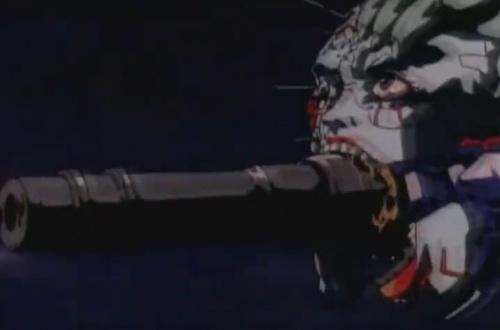
Controversial, ultraviolent, and just a mess. GenoCyber is a mess finally seeing it, hearing of it like the many bogymen, infamous works, in anime's history for all these years, but actually viewing GenoCyber is more complicated than this. Its twisted, and for a lack of a better term, fucked up, but having to actually watch it is a drastically different experience than something merely infamous. The first part - the work splits into three stories between Part 1 (A New Life Form), Part 2 and 3 (Vajranoid Attack & Global War), and Part 4 and 5 (Legend of the City of the Grand Ark I & II) - definitely shows everything that made the anime infamous. Nihilistic, complete hatred for humanity, horrifying images of dismemberment and mass death, body horror taking advantage of sci-fi tropes' most gruesome potential, and the episode was made with barely a budget. Barely a budget. Events abruptly happen with no pace. Live action inserts were used. The animation looks aesthetically foul and scuzzy in a horrifically compelling way. And it does fascinate. In a world where nearly every nation plans to unite into one peaceful, global utopia, a corporation sticks out as a potential threat in its self ostracization from everyone else. Taking advantage of a scientist's discovery of "mind shadows", latent psychic abilities he could unlock through a machine he made called the Mandala, (yes, there are clear Buddhist and Eastern spiritual symbolism here), they have human beings, as young as children, as potential weapons. Very much like Akira (1988), potentially dangerous psychics. Two of them are the twin daughters of the original scientist. One, Diana, is one the side of the corrupt scientist in control of the knowledge, left from birth with a completely crippled body which leaves her as a head supported in an android frame. The other Elaine, on the loose in the city of future Hong Kong, is physically healthy but with the mind of a savage animal, befriend a young boy. The corporation ran by the scientist wants Elaine back, employing android mercenaries, his pack of masked psychotic minions, and her own sisters after her and to silence anyone in the way. But not only is Elaine a very dangerous psychic, but when the two sisters are together, they could become one and become the titular GeonCyber, a horrifying demonic creature that could wipe out anything and everything.

From https://blogger.googleusercontent.com/img/b/R29vZ2xl/AVvXsEjnj2byz76P8my7jBqyVg_Z70Tmm931HYk1k0k5YdgKIQ7SBOsypsCNhJmhUbdtb9r2eBVbKlN5_03WmZYsUceF-Kv1snr-c8yh7bFF9TanEzxn0xqTt81k16hJBoteAyrfNVMuAtFFFDA/s1600/Genocyber11.jpg

The first episode is a complete car crash of gore, disturbing images of viscera and exposed intestines, wrapped in such a misanthropic work in its message. But its compelling. Body horror with no self censorship. Actually missed by myself in the later episodes greatly, the director went further to make the gore disgusting by using images of actual wet clay being smashed for icky effect. Its only done twice or so from what I registered, but its an incredibly lurid effect that should have been used in the later episodes, the kind of reckless idea, on such a cheap production, that lifts it up from just being trash but something legitimately interesting. It has nihilism that actually feels like it's from the bowels of the creators', the director and co-writer Shô Aikawa, guts than that a cynical liberals going for a cheap pop, discomforting but driven by a narrative where two mangled young women come together, and their collected rage collects to created a being on the scale of Cthulhu. Koichi Ohata is already controversial for his creation MD Geist (1986), to some one of the worst anime ever made, along with its sequel, but a best seller in the US. Aikawa is incredibly twisted in just the few works he penned I've seen. He's managed, of all things, to become the scriptwriter for some of the Full Metal Alchemist franchise, an incredibly popular work with a large, mostly young audience, but the man also wrote the scripts for a lot of the Urotsukidoji series and Violence Jack (1986-1990), the former the most controversial work in anime in the West, the later only really known for its drastically censored English dub version, and from I've read and heard, probably for the better for your stomachs. His filmography has a lot of notoriously bad, ultraviolent or scuzzy work, but Aikawa has a sense of body horror, and surprising potent ideas of the manipulation of the body and political ideas that managed to get into even Full Metal Alchemist. It's not surprising that GenoCYber ended up as it did with just him, let alone with his co-writer and director. It's no way near the most disturbing anime in existence, when Neon Genesis Evangelion: The End of Evangelion (1997) exists, but even if I am desensitised from a lot of this sort of thing, and frankly view it as merely animation on a cell not reality, it still leaves a gaping, nagging wound in your memory whether you see merit in it or not. With how this part ends, there was no real need for any other episodes. It could have stood up as one single, forty or minute piece of disturbing anime. It's a mess in quality control, but it its memorable and potent in what is seen. The only other work of the director I've seen before this was the TV series Burst Angel (2004), which was legitimately poor, all the most generic tropes, even in designing the female character designs meant to be lusted over, of current anime. That was the kind of anime that is truly bad. This episode, from the same director, is something uniquely itself even in its screwed up existence.

From http://i1.ytimg.com/vi/fd5uF17mXkA/hqdefault.jpg

But more episodes were made. Parts 2 and 3 probably have some importance though. Part 2 contains the most controversial moment in the whole work where, in the first scene, the first actual scene, young kids are chain gunned into gristly, fully detailed body parts. Its tasteless, its shocking, never done in any other anime I've seen yet, but doesn't compare to the kind content in the rest of this story arc or in the first episode. It's no way near as disturbing for me, in a story where a prototype android eventually goes out of control and literally melds with the whole of a naval warship, as just having a character, seeing the atrocity around her, suddenly throw up in revulsion in detail. What really disturbs in the whole of GenoCyber, what really makes it justify its reputation, is the mood and ideas rather than the gristly results. Shô Aikawa's writing, when it's not garbage, is far more disturbing in what he implies with full detail or not. His work is very Cronenbergian even when he's in a completely different genre like with Hades Project Zeorymer (1988-1990), an anime which shows a legitimate best with how, for its flaws, the ideas and where he goes with them are truly compelling in a startling way. This story arc is still an worthy inclusion for this. How our hero - Elaine and Diane one single being who are rescued by the warship and set off the android when it see them as a threat - is actually a monster who can destroy everything. That no one is sin free, or those who are good people will be killed, even children, or go insane. That this series, for all its disgusting gore designed to only shock and its shonky look, still forces the viewer to think of the consequences of man's brutality. That its use of body horror, in visuals and the concepts, is immensely imaginative, and downright disgusting and disturbing because of the ideas behind them, especially with part 3. These two episodes do deserve to exist, because while weaker they still fit the tone of the first one and are just as interesting.

From http://www.imfdb.org/images/thumb/2/27/Genocyber_Minigun1.jpg/500px-Genocyber_Minigun1.jpg

Which causes me to ask - what happened with parts 4 and 5, and why were they even made? Suddenly you are forced to watch legitimately awful pieces of anime. A drastic shift takes place. The GenoCyber has completely decimated all human populations in the world and is now gone, leaving all the clichés of anime of this era to repopulate the scorched planet in their tired flourishing. A utopian city exists which is actually a dictatorship, the writing suddenly losing all its distinct nihilism in favour of a generic tone without any real bite, where there's the corrupt rich, and the rebels in a terrorist group and a religious cult. Suddenly you're forced with two new protagonists, a young man and a woman, moving to the city and making their way barely as a knife throwing act and through street based mysticism. We're supposed to sympathise with them because she's blind and they're a couple about to be crushed by the evil city, not because they're of any interest. At this point, I cannot ignore the English dub. It was poor in areas before this arc and the added swearing was unnecessary, but some of it actually fit the tone. Here the dialogue readings, ignoring the tedious plot, are atrocious, with the voice actor for the main male protagonist performing some of the worst line delivery I have ever had to endure legitimately in a long while. It's up there with some of the worse I've ever encountered actually, clearly playing the character as everything people say about Keanu Reeves in Bram Stoker's Dracula (1992) at one point. This is why anime viewers like myself, let alone fans, eventually switched to Japanese dialogue with subtitles completely unless it wasn't available for certain releases or the English dub was actually exceptional. The entirety of this story arc, even though it's from the original manga the anime was adapting, is abysmal, a huge blot on the whole work. The blind woman encounters Diane through her mind, or an alternative world, befriends children living with the underground rebels, as you do in anime at this time, and eventually the obvious happens when GenoCyber awakes. You rise the memory of this arc from your mind and, if the whole work ever gets a DVD re-release, the only reason you would ever see this again is to check the disc(s) work. Suddenly it's not the original anime of the first few episodes but a completely different work, written by someone with no real grasp of what corruption means and merely using it as an excuse to bash the upper class and real life society in a cheap way to come up with a dystopia narrative. One, as in all the live action films that do it as well, that would put people off actually questioning their society and leaders because its trivialised to such an extent and because they don't want to suddenly become the characters in a crappy GenoCyber story arc. OVAs at this time in the nineties were also notorious for how abrupt their productions could be - anime works suddenly ending on a cliffhanger with no sequels ever to finish them, or with wildly different tonal shifts like here. Sometimes it's part of my fascination with these nineties anime, but here it's painful.

From http://www.animeclick.it/prove/serie/Genocyber/Genocyber8.jpg

Altogether, anyone with a strong stomach should attempt viewing Part 1 of the work. It's not a series to watch on a loop, too bitter, too misanthropic in tone to digest except occasionally. Its indefensible, but it doesn't feel like a mere mindless piece of anime ultra violence that the whole medium was lumped into by newspaper tabloids. Parts 2 and 3 are also worthwhile, but if it was possible to remove Parts 4 and 5 from existence I would do such a task. It has to be beared in mind that this has content that would even startle people used to animated gore and depravity, but it's a creation of individuals with throats full of bile for humanity rather than making cynical jabs, for attracting peoples' simpleminded views of anti-humanity and selling product by using such naive views on corrupt society. As perfectly put by an anime reviewer, it's the equivalent of punk rock, shambolic in production, offensive but with vitriol and energy you wish was there more often.

From http://www.anime-planet.com/images/anime/screenshots/genocyber1.jpg

Thursday, 27 June 2013

Anime 18 Review Link: Apocalypse Zero (1996)

From http://www.dubbedepisodes.co.uk/static/apocalypse-zero.jpg

Dir. Toshihiro Hirano
Japan

If there is one other thing to add to this review, I will say that a work that provokes any kind of reaction and "wakes" you from viewing it from a safe distance, where you can forgot it immediately afterwards, is worth taking seriously even if the material could be viewed as dubious to other opinions. This bizarre and ultra-gross anime, if I had viewed it back when I was between sixteen or seventeen, would probably be viewed as garbage. Now, rather than thinking I've regressed in my thoughts by giving it praise, I think its more the realisation - as someone who became obsessed with provocative art like the Dada movement before films, as mentioned in the review - that even in the most foul of areas a streak of subversion can be seen and given some merit. Back then, I didn't try to defend films that were clearly badly made like I did now, or defend works like this anime with questionable content, and probably would be viewed as having a better taste in films if one views cinema through the IMDB Top 100 list of films. I also however had such a narrow minded view of cinema and art in general that presumed anything that didn't follow a clear narrative or clear point was bad, including films by the likes of Jean-Luc Godard and truly great works of abstract cinema. Now my willingness to suggest that I find something like Apocalypse Zero to be a work of worth has also developed my ability to see the virtues of the likes of Godard and abstract cinema too because, after some of the films I've seen and covered on this blog, I'm prepared for films to take directions in content and presentation that the presumably "artless" works had. The erratic nature of the less defended films only differ from the celebrated works because they're repugnant to most or ended up the way they were by accident. That this anime may actually be intentionally getting a reaction out of the viewer, as I try to explain in the review, makes me want to defend it more.

As one find in live action, exploitation films, the most base of material can be the most daring in poking at taboos other filmmakers, or creators, are too cowardly to tackle. Yes, they can end up being offensively conservative at times, but others push the content in ways that make them impossible to view as celebrating bland stereotypes. In simple terms, sometimes the best weapon is to purposely show things so deeply "wrong", and in this case make it look like a Saturday morning cartoon on crack, and attack good taste even if the purpose of the anime was to just be an entertainment product. Rather than merely be offended or baffled by it, its worth actually thinking about why being offended by the images in a work happens and see if it has virtue from it. Plus, frankly people, including myself, get a perverse pleasure from these transgression and weird images, and to not admit it is lying to yourself. Sometimes its more healthier to submit yourself to something that isn't just blood for blood's sake, but something legitimately bonkers and throws images like "Double Big Tit Bomb" and other distorted animated images at your retinas. Far from viewing Apocalypse Zero as just an excuse to view Japanese culture as "peculiar", something like this is just in an entirely different orbit to anything else regardless of its country of origin. And far from being conservative, I seriously doubt anyone, except those who is going to celebrate how perverse the anime is, will come out as a fan of it. 


From http://www.videotapeswapshop.co.uk/wp-content/uploads/2013/06/az2.jpg

Sunday, 24 March 2013

Mini-Review: Family (2001)

From https://blogger.googleusercontent.com/img/b/R29vZ2xl/AVvXsEiVxMeGVkrfH0kEBrQKX5LK2q11xQ73bF1oUcVJfhLFVZbiWGyZzFByCnUUMPkrGgOq6aVuyY4o7ZQOgTFhbbLc64WQqgNzF8ZIBIWFDfngbJAHQ5HIZcIuIJR7LHdeWRqpBkVWBDcEt2Ml/s1600/family.jpg


Dir. Takashi Miike
Japan

I am a huge fan of Miike, but I realise that from a self proclaimed director-for-hire the massive output and the variety of formats he works in could lead to an erratic filmography. Sat between truly great films like Audition (1999) and Ichi The Killer (2001) is this work, bizarrely split onto two discs as two eighty or so minute films. A manga adaptation about warring yakuza, backstabbing and a budget large enough to afford a tank and a water-ski shootout, Family has the traces of all that makes Miike interesting. Brothers from a family broken into pieces by yakuza in different areas of the crime underground, a viewpoint from minorities in Japan, and a female character who is a Christian. Unfortunately it is an exceptionally dull story. Nothing in the film is inherently original or of interest, worsened by the technical quality. It is filmed on a cheap digital camera, which looks awful; Miike can use digital to his advantage, such as the probing of the image and voyeurism in Visitor Q (2001), but here it makes everything sparse and lacking. Miike also sadly continues the trend of using generic heavy metal music, at pointless loud volumes, over sequences that comes off as noise, surprising when he is very adept in his sound and music track choices.

It is a slug to get through both parts. It also makes the more gruelling sequences, such as a prolonged rape scene starting with molestation with feet, dubious. I will defend Miike over stuff like this, especially since he always, even in lurid genre works, makes such sequences discomforting and prevents the viewer from being able to shrug them off as merely sequences, but Miike needs to have made a good film around such sequences to prevent them from being merely tasteless, the result of which adds depth to them or sticks a metaphorical knife in the viewer’s brain to startle them. Since this is a poor film, barring some experiments with sound and image, such sequences just come off as pointlessly offensive, not helped by the fact that, while Miike is known for improvising or changing his scripts and stories during filmmaking, he is dependent on scripts being good or having something of interest for him to run with like many other directors. Family as a whole has no sense of Miike being fully engaged with it. It was made between some of his best work, showing this is a minor blip in his filmmaking, but unfortunately it is one of those true mistakes in a director’s filmography that discolours it. It is not an interesting failure one can learn to appreciate or actually love, by itself or in context of an auteur, but something so rudimentary you don’t want to own it even if it means a gap in the filmmography of one of your favourite directors.

Tuesday, 19 February 2013

The ‘Completely Indefensible Film I Happen To Love’ [Batman & Robin (1997)]

From http://images4.fanpop.com/image/photos/18700000/Batman-Robin-logo-batman-and-robin-1997-18774758-1280-720.jpg


Dir. Joel Schumacher
United Kingdom-USA
Film #24 of The ‘Worst’ of Cinema

With this review, all my credibility will probably dissipate, but I defended the film in this article regardless. Just don't call it a guilty pleasure, please, I love this film in its stupidity sincerely.

Saturday, 2 February 2013

The ‘Worst’ of Cinema [Dominator (2003)]


From http://3.bp.blogspot.com/_BcbuH_teL2Q/S8tIv8bKRFI/
AAAAAAAACdw/7uLQJH_bIds/s1600/DominatorCov.jpg

Dir. Tony Luke
United Kingdom
Film #25 of The ‘Worst’ of Cinema
 
There’s no point attempting to explain this film, the first all-CGI animated movie to be made in Britain. Just watch this extended clip...


Everything that I needed to explain about this Dominator is in that clip. Everything. I was masochistic to view it all the way through the first time, and I was masochistic enough to see it again years later just for this review. It’s catharsis for one of the worst films I’ve seen. It’s sad to say this because I should adore the ridiculously cheap looking animation, and get a goofy laugh from its heavy metal stereotypes. I feel guilt because, researching what little is available about the film, its director had just hastily recovered from lung cancer when he was working on it. But I cannot hide the pain I felt.

When the three daughters of Dr. Payne (Doug Bradley) play the contents of one of his occult books, The Lost Cord, they bring into the world the Dark Lord of Sonic Hell Dominator (Dani Filth from the band Cradle of Filth) but also leave open the gate to Hell for the individuals after him for a key, one which if returned to their leader Lord Desercater (sic) (Doug Bradley again) will help him take over the known cosmos as well as Hell. It is supposed to be as ridiculous as possible. With its rudimentary look, it is impossible to take it seriously beyond every cliché of heavy metal iconography put together in a work that is clearly influenced by the tone of Japanese anime. This is of importance as, surprisingly, the original source, a comic strip in Metal Hammer magazine, was readapted into a quite popular comic in Japan, one of the few cases where a Western creator, and probably the only case involving a British artist, created work for a solely Japanese market as actual manga. My problem with the film is not its look, or animation, as I should have fallen in love with this. It’s the story and ideas themselves behind them.

As a heavy metal fan, I can except and enjoy immensely all the clichés that are usually derided in its imagery – the obsession with Satan, motorbikes, skulls, and ridiculous large shoulder spikes – but I also find most of it embarrassing and unoriginal. Dominator is cringe worthy in how it trivialises heavy metal as much as it does, where character names like Dominator, Decimator, Hellkatt etc. are acceptable even in the context of a goofy animation or for the names of demons. The character designs and the look of the film is aborrant because of the tackiest heavy metal album designs and promotional images it brings up, of skulls on everything and random tentacles and spikes coming from everywhere. The only interesting looking character, in the clip above, that’s not a mess of adolescent metal cover designs or stock character models, is the awfully named Lady Violator, taking the fetish, almost-completely-naked-but-part-machine-in-cock-teasing-places design to ridiculous limits, and with the late Hammer horror icon Ingrid Pitt voicing her, but she was created specifically by another person in the production team.  And that this has such individuals like Doug Bradley, Pitt, and in another role the director Alex Cox staring in it is worse. This will not be said of for extreme metal singer Dani Filth. His main character Dominator is all the worst ideas of how an antihero should be – those repeatedly mentioned spikes everywhere on him, face masked all the time, and no charisma except wanting to shag all of Payne’s daughters, and any other women in the vicinity, at the same time like a horndog – and is made even more embarrassing by Filth’s voicing of him. Using his same raspy growl from his band Cradle of Filth’s music, you cannot take him serious even if its self deprecating as the attempt to sound cool and demonic is so forced. I feel pity for him if it wasn’t for the terrible feeling that, as is the whole problem with the film and large swaths of heavy metal and alternative culture, he is taking himself seriously for something that is childish in an empty way and marketed for anyone who wants to wear designer brand pentagram t-shirts and black hair dye without actually taking in the cultural and pop mythology heavy metal draws from. Two of my favourite metal groups, not taking account of the various sub-genres, are Rammstein and Mastodon. The former is known for their insane pyrotechnics and songs about sex, but have a political edge from their East German heritage mixed with songs drawing from fairy tales and literature, a melancholy to their slower songs, and a wicked sense of humour that goes against every stereotype of German culture. The later have made a concept album about a wolf man going up a mountain and fighting monsters, but not only melded it with a unique personality and an obsession with prog rock, but made it a follow up to a concept album about the novel Moby Dick. Some great songs and bands delve into the clichés of heavy metal, but as far back as Black Sabbath, they distance themselves from the limited, adolescent mindset by their other musical interests that influence their work, their interests in other art forms and their unique quirks.

What makes this even more worse with Dominator is that, as a British work viewed by someone born in the country, a bad British film is truly unbearable and drags into it talented people who should know better. In cinema, the British have been repeated kicked to the curb despite being the birthplace of director like Alfred Hitchcock and Michael Powell, not just from the bias of François Truffaut, and it is quite justifiable at times. We as a country champion laziness and lameness over quality as virtues when such ideas should be burn with fire. I get the feeling that Dominator was made with everyone involved having ‘fun’, words that now are dread inducing for me thanks to this film because it means that a movie like this is made, with a script full of pointless swearing and references only the British viewer could get without any meaning to them, and everyone calls it a day. It is a lack of quality control in favour of ‘enjoying’ oneself that makes this impossible for me to enjoy too. The only thing close to a salvation were the characters Decimator and Extricator (sic again), played by radio personalities Marc ‘Lard’ Riley and Mark Radcliffe, their lame and terrible humour actually amusing, and in a film which turns centuries and decades of mythology, rock music culture and Christian theology into a teenager’s lacking mindset without any sense of thrill or titillation to it all, they’re almost a demonic Greek chorus ripping into the awful film by not participating in the plot at all and being more interested in getting drunk instead.

That I returned to this film under the glib idea of reviewing it for a ‘Worst Of’ series is shameful on my part, but it becomes clear that it should be pulled up from the grave of mass obscurity as a warning of how this film’s mentality plagues pop culture. This lame, bastardisation of Christian mythology and alternative culture is still infecting heavy metal music, and will never create a song as great as Black Sabbath’s N.I.B. or Heaven or Hell, and for every good British film, or comic book, or TV series, or other cultural item except music or literature, which have grand canons of great artists to rest upon, there are too many creations which were made ‘for fun’ and make country look bad to myself and others, a cultural malaise that should have died long before I was born. Dominator is one of the worst films I’ve seen, but it’s also a tragic mirror to how bad British culture can be.

Click right mouse key and view on a new page to see images in larger detail
[From http://cf2.imgobject.com/t/p/original/uA350tyGx8fp4eN5HFtmNJ1vvFP.jpg]

Thursday, 13 December 2012

The Man In Black [Danger: Diabolik (1968)]

From http://www.retrorebirth.com/wp-content/uploads/2011/03/Danger-Diabolik-Movie-Ennio-Morricone-1968-1-400x225.jpg

Dir. Mario Bava
France-Italy

The following review is the second of mine for The Bond Season on the Videotape Swapshop website. Following on from Golgo 13, this is another comic book character famous in his home country that got his spot in the sunlight for the season.

Film Link - http://www.videotapeswapshop.co.uk/11710/danger-diabolik-%E2%80%93-1968-director-mario-bava/

Wednesday, 12 December 2012

Pull my trigger lovingly... [The Professional Golgo 13 (1983)]

From https://blogger.googleusercontent.com/img/b/R29vZ2xl/AVvXsEj2NQK0Y09tIYiSW9oaGA6iP6XKsc8fWvEYdghDpmznPyBj4g9InbxJaiXYEFSI1dItoFWtAWmtVLHYvbUsMHjR9htekhKbjzvmCvAhYdVG4Rx7Zyim_v4cThVFPhcvvLwNcW_wrdh9ibag/s1600/TITLE01_0002.jpg

Dir. Osamu Dezaki
Japan

The following review is part of The Bond Season on the Videotape Swapshop website, part of a series dedicated to films inspired by, ripping off, or within the same Sixties attitudes of the James Bond series (including an actual Bond film amongst the reviews). This review is for the sole feature length adaptation of one of Japan’s longest running manga series Golgo 13, loved by Japanese salarymen and, while directly inspired by Bond, the more cold blooded of the two.

Tuesday, 30 October 2012

On Her Majesty’s Supernatural Service [Hellsing (2001-2002)]

From http://static.tvtropes.org/pmwiki/pub/images/lt/hellsing.jpg

Series Director: Yasunori Urata
Japan
Work #29, for Monday 29th October, for Halloween 31 For 31

Horror is not as prevalent in Japanese anime as I think it would be, despite the ease and creativity animation could give a creator, in its vast catalogue. Even the well known aspects of Japanese horror in cinema – from Ringu (1998) to body horror and splatter – are not as vastly replicated in animated form despite the prominent amount of horror stories in manga. When straight-to-video works known as Original Video Animation were prominent - opposite to the traditional use of the term in that, excluding terrible examples, they were usually well (or incredibly well) animated and allowed more adult or experimental content - horror anime was more common, the bizarre one-offs and short form adaptations of manga mixed which genre works which were far more bloodier and gruesome in content. Even after the Japanese economic bubble crashed, and killed off the more experimental works, the 1990s still had OVAs and a great deal of them which were still gruesome or horror related in tone, going on to laserdisc and DVD later on. Without the concerns of censorship a TV series could suffer from, and the time and allowance to be different in content, the OVA allowed the distinct type of horror in Japanese culture, of the supernatural to the manipulation and distortion of the body, to exist prominently, blending into other genres, such as the versions of The Guyver before the live-action films. Bar the few exceptions, including Hellsing Ultimate (2006-ongoing), the more faithful to the manga reinterpretation that followed the series I am reviewing, the OVA is less prominent and has left a huge gap for the kinds of anime that can exist including the horror ones. There are TV series in the genre, but not that many; for more examples actually exist in hentai (pornographic anime), taking advantage of the lack of restrictions because of its porn content to include horror, but since I’ve seen none of them I can thankfully dodge the topic of how uncomfortable mixing violence and sex could be. Most of the existing horror works, as mentioned, are usually blended with other genres, Hellsing as much of an action series as well as horror.

Set in an alternative England, the thirteen episode series follows a secret government organisation that destroys vampires called the Hellsing Organisation, lead by Sir Integra Hellsing. Their ultimate weapon is however a vampire named Alucard, who along with a penchant for red trench coats and desiring a good vicious fight, is also a lot more noble, more powerful and more psychotic than most of his peers and vampire lowlife, making him a perfect tool for the organisation. With Seras Victoria, a policewoman turned into a vampire by Alucard who has to deal with her new undead life as a member of the force, the organisation has to deal with a swathe of artificially made vampires over the country, attacks on their headquarters and the Vatican approved vampire hunting organisation wanting to reclaim Protestant England back.

Upfront, this version of the original manga by Kouta Hirano is flawed and is the product of the often fragmentary nature of a lot of Japanese anime. The art form has a history of series and works which are left unfinished, or ending up with multiple versions and contradictory ones, pockets of dimensions, spin-offs, versions without endings, and parody spin-offs to make the late Kurt Vonnegut’s head spin. Some were designed only to interest people in the original manga, a concept that doesn’t translate to Western anime fans when said manga isn’t released over here. Some were financially stalled, had producers who closed down, or were unsuccessful in getting any sequels commissioned, leaving abrupt and unfinished conclusions to them. A few, like this version of Hellsing, were started before the original manga was actually finished, catching up with what the author has completed and leaving the anime creators to create new story shifts and endings. This version of Hellsing had to design and thread a new plot into the exiting material, starting off following the original story but by the halfway line ending with a new conclusion and new villain. In the more faithful version of the manga, without spoiling too much, it involves the Third Reich, as you do, while this version pushes a new plot involving artificially made ‘freak’ vampires. In thirteen episodes only, it can feel abrupt when plot strands and characters are introduced throughout and end in single episodes. This version has been viewed as immensely flawed, and there is also the factor of the studio that made it, Gonzo, who were known for making great looking works before their bankruptcy and being remade into a smaller studio, but were also notorious for anime fans for erratically toned and/or incompetently put together anime. I have thankfully avoided most of their worst work, and I will actually defend some of it, but the erratic tone is obvious in Hellsing.

Nonetheless, I will argue this version of Hellsing is not that bad. It’s flawed but as I will continue in this review, it has its virtues. While it’s been years since I saw it, Gonzo made a vampire series that they still need to be all punched in the face for in Trinity Blood (2005), what started off as an interesting if silly blending of vampires and science fiction but, if one was to show the progression to the final episode on a graph, would make a perfect straight line down into god awfulness involving space vampires. Once it gets into its stride after the first few episodes, Hellsing on the other hand starts to become more and more better. It is a standard, gun fetishising, action work with horror and the amount of strong gore acceptable for TV, but the black humour and giddy tone of the whole thing is clear and engaging. It is ridiculous, and with an anti-hero who is very sadistic, grazes on the ceiling of political incorrectness and is very edgy, but as a reinterpretation of Western vampire lore and British culture, I have to admire this knowingly lurid and revealing series. As an Englishman, I love the fact that the original source, from another country, was playing with my culture and had done their research too, whether it’s our obsession with form and presentation to the divide between the Catholicism and the Protestantism in our history as shown in two episodes. Despite the need to create its own ending, the creators managed to keep the original tone of the original manga and managed to make it a solid series. Even when it occasionally recycles scenes from previous episodes in the last ones, it manages to still have an immense punch to it.

In terms of the depiction of the British, I decided to view this series for this season with its English dub instead of the original one. For the most part, I listen to the original Japanese dubs for anime unless they are not available. English dubs when I still watched anime with them on could be incredibly stiff and lifeless, and anime’s history is littered with some of the worst dubbing and voice acting in any medium. But for Hellsing I wanted to go back to the English dub both for nostalgia and, as a story set in England, because it was decided that the cast should be voiced by mostly British voice actors. Some incidental characters sound wooden, and at first American actress K.T. Gray, voicing Seras Victoria, wavers a little in her accent in the beginning episodes, but after a while, as Gray gets into character fully and very well, the decision to have British voice actors, with an English script that clearly had more British colloquialisms and our creative use of swear words added to the material, turned out to be an inspired one. A great example of this would be British born actress Victoria Harwood as Sir Inegra Hellsing, who backs up her words as the leader of the Hellsing Organisation fully just in Hardwood’s voice.

One of the biggest reasons why this series, and the concept, still succeeds is the personalities of the character which the English language voice actors flesh out as well. The main character Alucard could have been terrible, a vampire whose abilities means the character could have been too powerful for there to be any risk and danger to be felt by the viewer, and with a sadistic streak that could be off-putting, but the sense of charisma is clearly prominent in him, both in look and how voice actor Crispin Freeman manages to convey him in voice. The same can be said of all the major and prominent characters, even the villain introduced near the end who isn’t from the manga, all having a distinguished look and personality to them that, while hyper stylised, makes them distinct. Regardless of the plot focus, the characters are treated with enough respect to make the material still work. It also emphasises that the original author Hirano in his use of Western culture goes as far as drawing upon archetypes and pre-existing characters for his own. Helen McCarthy, one of the most prominent British authors and speakers on anime, on an episode of the American podcast Anime World Order, suggested that Integra Hellsing was a concoction of a Gerry Anderson character and Emma Peel from the TV series The Avengers (1961-1969); the sense that Hirano managed to tap into the British concept of the stiff upper lipped, tough and charismatic women of our pop culture who are fetishitically sexual but still strong is clearly obvious. That he went as far as calling a weapon in the series the Harkonnen, kept in this series and the later OVAs, after a character from Dune says a lot about how he meshed together entertainment with legend.

The other aspect that helps the series immensely, and makes it worth seeing, is the great music. Beyond the use of Mr. Big’s Shine, still the least conventional choice for an ending theme for an anime that yet works perfectly, it is very varied and well made, adding to the bipolar mood of the series. It is probably one of the most distinct soundtracks I’ve heard in a while, one that doesn’t fall back on J-pop and incidental music but tries to be unique to the show.

All in all, the series is far from the best but it still stands up well and is far better than a lot of fellow series that failed miserably (like Trinity Blood), possessing a distinct style to it that would pass on further with Hellsing Ultimate, far more faithful, far more violent and far more perversely humoured than its predecessor, but is yet to be fully finished or released in the West as of yet. Until that changes, I am glad to see that this version, one of the first series I owned before my twenties and never reopened until this season, was still good. It did concern me with the first three episodes, the worst of the whole series, that it would turn out to be a disappointment on a re-viewing, but after them it manages to be something of immense merit despite Gonzo’s reputation and the flaws it has.

From http://tu.tv/imagenes/videos/h/e/hellsing-zombie_imagenGrande.jpg